
Greenhouse Grow Lights: When You Need Them and How to Use Them
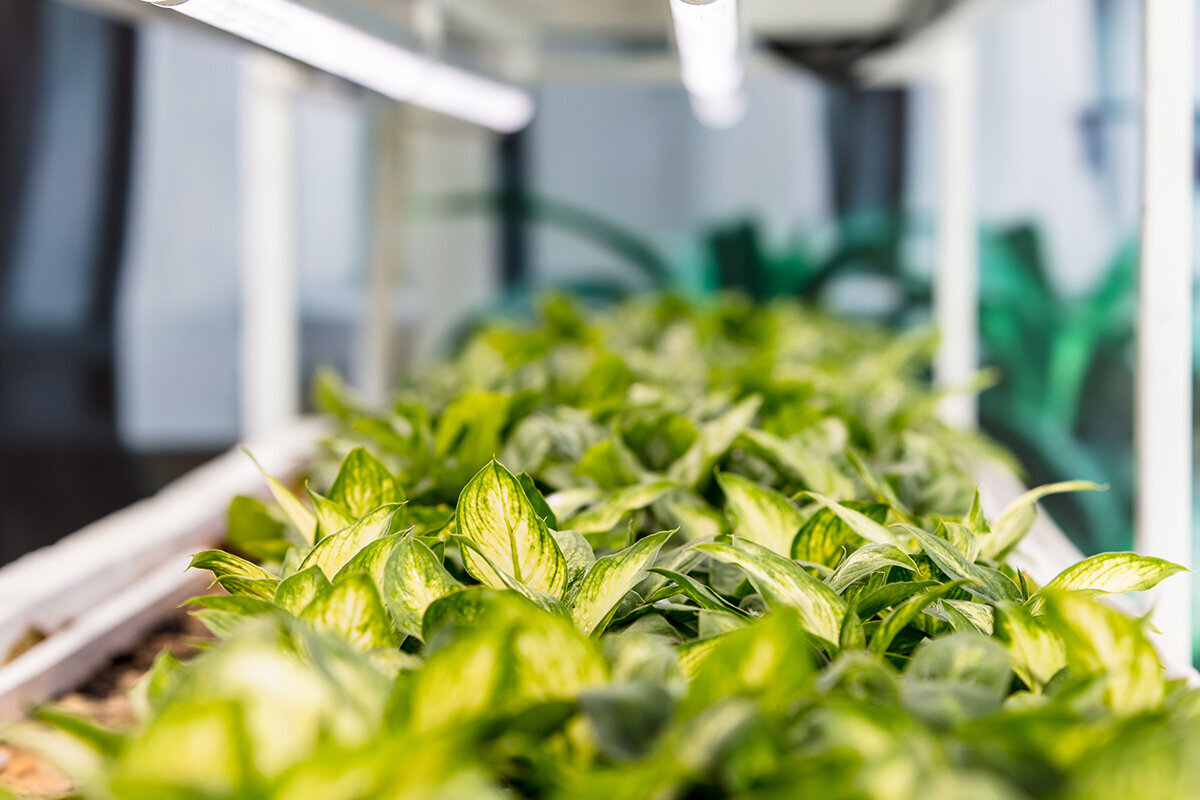
Bloomcabin practical guide / tailored light
Lighting plants in a greenhouse:
how to judge the need and use fittings effectively
Daylight is already captured by the structure. Add electric illumination only after the chosen crop, at that point in the year, is receiving light that is insufficient, brief or erratic.
For committed home gardeners in IrelandLet morning daylight lead; intervene only in deficient areas.
01 / Ask what the crop lacks
Is additional illumination actually necessary?
Brightness alone does not make a useful horticultural lamp. The right unit removes one constraint without upsetting temperature, moisture, energy demand or the plant’s growth cycle.
In Ireland’s brighter summer weather, clean glazing with open exposure can admit light beyond what some crops use, making ventilation and shade the pressing jobs. Conditions commonly reverse from November through February. Limited day length, a low solar angle, heavy cloud, nearby buildings or trees, glazing bars, grime and water droplets each cut the photons available at leaf level. Human eyes may judge the house cheerful while seedlings for early tomatoes, or plants on a low tier, remain underlit.
Study the plants across several days before purchasing equipment, and distinguish inadequate illumination from other stresses. Seedlings receiving too little light commonly lean towards the clearest pane, develop soft elongated stems and leave wider spaces between leaves. Warm nights, crowding, waterlogged compost, cramped pots, damaged roots or poor nutrition can produce similarly weak growth. Illuminating a cold, saturated root zone merely distracts from its underlying fault.
Start with a straightforward site check. Wash the glazing, remove avoidable obstructions and record when structural shadows cross benches or shelving. Then decide whether temperature, rooting volume and air circulation allow the crop to benefit from more light. Ireland’s Atlantic influence differs between exposed coasts, sheltered plots and inland frost pockets, so orientation, current weather, covering material, crop and intended result must all inform the decision.
Glass walls do not turn a greenhouse into a fully controlled growing room. Make the sun your primary input and use electricity for carefully targeted correction.
Likely light deficit Long, soft seedlings, uneven growth beneath frame bars, slow winter salads or propagation begun well before brighter spring days.
Check other causes first Chilled compost, trapped moist air, nutrition problems, stressed roots, excessive density, pest damage or a cultivar poorly matched to the time of year.
Lighting probably unnecessary Crops grown through spring or summer under clean, sunny glazing, provided their form is compact, development even and foliage normally coloured.
Lighting strategically useful Early seedling benches, leafy winter produce, cutting propagation and light-demanding fruit crops whose schedule must remain dependable.
Designing around daylight starts with sound orientation, unobstructed panes, opening roof vents and adjustable shade. The Classic Aluminium Greenhouse provides a durable, bright base. Glazing, roof vents and an orderly layout support seasonal climate management. Grow lights belong within this system; they replace neither a good site nor ventilation and sound crop care.
02 / Vocabulary for judging a lighting plan
Daily light received = intensity × duration
PPFD × hours
= DLI
= DLI
Lighting sales language can obscure what is, in practice, a simple connection.PPFD means the density of photosynthetically active photons received by the leaves at one instant.DLI stands for Daily Light Integral: the photosynthetically active total gathered during a whole day, combining the sun and any lamps.
A lower level sustained for more hours may add as much DLI as a higher level delivered briefly. For illustration, calculate PPFD × 3,600 × hours of operation ÷ 1,000,000. Use this for planning rather than as encouragement to lengthen lamp use unnecessarily.
- PAR
- The radiation range relevant to photosynthesis. It says more about plant lighting than the brightness a lamp appears to have for people.
- PPF
- A lamp’s total photosynthetic photon output. It helps compare products, yet says nothing by itself about the amount intercepted by foliage.
- PPFD
- Photon-flux density received at the crop canopy, expressed in µmol/m²/s. The reading varies according to suspension height, optical spread and sensor location.
- Photoperiod
- The timing and length of the daily illuminated and dark phases. Flowering may respond to this pattern separately from the accumulated quantity of light.
- Lumens and watts
- Lumens indicate human-visible brightness; watts report power consumption. On their own, neither reveals the usable intensity reaching a crop.
Examples of supplementary DLI
100 × 10 hrs
3.6 mol/m²/day
200 × 8 hrs
5.76 mol/m²/day
300 × 12 hrs
12.96 mol/m²/day
These are calculation examples, not crop recipes. Suitable DLI depends on species, variety, growth stage, temperature and the quality you want. Use crop-specific guidance first and establish how much daylight the greenhouse already supplies before specifying an electric supplement.
03 / Choose the fixture type before chasing peak figures
Match the light to the crop, not to the loudest claim on the box.
For many domestic greenhouses, LEDs offer a practical first route because useful shapes are available, efficient operation is possible and certain systems allow dimming. White light, or a horticultural spectrum with balanced colour, is generally more comfortable than continual violet illumination. It also makes changes in foliage colour, pest activity, deficiencies and illness easier to examine.
Compact propagation lights
Suitable for narrow propagation shelves, seed trays and cuttings where the fixture can sit close above small plants. Their compact form supports even, local coverage rather than lighting an unnecessarily large area.
Check: The PPFD at your intended distance, fitting length, approval for moist surroundings and a dependable way to raise the unit as seedlings develop.
Linear light bars
Useful above long benches, herb rows and leafy salads. Several bars can be arranged to avoid bright centres and dark edge pots. They suit greenhouses where evenness matters more than one maximum reading.
Check: Coverage map, recommended spacing, power-supply position, dimming and the system’s full electrical load.
High-output area modules
Plausible for deeper crops or a clearly defined larger growing area with sufficient mounting height. They need careful attention to load-bearing capacity, heat, glare, cabling, air movement and falling intensity at the edges.
Check: Verified distribution charts, supply requirements, allowed environmental conditions, safety clearances, guarantee provisions and the maker’s instructions for dispersing heat.
Wattage is an inadequate buying guide. A 100-Watt unit can perform very differently as optics, efficacy, covered area, suspension and losses vary. Total PPF provides context but cannot settle the choice. Ask instead:At the planned separation, what PPFD reaches every part of this bench?
Retain flexibility in the layout. During spring, one propagation table might need a low-mounted fitting while neighbouring crops continue under daylight alone. For well-organised cultivation and lighting zones, the Classic Aluminium Greenhouse creates room for shelving, safe walkways, ventilation and deliberately limited supplementary lighting without cluttering the greenhouse with later improvised additions.
04 / Mount to the current canopy, not to memory
Height changes the lit area.
Uniformity changes the result.
Suspending a fitting farther away usually broadens its footprint but lowers the level received by the leaves. Bringing it down raises intensity and can also create a tight hotspot. Appropriate spacing must therefore be reconsidered as the optical pattern, width of the bench and height of the crop change.
Middle Peak illumination
Outer area Reduced level
Shared beams Smoother distribution
Plant tops Readjust suspension
Begin with the spacing specified by the manufacturer, then test the footprint, if possible, using a PAR sensor of your own or one that you can borrow. Take readings at the middle, between the middle and perimeter, and wherever illumination appears weakest rather than testing solely beneath the unit. Nine positions arranged across a bench give a better picture than one impressive measurement. When variation is excessive, try raising the fitting, blending adjacent footprints, narrowing the planted area or opening the spacing between plants before adding operating hours.
Monitor seedlings particularly closely. Place the source near enough to discourage lanky growth without causing paling, curled foliage or dry lesions. An adjustable hanger lets the distance follow growth. The maker’s stated clearances remain mandatory, while the crop’s visible reaction guides smaller refinements.
05 / Let crop biology determine the lighting schedule
Add daylight gradually, and leave the dark period intact.
A consistent cycle across 24 hours matters to plants. Electric illumination contributes usable photons, yet poorly judged extensions or breaks in darkness may also shift flowering behaviour.
Young plants
Leafy crops
Flowering response
Young plants: plan steady days and a true night.
Leafy crops: add light only to fill a shortage.
Flowering crops: check photoperiod before changing darkness.
Blue marks darkness, wheat denotes sunlight and clay denotes the added hours. Regard the graphic as a seasonal illustration, not a fixed programme. Guidance for the species, observed growth and daylight at your site should govern the timer. Adding time before sunrise or after sunset is generally easier to manage than inserting an arbitrary interval overnight.
Nov.Observe
Dec.–Jan.Assess
Feb.Adjust
MarchReduce
From AprilReview again
Track the daily total at cloudy or more northerly sites.
This is often the deepest dip, although individual sites differ.
Daylight strengthens at an irregular pace.
Many propagation benches now need less support.
Clean glazing and ventilation often become more important.
Treat this timetable as an outline rather than a rule. An Atlantic-facing greenhouse, a shaded city garden, an inland frost pocket and a sheltered southern plot will not require identical lighting. Covering material, roof form, orientation, the proportion occupied by framing and winter shadows from leafless trees all alter available daylight. For a bright interior that can be divided into changing zones, the Classic Aluminium Greenhouse can provide an adaptable structural setting.
06 / One greenhouse, three different tasks
Give the light a clear job.
Young plants
Aim: compact, robust plants ready for planting out.
Concentrate a uniform source close above a defined propagation zone. Recheck stem length, spaces between leaves and foliage colour at intervals of a few days. When seedlings become lanky, investigate suspension and measured intensity over the plant tops before anything else. Extending the timer cannot reliably repair an uneven footprint.
Leaf vegetables and herbs
Aim: even quality and dependable winter harvests.
Lettuce, rocket, oriental leaves, parsley and basil respond well when illumination is distributed consistently over their foliage. A restrained, dependable top-up usually serves a mixed bench better than one powerful hotspot. Because extra light may accelerate drying, check compost and plant demand afresh rather than keeping the previous watering timetable unchanged.
Fruiting crops
Aim: vigorous plants, well-timed flowering and successful setting of fruit.
Tomatoes, peppers, cucumbers and similar crops need more than ample light. They also require suitable temperatures, enough root room, balanced nutrition, air movement and conditions that support pollination and fruit set.
Spectrum has a role, although it cannot compensate for inadequate intensity or unsuitable duration. Balanced white horticultural lighting covers many domestic greenhouse jobs. Selected wavelengths and deliberate far-red programmes can modify development, but applying them well requires knowledge of the crop. First establish adequate illumination throughout the foliage, dependable timing and the darkness appropriate to that species. Introduce greater technical detail only after defining the response sought and a reliable way to observe it.
07 / The side effects of a brighter crop area
Added illumination affects warmth, foliage temperature, moisture and irrigation.
All fittings release heat. Modern efficient LEDs normally send less radiant warmth towards foliage than older technologies, although their drivers and luminaires still warm the enclosed space. This input may be useful during a chilly morning but troublesome following a sunny afternoon. Take temperature readings among the upper leaves; a single thermometer beside the entrance or roof ridge may not represent the crop.
Greater illumination may drive stronger transpiration and cause containers to lose moisture sooner. It does not justify watering automatically on fixed dates. Examine the compost, lift pots to judge weight and inspect the rooting zone. During winter, vigorous shoots combined with chilled saturated roots can deteriorate. Venting and mild lateral airflow reduce trapped moisture around crowded foliage, but plants still need adequate separation.
Watch condensation as well. Changes in brightness and warmth redistribute moisture and alter crop demand. Avoid wet foliage where practicable, remove overhead drip points and provide a managed escape path for moisture-laden air. Constantly opening every vent is not the objective; seek steady, workable conditions around the crop, especially through Ireland’s cool and humid shoulder-season weather.
Dry service area / diagram
Sheltered electrical connections
Keep every cable raised and secure. Place power supplies, plugs, timers and other connections dry, raised and easy to reach. Cables must not be positioned so water can track along them into a connector or housing.
Keep floors and paths clear. Never trail domestic extension leads across pooled water, wet walkways or places where containers and tools could pinch them. Choose components intended for those conditions, provide proper strain relief and observe the supplier’s separation from crops and other materials. Mount luminaires on load-bearing supports designed for the purpose, rather than makeshift hooks, plant canes or unchecked structural pieces.
Electrical note: Condensation, irrigation, soil and wet footwear make electrical equipment in a greenhouse particularly vulnerable. Select lights, drivers, wiring and connectors intended for the actual environment; an IP mark is not a substitute for competent fitting. For fixed circuits, external connections or alterations, ask a Registered Electrical Contractor to decide whether the proposal is Restricted Electrical Work and what completion certification applies. Temporary domestic leads do not form a suitable permanent supply.
08 / Adjust using observations
Record the effect before expanding the system.
A modest trial usually teaches more than an immediate full installation: illuminate one bench and one related set of crops, record the programme, and observe long enough to judge whether the energy brings worthwhile horticultural results.
Baseline observations
- Crop and stage
- Note the species and variety, sowing date, current phase and size.
- Natural conditions
- Log incoming daylight, structural shade, glazing condition, recent weather and the bench’s location.
- Symptoms
- Describe stretching, uneven growth, pale leaves, slow development or delayed harvest.
- Crop climate
- Document canopy temperature, compost moisture, condensation and air movement.
After two weeks
- Light setting
- Note suspension distance, daily run time, dimmer position and any PPFD readings available.
- Plant response
- Review foliage colour, internode length, branching, evenness, strength and changes in harvest development.
- Water response
- Note changed drying rates and watering frequency for pots.
- Energy use
- Multiply the power in kilowatts by time in operation, and weigh the resulting consumption against energy cost and crop value.
Make one reversible change at a time. Pale, curled or scorched-looking foliage beneath the hotspot calls for reduced output or greater separation, followed by a temperature check. Where coverage varies, alter plant spacing, fitting position or beam overlap before adding hours. Once growth is healthy and spring daylight strengthens, taper the electric contribution and eventually stop it. Unexpected flowering is a reason to review day length and restore a continuous period of darkness.
As equipment is added, treat the room as a connected system: shelves, shade, vents, routes and watering all need to suit the lighting arrangement. A lasting base is the Classic Aluminium Greenhouse. It should remain orderly, comfortable and practical to tend when every lamp is off.
FAQ / Ireland
Common questions on lighting greenhouse crops
Are grow lights necessary in an Irish greenhouse in winter?
Sometimes, though their value depends on a demonstrated shortage for crops that are actively developing. Relevant cases include exceptionally early propagation, leafy vegetables carried through winter, rooted cuttings and timetables that demand sturdy plants before spring becomes brighter. Examine local exposure, recent weather, nearby shade, glazing, the purpose of the crop and existing daylight before deciding.
What daily running time should I set?
Judge the combined daily total and observed growth rather than applying one duration everywhere. Seedlings, leaves harvested as crops and species sensitive to day length may each require a different plan. Program the timer so darkness remains regular and uninterrupted. Begin from reliable guidance for that crop and the equipment manual, then revise the hours in response to measurements, changing daylight and development.
Do white broad-spectrum LEDs work under greenhouse glass?
Yes. Balanced white horticultural LEDs can cover numerous domestic tasks while allowing the gardener to assess foliage colouring, pest symptoms and disease more naturally. Selection should still account for the PPFD footprint, proposed suspension, electricity demand, environmental rating and area actually served. A “full spectrum” label does not decide suitability.
Is it wise to operate grow lights overnight?
Usually, it is simpler to add time beside sunrise or sunset while maintaining one continuous night. A planned interruption after dark is a specialist photoperiod treatment for selected species, not a routine shortcut. Darkness participates in plant development, and the initiation of flowers in certain ornamentals and flowering crops can react particularly strongly to the length of each day.
May grow lights use an extension lead?
Do not treat a standard household extension as the lasting electrical supply in a greenhouse, particularly amid watering, condensation and regular footfall. Every component, enclosure rating and fixing method must suit the environment, with plugs and junctions kept raised and dry. For new circuits, fixed cabling, outdoor connections or uncertainty, contact a Registered Electrical Contractor to establish the work category and any certification needed. Observe the equipment maker’s instructions throughout.
Sources and further reading
Plan further with measurements and crop-specific knowledge.
More from Bloomcabin: Setting up a greenhouse · Summer greenhouse care, ventilation and shading · Planning and equipping a bespoke aluminium greenhouse
- Julius Kühn Institute — study of LED assimilation lighting. Research into the effects and application of LED systems under controlled greenhouse conditions.
- LVG Heidelberg — trials on lighting red leaf lettuce. Trial report on hydroponically grown red salads under differing lighting regimes.
- Saxon State Institute for Agriculture — greenhouse lighting experiments. Trial findings and technical context on supplementary greenhouse lighting.
- German Environment Agency — resource-conscious gardening suited to place. Guidance on siting, spacing, crop care and regular ventilation before adding technology.
- Germany’s BAuA — electrical-light IP markings and protection classes. An explanation of class labels and safeguards against contact, solid objects and moisture affecting electrical luminaires.
- Germany’s BAuA — checking and using electrical products correctly. Advice about intended applications, maintaining safe condition and carrying out recurring checks on electrical equipment.
- Germany’s VDE consumer guidance — cables and exterior luminaires. Information about choosing outdoor-rated lights, enclosure protection, connectors and leads for locations exposed to moisture.
