
Spider Mites in the Greenhouse.
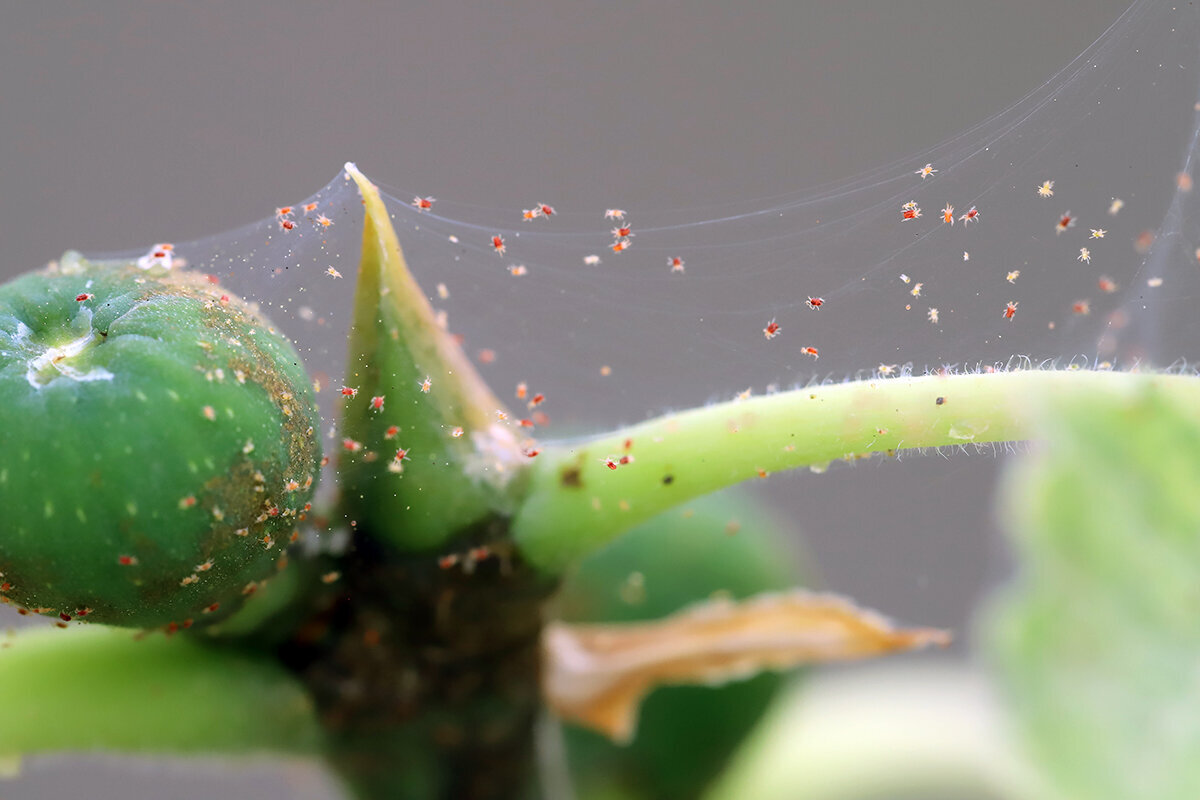
Greenhouse Field Note 41 · Detection & crop care
Managing Greenhouse Spider Mites.
To identify, prevent and manage an outbreak, begin by studying one leaf closely. Conspicuous silk is seldom the earliest clue. Fine pale pinpricks, a plant under strain and a modest colony often advance first within a dry, protected pocket of air.
First inspection
Diagnose more than the damage.
Spider mites pierce individual leaf cells and remove their contents; they neither make holes nor produce one clearly bounded injury. The earliest symptom is characteristic stippling, seen as minute cream or yellowish marks. Under glass, it may be mistaken for dust, poor nutrition, older foliage, sun scorch or thrips. Avoid a rushed blanket response. Instead, inspect the plant’s overall condition, its leaf surfaces and any active organisms in turn.
Survey the plant as a whole first. An outbreak commonly begins in one pocket: perhaps a cucumber at the hotter end of its row, a container short of water, foliage beside solar-heated glazing, or ageing leaves hidden from view. Record whether marks track the veins, concentrate low down, stay on one side, or occur in adjacent pots. Next, invert several leaves. Tetranychus urticae generally settles underneath; there you have the best chance of seeing mites, eggs, discarded skins and wisps of silk.
A magnifier is useful. Another test is to place a sheet of white paper under the chosen leaf and give the leaf a light knock. Minute dots that crawl across the sheet do not identify a species, yet they justify a more detailed search. Sample foliage at several heights and in contrasting microclimates. Reliable early identification avoids treating the whole house for one previously injured leaf when current activity remains confined to a small area.
The greenhouse layout also affects inspection. Paths, spacing and working heights should allow leaves to be raised, areas beneath benches to be cleaned and thick foliage to be reached without pressing adjacent plants together. A Classic Aluminium Greenhouse can provide an accessible setting for routine plant care, controlled ventilation and regular pest surveillance.
01 · Plant appearance
Read the distribution.
02 · Leaf surface
Read the pattern.
03 · Living signs
Read the colony.
Plant appearance. Notice dull grey-green foliage, speckled lower leaves and isolated plants under stress, any of which may indicate the first focus. Label each position so you need not remember it.
Leaf surface. Tiny pale marks may coalesce into irregular marbling, then become matt bronze patches. Inspect both faces of several leaves rather than concentrating on the most conspicuous one.
Living signs. Look for moving specks, round eggs, pale cast skins and the finest threads along veins or in leaf axils. Only such signs show whether visible damage is still progressing.
Damage atlas
From stippling to bronzing.
Visible injury helps you decide what needs attention first, but it is a poor measure of how many mites remain. Deeply bronzed foliage may preserve evidence of a past outbreak whose population has since fallen. Equally, a green-looking plant may carry newly laid eggs and busy colonies. Assess permanent symptoms together with current activity on the undersides.
These mites are arachnids rather than insects. Without magnification, the minute adults often resemble mobile pinpoints. Their colour varies with stage and pigmentation and may look green, yellow or red. Tetranychus urticae, the two-spotted spider mite, is an important greenhouse species; the pair of dark dorsal patches is characteristic. Even so, base decisions on the full set of plant evidence, not on an apparently distinctive colour by itself.
Fine stippling
Dense mottling
Bronzing
Silk appears
Leaf exhausted
Evidence, not worry
Spider mites and common lookalikes.
Stippled foliage merits investigation, although several causes can produce it. A dependable identification asks whether the symptoms suit sap-sucking mites and whether mites or immediate evidence of activity are present. Examine lower leaf faces, new and mature growth, symptom distribution, dark faecal spots and surface texture. Consider too whether the change followed hot weather, irregular irrigation or application of a spray.
Thrips may leave pale or silvered scraping damage, often in streaks, that can be confused with mite stippling. Look for dark faecal dots and narrow mobile insects among flowers, folded leaves or exposed surfaces. Mineral marks and dried spray remain on top and will commonly wipe away when dampened; damage caused by mites persists because the cells themselves are injured. Oedema tends to produce raised, blister-like or corked tissue associated with disrupted water balance. Ordinary senescence is usually steadier: an ageing leaf declines progressively instead of acquiring an enlarging patch of new pinpricks in one warm section.
Water shortage and other physiological changes require restraint as well. Limp, curled or irregular foliage does not by itself establish a mite infestation. When you cannot find mobile mites, eggs, threads or characteristic stippling below the leaf, investigate roots, irrigation and recent growing conditions first. If symptoms remain uncertain or continue spreading, seek qualified plant-health advice rather than applying a speculative treatment.
How a minor discovery can develop into a greenhouse outbreak
Warmth, water stress and delayed detection raise the risk.
Conditions strongly influence how spider mites develop and multiply. Higher temperatures may accelerate an outbreak, while plants short of water cope less effectively. Dust, crowded containers, concealed leaf undersides and slow detection add to the problem. Development cannot be assigned one standard duration because temperature, host, species and the immediate microclimate all matter. Regular observation in a home greenhouse is consequently more useful than relying on a universal timetable.
Area oneSun-warmed foliage
Area twoParched roots
Area threeCrowded plants
Area fourDelayed detection
Warm leaf surfaces: Foliage against the glazing, containers on the sunny side and stagnant air higher in the canopy may be considerably hotter than readings taken beside the entrance indicate.
Dry root zone: Repeated water shortage increases the loss of working leaf area and reduces a plant’s ability to tolerate an initially limited infestation.
Dense growth: Touching plants create sheltered routes between pots. Overcrowding also makes underside checks and even mechanical or authorised treatment more difficult.
Late discovery: Adults, immature mites and eggs can all be present at once. If an intervention affects only mites in exposed positions, renewed activity may emerge unless you reassess the plant.
Prevention is not a matter of maintaining maximum humidity continuously. Priorities are reducing avoidable stress, ventilating and shading promptly, keeping plants clean and reachable, and inspecting often enough to find modest populations before tangled foliage offers them a protected, silk-covered refuge.
Prevention through climate and access
A greenhouse you can inspect.
Examine each new plant before adding it to an established collection and, when practical, keep it apart for an initial observation period. Pay particular attention to herbs, vegetable seedlings, annual flowers and containers brought through winter, since a low-level population may cause little visible injury. Record the plant, position, date, symptoms, organisms found and response taken. Written observations expose repeated heat pockets and susceptible crops sooner and more dependably than recollection.
Irrigate to maintain even growth, not merely to rescue a crisis. Saturating a previously dry root ball will not remove spider mites, and repeatedly wet leaves cannot replace suitable watering. Judge moisture from the substrate or the weight of the pot, then supply each crop consistently according to its requirements. A planned growing area such as the Classic Aluminium Greenhouse can offer well-defined positions and practical routes for ongoing care.
Base ventilation and shading decisions on temperatures around the foliage itself. Opening doors and roof vents and using appropriate shade can reduce intense pockets of heat, although observation remains essential. Ireland’s Atlantic climate generally brings mild summers, yet conditions vary and enclosed sunny areas can still warm rapidly. A robust growing area therefore needs both shelter and enough working room to approach every plant. The Classic Aluminium Greenhouse has flexible layout possibilities; retain unobstructed paths, useful working heights and sufficient separation among plants.
Clean floors, the spaces below benches, container rims and the glazing regularly. Dust may favour mite difficulties, while abandoned foliage obscures inspection. Remove severely injured leaves unless doing so would strip the plant unnecessarily. Seal affected material in a bag and carry it away from the growing area. Avoid placing heavily infested specimens or cuttings on an uncovered compost pile immediately beside the greenhouse, where mites could regain access to cultivated plants.
- New plants: separate first, check leaf undersides and inspect again before moving them in.
- Plant spacing: avoid leaves constantly interlocking as bridges between neighbouring pots.
- Watering: prevent repeated drought stress without compensating with permanently saturated substrate.
- Heat: judge conditions around the foliage during sunny afternoons instead of relying solely on an earlier forecast.
- Checking routine: inspect at least weekly, and much more often in heat, after purchases or during an active infestation.
Treatment is about reach
Reach undersides, then inspect again.
A carefully directed wash can physically remove some mites and silk, particularly when an early infestation is confined to manageable plants. Protect the foliage and avoid working under direct midday sun. If using plant-protection products, choose only an Irish-authorised product approved for amateur use and for the intended crop and setting. Follow its label. Contact-dependent measures must reach the concealed population below the leaves to work adequately. Concentrate on complete, careful coverage rather than extra product or an indiscriminate cloud of spray.
Incomplete approach
Topside only
Methodical approach
Access before application
Excessive approach
More is not better
Topside only. Moisture lands on the upper surfaces but scarcely reaches the population underneath. Treatment may appear complete even though mites continue feeding in the sheltered part of the leaf.
Access before application. Separate the containers, lift compact foliage with care and proceed in sections as directed for the product or beneficial organism. Reinspect afterwards, since a single application should not be presumed to contact every developmental stage.
More is not better. Overdosing, treating heat-stressed plants or choosing a product unsuitable for the crop can damage leaves and affect beneficials. Follow the label, safety directions, temperature guidance, intervals and all restrictions fully.
For a small, separate focus, washing the plant, taking off badly injured foliage and monitoring closely might suffice. A broader outbreak calls for isolation, sanitation, relief from plant stress and a suitable management method. Greenhouse growers use predatory mites including Phytoseiulus persimilis against spider mites. The appropriate species, release rate and method vary with population pressure, crop, temperature and previous products. Discuss those factors with the supplier and verify whether earlier or intended treatments are compatible. Products with broad effects may injure beneficial organisms and undermine biological regulation.
Irish requirements: Amateur home and garden users in Ireland may use only Irish-authorised products approved for amateur use. Follow every label direction, including precautions, intervals and restrictions, and protect water from contamination. DAFM states that amateurs do not require formal training or user registration merely because they are amateur users. Consult its current guidance and verify the relevant product authorisation before use.
Recovery follows observation
The next leaf matters, not the old scar.
Stippled or bronze tissue will not regain its original green appearance. Improvement is instead indicated by fewer active mites, no additional punctures, stable rather than increasing silk, and healthy young foliage that remains unaffected through repeated inspection. Initially retain some marked but functional leaves for comparison. If every damaged leaf is removed immediately, later feeding can be difficult to distinguish from symptoms left by the earlier outbreak.
Day 0Confirm and contain.Mark affected plants, isolate where possible, inspect neighbours and note living mites, eggs or webbing.
Initial reassessmentInspect beyond what the intervention made visible.Examine undersides, leaf bases and dense plant centres again. Check whether washing or treatment actually reached the original colony zones.
Second follow-upSeparate old damage from fresh stippling.Compare marked leaves with new growth. Fresh punctures, moving mites, new eggs or silk mean activity is continuing.
AfterwardsReturn to the normal inspection routine.Retain the notes, address repeated problems with heat or irrigation, and keep a workable perimeter around the plants so another local outbreak can be noticed promptly.
Thoughtful greenhouse design makes this routine easier. The Classic Aluminium Greenhouse can be organised as a productive, well-kept area instead of overflowing with stored items. Leave a dedicated inspection route, keep vulnerable plants within comfortable reach, and adjust shade and ventilation for your own site. For continuing access and straightforward maintenance, consider the available configurations of the Classic Aluminium Greenhouse.
Questions gardeners often ask
Practical answers for precise inspection.
Can spider mites be present without webbing?
Yes. Delicate strands frequently remain inconspicuous until mite numbers rise. At an early stage, the clues may be limited to pale pinpricks, rounded eggs, shed skins and minute crawling mites underneath foliage. Silk adds valuable evidence when present, but you do not need to find it before making a well-supported identification.
Must an infested greenhouse plant be discarded?
No. Where the plant remains valuable and damage is light, you can often move it apart, wash it carefully or apply a suitable treatment, followed by frequent inspection. A specimen that is extensively injured, exceptionally congested and impossible to examine thoroughly may, however, keep seeding mites through the rest of the collection. Removing it hygienically can then be the most reasonable course.
Will extra humidity eradicate a spider-mite infestation?
No. Consistent moisture appropriate to the crop helps limit water stress and improves on excessively hot, arid conditions, but moisture in the air is not a complete remedy. Avoid maintaining a permanently damp growing space or continually wet foliage, because those conditions can favour separate difficulties, including fungal diseases.
Can I release predatory mites after spraying?
It may be possible, although the answer turns on which product was applied and its residual activity. Certain treatments can injure beneficial organisms more severely, or for a longer period, than anticipated. Read the authorisation and label, then consult the supplier about the required delay, appropriate predator, release method and environmental conditions.
What inspection schedule is suitable during an outbreak?
Inspect more often than the usual weekly schedule. Choose the timing in light of the crop, temperature, severity and intervention used. The essential step is returning to the same lower leaf surfaces soon enough to detect hatchlings from missed eggs or activity persisting in sheltered colonies.
Are spider mites actually spiders?
They share the arachnid group with ticks and spiders, but are minute mites that feed from plants. Their silk may appear as delicate strands or, in a severe outbreak, a dense covering over foliage. It does not form the large radial web associated with a spider.
Sources and further guidance
A short, reliable reading list.
The references below inform this guide’s approach to identification and integrated management. For any Irish crop or treatment, current Irish authorisation, the instructions on the particular label and advice from an appropriately qualified source take precedence.
More from Bloomcabin: Greenhouse curtains and shading · Setting up a greenhouse · Weather and pest protection in an aluminium greenhouse
- Chamber of Agriculture NRW: spider mites on greenhouse fruit vegetables
- Chamber of Agriculture NRW: spider mites in biological plant protection
- Chamber of Agriculture NRW: predatory mites as natural enemies
- DAFM: Irish-authorised products for amateur garden use
- DAFM: label use, water protection and amateur-user guidance
- Buying beneficial organisms: guidance from the Julius Kühn Institute and German Environment Agency
- Chamber of Agriculture NRW: diagnosing and controlling spider mites
- Chamber of Agriculture NRW: biology and control of spider mites
