
Whiteflies in the Greenhouse: How to Control Them
Glasshouse upkeep · Integrated pest management
Whiteflies in the Greenhouse: How to Control Them
A fluttering pale cloud is only the obvious symptom. Control begins out of sight under foliage, where eggs and immature insects are already producing another generation.
01 / The visible warning
The white cloud reveals only the leading edge of an infestation.
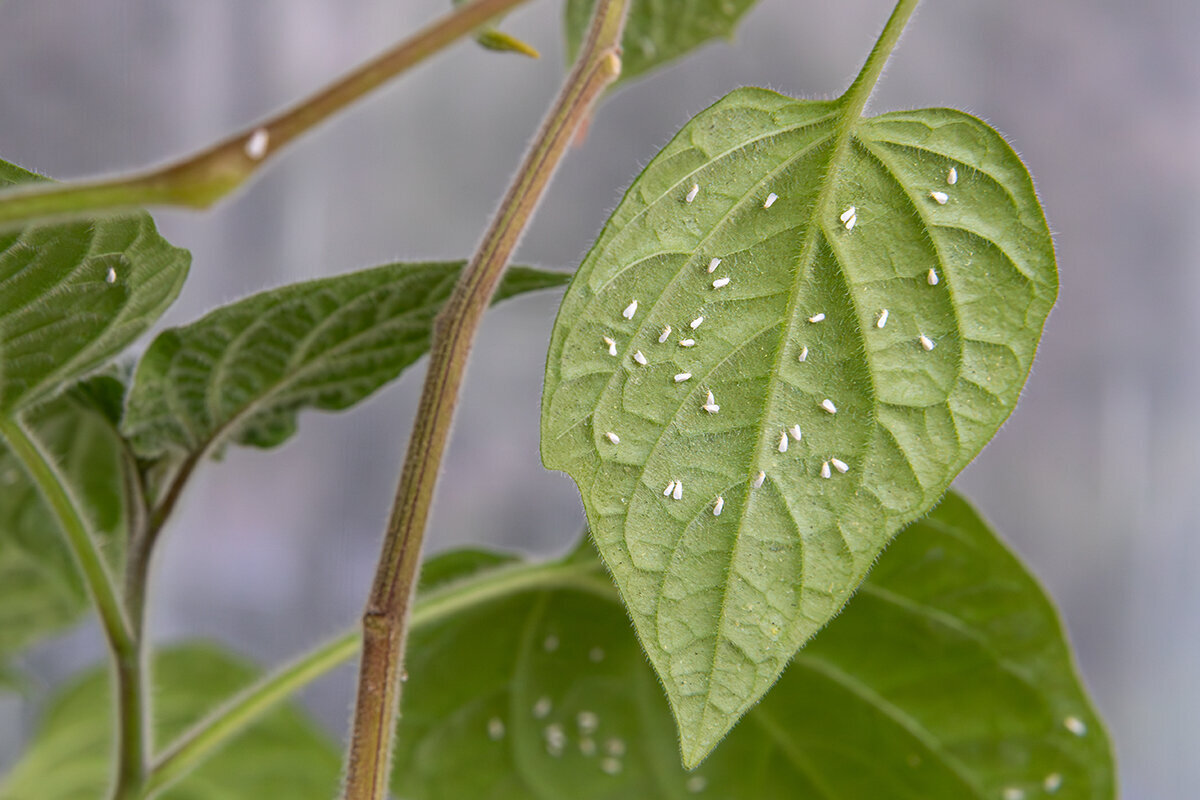
Touch the foliage of a tomato, cucumber, pepper, aubergine or fuchsia and tiny white insects may lift off together. That reaction is useful, although it exposes only the winged portion of the colony. Eggs, recently hatched crawlers and older, immobile nymphs stay underneath the foliage. Because those quiet stages survive unseen, another burst of adults can appear days or weeks after control seemed successful.
Whiteflies belong to the aleyrodid group and draw sap from plants. A severe or prolonged attack reduces vigour and productive foliage. Honeydew provides another clear sign, coating foliage, produce, containers and staging with sticky residue that can support black sooty mould. Greenhouse whitefly is one likely culprit, while brought-in plants may also introduce Bemisia tabaci . Whether to act, and how, is shaped by the plant, whitefly species, severity, growing conditions and plans for biological control.
Good organisation makes inspection easier: crops, walkways, vents and working areas can be cleaned and examined in a planned sequence. With a durable house such as the Classic Aluminium Greenhouse , leaf inspection should be as routine as watering, pruning, ventilation and shading.
02 / Diagnose before acting
Examine what lies beneath.
Using a hand lens turns an indistinct pest concern into a life-stage assessment. Species, host crop, temperature and glasshouse conditions alter both appearance and development, while the inspection principles remain dependable.
Do not limit inspection to the most convenient specimen. Turn foliage on several plants, checking beside the veins, around tender shoots, through the middle layer and beneath dense growth on older leaves. Distribution is seldom uniform: one protected plant may already support active breeding, although an adjacent specimen shows only isolated adults or newly laid eggs.
Eggs
Pale, tiny and often placed close to veins.
Crawling nymph
Briefly mobile after hatching.
Attached nymphal stages
Flat, scale-like and easy to miss.
Adult insects
White and powdery; fly up when disturbed.
Treat each leaf as four separate clues. Use the illustration to orient yourself, then verify what you see across multiple plants and cultivation areas.
This visual aid helps with checking, yet secure identification may require more evidence. Eggs are very small and can change as they develop. The first nymph moves briefly across its birth leaf before selecting a feeding site. Later stages are largely fixed in place and look like flat pale scales. Adults are conspicuous, but represent only the flying part of the population.
Look beyond the insects for fresh honeydew, sooty mould, pale feeding damage, empty cases and rising numbers of attached stages. Exact appearance depends on species, host plant, temperature and age. Greenhouse whitefly and Bemisia tabaci cannot always be distinguished reliably by individual field features. In a home garden, recognising the life stages securely is often enough. For valuable collections, unusual symptoms or a specialised beneficial-insect programme, seek identification from a garden supplier, plant-health adviser or suitable diagnostic service.
03 / Make sure the visitor is whitefly
Telling whiteflies from other small flying insects
Whiteflies
When disturbed: A small, white, powdery cloud rises from foliage.
Confirm the finding: Check leaf undersides and young shoots for eggs and flat attached stages.
Typical clue: Honeydew and dark sooty mould increase with infestation.
Fungus gnats
Dark, gnat-like insects mainly hover over damp growing medium. Their larvae live in compost and do not appear as flat scales beneath leaves.
Thrips
Slender, elongated insects more often associated with silvery feeding marks, distorted growth and small dark droppings than a white cloud.
Winged aphids
Usually clearly pear-shaped; wingless colonies are often visible on soft shoots and stems. Aphids can also produce sticky honeydew.
The result of identification determines what follows. Sticky yellow cards may catch insects from each group, whereas eggs and immobile whitefly nymphs are found by turning leaves. A treatment intended for thrips, aphids or fungus gnats should never be presumed either safe or effective against whitefly.
04 / Make monitoring repeatable
Follow the same inspection route every week.
An occasional sighting is useful, but it does not reveal whether numbers are expanding, clustering or falling. Establish one short circuit around the house: begin at doors and vents, continue past recent arrivals and dense planting blocks, then inspect shoot tips, mature foliage, weeds and debris below staging. Carry a magnifier and use either a basic notebook or one digital record that you update consistently.
1
Entrance zone
Inspect entrances, ventilation points and recent arrivals.
2
Infestation hotspots
Mark plants where adults fly up.
3
Upper canopy
Inspect shoot tips and fresh eggs.
4
Lower canopy
Check older leaves and nymphs.
5
Ground area
Remove weeds and plant debris.
For a modest collection, sample several useful plants from each crop instead of repeatedly choosing the specimen nearest the doorway. In a larger house, define permanent zones and inspect an equal sample within each one. Log date, crop, location, flying adults, immature stages, honeydew, leaves removed, treatments and beneficial releases. Consistency yields better decisions than a made-up threshold applied everywhere.
Pay extra attention to dense growth, sheltered corners and plants that are awkward to inspect. Whiteflies may reproduce unnoticed beneath thick foliage or in an undisturbed corner. Quietly tag several hotspots for comparison on your next circuit and, if practical, tag one plant that seems clear. Comparing both types helps distinguish an expanding outbreak from old injury that has only now become apparent.
05 / Read yellow traps systematically
Yellow traps monitor flight; they do not cure an infestation.
Interpreting the signal
TrendAdults are caught; leaf stages remain hidden.
Keep each check consistent
- Number every yellow trap.
- Keep its position unchanged.
- Count the same area each time.
- Record date and result.
Yellow cards attract winged whiteflies. When handled consistently, they indicate early arrivals, relative changes in flight and the response following action. They say nothing conclusive about eggs or immature insects still living on the crop. Regard each card as one monitoring instrument within a wider inspection routine, rather than expecting it to resolve an established colony by itself.
Return cards to fixed zones for every inspection, keeping them near canopy level and lifting them as the crop grows. Decide in advance whether you will count the full surface or one permanently marked portion. Altering the sampled area mid-season breaks the comparison. Fit a fresh card when dust, moisture, foliage or accumulated insects obscure the adhesive, then compare it only with the earlier card from that position.
For a domestic glasshouse, a card by the doorway plus cards assigned to separate crop areas is usually more informative than a lone card hung without a plan. Always interpret catches alongside turned-leaf observations. A fall in adults is promising, yet fresh crawlers or numerous living immobile nymphs mean breeding continues. Keep cards away from beneficial releases, splashing water, strong heat and frequent foliage contact.
06 / Time is the hidden structure
Why one intervention rarely reaches every whitefly
Life stages in a glasshouse population overlap rather than moving in step. Winged insects continue to deposit eggs while older nymphs remain fixed and another group begins hatching. Protected warmth can shorten development and increase the overlap between generations. Consequently, action aimed at exposed adults or moving crawlers may spare eggs and other immature forms.
Responding with stronger products or unscheduled extra applications is not the solution. Build reassessment into the initial decision: remove sources where possible, identify what remains and combine sanitation, biological controls or direct action when appropriate and permitted. Revisit the original marker plants promptly, before an unnoticed emerging wave has time to build.
Overlapping population waves
Adults lay eggs.
Nymphs hatch, move and feed.
Attached stages remain; new adults emerge.
The offset curves illustrate why an inspection commonly finds different ages together. Reassessment should therefore be scheduled with the first action. Do not borrow repeat intervals from a generic web timetable; base timing on what you observe, the crop and conditions, and, whenever a pesticide is involved, every direction on its current label.
07 / Reduce infestation sources
Isolate new plants, remove selectively and limit entry routes
Isolate plants
Keep newly purchased young plants, potted specimens and gifts apart initially. Gently disturb the foliage, turn a selection of leaves and inspect for each life stage prior to joining the main collection.
Remove heavily infested leaves
For a concentrated hotspot, densely colonised foliage may be removed provided enough healthy growth remains. Enclose the cut foliage first, then move it out of the house.
Clear hidden host plants
Weeds, seedlings, forgotten spare plants and old crop residues can sustain populations between crops. Inspect and clean beneath benches, along walls and around pots.
Take a selective approach rather than stripping the plant. Removing too much foliage can reduce vigour, delay recovery and leave crops or delicate tissues unprotected. Start with leaves bearing concentrated eggs and nymphs. If one expendable plant is heavily colonised and releasing many adults, removing it entirely may be sensible. Seal discarded growth in a bag for household residual waste; never leave it exposed in the glasshouse or add it openly to compost.
Physical exclusion is most useful before whiteflies settle. Fine insect mesh over openings can limit arrivals, although it must not compromise the airflow needed when a glasshouse heats up. Everyday habits matter as well: shut doors without delay, keep affected plants away from access points and maintain an orderly quarantine space for arrivals awaiting inspection. The Classic Aluminium Greenhouse supports clear paths, accessible plants and a manageable ventilation and work routine.
Clean glazing, unobstructed aisles and orderly benches have practical value in integrated pest management. Sticky honeydew is easier to notice, foliage can be turned without a struggle, and monitoring cards can remain in repeatable positions. Gardeners creating a well-ordered permanent space for a demanding collection can explore Aluminium Greenhouses for access, clear crop zones and regular care.
08 / Start biological control early
Beneficial insects depend on timing, not magic.
Parasitoid wasps and predators
Against greenhouse whitefly, the parasitoid wasp Encarsia formosa is an established biological antagonist. It is especially useful early in an infestation, when numbers are still manageable and incompatible residues from earlier plant-protection measures will not affect release. Where Bemisia tabaci is present, a different professionally matched beneficial-insect strategy may be needed, potentially including suitable Eretmocerusspecies. Suppliers or plant-health advisers can match the choice to whitefly, crop, temperature, light, crop size and previous measures.
Predatory organisms may also contribute to control. Macrolophus pygmaeus, for instance, can be considered for fruiting crops grown under cover, though small mixed collections need an individually planned approach. Instead of requesting a single ‘best’ beneficial, ask which organism suits the pest identity, crop, density, conditions and treatment record. Natural enemies differ in their roles and cannot simply be exchanged between glasshouses.
Before discarding dark nymphal cases, look for evidence that they have been parasitised. Greenhouse whitefly puparia attacked by Encarsia formosa may become dark. A magnifier and trustworthy identification material reduce the risk of throwing away active natural enemies together with infested foliage.
Biological control should be managed as an ongoing process, rather than treated as a token release. Success calls for repeated observations, correct identification, suitable conditions and time for establishment. Accessible staging and paths make a difference: they let you inspect foliage, move between zones and distribute beneficials evenly, unlike a spectacular canopy that nobody can reach. A Classic Aluminium Greenhouse with clear paths and accessible growing areas provides a suitable setting.
09 / Match the tool to the stage
Control uses several steps, not one product.
Hygiene
Removes hotspots and colonised plant material.
Yellow traps
Record the activity of flying adults.
Beneficials
Build biological control pressure over time.
Contact measures
Require full coverage of leaf undersides.
Hygiene and removal can remove concentrated colonies by taking away badly affected foliage, weeds, crop remnants or isolated source plants. Insects surviving elsewhere in the collection are unaffected.Yellow traps show relative adult flight activity but not the full offspring beneath leaves.Parasitoids and predators can establish sustained suppression when used early and correctly. They need correct matching, suitable conditions, protection from incompatible products and enough time.Contact treatments work only on insects and stages actually hit. A shiny upper leaf surface does not prove underside coverage.
Contact action requires real contact
Soap, oil and other contact products work only when the target is wetted. Whiteflies usually occupy the lower leaf surface, making spray placement, crop sensitivity, heat, moisture stress and label instructions important. Where a label provides for a small test, use it on sensitive crops or mixed plantings first. Never create improvised mixtures or substitute domestic washing-up liquid for an authorised pesticide. Warm glasshouse conditions can make tender foliage especially vulnerable.
Before treating an edible crop, verify through the DAFM register that the pesticide is authorised in Ireland for amateur use, then check that its current label covers the crop, pest and intended glasshouse setting. Observe every labelled direction, including rate, technique, application limits, harvest interval, protective measures and information about beneficial organisms. An old online recommendation cannot replace the Irish authorisation and full label.
10 / Chemical choices remain conditional
Use authorised plant-protection products sparingly and with records
No single spray schedule can responsibly cover every small Irish glasshouse. The appropriate choice changes with authorisation, crop, whitefly identity, protected setting, user category, plant health and any beneficial organisms present. Search the DAFM plant-protection product register before use and study the complete current label. Confirm that the intended crop and glasshouse situation are covered, then observe the stated rate, application limit, harvest interval, safety directions and restrictions.
If expert advice supports an authorised product, avoid relying on one mode of action through successive generations merely because products carry different trade names. Repetition may select resistant whiteflies. Sound resistance management follows the authorisation, label information and professional advice. Some Bemisiapopulations are notably troublesome. Maintain a detailed log of each application; it supports later choices and reveals residues that could compromise a planned beneficial release.
Ask an appropriate plant-health adviser for help while a persistent, worsening or uncertain outbreak is still manageable. Advice is also worthwhile for unfamiliar plant symptoms, doubtful identification or uncertainty about permitted uses. Within integrated management, pesticides have a selective, reasoned role alongside correct diagnosis, sanitation, thorough coverage and follow-up aimed at the stages present.
11 / Evidence comes after action
Judge recovery by new findings, not one quiet afternoon.
A house can look calmer immediately after affected foliage is removed, a direct treatment is made or biological controls are released. That welcome change is not yet proof of success. Improvement means fewer adults on cards kept in comparable positions along the established circuit, fewer new eggs and crawlers on young foliage, a falling count of living immobile nymphs and less newly deposited honeydew. Existing sooty mould, feeding marks and empty cases may persist, so assess fresh evidence rather than expecting pristine plants the following morning.
A
First follow-up
Revisit each tagged hotspot and examine the lower surfaces of a selection of leaves. Note which ages remain; remove newly crowded foliage only when the plant retains enough healthy growth.
B
Compare the trend
Compare each numbered yellow trap only with earlier counts from the same position and link the result to leaf findings. A lower catch is encouraging, but not proof on its own.
C
Adjust the strategy
If new nymphs continue increasing, review diagnosis, hygiene, coverage, beneficial compatibility and renewed entry via plants, weeds, doors or vents.
Maintain the routine while pressure declines. Resilient greenhouse management does not mean eliminating every insect; it means detecting a new arrival before it multiplies throughout the foliage. Unobstructed aisles, dedicated storage for your magnifier and records, suitable ventilation and shading, and easy access behind the crops turn an intended routine into regular practice.
FAQ / Small Irish greenhouses
Clear answers to whitefly questions
Do yellow traps completely eliminate whiteflies from my greenhouse?
No. Yellow traps monitor flight activity and catch some adult insects. Eggs and most crawling and attached stages on leaf undersides remain untouched. Use the cards as an early-warning and comparison tool, and combine every reading with systematic leaf inspection.
Must I dispose of every infested plant completely?
No. First separate the affected plant, judge the severity and identify the stages present. Remove only densely occupied leaves if ample healthy foliage will remain. Complete disposal can still be sensible for one expendable, severely affected specimen that is acting as an important breeding and dispersal point within the collection.
What makes whiteflies reappear following control?
The colony generally contained overlapping ages. Action against obvious adults may spare eggs and fixed nymphs, while poor contact beneath foliage allows survivors after direct treatments. Whiteflies may also be brought in on plants, persist on overlooked hosts or enter through vents and doors, creating another rise in activity.
Can I introduce beneficial insects after treatment?
Perhaps. Suitability varies according to the product and active ingredient, when it was applied, how long residues persist, the crop and the beneficial organism proposed. Retain the application record and discuss it with the biological-control supplier, a garden specialist or an adviser before release. Incompatible contact treatments may seriously weaken the programme.
Can whiteflies harm tomatoes, cucumbers, peppers and herbs?
Yes. A continuing colony can reduce plant vigour and productive foliage. Sticky honeydew marks produce and leaves and supports sooty mould. For food crops, choose only suitable methods; before using a pesticide, verify its Irish amateur-use authorisation and follow every current label requirement concerning the crop, application, harvest interval and safety.
How often should I check for whiteflies?
A weekly inspection is the minimum while plants are actively growing. Check sooner during warm spells, near established hotspots, after introducing plants or when card catches rise. The important feature is a route applied consistently enough for useful comparison. Your inspection schedule does not override pesticide-label conditions or specialist advice.
Sources and further reading
Work with current, reliable information.
Species, biological-control programmes and authorised pesticide uses may differ or change. The Irish authority below addresses amateur use; the other links are clearly identified German specialist references supporting identification and life-stage management.
More from Bloomcabin: Planning greenhouse layout, planting and routine care · Summer greenhouse care · Bloomcabin greenhouse overview
- North Rhine-Westphalia Chamber of Agriculture – Whitefly on vegetables
- North Rhine-Westphalia Chamber of Agriculture – Biological whitefly control
- North Rhine-Westphalia Chamber of Agriculture – Parasitoid wasps for whitefly
- Bavarian Garden Academy – Whitefly identification and control guidance
- Julius Kühn Institute – Bemisia tabaci factsheet
- German Environment Agency – Plant protection and beneficial organisms in vegetable gardens
- DAFM – Amateur users: home and garden pesticide guidance
- North Rhine-Westphalia Chamber of Agriculture – Recognising whitefly in home gardens
