
Climbing Plants on an Aluminium Pergola: Approval Checks
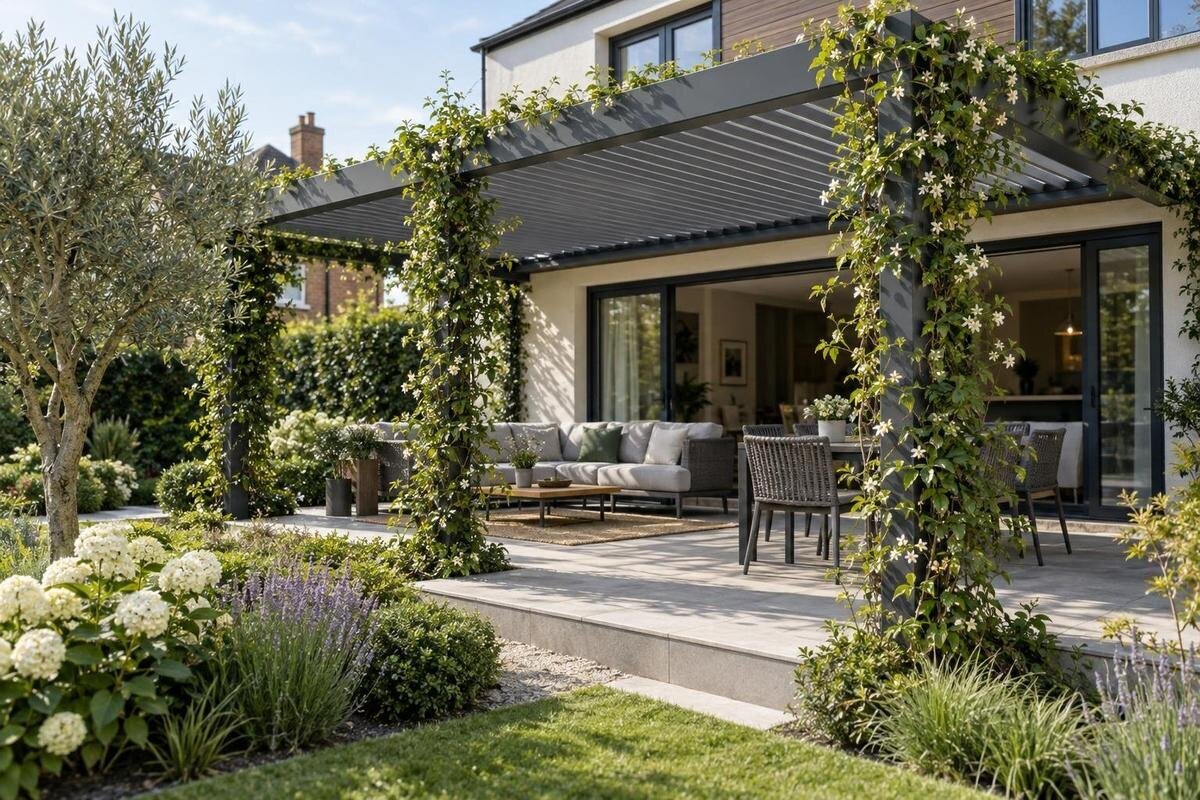
Pergola planting guide
Climbing plants can soften a pergola and provide seasonal shade, but an aluminium frame should not be treated as a ready-made trellis unless its supplier confirms that use. A young vine gives little indication of the space and weight it may reach at maturity. Wet foliage can add weight, dense growth can catch wind, and stems may reach joints or moving roof parts. Before planting, check permitted fixings and added load in writing, show the plant route on a dimensioned drawing, and confirm clearance across the roof’s full movement. If the frame is not approved to carry the plant, plan a separate support.

Why climbing plants need separate approval
Climbers change the loading conditions as they grow. The relevant load is not simply the young plant’s weight: stems, foliage, ties and any separate support add mass, and wet growth can be heavier. Dense foliage can also catch wind. How those effects reach beams, posts, joints or mounting points depends on the plant’s mature form and the route it follows. A stem may thicken, cross a joint or pull against the part supporting it. These conditions can develop over several seasons, after the frame and garden layout are already in use. The appearance of an aluminium frame does not reveal what additional loads it has been assessed to accept.
A product page, photograph or material label cannot show whether extra plant loading has been assessed. When enquiring about the Bloomcabin Pergola, give the supplier the exact model, selected configuration, intended plant and proposed support route. Ask in writing whether plant growth is permitted, which attachment methods and locations are accepted, and whether a qualified structural assessment is needed. The answer should refer to your actual plan, rather than to aluminium pergolas in general. If the supplier cannot confirm the proposed use, ask a qualified structural professional to assess the specific arrangement instead of judging capacity from the frame’s appearance.
Keep growth clear of a moving roof
Where a roof opens or otherwise moves, check the full operating path, not only the space available when it is shut. Depending on the design, roof parts may rotate, slide or change position; a photograph does not establish what moves. A vine, tie, wire or leaf could reach that area even if the support appears to sit below it. Ask the supplier to identify the moving components and the required clearance for the exact configuration. Mark that zone on a dimensioned landscape drawing so the planting route can be reviewed against it before anything is attached.
If you are considering the Bloomcabin Bioclimatic Pergola, ask which roof components move in the chosen configuration and where planting must remain clear; the product name alone does not establish a planting allowance. Show the roof’s open and closed positions, along with any clearance the supplier specifies between them. The mature plant, ties, clips and supporting wire all need to stay outside that zone. Allow access to inspect and maintain the roof components, too. Plants spread and sway, so a narrow gap at planting time may disappear. If the specified clearance cannot be maintained, place the trellis elsewhere.
Check every fixing method
The method used to guide a plant is a separate approval question from the plant’s overall weight. Drilling, screws, clamps, clips, adhesive ties and wire can each affect a frame differently, and the exact point of attachment matters. A fixing that seems secure by hand is not evidence that the frame has been assessed for that use. Do not drill, glue, clamp or wrap a support around a frame member unless the supplier has approved the specific method, location and accessory. Ask whether any approved fittings have to avoid particular parts of the structure, and how the arrangement can be inspected once the plant grows around it.
Describe how the chosen climber grows: it may twine around a guide, use tendrils, cling to surfaces or need to be tied to a support. Those habits affect where a trellis is needed and what must remain clear; a plant’s ability to attach itself does not make the pergola an approved plant support. For the Bloomcabin Wall Pergola page, mark each proposed fixing separately and ask which, if any, are permitted. The product page identifies a model, but does not establish that a plant trellis may be fixed to its frame or to the adjacent wall.
Assess the plant at mature size
Plan around the plant’s expected mature form, not its size in a pot. Record its name, expected height and spread, growth habit, seasonal foliage and pruning requirements. A horticulturist or landscape designer can document the plant’s requirements for the proposed site. If a structural load estimate is needed, have a qualified structural professional assess the specific arrangement; do not substitute a rough figure from a general care label. The weight and direction of growth depend on how the plant is supported, so plant details should be considered alongside the pergola and the planned trellis.
A dimensioned landscape drawing should show the pergola outline, planting position, trellis route, likely mature canopy and areas that must remain clear. The Bloomcabin Pergola options are listed from 9 to 24 m²; that stated area describes the product options, not an allowance for additional plant load. A plan with actual dimensions lets the supplier review where growth might meet the frame or roof path, while a structural professional can assess how loads reach the support. Include the proposed attachment points and enough space for access and pruning; a mood image or plant name alone cannot explain the arrangement.

When a separate trellis is the better option
A separate trellis makes sense when the supplier has not approved plant loading or direct fixings, or when growth must be kept away from a moving roof. Here, separate should mean that the trellis carries the plant without relying on the pergola. A screen clipped to a post or leaning against a beam still uses the pergola for support. The trellis needs its own design and support suited to the mature plant and the site, with professional input where necessary. An independent structure is not automatically suitable simply because it is beside, rather than attached to, the pergola.
If your layout includes the bioclimatic pergola model, draw the pergola and plant support as distinct elements, with the roof’s required clearance clearly marked. The product page does not confirm whether a trellis is supplied or approved for this arrangement. Leave space between the structures so growth can be managed without crossing onto the frame, and make sure pruning access is practical. A separate support still needs to be checked for its own location and any permissions that apply; it does not remove the need for a site-specific design.
Wall fixings for the pergola and plant support
A wall-mounted pergola brings the building into the assessment. There is the approved connection between the pergola and the wall, and there may be a separate fixing for the plant support. Approval of one does not automatically approve the other or establish that the wall can take added plant loads. The wall’s material and condition need to be considered at the actual fixing points; a solid-looking finish is not enough to judge what lies behind it. Ask the supplier what it approves for the pergola, and have a qualified building or structural professional assess any additional wall-mounted support where needed.
For the wall-mounted Bloomcabin model, distinguish the product’s wall connection from the proposed plant arrangement in your enquiry. Ask which details the supplier can confirm and which require a separate site assessment. If the trellis will be fixed to the wall independently, show its locations and plant route on the drawing rather than treating it as part of the pergola connection. If the plant will use a freestanding support instead, check that it remains independent and clear of the roof’s movement. The model name describes the type of product; it does not establish that a particular wall or plant fixing is suitable.
Choose a plant for the approved support
Plant choice is part of the support design. A climber that twines around a guide needs a different arrangement from one that clings to a surface or needs to be tied in. Ask a horticulturist or landscape designer familiar with the site to document likely mature size, growth habit, foliage and pruning needs. Consider whether the planting position and intended route suit the plant, rather than choosing only for appearance. The aim is to specify a plant that can be managed within the approved support and roof clearances, not to assume that every climbing species will suit the same pergola.
Be realistic about the care needed to keep stems and foliage within the planned route. If regular pruning would be difficult, a fast-growing or wide-spreading plant may make it harder to preserve the clearance shown on the drawing. For a proposal involving the Bloomcabin Bioclimatic Pergola, name the intended plant and its mature spread in the same submission as the exact model. Approval for one growth habit should not be taken as approval for a different plant or route. If the species changes after the supplier has reviewed the plan, ask whether the change affects the support or moving-roof clearance.
What to include in a written approval request
Send the supplier the exact model and configuration, a dimensioned drawing, the plant’s name and expected mature dimensions, its growth habit, and the proposed trellis and fixings. Mark the planting position and route, every attachment point, and the area that must remain clear around moving roof parts. If the roof moves, identify the configuration being considered rather than relying on a general product category. Ask direct questions: can the frame carry this plant arrangement, which fixings and locations are allowed, and what clearance must be maintained? Clear documents help the supplier respond to the actual proposal instead of guessing what “a climber on the pergola” means.
A useful written response identifies what it covers: the model and configuration, any accepted fixing method, restrictions on plant support and the clearance around moving parts. Ask the supplier to flag questions that need a structural professional or installer, since product compatibility and site assessment are not the same task. For the Bloomcabin Wall Pergola listing, name the precise model in the enquiry rather than relying on the broad term wall-mounted pergola. Keep the response with the drawing and installation documents. If the model, plant, support route or fixing method changes, ask whether the earlier approval still applies.

Supplier approval is not property permission
A supplier can address whether a proposed use is compatible with its product; that response does not grant permission to alter a property. If the pergola or planting affects a rented home, shared terrace, managed property, boundary or building façade, ask the relevant owner or manager before arranging work. Where planning, conservation or building controls may apply at the site, check with the appropriate local authority or a qualified professional. The applicable requirements depend on the property and location, so do not assume that a supplier’s product approval answers those separate questions.
A dimensioned plan can help explain the proposal to each person who needs to review it. Show where the pergola and trellis sit, how high and wide the mature plant is expected to grow, where supports attach and which areas must stay clear. Direct each question to the right person: the supplier for product use, a qualified professional for structural matters, and the owner, manager or relevant authority for property or local permissions. One response does not replace another. If permission for a proposed fixing or location is unclear, wait for clarification before attaching the plant support.
Plan for pruning and future growth
Approval is based on a planned arrangement, while a living plant keeps changing. Make sure the chosen route can be maintained as the climber grows, and leave practical access for pruning and visual checks. Follow the plant’s care requirements and the pergola supplier’s instructions for the roof and its components. Do not rely on the pergola as a ladder or as an unapproved route for tying in new growth. A trellis that is easy to reach and manage is more likely to remain within the boundaries shown on the original drawing.
Compare the plant’s growth with the approved route from time to time. If stems approach the roof’s movement area, cross a joint or begin to pull on a fixing, stop adding ties there and seek appropriate advice on redirecting or pruning the plant. Do not force a roof past an obstruction or treat unexpected movement as a routine gardening issue. Before adding a second plant, changing fixings or extending the trellis, ask whether the supplier and any relevant professional need to review the change. Keeping the plan current helps preserve the separation between plant support and pergola.
Frequently asked questions
Can I attach a wire or trellis directly to an aluminium pergola?
Only if the supplier approves the proposed fixing method and location for the exact model. Wire, clips, ties and clamps can place loads differently, so show the proposed attachment and plant route in a drawing. If the frame is not approved for this use, choose a separately supported trellis.
Does a small climber need the same checks?
Its size at planting is not a reliable guide to its mature growth. Stems and foliage develop over time; wet foliage can add weight, and dense growth can catch wind. Ask about the mature plant and its support arrangement, rather than judging by the nursery pot.
Can a plant grow over a pergola with a moving roof?
Only where the supplier confirms that the plant and its support can remain clear throughout the roof’s full movement. A gap that looks sufficient when the roof is closed may not be enough as it opens or changes position.
Does an independent trellis remove the need for approval?
No. It can keep the plant’s load off the pergola only if it is genuinely separate and has its own suitable support. Its location, support and clearance still need to be planned, and any property or local permissions should be checked separately.
What should I send with an approval request?
Provide the exact pergola model and configuration, a dimensioned drawing, the plant’s name and expected mature size, its growth habit, the proposed trellis and fixings, and the clearance needed around any moving roof parts. Ask for a written response that identifies what it covers.
Treat the climber as part of the pergola’s planned use, not simply as decoration added later. The useful approval is specific to the model, mature plant, proposed support and roof clearance. If the frame is not approved to carry the plant, keep the trellis genuinely independent and have its separate support assessed. A drawing that shows both structures, the plant’s growth route and access for pruning makes it easier to keep the roof clear as the climber matures.
