
Buying a Bioclimatic Pergola on Black Friday: Features to Compare
BLACK FRIDAY BUYING GUIDE
Black Friday can put several pergola listings side by side, but a seasonal label does not tell you how the roof moves, what the frame is made from or where rainwater will go. Those details help determine whether a bioclimatic pergola suits the way you expect to use your outdoor space. Compare the stated features first, then review the offer and order terms. This guide focuses on roof operation, controls, materials, drainage and dimensions; it does not assume that a particular model includes features not confirmed on its product page.

The intended use determines which roof features matter
For many buyers, the main reason to consider a bioclimatic pergola is the option of adjusting the roof to change the balance between overhead shade and open sky. Decide what the covered area needs to do before comparing Black Friday listings: shade a dining table at particular times, keep a seating area comfortable as the light changes, or provide cover beside the house. Those priorities lead to different questions. An adjustable roof may let you vary light and airflow, but a product name does not tell you its movement range or how much protection a closed position provides. Treat each of those points as a specification to verify. Consider whether the area is mainly for meals, shade or passing between the house and the rest of the outdoor area; that use helps set the priorities.
Write down the features you expect to use, rather than starting with an offer label. Note whether adjustability itself matters, which part of the patio should be shaded, and how often you expect to change the roof position. Then compare product descriptions, operating explanations and labelled drawings. The bioclimatic pergola page can be one point of reference, but use only the details actually stated there; the category name alone does not confirm the roof controls or weather performance. If a listing leaves a point unanswered, mark it as unknown instead of assuming that every bioclimatic design works in the same way. Separating essential features from nice-to-haves also makes it easier to judge whether a seasonal offer matches your requirements.
Louvre movement matters more than the closed position alone
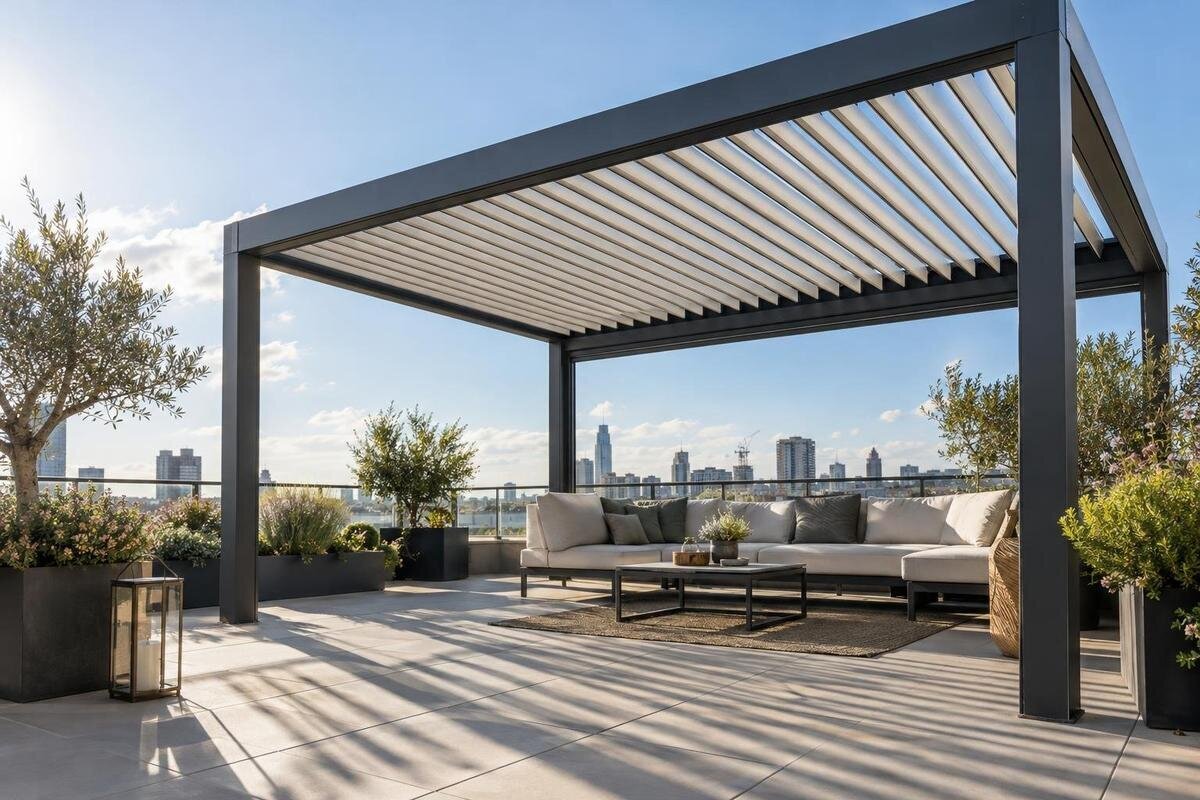
Look for an explanation of how the roof sections move and which positions the system supports. With a louvred design, compare how the slats adjust rather than relying on a single picture of them at an angle. A diagram can be useful, but only if its labels make clear what is shown; a photograph does not show the full range. Check whether all sections adjust together or whether the description distinguishes separate areas. If the page gives angles or opening limits, record them as written and ask what they refer to. Also note whether the positions are fixed stops or continuously adjustable, if the listing explains this. Avoid guessing from words such as tilting or adjustable: they may leave important details unspecified.
Separate the closed position from the open settings in your notes. Ask whether the product has a defined fully closed position, how the roof stops at each limit, and whether the operating description explains the transition between settings. Record any unanswered point, such as whether different sections move independently, rather than filling the gap from an image or generic wording. The general pergola page may describe another configuration; use it only to see what that page says, not as evidence that its roof movement matches a bioclimatic design. Compare mechanisms only when the listings identify them clearly, and keep each model’s information separate.
Manual and powered roof operation
Once movement is clear, check how a user operates the roof. The listing may describe a manual mechanism, a powered system or another control arrangement, but the category name does not establish which one a particular model uses. Look for the operating method, the controls included, where a user is expected to reach them and any stated limits on use. If several people will use the pergola, consider whether the control position and method are practical for all of them. Think about access from the usual seating or dining area too; a control that seems convenient in a product photo may be awkward in the actual layout.
For a powered roof, check the documented electrical requirements and who supplies or connects any required equipment; leave wiring and installation decisions to a qualified professional. Ask whether a remote, wall control, manual override or other accessory is included rather than merely shown. If information is available, find out what happens during a power interruption instead of assuming an alternative operation is provided. The Bloomcabin bioclimatic pergola listing should be assessed on its own terms: confirm the operating method and controls stated there, not a presumed standard. Note any care instructions for the mechanism as well, since they form part of ongoing ownership.
Frame material, finish and maintenance
Frame material and surface finish affect how you assess upkeep, but neither is reliably identified by a colour swatch or staged photograph. Look for the material named for the main supports and roof parts, then check whether the finish is described separately. If a page names aluminium, steel or another material, confirm which components that wording covers and whether a coating or finish is specified. Different elements may not share the same material, so do not infer that the roof slats, posts and connectors all have identical construction from one general description. Check whether care guidance covers both the frame and moving roof parts.
Consider the conditions at the intended site when reading the care instructions. A pergola close to the sea, exposed to dust or positioned beneath trees may need particular attention, so ask whether the stated finish and cleaning guidance address those conditions. This is a point to verify, not a basis for assuming that one material will perform well or poorly. The Bloomcabin’s pergola listing should be used only for its own stated material and finish information. If the page does not identify them, record that gap rather than guessing from colour or from another model’s description. If site exposure matters, ask which finish statement applies to the complete assembly.

The rainwater route through and around the pergola
Rain management needs a separate comparison line because the roof’s appearance does not show the route water takes. Find out whether the description names channels, gutters, downpipes or another drainage arrangement, where any outlets are positioned, and whether water is directed away from the covered area. Do not assume that a closed roof is watertight, that drainage components are included or that a pictured outlet will suit your layout. Look for stated information about performance in rain and any limits on operation; a broad phrase such as weather protection is not enough to answer every question. If rain cover is central to your choice, ask for a clear product statement about the intended use and limitations.
At the intended location, note nearby doors, paths, paving edges and existing drains that could be affected by the discharge. Mark any walkway or doorway where redirected water would be inconvenient; that gives an installer useful context without asking you to design the route yourself. Ask where the outlet is meant to lead and what parts, if any, must be provided separately. A qualified installer can assess how a stated drainage arrangement would work at your site. If you are also comparing a wall-mounted design, review the wall-pergola product page as a separate configuration and check its drainage information independently rather than transferring details to another model.
Footprint, height and usable clearance
Compare overall dimensions with the clear space beneath the structure. The footprint indicates the area occupied, while the distance between supports and height under beams affect how furniture, people and doorways fit. Check whether published measurements include posts, roof edges, gutters or other projections, and whether height refers to the highest point or the lowest clear point. A product photograph cannot settle those distinctions. Put the stated width, depth and height beside your patio layout, using the same units and reference points, before deciding that a pergola fits. Also note eaves, lights or opening windows that could conflict with the height or projections.
Allow for how you intend to use the area: chairs need room to move, people need a route past the table, and doors should remain accessible. If roof components, a gutter or another part projects beyond the supports, include that only when the product information gives the relevant measurement. The listing for Bloomcabin’s bioclimatic pergola is a place to review its own stated dimensions; if there is no clear drawing or measurement reference, ask before ordering rather than estimating from a picture. When comparing sizes, use the same reference points and check whether any stated clear width is internal or external. Compare clear height as well as outside footprint.
Site conditions and support arrangements
An outdoor pergola has to suit the surface and surroundings where it will stand, not just the dimensions on a product page. Note where the supports would sit, what lies beneath the proposed footprint, and how close the structure is to walls, roof edges, doors and drains. The listing should make clear whether the chosen design is freestanding or intended to be supported by a wall, and state the relevant support conditions. Ask which surface or attachment assumptions apply to the configuration, and whether they match your site. If this is unclear, a product image is not enough to establish how it can be positioned.
Exposure and the condition of the supporting surface are site-specific questions for a qualified installer or other relevant professional; do not infer a safe fixing method or suitability from a general category description. For a wall-supported arrangement, the wall-mounted pergola page is a distinct page to review for what it actually states, but it does not replace a site assessment. Give the professional the current product manual or technical drawing, if supplied, rather than a cropped image. This matters before ordering because a pergola can match the patio dimensions yet still be unsuitable for its intended support arrangement.
Included components versus optional extras
Product images can show a fully furnished setting while the item being sold may include only specified parts. List the components that matter to your choice: frame, roof sections, operating mechanism, controls and drainage parts, plus any accessories such as screens or lighting if they appear in the images. These are comparison categories, not a claim that any particular package contains them. Look for a clear included-items list and a separate explanation of optional extras. Accessories may be described as compatible without being included, so check the wording carefully. If it is vague, ask what is supplied before relying on the picture.
During Black Friday, distinguish a seasonal label or price change from a change in package contents. Check the exact model or configuration in the basket, whether selected options affect the displayed total, and what delivery or assembly the written terms include. The page for the Bloomcabin pergola is useful only for items its own description names; do not carry inclusions over to a bioclimatic page or another configuration. Keep a copy of the relevant product description at the time of ordering so the details you compared remain clear. Check that any selected extras do not change the configuration you originally assessed.

A feature-by-feature Black Friday comparison
A feature table makes comparisons clearer than a headline promise. Give each listing a column and enter the stated roof movement, operating method, frame material and finish, drainage route, overall dimensions, clear height and included components. Use the same units, and mark each item as stated, unclear or not listed. That prevents a missing specification from being treated as a difference in quality or as a feature that the model has. Compare two pages directly only when the named configurations match; otherwise record the difference rather than blending the descriptions. Keep a short note of where you found each detail so you can recheck it before ordering.
Read any Black Friday terms separately from the product specification. Confirm which model and configuration the terms refer to, what the displayed total covers, and whether selected accessories are listed separately. A seasonal tag does not prove that a particular product is discounted, and a headline figure does not show whether two offers contain the same controls or drainage pieces. If an offer depends on a selected option or has a stated time condition, make sure that condition is visible at the point of order rather than assuming it applies to every configuration. If a missing detail affects your choice, ask for written clarification before deciding.
Order information that should match the listing
Before checkout, match the product name and chosen configuration in the listing, basket and order summary. Confirm the stated dimensions and roof operation, and make sure you can find the relevant material, drainage and included-items information in the listing or product documents. Check that measurements refer to the selected size and not a separate example image or variant. If you have asked the seller about an unanswered point, keep the response with your comparison notes so the basis of your choice is clear. This is particularly useful when similarly named pages describe different pergola types or options.
Review the current order terms that affect your plans, including delivery arrangements, assembly responsibility, return conditions and warranty coverage as stated. Ask whether the product guidance calls for a professional installer and what documents that person should use; do not derive structural or electrical suitability from a marketing page. If support or wiring remains unconfirmed, resolve that before placing the order rather than relying on a general description. The right choice is the one whose documented operation, size and rainwater handling meet your priorities and site constraints. A seasonal buying event is a useful time to compare, but not a substitute for understanding the model you are ordering.
Frequently asked questions
What does bioclimatic mean for a pergola?
A bioclimatic pergola is generally designed around an adjustable roof, often made up of louvres, so the overhead opening can be changed. The term does not tell you the exact positions, controls or rain performance of a particular model; check its product information.
Can I assume the roof is watertight when closed?
No. A roof that looks closed does not prove that it seals against rain or define its limits in wet weather. Check the stated drainage arrangement, rain performance and operating limitations. If these details are missing, ask the seller or a qualified installer.
Which measurements should I compare?
Compare the outside footprint, clear width between supports, height beneath the structure and any projections such as roof edges or gutters. Check how each measurement is defined, then compare it with your layout, furniture and routes to doors.
Is a motorised roof always the better choice?
Not necessarily. Compare the stated operating method, included controls and any electrical requirements with the way you expect to use the pergola. For a powered system, ask what equipment is included and have installation questions checked by a qualified professional.
Does a Black Friday label mean the pergola is discounted?
No. The label alone does not confirm a discount or explain what is included. Check the current terms, exact model and configuration, displayed total and any separately listed options before ordering.
For a Black Friday purchase, compare the documented features rather than the headline: roof movement and controls, frame and finish, rainwater route, usable clearances and the exact package contents. Decide which details matter for your intended use, note anything the listing leaves unanswered, and check the final configuration before ordering. That keeps the choice tied to your space and the product information available. If a missing detail affects fit or safe operation, resolve it with the seller or a qualified professional before proceeding.
