
Buying a Wall-Mounted Pergola: Check the Building Connection
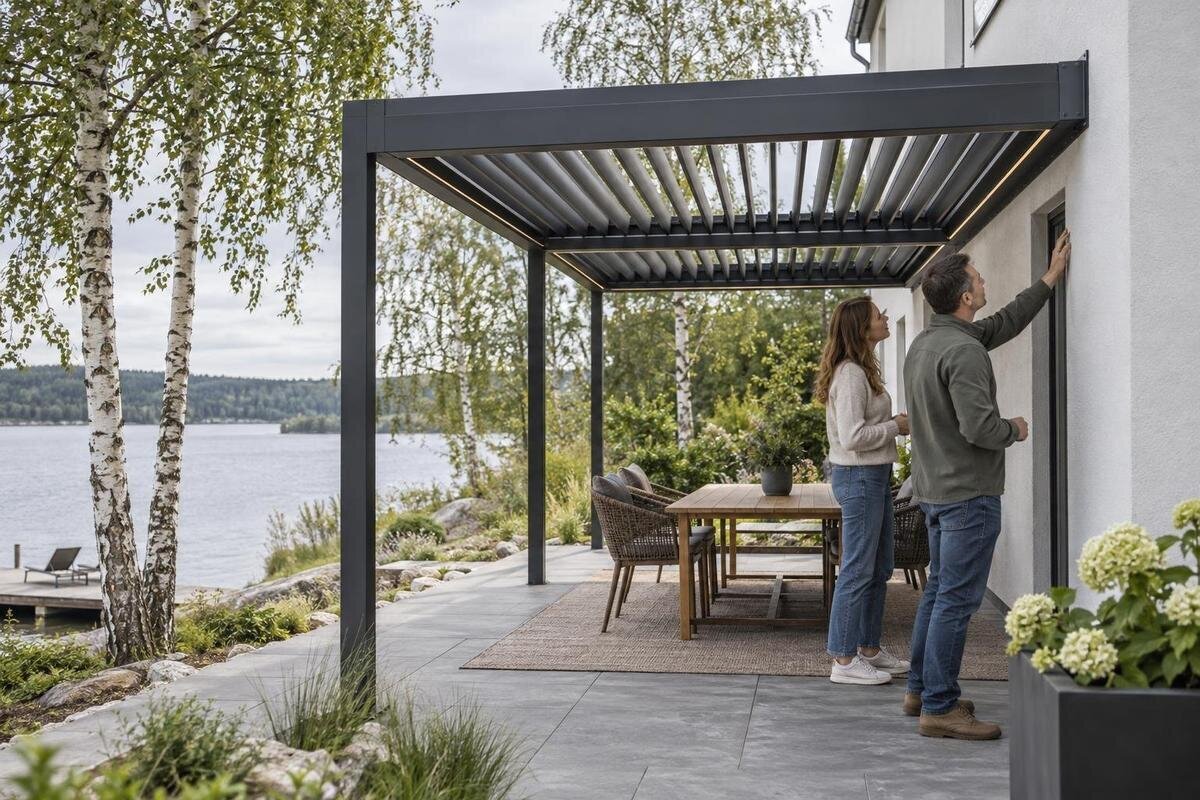
Pergola buying guide
Buying a wall-mounted pergola involves one question that a product photograph cannot answer: what will connect it to the building? The wall’s construction, condition and position all need to match the chosen model’s documented requirements. This guide focuses on the building connection before you order, so you can distinguish a visual fit from one that a qualified professional has confirmed for your outdoor space.

Why the wall connection belongs in the buying decision
With a freestanding pergola, a buyer may focus on its position and what supports it on the ground. A wall-mounted design adds a separate interface: one side of the structure has to meet the building in the way the product specifies. That changes what you need to confirm before ordering. A wall that looks solid from the patio may be covered by a finish or hidden layer that is not the structural material. The visible line of the facade does not tell you which fixings are appropriate. Treat the pergola wall connection as a match between a specific product and a specific building, not as a minor decorative detail. Also confirm that the intended position provides the uninterrupted wall area required by the model’s documentation. Changes in construction behind the facade can matter just as much as the surface finish.
Start by separating three questions: does this exact model allow a wall connection; do its documented requirements match the construction at the intended location; and can a qualified professional confirm that the building can accept the proposed connection? A yes to the first alone is not enough. A product name or photograph cannot answer the other two. If a model is on your shortlist, note its exact name from the Bloomcabin wall-pergola listing and ask for information for that model rather than relying on a general description. That keeps product identity separate from compatibility with your wall.
Identify the wall construction behind the finish
Begin with what is known about the wall behind its finish. A surface may be rendered, tiled, clad or covered by insulation; beneath it could be masonry, concrete, a framed construction or several layers. These descriptions are not interchangeable when choosing a fixing method. If you have building drawings, renovation records or details from earlier work, keep them with your buying notes. If you do not know the wall build-up, say so rather than guessing from appearance. Note any known extensions, alterations or repaired areas, since the construction may differ across one facade. The aim is to give the person assessing the connection accurate information, not to diagnose the wall’s capacity yourself.
Ask the supplier for the model’s stated mounting substrates and limitations, then have a qualified professional compare them with the actual wall. Keep the Bloomcabin pergola product page with the relevant documents as an identity reference; the page alone is not confirmation of wall compatibility. A product title may not identify suitable wall types or explain how a finish layer is treated. Flag insulation, cavities or a separate facade system early, and do not assume a longer fixing or a different anchor will resolve an incompatibility. If records are incomplete, say so before ordering.
Ask for model-specific mounting documents
Before comparing finishes or optional extras, request complete mounting information for the exact model. Ask whether the maker specifies a wall-mounted configuration, which wall constructions are accepted, what limitations apply, and which connection parts or pergola wall fixings are required. Check that the documents relate to the model and configuration you plan to order; similar names or photographs do not guarantee the same requirements. Confirm whether the information applies to the selected size and any options that affect the wall-side arrangement. If a listing leaves a point unanswered, ask for the relevant document or a written answer rather than filling the gap with a general assumption.
Keep product identity, package contents and building work as separate items in your notes. A short online description can help identify a model, but it is not a fixing schedule. When viewing the other Bloomcabin pergola listing, note the exact item name and ask which mounting documents apply; request clarification if substrate limits, fixing requirements or connection details are not stated. This helps avoid choosing on appearance alone and discovering later that the confirmed mounting requirements do not match the information available about your wall.
Check the condition at the attachment area
Even when the wall type is known, its condition at the intended location matters. Cracks, loose or bulging render, signs of ongoing moisture, or a history of repair near the proposed area may be reasons for closer assessment; none proves on its own that the wall is unsuitable. A clean surface does not prove suitability either, because some issues may be hidden. Check whether the proposed line crosses a repaired section, junction or visibly different area of the facade. Share visible signs, close-up photographs and any repair history with the professional who will assess the building. Ask whether an in-person inspection or more records are needed rather than deciding from a quick look that the area is sound.
Ask who is responsible for confirming the wall’s condition before the order moves ahead, and what that confirmation covers. A supplier can explain the product’s requirements, while an appropriately qualified building professional can assess the existing construction against the proposed connection. Do not treat a patch repair, fresh coat of render or previous use of the wall as proof. If you are considering the wall-pergola product page, keep its exact model details with the assessment; do not assume every facade can take a wall-mounted design.

Plan the position around openings and services
Sketch the intended wall-side position before committing. Note door and window openings, shutters, vents, pipes, lights, gutters and other fixed features near the proposed mounting line. The connection point specified for the model may not be freely moved just to avoid an obstacle, so any change needs to be checked rather than improvised. Include features that may be less obvious from ground level, such as external cables, sensors or access points for maintenance. Take an overall photograph and close-ups of the relevant area, and mark openings and obstructions on a simple plan. This gives the seller and qualified professional useful context, but it is not a site survey or a design for the fixing points.
Compare the connection height and projection in the model’s documentation with how you use the doorway and nearby windows. Check whether doors can open freely, handles remain accessible, and shutters or windows can still be used. Note any effect on a gutter, downpipe or access needed to maintain the facade. If that Bloomcabin pergola listing is on your shortlist, use published measurements where available; do not estimate wall-side dimensions from a photograph. Ask for missing information before treating the proposed position as settled.
Clarify water management at the wall
The wall junction also needs a clear plan for rainwater and the edge where the pergola meets the building. Ask how the particular product is intended to manage water at that edge, whether its instructions call for separate flashing or sealing, and who is responsible for the interface. Do not assume that the package includes a gutter, flashing or a weatherproof joint; these details cannot be inferred from a product name or appearance. Consider how the proposed junction meets existing facade details, rather than treating sealing as an item to add after the position is fixed. The answer should refer to the model’s instructions and the details of your facade, because an improvised seal may conceal rather than resolve a mismatch.
Ask where water is expected to go and whether that route could affect a door, window, drainage point or wall finish below. Establish who will specify the interface and who will look after any separate sealing or drainage components. If these details are not part of the pergola supply, make the division clear before ordering. To keep the discussion tied to the right item, name the Bloomcabin pergola page in your shortlist and request information for that model; do not assume different products or configurations share the same wall detail.
Include site exposure in the assessment
Site exposure belongs in the connection assessment, not only in a discussion of comfort. Wind, driving rain and the way nearby buildings or screens affect exposure vary from one position to another. A wall does not automatically make a pergola secure, and visual sturdiness is not evidence of a rated capacity or suitable connection. Seasonal changes can also alter exposure when nearby planting or temporary screens no longer provide the same shelter. Ask the supplier for any applicable model-specific limits and give the installer or structural professional details of the precise location and surroundings. They can decide what assessment is needed; do not calculate loads or choose anchors from a general online guide.
Describe the site where the pergola would stand, not just the building’s general location. Note whether the position is exposed, partly sheltered or affected by nearby obstructions, and share relevant photographs. This is context for a qualified assessment, not a way to select fixings yourself. When asking about the Bloomcabin product page on your shortlist, request any model-specific exposure limits and check whether they apply to the exact configuration you are considering. If the information is not available, record that uncertainty before paying.
Confirm what the order includes
Before paying, make clear what the pergola order covers and what is separate building work. Confirm whether wall-side components and fixings are supplied, excluded or need separate specification; never infer this from a product image. Ask who will identify the substrate, assess the attachment area, confirm the mounting approach, and deal with facade finishing or water-management details. Request that important exclusions and responsibilities are recorded with the order rather than left to an informal conversation. If installation is offered, read its scope for the specific interface and any work assigned to somebody else. The aim is to know who resolves each outstanding connection question, not to treat a product package as a complete design for the building.
Record unanswered items against the exact product: the accepted wall construction, the documents supplied, the hardware included, and any work outside the package. If a professional says the proposed connection needs separate design work or an alteration, pause until everyone is clear about who will provide it and whether it affects your choice. Use the second Bloomcabin product page as a product reference, and ask the seller to confirm the name and options on your order. An item description is not confirmation that wall fixings are included.

Compare shortlisted models on the same evidence
Create a short comparison record for each wall-mounted model you are considering. Include the exact model and configuration; its mounting documents and stated substrate limits; the known wall build-up and condition; the proposed connection location; and open questions about fixings, water management and assessment. Add the date and source of any answer, especially where a detail is still awaiting confirmation. Keep confirmed facts separate from assumptions, and mark anything still missing. This makes options easier to compare on the point that matters most here: whether each product has documented requirements that can be assessed against the building where you plan to put it.
Use the same questions for every product rather than accepting a vague promise that it can be fixed to a wall. If the information differs, ask whether the difference is a product requirement, separate building work or simply a detail not yet supplied. Compare models only when the responsible professional has enough information to assess the relevant connection; no comparison record can establish the wall’s capacity on its own. This keeps appearance and other preferences in their proper place without letting them substitute for compatibility.
Know when to pause before ordering
Pause if the wall type is unknown, the facade includes layers no one has accounted for, the proposed fixing area shows damage, or the supplier cannot provide information for the exact model. Each is a question to resolve, not an automatic reason to abandon a wall-mounted pergola. A pause is particularly useful before arranging related building work that depends on an unconfirmed connection. Ask the relevant professional what information is needed and whether the design can be assessed at the proposed position. If it cannot, you can consider another location or product type rather than pressing ahead on a guess.
Proceed when the product documents, building information and agreed work all describe the same connection. That does not mean you must design the attachment; it means you should know who is assessing it and what assumptions the purchase depends on. If the proposed connection cannot be confirmed for the specific model and building, delay the order until the uncertainty is resolved. A clear answer before buying is more useful than discovering that the product and wall require different plans after delivery.
Frequently asked questions
Is a rendered wall automatically suitable for a wall-mounted pergola?
No. Render is a finish; it does not identify the supporting wall or establish that a particular connection is suitable. Find out what the wall is made of and how it is built up, then have the requirements for the exact model checked against the actual construction by a qualified professional. Appearance alone is not confirmation.
Can existing wall fixings be reused?
Do not assume so. Existing fixings may have been chosen for a different purpose, product or wall condition. Ask for the new model’s requirements and have a qualified professional assess whether anything already in place is suitable. Reuse should be an explicit, informed decision, not a shortcut based on apparent size or strength.
Does the pergola package include flashing or sealing at the wall?
That depends on the product and the order, so check rather than assume. Ask what the model’s instructions specify for the wall junction, whether separate flashing or sealing is needed, and who will provide and maintain it. The answer should address your product and facade, not just a general product description.
What information should I provide before ordering?
Share the exact model name, photos of the intended wall area, any known building or renovation information, and details of nearby openings, drains or facade layers. Mark uncertain details as uncertain. This gives the seller useful context for product questions and helps a qualified professional assess the building without asking you to decide the fixing method.
Can a product page or photograph confirm that the pergola suits my wall?
No. A listing can identify a product and a photograph can show its appearance, but neither establishes the wall’s construction or suitability. Request the model-specific mounting information and have it checked against the actual building and proposed position. If dimensions or requirements are not stated, ask instead of estimating from an image.
A wall-mounted pergola is a considered purchase because the building forms part of its support system. Make the connection part of choosing the model: understand the wall build-up, compare it with model-specific information, and have a qualified professional assess the proposed location. Once the connection and the responsibilities for related work are clear, you can weigh the remaining design choices on their own merits. If compatibility is still uncertain, resolve that point before placing the order.
