
Buying a Pergola for a Windy Location: What to Consider
Pergola buying guide
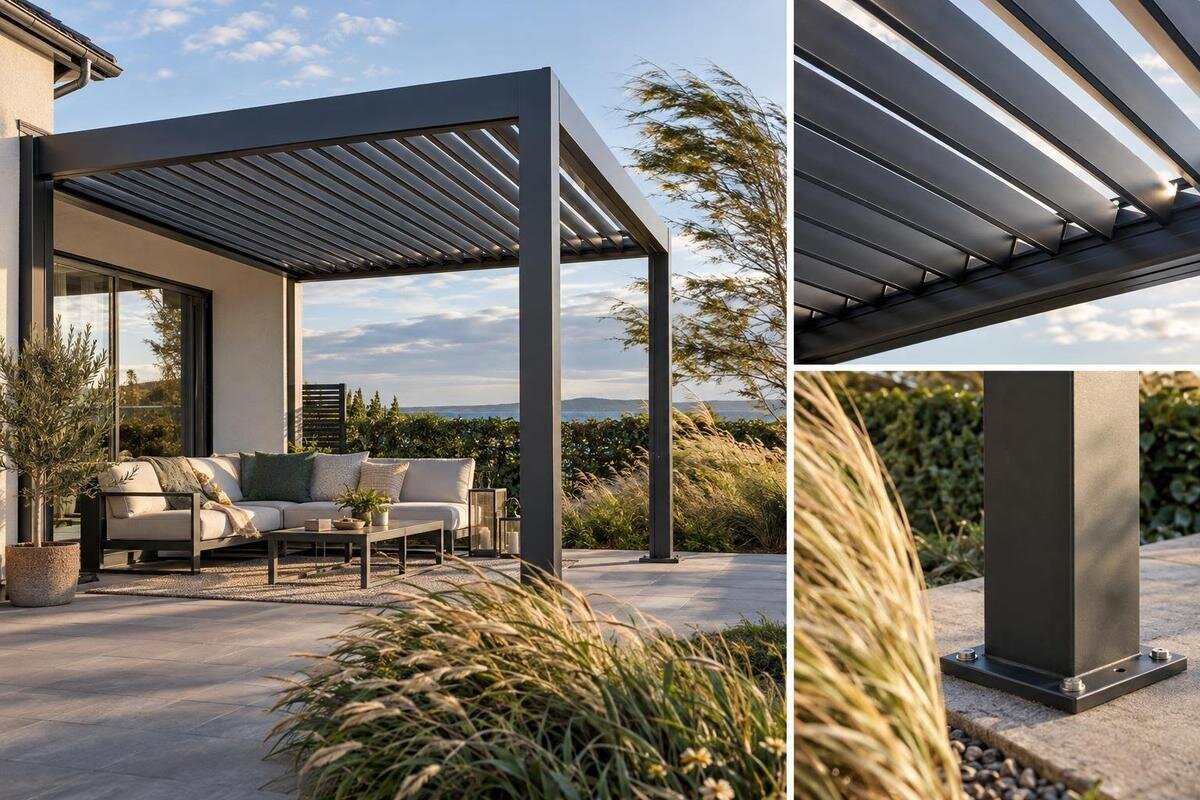
Buying a pergola for a windy location takes more than choosing a style that suits the garden. Exposure at the precise position, the complete roof and frame configuration, and the way the structure is fixed to its support all affect whether an option can be considered for that site. This guide explains what to observe, which product details to request and how to compare candidates before ordering. It treats wind as a site-specific buying question, not as a feature that can be judged from appearance alone.
Assess the exact position, not just the garden
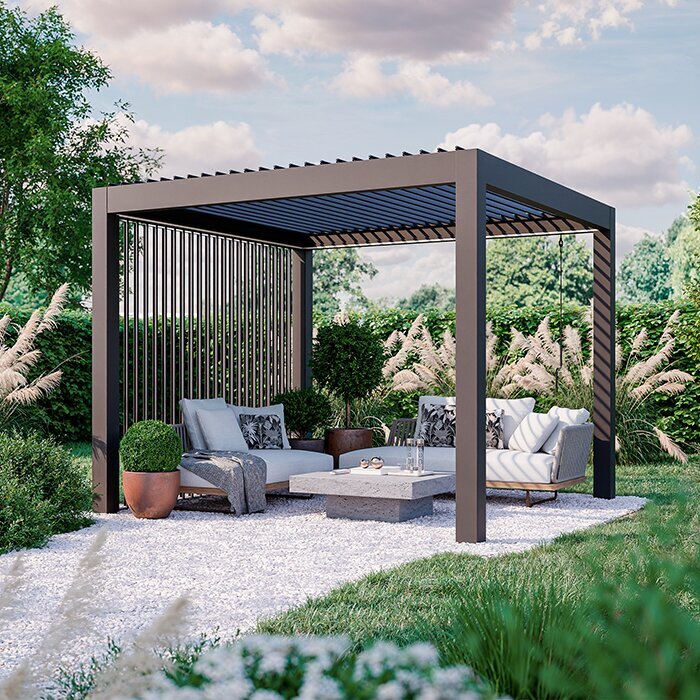
Assess the exact spot, rather than labelling the whole garden as windy or sheltered. An open boundary, a gap between buildings, a passage, a corner or a change in level can make one part of a property feel different from another. Nearby walls, fences and trees may interrupt or redirect airflow, but their presence alone does not prove that a pergola will be protected. Consider the proposed footprint, not just the view from indoors: a barrier that shelters people at ground level may not offer the same shelter at roof height.
Make a simple note or sketch before comparing products. Mark the intended footprint, nearby barriers, gaps, open edges and the direction from which you have noticed the strongest gusts. Add the routes people use and the sides you expect to keep open. This helps distinguish a sheltered-looking corner from one where airflow may be channelled through an opening. Note whether vegetation, temporary fencing or neighbouring works could change the conditions at different times of year. If the site is difficult to read because of several walls, levels or exposed edges, ask an appropriate professional to assess it. Your observations explain the location; they cannot establish a product’s wind limit.
Observe wind conditions over time
Visit the proposed spot under more than one set of conditions if practical. A calm day helps you assess access and layout, but reveals little about what happens there during gustier weather. Consider conditions you have actually experienced over time, rather than relying on one memorable storm or a single pleasant visit. If the property is new to you, separate your own observations from what others report. The aim is to notice recurring patterns and uncertainties, not to calculate a design wind speed or decide that a particular pergola will be suitable.
Record which directions seem most exposed, whether gusts arrive steadily or shift around nearby buildings, and when the area is normally used. Notice whether wind at the proposed roof level feels different from wind where people sit, and whether doors or gates create short bursts of airflow nearby. Reliable local weather information may help put your observations in context, but it cannot confirm that a particular pergola or installation is suitable. If the direction varies, include that uncertainty in your questions instead of choosing a roof or screen based on one prevailing direction. A clear description of the site helps a supplier or installer discuss whether the product information applies to the conditions you have noticed.
Fit the footprint to how you use the garden
Decide what the pergola needs to accommodate before settling on a size. Mark the proposed corners and allow for the posts, roof edge and the space needed to move around the structure. Consider paths, doors, steps and the route used to bring furniture in or out. Then check that your intended seating or dining area fits without blocking regular access. A pergola can appear to fit when viewed from indoors but feel awkward once its supports and everyday circulation are considered. This layout check helps you compare practical options without treating a larger footprint as automatically better.
Use published measurements and support positions to test each candidate against your sketch. If you want to inspect the Bloomcabin pergola listing, look for a dimensioned plan or stated measurements that let you check the proposed position; if they are not provided, request them rather than estimating from a photograph. Images can make a structure look larger or smaller than it is and do not reliably show where posts sit. Check clearance on every side that will be used, including space for chairs to be pulled out and for routine cleaning. Keep the intended use in view, too: usable space depends on the arrangement of the supports as well as the overall footprint.
Ask what a wind rating covers
Look for a stated wind-performance rating or other specific evidence for the exact model you are considering. Ask which dimensions, roof arrangement and accessories it covers, and whether there are conditions attached to the stated performance. Words such as sturdy or suitable for outdoor use do not tell you how a pergola has been assessed for an exposed position. A rating for one version should not be assumed to apply to another size or configuration. When information is unclear, ask the supplier to identify the documentation that applies to the product as ordered.
Check the units, assumptions and installation conditions behind any published figure, including the fixing arrangement it relies on. Ask whether the figure concerns the complete installed structure or only a particular version, and keep the supplier’s answer with your notes. Numbers are not useful for comparison if they refer to different configurations or conditions. Treat another Bloomcabin pergola listing by the same standard: look for model-specific information and ask whether it applies to your intended setup. If a page does not state a wind rating, that does not by itself prove the pergola is unsuitable, but it does leave an important point unverified. Avoid filling the gap with a guess based on appearance or a general sales description.

Check the roof and any side accessories
The roof arrangement is part of the wind question. A candidate may have a fixed roof, an open arrangement or moving elements; do not assume that one type is automatically better in windy conditions. Wind can interact with the top and sides of a structure, and the permitted position of any moving parts may depend on the product’s instructions. Ask which roof configurations are covered by the available performance information and whether the manufacturer gives operating limits. Do not guess that opening or closing a roof is the right response to a particular forecast.
Screens, curtains, panels and other optional additions can change how exposed the pergola is, so confirm compatibility and any use restrictions for each accessory. Include accessories you may add later in your questions, because the relevant information may differ from that for the bare frame. Check whether the product information covers the complete combination you want, not just the frame on its own. The separate Bloomcabin pergola page is another listing to examine for clear details on the product and any stated options; the name or image alone cannot confirm that a particular accessory combination suits a windy site. Keep accessories in your comparison from the outset rather than treating them as an afterthought.
Treat anchoring as part of product selection
A pergola’s frame is only part of the installation: its joints, posts, fixings and supporting base all matter to the complete arrangement. Ask what fixing method is specified for the exact model and configuration, which types of support it is intended for, and whether the necessary fixings are included or listed separately. Request any relevant mounting instructions or drawings before deciding. Do not assume that a fixing method shown for one surface can be adapted to another, or that hardware visible in a product image is part of the order.
Give the supplier’s fixing requirements to a qualified installer so they can compare them with the actual site. Provide the exact product version, proposed post locations and any available documentation rather than relying on a verbal description of the pergola. A general statement that a pergola can be secured is not enough to establish that its requirements match your location. When reviewing the Bloomcabin pergola product page, use any product-specific fixing information as a point to confirm for your planned installation, not as permission to improvise or substitute hardware. If the details are unavailable or unclear, resolve that before ordering rather than leaving the fixing decision until the structure arrives.
Confirm the supporting surface and attachment point
Establish what will support each post before committing to a pergola. A visible surface does not necessarily show what lies beneath it, and different bases may need different fixing arrangements. Do not assume that a surface that looks solid is compatible with the product’s specified requirements, or that an older base is suitable simply because it has supported other items. If the installation involves attaching the structure to a building, the wall and proposed attachment point also need an appropriate assessment; proximity to a wall is not proof that it can support the planned installation.
Ask a qualified installer or relevant professional to assess the actual support, post positions and any site constraints against the product documentation. Explain what you know about the base and mention relevant restrictions or uncertainty, such as visible joints, drainage features or areas that cannot be disturbed. You can include the other Bloomcabin pergola product page in that discussion if its requirements are available, but a listing cannot confirm that your particular surface or attachment point is suitable. This is a site-specific check, not a reason to guess at a fixing method or to carry out structural calculations yourself. Record any required preparation before comparing installation quotations.
Separate material choice from wind performance
A material name or heavier-looking frame is not a wind rating. Ask what materials and finishes are specified, how the product’s information describes its construction, and whether any stated performance applies to the complete structure and its required fixings. The frame, connections and support arrangement work together; choosing on appearance alone may leave important details unanswered. For a distinct Bloomcabin pergola listing, look for the information it actually provides about the product rather than reading wind performance into its name or finish. If details are absent, ask the supplier rather than filling them in yourself.
Consider ongoing care as well as the initial choice. Ask for the manufacturer’s maintenance guidance, including any checks recommended for connections or moving parts, and whether components have particular care requirements. Clarify who is expected to carry out those checks and whether any instructions apply before or after periods of severe weather. Do not assume that every material, finish or mechanism has the same upkeep. Clear care information helps you understand what ownership involves, but it does not replace evidence that the chosen configuration is suitable for the site. Keep those questions separate when comparing products: one option may be easier to maintain, while its wind performance still needs to be verified independently.
Compare like for like, including the full quote
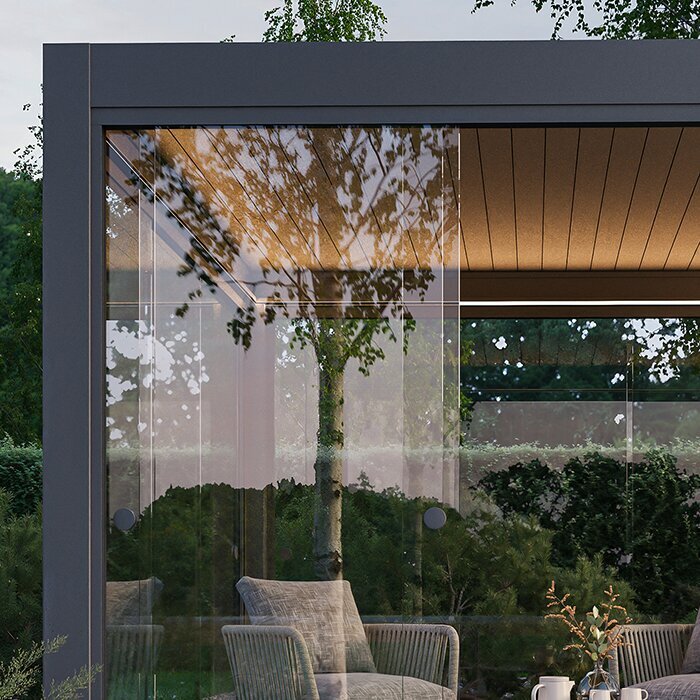
Make a shortlist using the same questions for every option: overall dimensions, support positions, roof configuration, stated wind performance and the conditions behind it, fixing requirements, included parts and optional accessories. Record any missing information instead of assuming it is the same across models. This gives you a clearer comparison than a general description or a collection of photographs. If two products have different roof or accessory configurations, compare the information for the versions you would actually order, rather than treating them as equivalent because they share a broad product category.
Ask for a clear quotation and establish what it covers, including the product configuration, selected accessories, fixings and any installation or site preparation if those are quoted separately. Identify any item that remains to be selected or confirmed, since this can affect whether two quotations describe comparable installations. This makes it easier to compare the full scope rather than just headline figures. For the separate product listing for a Bloomcabin pergola, assess only the details it actually states and ask for missing information before placing it beside another option in your comparison. Keep written answers with the quotation so that the product and installation requirements are not confused later.
Final checks before placing the order
Before ordering, confirm the exact product and configuration, the dimensions and support positions, the accessories you want and the fixing requirements that apply. Share a sketch or photographs of the intended site with the relevant supplier or installer, while recognising that images cannot replace an inspection where one is needed. Check that the product description and quotation match the version discussed, and that no important assumption about the base, roof position or optional screens has been left unresolved. Written confirmation is useful when several details have been discussed across different conversations.
If the available information does not establish how the pergola is intended to be supported or what wind conditions it covers, pause and ask for clarification or a qualified site assessment. Check that any response relates to the selected configuration rather than a broad range of pergolas. Revisit the listed Bloomcabin pergola page with those questions, but do not treat a product page as proof of site suitability. If the fit cannot be verified, consider a different option with clearer applicable information or defer the purchase. The aim is to order a complete, understood configuration—not simply a style that looks right in the proposed position.
Frequently asked questions
Can a product photo show whether a pergola is wind-resistant?
No. A photograph can show appearance, but not a wind rating, the conditions that rating covers or the fixing arrangement it assumes. Look for written, product-specific information and ask the supplier if the relevant details are missing.
Does a heavier-looking frame mean it will suit an exposed spot?
Not by itself. Appearance and material do not confirm how the complete structure performs, including its joints, posts and fixings. Compare documented information for the full configuration rather than judging suitability by weight or finish.
Will adding a privacy screen make the pergola more sheltered?
Do not assume so. Screens and other side accessories change how wind interacts with the structure. Check that each accessory is approved for the exact pergola and ask what operating or use limits apply in windy conditions.
Can I judge anchoring from the visible ground surface?
No. The surface may not reveal what is beneath it or whether it suits the product’s specified fixings. Have a qualified installer assess the actual support and compare it with the requirements for the exact pergola configuration.
What if the product page gives no wind rating?
Ask the supplier for written information on wind performance, the configuration it applies to and its fixing requirements. The absence of a rating does not prove the product is unsuitable, but it leaves an important point unverified. Do not rely on a general reassurance instead.
A sound purchase decision brings together the exposure at the exact location, documented information for the chosen configuration and a fixing plan that suits the real support beneath it. Observe the site, compare options on the same basis and resolve uncertainties before ordering. That way, a pergola is chosen for both the way the garden will be used and the conditions the product is documented to meet.
