
Buying a Pergola for Rain Protection: Roof and Drainage Limits
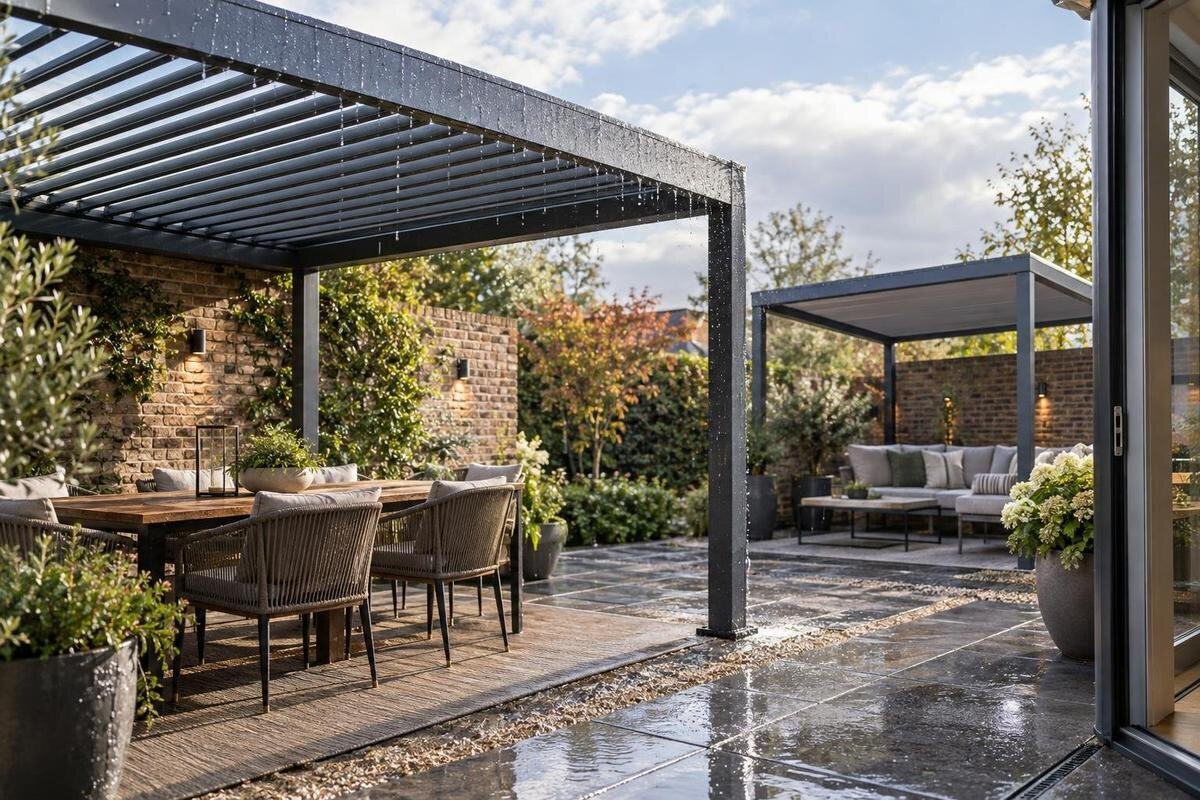
Pergola buying guide
Choosing a pergola for rain protection is not just a matter of selecting a roof that looks solid. The useful shelter depends on roof coverage, how water leaves its edges, how much wind-driven rain can enter at the sides, and whether the installation fits the space. This guide explains what to compare in product information, which limits to expect, and what to clarify before placing an order.
01
Define the rain protection you need
Before you buy a pergola for rain protection, define what you want to keep dry. It might be the table and chairs during a brief shower, furniture that stays outside, or a clear route between a doorway and a seating area. Those uses set different expectations. Consider how long the area needs to remain usable after rain starts, whether cushions can be moved indoors, and whether a wet threshold would cause inconvenience. A roof can intercept rain from above while wind pushes it under the edges, so a sheltered space is not automatically dry in every shower. Note what must remain usable and whether you need occasional cover or a space you expect to use through changing weather. This makes comparisons more realistic than choosing from a photograph alone.
Set a practical boundary for the decision as well. If your priority is keeping belongings dry while no one is present, verify that the roof is intended for that use and what the maker says about the relevant weather conditions. If you mainly want somewhere to sit while a shower passes, you may accept occasional spray at the sides or runoff near the perimeter. Note this distinction before browsing, so a product that offers partial cover is not judged against a different expectation later. For any candidate, use the Bloomcabin pergola product page to inspect the published description; its name alone cannot establish how much rain it keeps out.
Compare roof designs by how they handle rain
The roof is the first feature to examine, but broad labels can conceal important differences. An open-slat roof lets some rain through; a roof with movable sections depends on their shape, closing position and the way the joints meet; a continuous covering can still direct water towards unprotected edges. These are general design distinctions, not guarantees about a particular model. Ask for a drawing or description showing the roof in the position intended for rain, and check whether the maker describes it as water-resistant, rain-shedding or waterproof. Read those terms as written rather than treating them as interchangeable, and ask for clarification if the wording is unclear.
Where the roof opens or adjusts, establish what happens in each position and what the instructions say when rain is forecast or begins. Some systems have use limitations that depend on the position or the weather; do not assume an adjustable roof can simply remain partly open during rainfall. Also ask whether roof elements or seals are included in the configuration you are considering, or whether a particular accessory is needed. The Bloomcabin bioclimatic pergola page is one listing to assess by its own stated details, rather than by the word bioclimatic alone. If the information is missing, request a written answer for the exact version.
02
Separate roof coverage from the dry area
Roof coverage and usable dry area are not the same measurement. A product’s overall footprint may include posts or frame edges, while the roof itself defines the area that intercepts rain from above. Compare the stated width and depth of the roof with the area you want to cover, and note whether the measurements refer to outside edges, supporting posts or another reference point. If a plan or diagram is available, check where each measurement begins and ends. Do not estimate from a perspective photograph, which can make an overhang or covered area appear larger or smaller than it is.
Allow for the path water takes beyond the roof perimeter. Rain can fall or drip close to posts, and a breeze can carry it beyond the overhead area, so a table placed at the edge may be less sheltered than one nearer the centre. Think about the space needed to pull chairs back, serve food or walk around the table without stepping into runoff at the edge. Consider doors, steps, stored items and the path to a seat when deciding where the covered area needs to be. The Bloomcabin wall-pergola page can be assessed against its stated dimensions and layout notes; the name or image alone cannot confirm a particular projection or rain-covered zone. Mark the intended footprint on a simple site plan before comparing sizes.
Inspect joints, edges and overhangs
Rain protection also depends on the details where roof sections meet and where the roof finishes. Overlaps, seals, channels and edge profiles can affect whether water is guided away, drips along a particular line or escapes through a joint. Their presence and design vary by product, so do not assume that a roof shown as closed has sealed joints. Look for close-up diagrams, written descriptions and the maker’s guidance on the closed position. If the page only shows the roof from a distance, ask what happens at the joints and perimeter in the configuration you are considering.
Check the relationship between the roof edge and your layout too. A generous overhead area may still direct water towards an entrance, furniture or a narrow walkway. Ask whether the roof-edge components are part of the selected model and how the product description defines its rain protection. When reviewing the Bloomcabin pergola listing, apply the same questions rather than inferring sealed joints from a clean product image. A precise description of the roof edge is more useful than a broad category label, particularly if you plan to leave outdoor items beneath the pergola.

03
Trace the drainage route
A roof needs a route for the water it collects. Check whether the proposed system includes gutters, channels or downpipes, whether these are built into the roof or offered separately, and where water is intended to leave the structure. Do not assume every pergola includes drainage simply because it has a roof. Ask for the full configuration list, including any parts needed to complete the route from roof edge to outlet. Establish whether the outlet position is fixed by the design or can be selected, as this can affect how the pergola sits within your layout. If a component is optional, confirm that it is compatible with the model and included in the order you are considering. It is also worth asking what maintenance the drainage arrangement requires.
Then consider the discharge point on your site. Water released beside a doorway, on steps or onto a small paved area can be inconvenient even if the roof sheds rain as intended; runoff may also collect where the ground does not drain away. Make clear where a gutter outlet can lead and whether that route suits your paving, planting and access. For the bioclimatic pergola listing, check its own information for drainage components and limitations; do not infer them from the model name. If the route affects a wall, existing drainage or neighbouring space, ask a qualified installer for practical advice.
Check the proposed position against the site
Before ordering, compare the intended position with the shape of the terrace or patio. Mark the posts, roof perimeter, nearby doors, steps, windows, walls and fixed furniture, then consider how rain normally moves across the area. This is a planning check, not an installation drawing: it helps reveal whether a roof edge or likely water outlet would sit above a threshold, a narrow route or a spot where people gather. If the pergola will connect to a building, note the wall surface and ask what the product’s installation information requires. Do not assume every wall or fixing arrangement is suitable.
Drainage and support questions can be linked: a convenient place for posts may not leave a sensible path for collected water, while a useful outlet location does not prove that the structure can be installed there. Compare the wall-pergola product listing with the actual site and the manufacturer’s installation requirements; the listing is not proof that a particular wall is appropriate. Have a qualified installer assess uncertain attachment, surface or water-routing issues before ordering. This is especially important where the proposal depends on existing building details or on directing runoff into an existing drainage arrangement.
04
Allow for wind-driven rain at the sides
Rain does not always fall vertically. When wind drives it across an open side, a roof may cover the area above while leaving chairs, cushions or the approach to the seating space exposed. Think about the direction from which rain reaches your site, whether the pergola is beside a wall or in a more open area, and how often the open sides matter in use. Observe where rain reaches the terrace during ordinary showers, rather than basing the decision only on the direction of prevailing sunshine. The aim is not to predict every shower, but to avoid assuming that overhead coverage protects the whole footprint. If side exposure is important to you, treat it as a separate point to check when comparing models.
Do not count side screens, curtains or other add-ons as a complete solution unless the exact arrangement is described for the weather you expect. Side products can change how exposed a space feels, but their presence alone does not establish a rain rating or suitable conditions for use. If the product information distinguishes between overhead protection and side protection, keep that distinction in mind. When reviewing the the Bloomcabin pergola model page, check whether the published information addresses rain entering from the sides. If it does not, treat the point as unresolved rather than filling the gap with an assumption.
Read the product’s rain-use information
Product information should answer more than whether the roof opens or closes. Look for dimensions, roof construction details where supplied, the conditions covered by any rain claim, drainage components, operating limits and care instructions. Ask whether the information applies to the complete system, including the selected roof and optional parts, or only to one element. If the maker gives a limitation, such as a requirement to use a certain roof position, include it in your decision. A general statement that a pergola is suitable for outdoor use is not the same as specific information about how it handles rain.
Keep a note of unanswered questions and seek answers before ordering, rather than arranging the site around an assumption. For an adjustable or retractable roof, that might mean confirming how it should be positioned in rainfall; for drainage, it means identifying the included components and discharge arrangement. Judge the Bloomcabin bioclimatic pergola listing on the published details for the exact item, just like any other option. If the answer depends on the installation site or structural support, ask an appropriately qualified professional to assess it; a product name or image cannot establish suitability.
05
Confirm what the order includes
A product page may not show every item needed for a finished installation in one place. Before committing, check what is included, which items are optional, whether the roof and drainage parts belong to the same configuration, and whether assembly or an installation service is part of the order. Confirm the selected dimensions and version on the order details, since a general image can illustrate a range rather than the exact combination. Ask how care, cleaning and operating instructions are provided, especially if you expect to use the roof during wet weather.
Make a simple comparison for each candidate: stated roof coverage, rain-use guidance, edge or joint information, drainage route, side exposure, installation requirements and unresolved questions. Note whether each point is documented, needs confirmation or does not suit your site. Keep copies of the product information and any written answers alongside this comparison, so it remains clear which configuration each answer concerns. If a specification, accessory or fitting is essential to the result, get confirmation for the exact version you intend to order rather than relying on a verbal shorthand such as all-weather or waterproof. That keeps the comparison focused on the configuration you will actually receive, not a general impression created by a product photograph.
Match the choice to the shelter you expect
Use the evidence to decide whether a pergola meets your actual threshold for shelter. A model with a roof that intercepts rain may still leave the outer part of the area exposed, allow water through joints or rely on a drainage route that does not fit the site. Those limits matter if the purpose is to keep furniture, a doorway or a seating zone dry for a particular use. If an essential feature cannot be verified, request clarification or compare another pergola configuration; do not quietly lower the requirement once a style has caught your eye.
Before ordering, record the exact product version, roof arrangement, dimensions and drainage parts discussed, and make sure any answer relates to that selection. Confirm which unanswered points need a site assessment, especially support and water discharge. A clear view of roof boundaries, side exposure and the runoff path helps set realistic expectations: if the available information supports partial shelter, plan for partial shelter. The choice should reflect what the product is documented to do, rather than a broad impression created by its name or image.
Frequently asked questions
Will a pergola keep the area dry in every shower?
Not necessarily. A roof can reduce direct rainfall, but joints, edge runoff and rain entering from open sides still affect the shelter. Check the exact model’s rain guidance and drainage details before treating it as full weather protection.
Are bioclimatic pergolas waterproof?
The word “bioclimatic” does not confirm that a particular model is waterproof. Check how its roof is designed to handle rain, which position is intended for wet weather, and what limits the manufacturer states.
Does a roofed pergola always include gutters?
No. Gutters, channels and downpipes may be included, optional or not specified. Confirm which drainage parts belong to the exact configuration and where the water is intended to discharge.
Does the roof size tell me how much space will stay dry?
It helps define the overhead coverage, but it does not guarantee a dry area. Wind can carry rain under the edges, and water may drip near the perimeter. Compare the roof dimensions with your layout and expected use.
What should I confirm before ordering a pergola for rain protection?
Confirm the exact roof configuration, its stated rain-use limits, the covered dimensions, included drainage parts and the intended discharge route. Also check installation requirements and seek qualified advice if site conditions affect support or drainage.
Rain protection from a pergola depends on a chain of details: roof coverage, joints and edges, drainage, and the conditions around the site. Compare the exact configuration and written guidance with the area you want to use, and allow for exposure at open sides. Where performance or installation depends on site conditions, seek clarification before ordering. A choice based on documented limits gives you a more realistic expectation of the shelter the pergola can provide.
