
Can a Ceiling Fan Be Installed Under a Pergola?
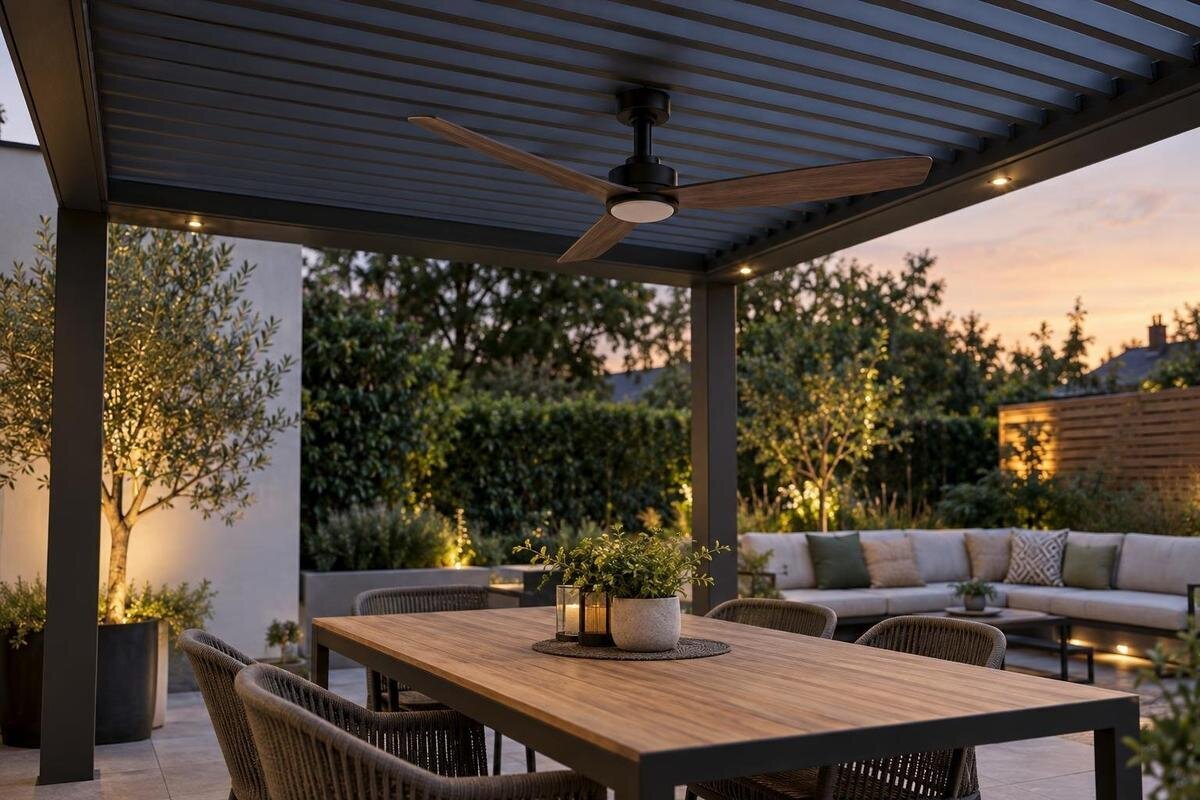
Pergola planning
A ceiling fan can be fitted under a pergola only when the exact frame, fixing point and fan are approved for that arrangement. A roof that leaves enough headroom is not automatically designed to carry a motorised, rotating load. Before choosing a fan, check structural approval, blade and roof clearances, outdoor-use instructions and a qualified electrician’s plan. This guide explains what to ask for and when to consider another arrangement.

01
When a ceiling fan is compatible with a pergola
A ceiling fan may be possible under some pergolas, but the word “pergola” is not an approval. A fan is suspended equipment with a rotating motor and blades; it is not equivalent to a small light or decorative fitting. The frame must be expressly suitable for the forces from the exact fan, with a permitted fixing point and an approved connection. A beam that looks substantial, a sheltered position or a fan that physically fits below the roof proves none of those things. Catalogue photographs can show appearance and layout, not structural capacity. The Bloomcabin Pergola is a named product option, not evidence on its own that a ceiling fan is approved. The assessment needs to match the roof and frame actually selected, not just the range name.
Treat compatibility as three separate checks: the pergola can carry the fan; the fan has safe clearance from people and every fixed or moving part; and the equipment and electrical installation suit the exposure. All three must be confirmed for the selected configuration and fan model. Approval for a different fan, bracket or roof variant may not apply, even if the items look similar. If either manual rules out suspended equipment or does not cover the proposed arrangement, do not infer permission from an indoor installation or a similar-looking structure. Ask the pergola manufacturer or a suitably qualified structural professional to assess the exact combination. In practical terms, “possible” means documented approval, not simply a bracket that can be made to fit.
Why a fan needs dynamic-load approval
A fan is not just a fixed weight hanging overhead. Its mass is present continuously, while motor operation, starting and stopping, and vibration create changing forces. The bracket passes those forces into a particular part of the pergola and then through its joints and supports. A general load figure for the structure may refer to a different direction or purpose, so do not treat it as a fan rating or calculate an allowance from the fan’s weight. Wind can also influence equipment in an open-sided setting. The exact fan, attachment and installation conditions matter, not only the fan’s indoor specifications.
Ask for written, model-specific confirmation that the selected pergola configuration accepts the exact fan, or a clearly defined fan specification that includes it. The answer should identify the permitted fixing position and mounting method, and make clear that the assessment covers dynamic loading rather than static weight alone. For a Bloomcabin Bioclimatic Pergola, quote the full model and configuration in your request; the product name itself does not establish a fan-load allowance. If a standard approval is not available, a qualified structural professional may need to assess the arrangement using reliable manufacturer information. If nobody can confirm the fixing and load path, treat the installation as unapproved rather than asking an installer to improvise.
02
Which pergola parts can support a fan?
Approval applies to a fixing point, not merely to a whole product. A roof edge, trim, gutter, decorative cross-member or roof blade may be visible and accessible without being a permitted fan support. Even a bracket that fits a beam does not prove that the beam, its joints, posts and base can carry repeated forces. The product instructions or project drawings should identify the authorised support location and attachment. If you are considering a wall-mounted arrangement, the Bloomcabin Wall Pergola is a model reference only; the wall connection or another frame member still needs separate approval for a fan.
Do not choose a location by tapping the frame, judging its apparent thickness, copying another installation or asking a general installer to pick a convenient spot. Drilling, clamping or altering a member can affect its finish, drainage, movement or structural role. Ask the pergola manufacturer whether the proposed change is permitted and what documentation applies before any work is planned. Give the person assessing the support the full fan model, its supplied bracket and its installation manual. If a separate support is proposed, it needs its own appropriate design and professional confirmation, including how it relates to the pergola and site. Avoiding the roof does not automatically make an alternative support suitable.
How to check blade and headroom clearances
Clearance has to be measured for the fan’s actual diameter, blade shape and hanging length, not estimated from the pergola footprint. Check the lowest point against the fan maker’s headroom requirement, then consider the blades’ full sweep relative to posts, beams, walls, lighting and other equipment. Ask for the distances specified for the exact fan and mounting arrangement, including clearances from the ceiling, floor, walls and nearby objects. A generic diagram or another fan’s instructions is not a safe substitute. When discussing a Regular Bloomcabin Pergola configuration, request layout information for that exact model; its product category alone cannot establish the blade clearance.
Map the occupied area as well as the empty space above it. Include where people stand, sit or walk, chair backs when pulled out, doors and windows when open, and the route between the terrace and house. A fan that clears a table might still hang over a passage or interfere with a light, screen or curtain. Include access for cleaning and maintenance, so nobody needs to reach awkwardly around the blades or stand on unstable furniture. A measured plan showing the fan sweep, roof supports and furniture is more useful than a single floor-to-roof measurement. It can reveal that a seemingly central position is not the safest or most practical one.

03
Clearance from louvres and other moving roof parts
Where the roof has moving parts, clearance must be checked through their full operating range, not only in the most open or closed position. Louvres, retractable panels or other mechanisms may change angle, occupy space or need access as they move. The fan blades, stem and mounting hardware must remain clear, and nothing should obstruct the mechanism or its service points. For a Bloomcabin Bioclimatic Pergola configuration, obtain the exact roof instructions and confirm how the proposed fan position relates to every roof position.
Ask the manufacturer or installer to confirm the relationship with the fan fixed in its intended position and the roof operated as specified. Do not rely on switching the fan off before operating the roof: a stationary fan still occupies the same space, and a moving roof can cause a collision. Nor should the mechanism be disabled or its use restricted informally to make the fan fit. Check that the location leaves access for servicing both systems. If the roof and fan cannot be approved to operate without interference, choose a different location or airflow arrangement rather than accepting a compromise clearance.
Choosing a fan for outdoor exposure
An outdoor-rated label is not a blanket promise that a fan can sit in any exposed position. Read the manufacturer’s instructions for the exact product’s permitted location and exposure, including whether it is intended for a covered, damp or directly exposed setting. A pergola may have open sides, so wind-driven rain, humidity, dust and airborne salt can reach equipment that feels sheltered at seating level. Check that the motor, controller, remote and any accessory, such as a light kit if fitted, are all suitable for that environment. An outdoor mark on one component may not cover the complete assembly.
Read any ingress-protection or environmental rating alongside the installation and maintenance conditions. A rating does not show whether the pergola can carry the fan, and the word “outdoor” does not settle every exposure question. If the manual limits use to a dry or covered location, compare that wording with the actual site and how weather reaches the ceiling from the sides. Ask the fan supplier or manufacturer to confirm the intended setting in writing where the limits are unclear. Also check cleaning and corrosion guidance for the location. Weather suitability and structural approval are independent checks, and neither can replace the other.
04
What an electrician needs to check
Bring a qualified electrician into the decision before the fan is ordered or mounted. Give them the exact fan manual, proposed position and pergola documentation, then ask them to review the supply, controls, circuit protection, cable route and accessories for this specific installation. The route needs to be coordinated with roof movement, water paths and structural fixing points, rather than chosen after the fan is in place. Do not assume that a motorised roof, lighting provision or an existing outdoor socket automatically makes the fan connection suitable; those items may have their own requirements and controls. The electrician can confirm what is appropriate for the site and the applicable local requirements.
Discuss how the fan will be operated, whether a wall control or remote is practical, how it will be switched off for service, and whether its controls could be confused with those for the roof or lighting. These are planning questions, not DIY wiring tasks; the electrician must decide the installation method and protective measures. If a wall-mounted option is being considered, identify the exact wall-mounted Bloomcabin Pergola model in the layout discussion so the electrician can assess the proposed cable route alongside the structure's connection to the house. Ask the electrician to coordinate with the pergola supplier so the final plan remains compatible with the approved structure and roof operation.
Planning the fan into a new or existing pergola
For a new pergola, make fan compatibility part of configuration planning before the frame, roof, lighting and furniture positions are finalised. Give the supplier the exact fan model and installation manual, or ask which approved fan specification can be accommodated. Request the permitted location, attachment detail, any usage limits and a plan or written note showing the fan in relation to the roof. If you are evaluating a Bloomcabin Pergola model, ask for the answer against the selected configuration, with the proposed lighting and furniture positions shown on the same plan. Early confirmation can prevent choosing a fan that later proves too exposed or impossible to mount.
For an existing pergola, gather the product identification, installation paperwork and records of later changes. Take useful photographs and measurements for the manufacturer or professional, but do not remove covers or alter parts to inspect a fixing. State the intended fan, bracket, roof positions and weather exposure; missing paperwork is not proof that a support is adequate. Ask whether the proposed work affects the structure, finish, drainage, operation or any warranty terms, and whether access for future maintenance remains available. If the model or its history cannot be established, a qualified professional may need to inspect it before a fan is chosen.

05
Will a ceiling fan provide useful airflow?
A ceiling fan is useful only if its airflow suits the way the area is used. A pergola is open-sided, so moving air can disperse and outdoor breezes may change the effect; a room-size guide or indoor performance claim does not automatically translate to this setting. Check whether the manufacturer gives guidance for covered outdoor spaces and choose a position based on the seating or activity zone, while keeping all clearance and support rules intact. A fan moves air; it does not lower the outdoor air temperature. Avoid buying on blade diameter or canopy area alone if the manufacturer does not approve that fan for the location.
If a ceiling mount cannot be documented, a floor-standing appliance avoids placing its weight on the pergola, but it still needs approval for the intended outdoor exposure and a position where it will not block circulation or be knocked over. A wall-mounted fan still requires suitable, verified support and a weather rating; it is not a shortcut around structural checks. You may also decide that the area’s natural airflow is sufficient. Compare alternatives against the actual use, power access and storage needs, but do not trade an unresolved overhead risk for an unverified attachment elsewhere.
What to confirm before ordering
Before paying for the fan, assemble four items: the pergola make, model and configuration with its installation documents; the fan model and full manual; written confirmation of the approved fixing point and dynamic-load allowance; and a measured plan showing blade sweep, roof positions, furniture and user routes. For the bioclimatic pergola option, include the selected roof configuration in this brief so the assessment covers its moving parts. This shared brief helps the manufacturer, installer and structural professional assess the same fan and position instead of making assumptions from different product descriptions.
Obtain separate answers on structural support, clearance, outdoor suitability and electrical work, because approval in one area does not cover the others. If any part changes—the fan, bracket, location, roof configuration or accessory—ask whether the previous confirmation still applies. Keep the written response and manuals with the project records, and agree who will carry out installation and future maintenance. A clear refusal is useful: it avoids spending on a fan with no approved mounting position. Proceed only when each responsible person has confirmed the part they are qualified to assess.
Frequently asked questions
Can I attach a ceiling fan to pergola louvres?
Only if the pergola manufacturer expressly approves that fixing point and fan arrangement. A louvre may move as part of the roof and should not be assumed to support suspended equipment. Check the instructions for the exact pergola configuration and fan before considering installation.
Does an outdoor-rated fan automatically suit a pergola?
No. The rating and manual need to match the exposure at the actual site, including whether the fan is under cover or may receive wind-driven rain, humidity or airborne salt. Outdoor suitability also says nothing about whether the pergola can carry the fan.
Is a fan’s weight enough to check its load?
No. The support must be approved for the exact fan and the changing forces associated with its operation, as well as its weight. A general pergola load figure or an estimate based on the fan’s weight is not a dynamic-load approval.
How much clearance should there be around the blades?
Use the clearances in the exact fan’s manual and check them against the pergola, roof movement, nearby fittings and the areas people use. There is no universal measurement that can be applied to every fan and pergola.
Who should confirm whether installation is suitable?
Ask the pergola manufacturer or a suitably qualified structural professional to confirm the fixing and load approval. A qualified electrician should assess the electrical plan and the fan’s outdoor suitability. These are separate checks, and one does not replace the other.
A ceiling fan under a pergola is compatible only when the exact frame and fixing point are approved for its dynamic load, the blades clear occupants and moving roof parts, and the fan and electrical provision suit the exposure. Headroom and a seemingly strong beam are not enough. If the documents cannot confirm all of those conditions, choose another airflow arrangement rather than adapting the pergola by guesswork.
