
Choosing Manual or Motorised Pergola Louvres for Your Routine
Pergola operating guide
Choosing between manual and motorised pergola louvres is less about which option sounds more advanced than about how you use the space. A roof adjusted only occasionally makes different demands from one changed repeatedly during a meal, throughout a working day or by several people. Consider how often you expect to move the louvres, whether you can reach the control without awkward movement, and whether power can be provided for the exact model. Do not infer a motor, remote, sensor or automatic function from a product name alone.
How manual and motorised louvres work
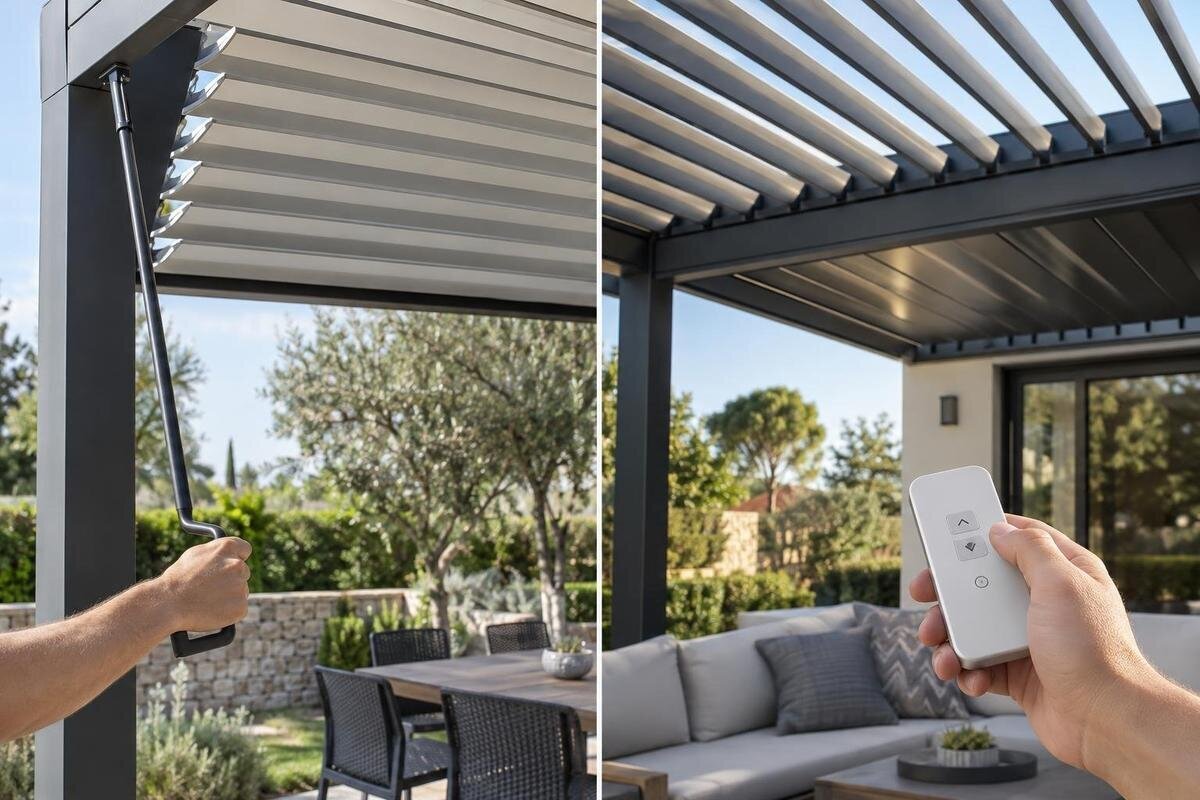
Both arrangements alter the louvre angle, but the way you operate them differs. With manual operation, you move a handle, crank or another mechanical control, and the mechanism transfers that input to the blades. The actual control and movement differ by design, so do not assume a particular handle, direction of travel or number of turns. You need a clear approach to the operating point and enough space to use it without reaching across a table, chair or person. If your usual seating position makes the control hard to reach, the roof may be adjusted less often than you expect. Think about whether you would need to stand, move furniture or ask someone else to operate it; these small interruptions matter more if adjustments are part of your everyday use.
Motorised operation uses a powered drive to move the louvres from a control interface. It can remove the physical turning effort for each adjustment, but brings an actuator, a power requirement and controls that must be accessible and understood. The word motorised describes what drives the movement; it does not tell you whether the control is a fixed switch, remote, app or anything else. Nor does it mean the roof reacts automatically to sun or rain. In either arrangement, the actual mechanism and its operating instructions define which positions are available and how you can reach them. A useful comparison includes the action the user performs, not just a label in a brochure.
How often will you adjust the louvres?
Count adjustments, not just days spent under the pergola. For one typical week, note when you would change the louvres: perhaps before sitting outside, when the sun moves, when people come and go, or when you want a different balance of shade and open sky. The point is not to predict every change in weather; it is to see whether you expect one setting to last for hours or several small corrections during a visit. Also consider who will notice the need to adjust and whether the same person will be there to operate the roof. A routine with rare changes can make a direct mechanical control perfectly workable; frequent changes make effort and convenience more important.
Keep that note beside the technical information when comparing products. For a model such as the one identified in the Bloomcabin Pergola product listing, use your weekly pattern to frame a practical enquiry: how is the roof moved, how many user actions are involved, and what must be available each time? Ask how you would make a small adjustment as well as move between the available end positions. The answer should relate to the selected size and configuration. This makes it easier to compare the effort involved in occasional use with the convenience you would want for repeated adjustments.
Can you reach the operating control comfortably?
Reach depends on the planned layout, not just the height of the roof. Mark where a person is likely to sit, stand or walk, then ask where the manual control will be placed and how it is approached. A handle near a boundary may be easy to use when the perimeter is clear but awkward beside a fixed bench, planting or a dining table. Allow for the full movement needed at the control, not merely the spot where a hand can touch it. If normal operation involves stepping around chairs or leaning over furniture, that inconvenience may discourage small adjustments. Check the route in the layout you will actually use, with furniture in position.
A motorised system may reduce the need to reach the roof mechanism, yet its controls still need to be accessible and easy to use. A wall switch, handset or other control has different access considerations; ask which one comes with the chosen model and whether it can be operated from the places you normally sit. Do not assume the controls are wireless or that a remote is included. If you are considering the model on the Bloomcabin Wall Pergola page, include the proposed control position in your layout enquiry. Assess access with the furniture in place, rather than on an empty terrace.
What power does a motorised roof need?
A manual drive does not normally depend on mains electricity to move the louvres, which can keep this part of operation independent of a powered actuator. That does not make the whole pergola free of electrical requirements: lighting or other accessories may be separate choices, and each must be assessed on its own. With a motorised roof, confirm what supply the selected drive requires, where the connection and controls are expected to sit, and which work must be handled by a qualified installer. Do not plan a cable route or assume an existing socket is suitable from a photograph or model name. Have the installer confirm the actual requirement before finishes or furniture make access more difficult.
Ask also what happens if the power or control is unavailable. Some mechanisms may offer a manual override, but do not assume that every motorised system can be moved by hand, has a battery, or will remain in the chosen position. For an enquiry about the model on the Bloomcabin Bioclimatic Pergola listing, include a specific question about operation during a power cut. Establish whether a fallback is available, who can use it and what the instructions permit. If no fallback is documented, consider how that would affect your routine when you cannot operate the roof.
How your outdoor routine affects louvre settings
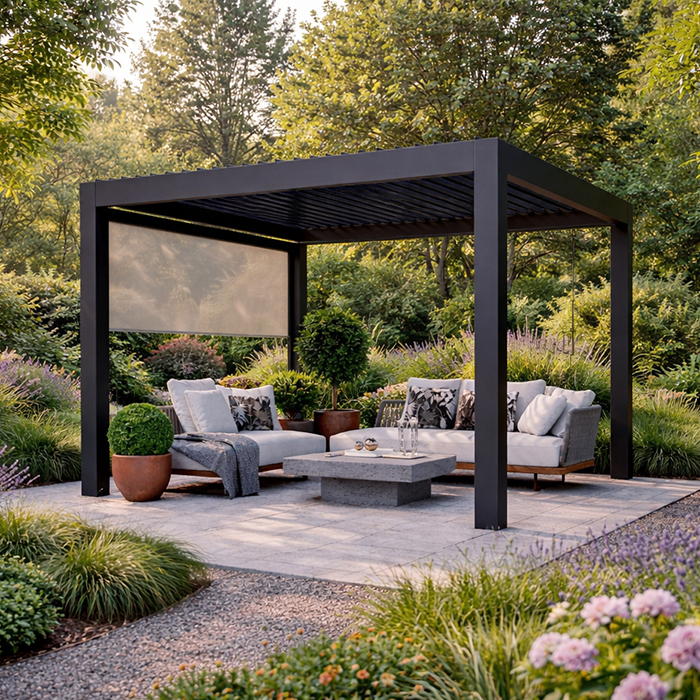
Think about what a change in blade angle means for your ordinary use. You might want more shade while eating, a more open view at another time, or to alter how much air moves through the covered space. Those are different aims, and a single chosen position may not suit all of them. If you normally set the roof once before using the area, speed may matter less than a simple, accessible control. If you expect to respond to shifting sun during a long visit, more frequent adjustment may make reducing effort worthwhile. This is a question of your pattern, not a promise that one control will create a particular temperature or level of comfort.
Separate the ability to change a roof from the degree of weather protection it provides. Angling louvres changes the overhead opening, but it does not prove that a roof is sealed or suitable for every rainfall or wind condition. When reviewing the Bioclimatic Pergola model details, distinguish the roof positions you would like to use from those permitted in particular weather conditions. A model-specific diagram or demonstration can clarify the available movement, while the operating instructions explain its limits. This helps you judge whether your preferred settings fit the way the selected roof may be used.
Motorised operation is not the same as automation
A motor can make a louvre adjustment with less effort, but automation is a separate layer. Automatic response might depend on sensors, schedules, a compatible controller or other equipment; none should be presumed from the word motorised. A switch that runs a drive still requires a person to decide when to operate it. If you want the roof to react without someone pressing a control, ask which sensor or accessory is supplied, which functions it triggers, and whether it is compatible with the exact model and motor. Get the answer in the product documentation rather than relying on a general description of a product family.
Be specific about what automation would add to your routine. A weather sensor, if offered, may have defined operating conditions and limits; it should not be treated as a substitute for checking the manual or safe operating guidance. An app or remote, if included, does not by itself establish that the louvres will move automatically. Ask what the user must do, what still needs supervision, and how the system behaves if a sensor, network or power supply is unavailable. If your only aim is to avoid turning a handle, an ordinary motorised control may be enough. Compare accessories separately, and check whether they are optional, compatible and part of the configuration being considered.
Who will operate the pergola?
Think about every regular user, not only the person choosing the pergola. A manual control asks each operator to reach it and use the required movement; someone comfortable doing that may find it straightforward, while another person may prefer less physical effort. Motorisation can reduce effort at the mechanism, but the control itself still needs to be reachable, legible and simple for its users. If household members, guests or older children will adjust the roof, decide who is expected to operate it and make sure the instructions and controls are clear to them. Do not assume a remote or app makes a system easier for everyone.
Shared use also changes how often a roof may be adjusted. One person may prefer an open view, another may want more shade, so an accessible control can prevent operation becoming a task that only one person takes on. Consider where the control is kept, whether it is easy to find, and whether users can understand it without a demonstration each time. If you are comparing the model identified in Bloomcabin’s Wall Pergola listing, involve the intended users when discussing its available controls. A demonstration of the proposed arrangement can reveal an awkward grip or hard-to-see switch more clearly than a specification sheet.
Manuals, maintenance and support
Manual mechanisms still have moving parts, so manual should not be equated with maintenance-free. A motorised version adds electrical and drive components, which may mean different inspection, care or service requirements. Follow the instructions for the precise mechanism; do not apply oil, adjust linkages or attempt repairs unless the manufacturer’s guidance calls for it. Before deciding, ask what routine care is required, what signs mean operation should stop, and which parts are replaceable. The answer should be specific to the product configuration, not a general assumption that a simpler-looking control will always be easier to look after.
Support matters most when a roof does not move as expected. Find out who can diagnose the mechanism, which parts information is available, and what you should do if the drive or control fails. Use the regular pergola product page to identify the model in a service enquiry, then ask about support for the proposed operating arrangement. Confirm what the warranty covers and excludes, including any differences between the mechanism and controls. Keep the manual and support contact details together where users can find them. This is especially useful if the person arranging the purchase will not always be there to deal with a problem.
How to compare the exact model configurations
Compare like with like by writing down the exact model and configuration, then separating the roof mechanism from the method of operating it. Ask whether the selected roof has adjustable louvres at all, how it moves, what control is supplied, and whether motorisation is included or an option. Record any stated power requirement, control position, override and compatible accessories. A product family name can cover more than one arrangement, so ask the supplier to identify the option you would actually buy. If two proposals differ in roof design as well as control, compare the roof functions separately; differences in movement or available positions may also affect how you use them.
The supplied Bloomcabin listings identify the Regular, Bioclimatic and Wall Pergola models, each with a stated area range from 9 to 24 m². The available product facts do not establish whether a particular configuration has manual or motorised louvres, which controls it includes, or what power it needs. For example, Bloomcabin’s Bioclimatic Pergola product page identifies the model and area range, not those operating details. Request configuration-specific specifications, diagrams and instructions for any model you compare. Keep the answers alongside the quotation, with included controls and optional accessories clearly distinguished. Neither a family name nor a product image establishes a particular drive.
Which control is likely to suit your routine?
Manual operation is likely to suit a routine with occasional changes when the operating point is easy to reach, users are comfortable with its movement, and avoiding a powered drive is a priority. Motorisation is worth exploring when you expect to adjust the roof repeatedly, when more than one person needs to make those adjustments, or when the manual control would be inconvenient to reach. These are starting indicators, not guarantees: the drive and interface must match the actual layout. The simpler option on paper is not necessarily simpler in use if it is awkwardly placed or requires an action people will avoid.
Use a short decision test before settling on a type: describe a normal adjustment, identify who will make it, show where that person will stand or sit, and list what must be available for the movement to work. When enquiring through a Bloomcabin Pergola model page, describe that routine so the supplier can address it for the proposed configuration. Compare the response with your layout and expectations, including what happens when the usual control cannot be used. If a feature essential to your routine remains unconfirmed, leave that part of the comparison open rather than counting it as an advantage.
Frequently asked questions
Are all pergolas with adjustable louvres motorised?
No. A product category or name does not establish how its roof is operated. Check the exact model and configuration for the drive, the control supplied and any power requirement. If the available information is silent, ask for the relevant manual or mechanism diagram before comparing options.
Does a motorised pergola adjust itself to the weather?
Not necessarily. Motorised means a powered mechanism moves the louvres when operated; automatic weather response would require compatible sensors or other controls that are explicitly included. Confirm the functions and their limits rather than assuming a sensor, app or schedule comes with a motor.
Can manual louvres be used if electricity is unavailable?
A purely mechanical drive ordinarily does not need mains power to move the blades, but confirm the selected mechanism. A pergola may have separate powered accessories, while a motorised roof needs model-specific guidance for an outage. Do not assume a battery or manual override is included.
What should I ask about operation during a power cut?
Ask how the exact drive behaves if power is lost, whether a documented manual override or other fallback exists, and who can restore operation. Check the model’s manual and support terms. Do not try to force the mechanism unless its instructions expressly permit it.
Is motorisation worth it if I adjust the louvres every day?
Frequent use makes reduced operating effort more valuable, so motorisation may be worth comparing. It is not an automatic answer: verify that the control is convenient, power is available and the exact model includes the drive and functions you expect. A reachable manual system may still suit your routine.
Choose the control you can picture yourself using on an ordinary day. A manual mechanism can be a sensible fit when the roof is changed infrequently and the operating point is accessible. A motorised drive may make repeated adjustments easier, provided its controls suit the people using it and its power requirements can be met. Neither approach is automatically more convenient: the useful comparison is how easily you can make the adjustments you expect, in your actual terrace layout, with the configuration you are buying.
