
Comparing a Fabric Roof with Aluminium Pergola Louvres
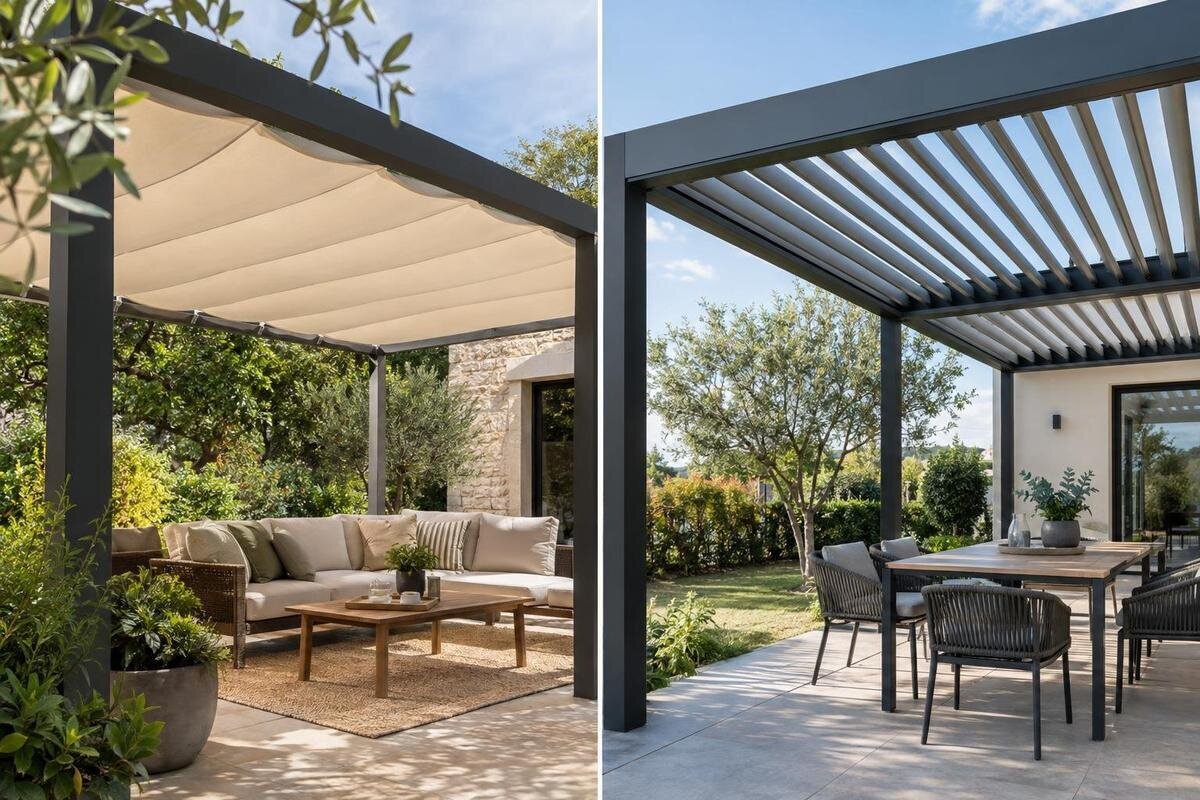
Pergola roof guide
Choosing between a fabric roof and aluminium louvres is mainly a choice about how you want to control overhead cover. A fabric roof may be fixed or retractable; louvres turn to change the angle and gaps between blades. Both categories include different mechanisms, materials and weather limits, so the label alone does not settle how a particular model performs. This guide compares operation, care and the questions to ask about rain and wind. It does not assume that a pergola is motorised, that its roof retracts, or that either system is suitable for every exposed site.

How the two roof mechanisms differ
A fabric-roof pergola places a textile covering over its supporting frame. Some designs keep the cover fixed; others let it move along guides, fold or roll into a gathered position. The movement and the amount of roof uncovered vary by mechanism, so the word fabric does not tell you whether the roof opens or how much sky it reveals. A fixed cover gives no roof-opening adjustment, while a retractable one may expose only part of the opening or a larger area. A plan or operating diagram is more informative than a category label. A gathered cover still needs somewhere to sit, and guides may remain at the edges, so check how the open position looks from below.
An aluminium louvred roof uses a set of blades that rotate to alter their angle. Changing that angle changes the gaps between the blades and the amount of light and air passing through. The blades generally stay over the frame rather than gathering away like a retractable canopy, so an open setting does not necessarily mean an unobstructed view of the sky. The pivot arrangement and range of movement differ by model. Some roofs offer several intermediate positions; others may have a narrower range. Compare the physical mechanism and available settings, rather than relying on a photograph of one position.
Shade, daylight and airflow
Fabric can provide a broad area of overhead shade, but how much light passes through depends on the textile’s weave, density, colour and position. A light-looking sample does not establish how much sun it filters, and a darker one does not prove that the space below will feel cooler. If daylight matters, ask for the manufacturer’s stated fabric properties and, where possible, compare the roof both deployed and gathered. When reviewing alternatives such as the Bloomcabin Bioclimatic Pergola model page, distinguish the specified roof type from its stated shade performance. Compare those details with the fabric option rather than judging either roof by appearance alone.
Louvres let you alter the balance between shade and sky by changing blade angle, though no setting guarantees the same cover at every hour. Sun direction, blade layout and nearby walls or trees all change the light pattern; angled blades may also cast bands of sun and shade. An open gap can let air and daylight through, while a more closed setting gives more overhead cover, but the result depends on spacing and orientation. Consider where the table or seating sits and when you use it. If possible, assess the intended spot at different times rather than judging from a midday photograph.
The amount of adjustment you need
With a fixed fabric roof, daily operation is simple because there is no opening movement, but you cannot uncover the roof when you want more sky. A retractable design gives that choice only if the mechanism is included in the selected model, and it may have a defined travel path or stopping positions. Think about how often you will change it, who will operate it and whether the mechanism is easy to reach from the terrace. Check where the fabric sits when open, whether the track needs clear space and what the instructions say about stopping or securing it. Ease of use depends on the actual control, not just the word retractable.
Louvres are adjusted by rotating the blades, either through a manual control or a powered mechanism where that option is specified. Do not assume an adjustable roof includes a motor, remote, rain sensor or automatic response; these are separate features. When considering the Bioclimatic Pergola listing, compare the precise model details with its operating instructions and note the available positions, control method and any manual override. If several people will use the terrace, understand the everyday control sequence as well as the maximum opening shown in a diagram. Also check whether the instructions limit when the mechanism should be operated.
Rain protection depends on the exact roof
Rain performance is not established by the word fabric. Some textiles are intended chiefly for shade, while others may be described as water-resistant or waterproof; the maker’s terms and any stated test conditions should guide the comparison. Seams, tension, roof pitch and the way water leaves the cover also matter. Ask whether the cover is meant to remain deployed in rain, whether water can pool and whether it should be dried before folding or storage. Follow the care instructions rather than treating every fabric roof as a sealed canopy. A cover’s appearance in a product photograph does not establish how it performs in sustained or wind-driven rain.
Closed louvres may channel rain only when the roof is designed with suitable joints and a drainage route. Open or angled blades let some rain through, and wind-driven rain can enter from the sides even under a closed roof. Check where water exits and whether the maker gives a particular blade position for rain. On a wall-mounted structure such as Bloomcabin Wall Pergola, the exact roof and installation details still matter; the model name alone does not show how water is directed. Consider where runoff will go in the actual setting, including whether it crosses a doorway or a regularly used path.

Wind limits and exposed positions
Wind deserves its own comparison because the roof’s position can change how a system is exposed. A wide fabric panel left deployed can catch wind, but folding it away should not be treated as automatic storm protection unless the manufacturer says so. Some mechanisms have specified operating or storage positions, and the correct position must come from the instructions for that exact product. Look for stated limits, how the cover should be secured and whether guidance changes when the roof is open, partly open or closed. Do not borrow a limit from a different model. A sensor or powered control should not be assumed to replace the written weather instructions.
Louvred roofs also need model-specific guidance: an open angle, a closed position and the overall frame may each behave differently in gusts. Do not assume that blades should be left open or shut in wind; follow the manufacturer’s instructions. If the documentation is unclear, ask the supplier or a qualified installer to explain the limits for the complete assembly and site, rather than inferring them from the blade material. Nearby walls, side screens and a particularly exposed position can affect how the structure is used, so check whether any specified accessories change the guidance. There is no universal wind setting that can be applied to every pergola.
Routine care for fabric and louvres
Fabric care centres on the textile and its moving parts, if any. Remove dust, leaves and marks using the method stated by the maker; unsuitable detergents, abrasive tools or strong pressure can damage some fabrics or finishes. Inspect accessible seams, edges, fixings and guides for dirt or wear without forcing the mechanism. If a wet cover is to be retracted, check whether the instructions call for drying it first, since trapping moisture can create care problems. When reviewing the Bloomcabin Pergola listing, identify the specified roof before comparing its care requirements with those of a fabric canopy. Do not transfer cleaning instructions from one roof material to another.
An aluminium louvred roof has different routine checks. Leaves and grit can collect around blade pivots or in drainage channels, so clean these areas as described by the maker to keep the mechanism and water route clear. Use products compatible with the stated finish, and do not force a blade that sticks or lubricate parts unless the instructions allow it. Ask which parts you can clean yourself and which require servicing. If movement becomes difficult after cleaning, stop rather than forcing the control. Include access to pivots and drainage channels when comparing the work involved in caring for each roof.
Mounting and site layout
Installation can affect which roof is practical, as well as where the pergola can sit. A retractable fabric cover needs its movement route and any gathered section accommodated; a louvre system needs room for the intended blade movement and suitable frame support. The arrangement depends on the design, so use the product drawing to check head clearance, post positions and the area that must stay free. Think about how the space works when the roof is fully open, not only when it is closed. A photograph rarely shows these clearances as clearly as a dimensioned plan.
Wall-mounted and freestanding arrangements raise different questions about attachment and access, independent of whether the roof is fabric or louvres. The Bloomcabin Wall Pergola model page identifies a wall-mounted model; that description does not establish whether a particular wall can support it or how it should be fixed. Have a qualified installer assess the actual wall, substrate, site and drainage route; there is no universal fixing method. Check that the chosen roof mechanism can still be reached for operation and routine care after installation, without obstructing doors or regular access routes.
Compare the stated size with usable cover
Size labels need careful reading because a listed area does not necessarily equal the uninterrupted, weather-protected area beneath the roof. The supplied Bloomcabin entries name Bioclimatic Pergola, Wall Pergola and Pergola models, each shown from 9 to 24 m². The Bioclimatic Pergola area listing is one reference for that range, not a substitute for the drawing of the exact version you are considering. Compare overall dimensions, usable clear space and roof coverage separately. A range alone does not give precise dimensions, the gap between supports or the amount of space available around the frame.
Put the structure’s footprint alongside the furniture plan and the route to doors or garden paths. Support posts, wall connections, space for a retracted fabric cover and room around a louvre control can affect how the area works day to day. Ask for the maximum outer dimensions and clear dimensions between supports, then compare them with the place you intend to shade. If the roof moves, include its fully open position in the plan and check the clearance needed for fabric to gather or blades to rotate. The aim is to compare usable cover and space for movement, not simply a headline area.

What the product documentation should confirm
Before relying on a product name or sales image, locate the technical sheet, dimensions and operating instructions for the exact model and configuration. For fabric, confirm whether the roof is fixed or retractable, what textile is specified, how it is cleaned and what the manufacturer says about rain and wind. For louvres, check the movement range, control method, water route and required cleaning. Confirm that the details refer to the configuration you are buying, not a similar version or optional accessory. If an important point is missing, ask for the exact answer rather than filling the gap with a feature seen on another pergola.
Ask as well about replacement parts and the expected care of the specific roof: fabric panels, tracks, blade pivots, finishes and drainage components may have different maintenance or replacement arrangements. When reviewing the Wall Pergola catalogue entry, record the roof configuration and any accessories you want included, then compare that selection with the order details. Confirm which items are separate and what terms apply to any warranty. Keep these details alongside the operating and maintenance information for the selected version. This makes it easier to compare complete configurations without assuming that similar-looking products share the same mechanism, included equipment or servicing requirements.
Which roof suits your way of using the terrace?
A fabric roof may be the closer match when you want one textile layer overhead and do not need to alter blade angle. A fixed roof may suit a consistent shade arrangement if its light and weather guidance fit the site; a retractable roof adds flexibility only when that mechanism is part of the selected model. The Bloomcabin Pergola listing should be read for its exact named configuration, not as proof that it is fabric-roofed. If a fabric roof is essential, the product description needs to state that feature explicitly. Include the care of the textile and the roof’s specified open or closed positions in your comparison.
Aluminium louvres are worth comparing when you want to change the angle of overhead blades and accept that the blades remain part of the roof structure. That adjustment can help balance shade, daylight and airflow, but it also brings questions about controls, cleaning and rain drainage. Neither system wins on every measure: weigh how often you will alter the roof against the care it needs and the documented weather limits. If you rarely adjust a roof, a complex mechanism may be unnecessary; if flexibility matters in daily use, a fixed textile cover may not offer it.
Frequently asked questions
Is a fabric pergola roof waterproof?
Not necessarily. Some fabrics are intended mainly for shade; others may be specified as water-resistant or waterproof. Seams, installation details and the maker’s stated limits matter too. Check the documentation for the exact fabric and whether it should remain deployed in rain. The word fabric alone is not a rain guarantee.
Can aluminium louvres stay closed in the rain?
Only if the manufacturer specifies a rain-safe position and drainage route for that model. Open blades let rain through, and gaps or wind-driven rain may still matter. Check where water exits and whether the instructions call for a particular blade position.
Which roof is better in windy weather?
There is no category-wide winner. A deployed fabric panel can catch wind, while a louvred roof and its supporting frame also have model-specific limits. Follow the instructions for the exact system; do not infer a safe open or closed position, or assume a retractable cover makes the structure storm-proof.
Does a fabric roof or a louvred roof need more maintenance?
They need different care; neither is automatically maintenance-free. Fabric needs cleaning suited to its textile and any tracks, while louvres may need attention around blade pivots and drainage routes. Check the cleaning and finish guidance for the exact model.
Are these pergola roofs motorised or automatic?
Some systems offer manual or motorised operation, and some may have automation, but none of those features is implied by the roof category. Verify what the exact configuration includes, how it is controlled and what happens if power is unavailable. Do not assume a backup function.
The clearest choice comes from picturing an ordinary day and a change in weather: fixed shade, a roof that gathers away, or blades that change angle. Match that routine to the exact mechanism, then judge it by the written guidance for operation, rain, wind and care—not the material name alone. A useful comparison makes clear what the roof can do and where its limits are.
