
Fixed Glass or Adjustable Louvres for a Pergola Roof?
Pergola roof guide
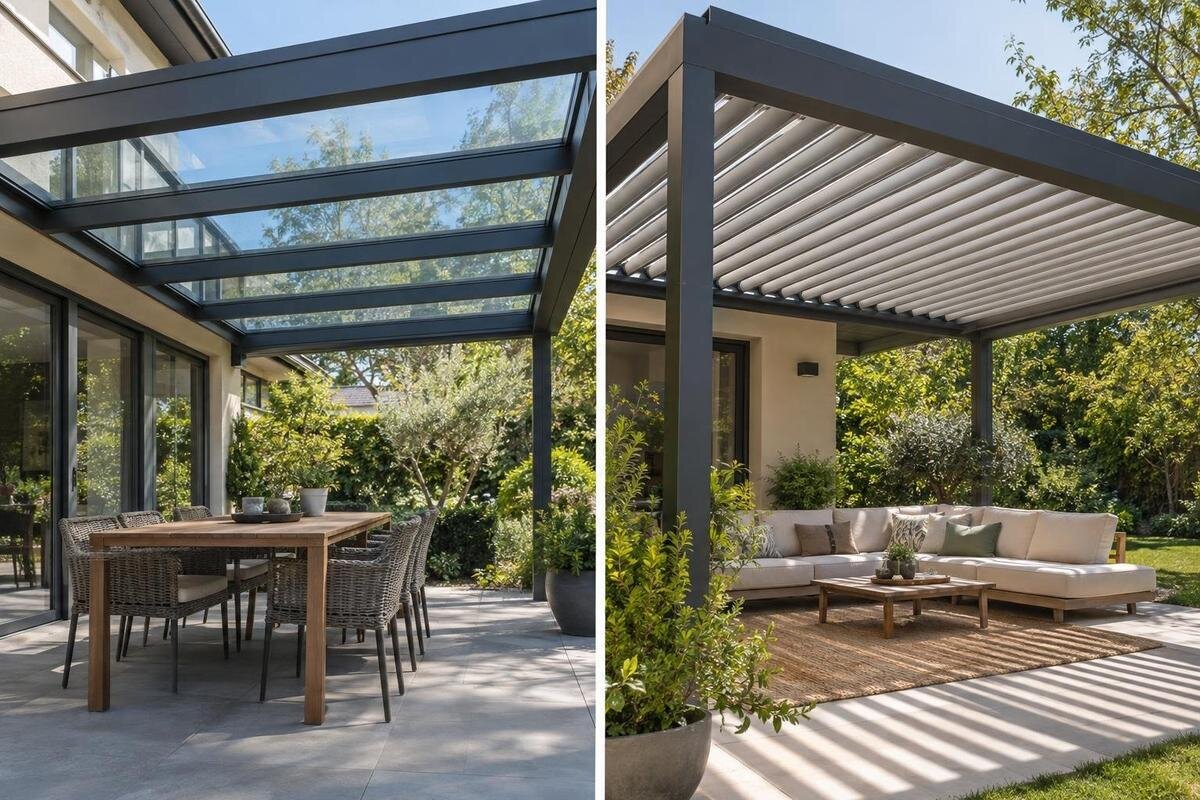
Fixed glass and adjustable louvres can both sit above a pergola, but they offer different kinds of control. Glass provides a permanent transparent cover; louvres let you alter shade and the opening overhead. Neither description alone tells you how much light or heat reaches the terrace, whether rain stays out when the roof is closed, or where runoff goes. Compare the actual roof specification, the openness of the sides and the drainage details before treating either option as all-weather cover.

01
How the two roof systems work
Fixed glass and adjustable louvres provide different ways of covering a terrace. A fixed glass roof stays in one position: its glazed surface admits daylight, but it cannot be opened to let air rise through the roof. Adjustable louvres change the angle of their blades, creating a more open or more shaded setting. With the blades open, more of the sky is visible and air can pass through the roof; when they are more closed, they intercept more direct sun and may direct rain away if the system is designed to do so. The key distinction is day-to-day control, not simply the finish seen from below.
Keep adjustable distinct from retractable. A louvred roof may tilt its blades without sliding them completely away, while fixed glass has no opening mechanism. Glass can vary in clarity and solar behaviour; louvre designs vary in blade spacing and movement. Ask for the operating diagram and written roof specification for the exact model. Identify what its open, partly open and closed positions mean. A photograph or broad term such as bioclimatic cannot establish the control range, rain performance or equipment supplied.
Daylight under a fixed glass roof
Glass offers a view of the sky and generally admits more overhead daylight than louvres set to provide shade. It does not guarantee neutral light: tint, coatings, panel design, dirt and the sun’s angle affect brightness, glare and solar gain. A clear panel may pass direct sun onto a table or floor, while a different glazing specification may reduce some of it. Visible light and heat transmission are related but not identical, so ask for the actual glazing description and any available light or solar data. A photograph cannot show performance at your particular site.
If the pergola sits beside a door or a room with windows, consider both the terrace and the interior. Glass may retain more daylight overhead than closed louvres, but the frame and roof still alter the light reaching adjoining spaces. The result depends on layout, roof height, glazing and sun path. Observe the area at the hours when you expect to use it, and note where direct sun falls. Look out from inside the adjoining room as well as from the terrace: the view from a dining chair may reveal a different priority from the view through the doorway. Record whether you want brighter surroundings, less direct sun on a particular seat, or an uninterrupted view upwards. These are different preferences, and a bright product photograph cannot settle them. The Bloomcabin Pergola listing can identify a model for comparison, but its name alone does not confirm a fixed-glass option or the glazing specification.
02
Adjustable louvres give you control over shade
With adjustable louvres, changing the blades’ angle changes how much sky is visible from below. A more closed position usually intercepts more direct overhead sun; a more open one lets in more daylight. That gives you a choice as the sun moves, but it does not promise uniform shade. Blade width, spacing, angle and sun direction all affect the pattern, and narrow bands of light may remain even when the blades are positioned for shade. When comparing settings, focus on where people will sit rather than whether the whole terrace looks shaded. For a dining area, consider the table surface and the seats around it; for a reading corner, consider the position of that particular chair. Ask to see the available blade positions from below so you can relate the adjustment to your layout. The setting that suits a sunny part of the day may not be the one you prefer later.
Ask how the specific mechanism is operated and what adjustment range it offers. Do not assume a motor, sensor, remote control, manual override or automatic response; confirm any such feature for the exact model. If one person will change the roof frequently, ease of operation may matter as much as the range of movement. The Bloomcabin Bioclimatic Pergola page identifies a model to compare; check its current specification and request the operating information before relying on a particular control.
Roof-level ventilation and the open sides
A fixed glass roof does not provide a direct opening for air to escape upwards. Air may still move around an open-sided pergola, but the roof itself remains closed. The amount of movement depends on the breeze, the surrounding layout and whether air can enter and leave the space. If your priority is ventilation through the roof, fixed glass cannot provide that function unless a separate opening is explicitly included in the proposed design. Do not treat daylight or rain cover as evidence that a roof will also provide airflow.
Open louvres create a route for air to move through the roof, but the result depends on more than the blades. Fresh air needs a way into the space, and enclosed sides or still conditions can limit circulation. Louvres are one means of adjusting ventilation, not a fan or a guarantee of cooling. If airflow matters, check the operating diagram for the opening available in the position you would actually use. Compare both roof options with the same side arrangement: an open-sided glass-roof proposal and a more enclosed louvred proposal do not isolate the difference between the roofs. Note which sides you expect to leave open during normal use, rather than judging only the most open display configuration. For the bioclimatic pergola model, establish how the roof opening relates to that intended arrangement instead of treating the product category as a measure of airflow.

03
Rain performance depends on the roof’s closed position
A fixed glass roof can provide consistent cover from rain falling from above when the panels, joints and installation are designed for that purpose. Because the roof has no opening position, the covered area does not switch to an open roof during a shower. However, glass is supported by frames and meets other parts of the structure, so seals, joints, perimeter edges and any wall junction affect where water may enter. An open-sided terrace remains exposed to wind-driven rain. The useful question is what coverage the specified assembly provides, not whether glass is inherently waterproof.
For louvres, ask what the manufacturer states about rain when the blades are fully closed, and whether its information covers partly open settings. Blade overlap, seals, channels, edges and installation can all affect the result; a photograph of closed blades cannot confirm it. If the description only says that the louvres close, ask what that means for water. When reviewing the regular pergola page, check the exact listed roof configuration and rain information rather than assuming the model name describes a glass or louvred roof.
Check where rainwater is collected and discharged
Water needs a clear route off the roof. Confirm whether the chosen design includes gutters or drainage channels, where the outlets are located and where water leaves the structure. Consider whether runoff could fall across a doorway, seating area or walking route, splash onto a wall, or collect in a place you use. Do not infer a gutter or a particular outlet from the roof type; look for it in the specification or drawings. A simple plan showing the roof edges, outlets and nearby doors can make the comparison easier to follow. Ask the supplier to identify the discharge points on that plan, so you can distinguish water being collected within the structure from water leaving it. The aim is to understand the complete proposed route, not simply to know that rain is shed from the roof surface.
If the pergola joins the house, give the wall junction separate attention. Ask how that edge is sealed, how runoff there is handled and how the proposed assembly relates to existing surfaces and drainage. A Bloomcabin Wall Pergola listing identifies a wall-mounted model, but the name alone cannot show how it will connect to your particular wall or manage water at that junction. Ask the supplier or a qualified installer to explain the site-specific details before comparing a wall-mounted layout with a freestanding one.
04
Plan around the terrace and its furniture
Use the way you furnish the terrace to test both options. Mark out the table, chairs, doors and main walking route before choosing the covered area. A fixed glass roof remains closed overhead, but the light and shade beneath it still change as the sun moves. Louvres let you alter the blade angle, although their shade may also move across furniture and floor. Decide where shade is most useful and where you would prefer an open view of the sky. Include the space needed to pull chairs back and move between seats, rather than marking only the tabletop. If the same area serves as both a dining space and a place to relax, compare each arrangement separately. This helps you judge whether one roof setting would meet both needs or whether adjustment would be useful. Compare likely roof positions, not just one midday impression or a staged product image.
Think about how often you would actually adjust the roof. If you prefer one stable setting and have little need to open the roof for air, a mechanism may add a choice you rarely use. If your priorities change between daylight, shade and airflow, louvres can respond, provided someone is willing and able to operate them. Do not count on automatic sensors or remote operation unless the specific specification confirms them. Consider who will make the adjustment and whether the controls are convenient for that person; a useful range matters only if you will use it.
Cleaning and maintenance access
Both options need a realistic cleaning plan. Dust, leaves and other debris may be visible on fixed glass and can affect the light; depending on roof access, cleaning its outer face may be less straightforward than cleaning the underside. Ask how the glass, frame and drainage channels can be reached safely, and which cleaning methods are permitted. Distinguish between surfaces you can clean as part of routine care and work that requires a suitable service provider. Before agreeing on the layout, ask whether furniture or other obstructions would need to be moved for access, and where access must remain available. Include gutters and outlets in the maintenance plan because blocked drainage can change how water leaves the roof. Do not climb onto a roof or use a cleaning method that the manufacturer does not allow.
Louvres have more edges and a moving mechanism, so ask what cleaning and routine checks are required, how the mechanism should be kept clear, and whether access is needed with the blades open or closed. Exact care instructions depend on the system; neither a roof type nor a product image provides a maintenance schedule. Use the Bloomcabin Bioclimatic Pergola page to identify the model you are considering, then request its current manual or written care guidance before deciding whether the upkeep suits you.

05
Compare exact specifications, not product names
Ask for a like-for-like comparison. For glass, identify the glazing type and any published light or solar information; for louvres, identify blade movement, adjustment range and the controls included. For either system, ask what is stated about rain, what parts collect or discharge water, what is included in the quoted configuration and what maintenance it needs. Keep the same intended covered area and side arrangement in both enquiries, and separate included items from optional ones. If a detail is missing from one proposal, leave it marked as unconfirmed rather than assuming it matches the other. Confirm whether the dimensions refer to the outside footprint or the covered area. A photograph may show a different configuration or optional equipment, so use the specification and manual to establish what is actually being offered. This gives you a clearer basis for comparing the two roof systems without confusing differences in the quotations with differences in roof type.
Measure the terrace and the useful area beneath the roof, allowing for doors, paths and furniture, then compare the chosen model’s exact dimensions. The Bloomcabin listings for the Regular, Bioclimatic and Wall pergolas each show sizes from 9 to 24 m²; that range does not identify which size or roof detail suits your site. The wall-mounted pergola page identifies a model category, but verify the exact configuration, footprint and wall-connection information for the option you are considering. Ask a qualified local professional about site-specific installation requirements where needed.
Which roof matches your priorities?
Fixed glass is worth considering when daylight and a permanently closed overhead cover matter more than ventilation through the roof. It is less suited to someone who wants to vary shade or open the roof for air. Adjustable louvres fit a different priority: you want to vary shade and roof-level airflow and will use the adjustment. They are not automatically the better choice for rain; confirm their closed-position performance and drainage. If your shortlist includes a Regular pergola entry, match its specified roof configuration to these priorities rather than choosing by the model name.
If no single benefit outweighs the others, rank your requirements: the light you want, the ventilation you need, then the rain performance and drainage you can verify. A visually appealing roof is a poor compromise if it misses your most important practical need. If rain cover is essential, require clear information on the complete installed assembly; if daylight matters most, request glazing data rather than choosing by appearance. This order keeps the decision focused on how you use the terrace, rather than on a broad product label.
Frequently asked questions
Which pergola roof lets in more daylight?
A fixed glass roof generally admits more overhead daylight than louvres set to provide shade. The difference depends on the glass tint and coating, the louvre design and position, and the sun’s angle. If daylight is a priority, compare the glazing information rather than relying on product photographs.
Can louvres improve ventilation under a pergola?
When open, adjustable louvres provide an opening at roof level; fixed glass does not. Air movement still depends on the pergola’s open sides, the breeze and the route for fresh air. Louvres offer control over the roof opening, but do not guarantee a particular temperature or airflow.
Will closed louvres keep rain out?
Only if the particular system is designed for rain in its closed position and is installed as specified. Ask for written details about its rain performance and drainage, including what applies when the blades are partly open. An open setting leaves gaps overhead.
Does a fixed glass roof guarantee a dry terrace?
No. The glass, joints, frame edges, wall junctions and drainage route all affect how well the installed roof sheds rain. An open-sided terrace can also be exposed to wind-driven rain. Confirm the performance of the complete assembly, not just the type of roof surface.
What should I ask a supplier before choosing?
Ask for the exact roof configuration, glazing or louvre details, rain performance, drainage route, included controls, dimensions and maintenance guidance. If the pergola attaches to a building or affects existing drainage, ask a qualified local professional to assess the site-specific installation details.
Treat daylight, ventilation and rain protection as separate tests rather than asking one roof type to solve all three. Fixed glass provides a permanently closed cover that admits daylight; adjustable louvres give you more control over shade and roof-level airflow, while their rain performance must be confirmed in the closed position. Make the water route and the exact roof specification as clear as the visual choice. The better fit is the system whose documented behaviour matches how you will use the terrace.
