
Sliding Privacy Panels or Fixed Screens Around a Pergola?
Pergola planning
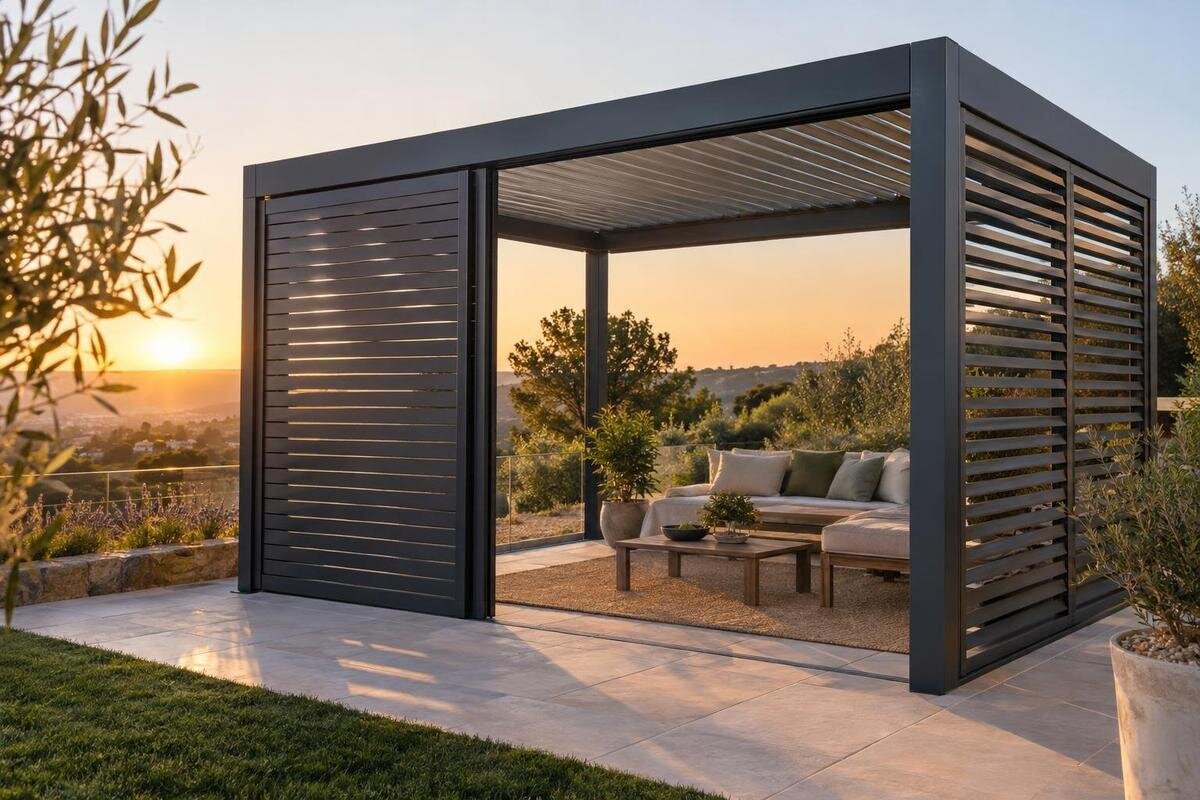
Fixed and sliding opaque panels can both shield a pergola side, but they support different routines. A fixed screen keeps the same visual boundary in place; a sliding panel lets you change how much of the side is covered. The choice depends on the views you want to block, whether that side is also an entrance, and whether a compatible panel is available for the exact pergola model.
Before you choose 1
How fixed screens and sliding panels differ
Fixed and sliding describe how a panel behaves, not how much privacy it provides. A fixed screen stays in one chosen position after installation. A sliding panel is designed to move along a specified track or mechanism, allowing coverage to change; its travel distance and parking position depend on that system. Here, opaque means that you cannot see through the panel itself. It does not mean the entire pergola side is sealed or every view around it is blocked. The labels alone also tell you nothing about height, width, edge gaps or finish; those details determine the area actually screened. This is a comparison of opaque side screens, not fixed versus sliding glass walls.
That difference affects daily use. A fixed panel provides the same visual barrier whenever you use the pergola, but keeps that part of the view covered even when you would rather look out. A sliding panel offers more choice, yet privacy depends on where you leave it and the moved panel needs a place to go. Compare the closed, partly open and parked positions rather than relying on one photograph, which may show only a single state. Ask to see those positions on the proposed layout: a panel that moves may not clear the view or route you have in mind. Neither type is automatically better; choose by the side’s main job, then confirm coverage, movement and compatibility separately.
Map the sightlines on each pergola side
Draw a simple plan of the pergola and mark where people sit, stand, enter and pause. Add the directions from which unwanted views reach those spots, such as a neighbouring patio, shared walkway or gate. Check important lines from both seated and standing eye level instead of judging from one position alone. If the screen is meant to protect a dining seat, trace the view from that seat to the outside observer; a panel on another side may not interrupt it. Distinguish a view that bothers you during everyday use from an occasional glance. This keeps the plan tied to how you use the terrace, rather than to a general wish for more privacy.
Next, mark the portion of the side the panel would cover and any places it would leave open. A direct view can pass around an end or through a gap even when the surface is opaque; a sliding panel can also expose the sensitive sightline if it is parked at the wrong end. For a wall-attached layout, Bloomcabin Wall Pergola is a model reference for asking whether the arrangement in your sketch has an approved compatible option. The product page alone does not confirm that a privacy panel is included or available, so ask about the exact model and proposed side.
Before you choose 2
A fixed screen suits a lasting privacy boundary
A fixed screen is often the clearer choice when one particular boundary needs privacy every time and the layout is unlikely to change. This may describe a seating area that always faces the same exposed side, a dining table kept in one position or a side where nobody needs to pass. Because the panel stays put, you do not need to remember to move it to restore coverage. Its practical advantage is consistency at that boundary, not greater privacy in every direction. If chairs move between dining and lounging, test both arrangements before deciding that one fixed position will work.
The trade-off is permanent coverage. If furniture later turns towards a view you want to keep, or the side becomes part of the main route, a fixed screen cannot be shifted aside. Depending on the layout, it may also make the outside face awkward to reach for cleaning or maintenance. If you are considering a fixed option with the Bloomcabin Pergola, include your usual seating arrangement and any regular changes in your enquiry. Mark which part of the side should remain screened in both arrangements, so the supplier can assess the proposed position rather than just a general request for privacy.
Sliding panels work when the opening needs to change
A sliding arrangement is useful when the same side has two genuine purposes: privacy at some times and an open outlook or passage at others. It may suit a space where seating changes between uses, or where you want to uncover a side for access rather than leave a permanent barrier across it. The flexibility matters only if you expect to move the panels; a system chosen for an occasional possibility may stay in one position. Consider who will operate it and whether changing the position fits into normal use, rather than relying on an idealised plan.
Ask how the panel moves before assuming that it clears the whole side. A system may have limited travel, overlapping sections or a particular parking position; the supplier’s drawing should show the usable opening in each state. Check whether a panel parked at an edge still blocks the view or route you hoped to recover. Ask for a demonstration of the operating steps as well as a drawing, so you can judge whether the movement is practical from the usual route. If enquiring about the Bloomcabin Bioclimatic Pergola, ask whether a compatible sliding privacy system is offered for that exact configuration; its model listing does not prove that the accessory is available.
Before you choose 3
Set the amount of opaque coverage
Decide whether you need to block one narrow view or create a visual boundary along most of the side. A partial panel may cover the line from a particular chair while leaving other areas open; a longer or taller panel may screen more of that face but also remove a view you value. The right coverage depends on where the observer and the user are, not simply on whether the mechanism is fixed or sliding. Sketch the panel outline against the planned furniture and note the sightline it should interrupt. If it needs to protect several seats, test each position rather than assuming one panel covers them all.
Look closely at the stated opacity, dimensions and gaps at the edges or between sections. An opaque centre does not prevent a view around an uncovered end or through space above or below; a small opening on a drawing may line up with a seated viewpoint. Privacy should not be mistaken for sound reduction, weather enclosure or insect protection, none of which follows from opacity alone. If the proposed panel is not fully opaque, ask how its visibility is described rather than relying on a colour image. When enquiring through the regular pergola model page, specify the coverage you need and ask which approved side components could provide it.
Keep entrances and walking routes clear
Treat the entrance as part of the screen plan. Mark the route from the house or garden to the usual seating area, including space to walk through carrying a tray or to pull a chair out. A fixed screen can sit beside an entrance if it does not narrow the route; a sliding panel helps only if the system’s actual opening is wide enough and the parked panel does not obstruct the same path. Check circulation with furniture in use, not only with an empty pergola. If people pass one another on the route, consider that as well as a single person walking through.
Check the route in every position you intend to use: covered, partly open and fully parked, where those positions are possible. Ask whether a track, threshold, handle or lower edge affects the walking route, and whether someone can move the panel without shifting furniture. Consider maintenance access too: a screen can block a view from one side while making its far face awkward to reach. For a wall-mounted layout, use the wall-mounted model page as a reference when asking where a compatible screen or track could sit. Have the usable opening marked on the proposed layout, including any space occupied by the parked panel.
Before you choose 4
Balance privacy with an open side
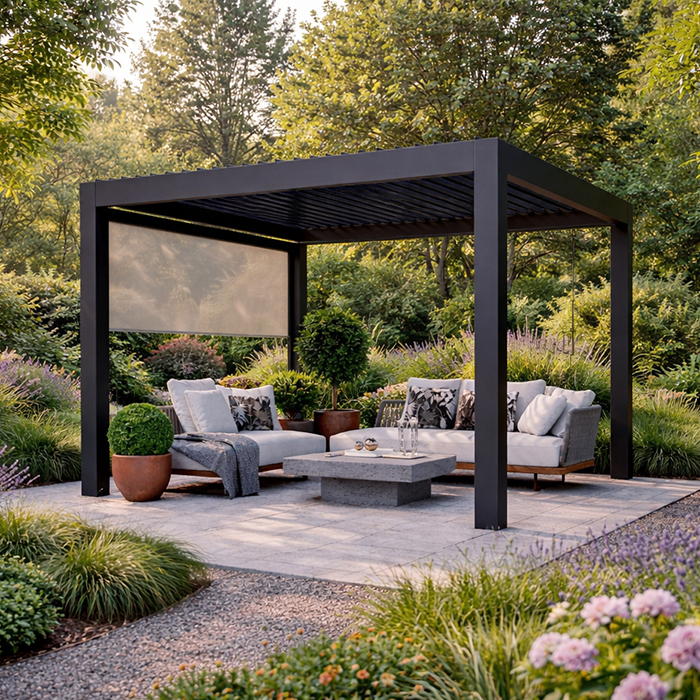
Privacy and openness often compete on the side where a screen sits. A fixed opaque panel can interrupt a view and reduce air movement or daylight through that part of the side, although it does not turn a pergola into a fully enclosed room. The effect depends on the panel’s coverage and the surrounding layout. If you value an open feel, decide which face should remain unobstructed instead of screening every side by default. Consider how the proposed panel relates to the other open faces, not just how it looks in isolation.
Sliding panels uncover only as much of the side as their travel and parking position allow. A partly open panel may still obstruct the view you want to retain; moving it further may restore more of the outlook but remove privacy at the same time. Think about the position you will use most, not only the most open option in a drawing. If airflow matters, preserve an open route across the structure and ask about the proposed screen’s effect. A movable panel does not guarantee a particular breeze. A fixed screen on one face and an open face elsewhere may suit your plan, if that configuration is approved for the chosen model.
Confirm the panel fits the pergola model
Accessory compatibility is a model-specific question. Ask whether the privacy panel is approved for the precise pergola model, the side and span you have planned, and the way the frame is configured. Confirm whether the screen is supplied with the pergola or ordered separately, what components are included, and how the panel is fixed or guided. Request a drawing that shows dimensions, travel, parking position and clear opening in each state, along with any stated operating limits. Do not use a lifestyle photograph or generic product description to establish an attachment or safe operating condition. Ask whether adding a screen later would affect access to parts that need inspection or maintenance.
The Bloomcabin Pergola listing gives a size range from 9 to 24 m²; that information alone does not establish that a fixed or sliding opaque screen is available, included or suitable for a particular side. Ask for written compatibility information and the relevant installation and operating instructions. Where attachment, wind exposure or structural suitability needs assessment, have it confirmed by the manufacturer or a qualified professional. Do not infer limits from a different pergola or a generic screen.
Before you choose 5
Compare both options against the same layout
Compare the options side by side for each face rather than choosing one label for the whole structure. Write down the sightline to block, the route that must remain open, the view or daylight you want to retain, and how often the panel would need to move. Test a fixed and a sliding drawing against the same furniture and routine. A simple table with one row per side can expose a mismatch, such as planning a permanent screen across the main entrance. Include the normal set-up and a likely alternative, such as chairs moved for a gathering.
A fixed arrangement often makes sense when privacy is constant and the position never needs to change; sliding is more compelling when access or outlook genuinely varies and there is room to park the panel. If you would rarely reposition it, the moving system may add a mechanism without solving a regular problem. When enquiring through the bioclimatic model listing, include your side-by-side comparison and ask whether the proposed fixed, sliding or mixed arrangement is available. For a mixed layout, show where the two types would meet and which opening you intend to use. Assess the confirmed arrangement as a whole, rather than judging each screen separately.
Test the planned positions before ordering
Before ordering, make a quick full-size visual test. Mark the proposed panel edges with removable tape on a nearby surface, or hold up a plain board where the panel would sit without attaching anything to the pergola. Sit and stand in the places you use most, then ask another person to check the view from the locations you want screened. Repeat with the panel represented as fixed and in its intended open or parked positions. This can reveal a panel that blocks the wrong sightline or sits across a route before you commit; a small sketch may hide those conflicts.
Give the supplier a short written brief: pergola model, side, desired opaque coverage, entry route, furniture positions, preferred open states and any view you want to preserve. Include a simple sketch or annotated photographs, then ask the supplier to confirm compatible options, dimensions, attachments and usable opening. If the enquiry concerns the Wall Pergola listing, use the exact model name so the response addresses the right pergola. Record any changes to the panel position or coverage agreed during the enquiry, and keep the confirmed layout with the order so everyone is working from the same plan.
Frequently asked questions
Will an opaque fixed screen guarantee privacy from every angle?
No. It blocks a direct view through the covered surface, but a sightline may pass around an end or through an uncovered gap. Check the places people actually sit and stand, and mark the panel edges on a sketch before treating the whole side as private.
Does a closed sliding panel cover the whole pergola side?
Not necessarily. The amount screened depends on the panel dimensions, its overlap with other sections and any gaps or uncovered parts. Ask for a drawing of the exact system in its closed position; a product photograph alone cannot confirm full coverage.
Can a sliding panel create a clear entrance?
Only if its travel and parking position leave enough usable space for the route. Ask for the clear opening when the panel is moved, and check where it sits when parked. Try that route with the furniture in its usual positions.
Is a fixed screen automatically safer in a windy location?
No. A fixed or sliding opaque panel can affect how wind acts on the pergola, and one type is not automatically safer. Check the model-specific operating and attachment information, and ask the manufacturer or a qualified professional to assess the proposed configuration where needed.
Can I add a privacy panel to my pergola later?
Possibly, but confirm compatibility before buying. Ask whether the exact model accepts the panel and its guide or track, whether fitting after installation is possible, and what preparation is needed. Do not assume a third-party screen can be attached to the frame.
Choose fixed coverage where privacy should remain constant and the side does not need to open. Choose sliding panels when access or the view genuinely needs to change, provided the system has a useful opening and parking position. The deciding question is how the panel works in its everyday state, not simply which type looks more flexible. A clear sightline sketch and model-specific compatibility confirmation make that choice much easier to judge.
