
When Frost Freezes Pergola Louvres: Do Not Operate the Roof
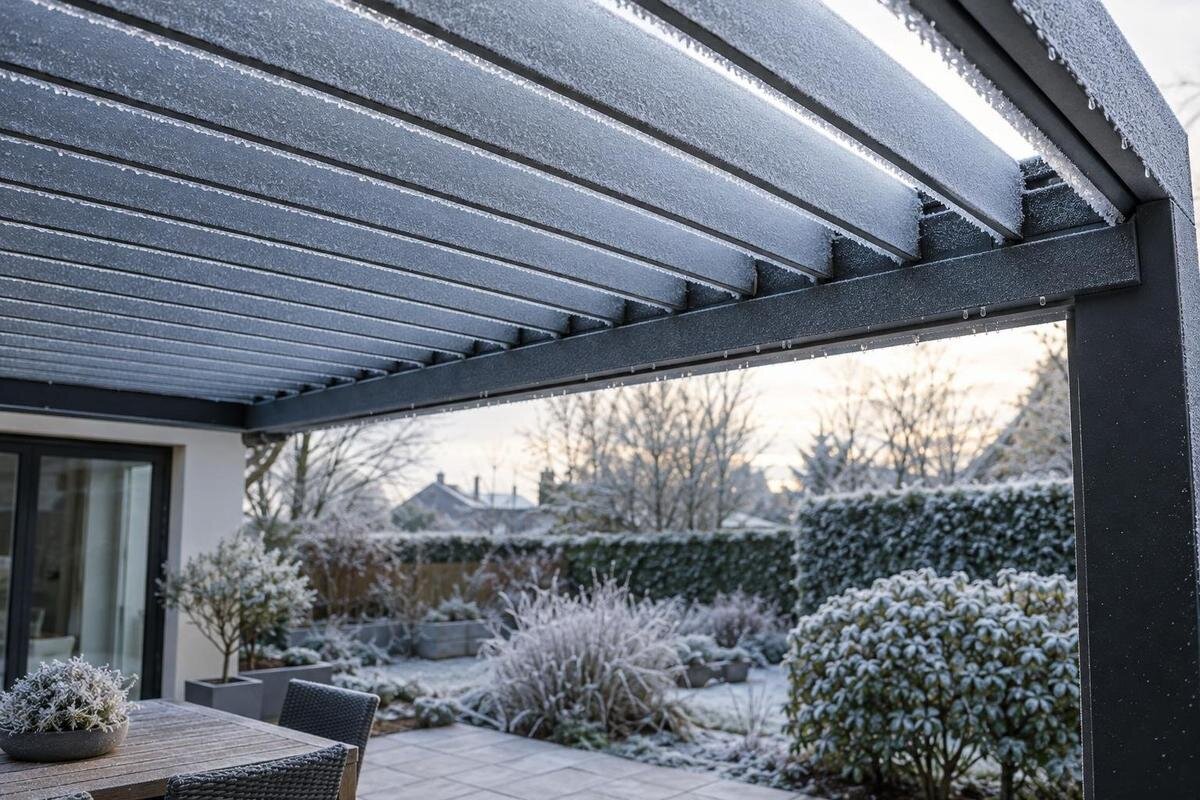
Pergola weather care
Frost can stop a pergola’s louvres even when only a small amount of ice has formed. Water may freeze at overlapping edges, pivots or parts of the drainage route, so the roof can resist movement before the obstruction is obvious. If the louvres stall, do not test the drive with more force or use an improvised manual release. Leave the roof still and follow instructions written for the exact model and configuration. The cause and approved response are not identical for every louvred roof.

01
How frost can immobilise pergola louvres
A louvred pergola roof may stop moving because a small amount of water has frozen at a point that needs to move freely. Depending on the design and conditions, rain, dew or condensation can leave moisture along overlapping louvre edges, around pivots or within connected parts. If a surface cools below freezing, a thin layer of ice may bridge a gap between components; it need not form a thick layer across the roof. A sheltered joint may also remain icy after an exposed face looks clear. These are possible freezing points, not a diagnosis: another obstruction or fault can make a roof stall, and the relevant parts differ by model.
Where louvres are linked, resistance at one point may affect the whole assembly. A stall alone does not identify ice as the cause, and another command will not make the diagnosis clearer. With a hand-operated roof, applying extra effort still puts strain on the mechanism. Drive type and joint arrangement matter, so do not assume all louvred roofs react in the same way. If you are considering the Bloomcabin Bioclimatic Pergola, request cold-weather operating guidance for the exact configuration rather than inferring a frost procedure from the product category.
Where ice may form in a louvred roof
Ice does not have to cover the roof to affect a moving part. Depending on the layout, moisture may remain where louvres overlap, at a pivot or linkage, or in a sheltered recess beside a fixed component. A thin obstruction at one point can matter more than a visible layer across a broad surface. Water can also remain in channels that carry rainwater; whether those channels connect with moving parts or sit apart from them depends on the model. A view from below may not show every joint, so visible appearance is not a complete inspection.
Ice in a drainage channel has a different consequence from ice binding a pivot: it may obstruct water flow even if the louvres are not seized. If you are evaluating a wall-mounted pergola option, ask for the drainage drawing that matches the proposed configuration; the mounting category alone does not establish the route, access points or cold-weather limits. Do not reach into a channel or move the roof to clear it. Ice or snow visible on top also does not tell you what load a structure is designed to carry; check the model-specific documents.
02
Surface frost does not prove that a mechanism is frozen
Surface frost is a clue to conditions, not a diagnosis. A white layer on a nearby table, railing or exposed face does not prove that a louvre joint is frozen, while a clear top surface cannot rule out ice in a sheltered joint. Sun, shade, wind and moisture can vary across one structure. Do not judge movement by touching the blades or making a brief test. Inspect only from a safe position at ground level, without climbing, reaching into the roof or disturbing parts.
Possible warning signs include a roof that stops part-way, moves unevenly, makes an unfamiliar sound or behaves differently from the normal operation described in its manual. None of these signs proves that frost is the cause; a fault or obstruction can look similar. If a display or indicator is present, note what it shows rather than repeatedly resetting it. The Bloomcabin Pergola product page can help identify the product, but it cannot diagnose a frozen mechanism or provide restart instructions.
What to do when the louvres stop moving
If movement stops or the control meets unusual resistance, stop the command and leave the roof in place. Do not keep pressing open and close, try the opposite direction as a test, or hold a control longer in the hope of freeing the louvres. If the roof has stopped part-way, do not push individual blades or put a hand between them. Do not remove covers, reach into the mechanism or disconnect anything to investigate; use the normal stop procedure described in the manual.
Make a note of what happened while it is fresh: the approximate time and weather, recent rain or dew, the roof’s position, the direction commanded and any sound or display. Separate what you observed from what you suspect. For example, say that the roof stopped during opening after a cold night, rather than reporting ice as a confirmed cause. Record whether it failed to move at all or stopped after movement began, and mention any further commands already attempted. Take a photograph only from a safe place at ground level; do not climb for a closer view or recreate the problem for a recording. These details can help an installer or manufacturer understand the sequence without disturbing parts. When contacting support about the product identified on Bloomcabin’s bioclimatic pergola page, provide the name and any model code from your paperwork, and explain that the roof stalled in conditions where frost was possible.

03
Why forcing a frozen roof can cause damage
Effort at a control may be transferred to a small pivot, connector or drive component. Depending on the mechanism, forcing a frozen roof may strain a linkage, disturb alignment, damage a gear or coupling, or turn a temporary blockage into a repair problem. Repeated commands on a powered drive may load components without clearing the ice; extra effort on a hand-operated system is not proof that the blades are free. The precise risk is model-specific, but there is no safe reason to test how much resistance the mechanism will take.
Resistance can disappear suddenly if ice shifts or melts, allowing the assembly to move when someone is pulling or standing close. Keep hands clear and stay out from beneath moving parts; do not ask another person to push the blades while you operate the control. If a louvre appears bent, displaced or loose, leave the whole roof stationary and request an inspection rather than trying to realign it. A roof that starts moving later is not proof that nothing was strained. When comparing the Bloomcabin Wall Pergola listing with other options, ask what written response applies if a roof stalls.
Why an override is not a way to free seized parts
A manual override, if a particular model provides one, is not automatically a way to clear ice. A release or hand operation may be intended for a defined situation such as a power failure, but that does not establish that it is safe to use against a frozen louvre. A power fault and an ice-bound mechanism are different conditions; instructions for one should not be transferred to the other. Even if a release can be engaged, do not use it to push through resistance.
Do not insert a crank, lever, bar or other tool unless the exact instructions specify it for the condition at hand; do not bypass controls, disconnect a drive or access electrical parts. Those actions can damage the mechanism and make the roof difficult to control. The Bloomcabin Pergola listing identifies a product, not whether a manual release exists or when it may be used. If the manual does not address a frozen or jammed roof, leave it stationary and ask the manufacturer, supplier or a qualified service person for an approved response.
04
Find instructions for the exact pergola model
Use the operating manual for the exact pergola model, roof version and drive type, not a general brochure or instructions for a similar-looking unit. Gather the model code and installation paperwork, plus controller or actuator identifiers if they are available without opening equipment. Keep the pergola’s identity separate from the name printed on a remote control: give the supplier both rather than assuming one identifies the complete installation. Note any side enclosure or accessory that forms part of the installed configuration. Ask the supplier to confirm which manual revision applies and which parts of it address the roof and its controls. Keep that information together so that anyone responsible for operating the pergola can refer to the same guidance. If a second-hand pergola has no instructions, request a matching copy before trying to move a roof that may be frozen.
The useful questions are specific: does the manufacturer permit operation in frost; what signs mean stop; what approved response applies if louvres stall; is any thawing or cleaning method permitted; and what conditions must be met before operation resumes? Ask for any stated temperature or weather limits rather than assuming a number from another model applies. A listing such as the bioclimatic pergola listing can help identify the product, but the answer should be in guidance matched to its model and configuration. If a document is silent, get clarification rather than filling the gap with a generic tip.
Treat ice in drainage paths separately
Ice in a drainage route needs separate attention even if it did not stop the roof. A frozen channel or outlet may delay water from leaving; when the ice thaws, water can collect or follow a different route. That does not mean every frost event causes a blockage, nor does a clear outlet establish that the roof is watertight. Do not open or close louvres to clear a drain, and do not pour salt, de-icer or hot water into a channel unless the manufacturer expressly approves that method.
Ask for the model’s drainage diagram and maintenance instructions, including how outlets are meant to be checked. Use the diagram to distinguish the intended water route from the parts you can actually see; a visible opening alone does not show the complete route. Ask which checks belong to routine user maintenance and which require a service visit, rather than treating a diagram as permission to dismantle the system. If ice or a blockage is above reach, do not climb onto the roof, lean out, dismantle parts or scrape around moving joints. Use the wall-mounted pergola product page to identify the product, then request drainage guidance for the intended layout; a diagram for another model may not match the installed water route. If water is entering an unexpected area, note where it appears, keep the mechanism still and arrange qualified assistance.

05
Check cold-weather limits before choosing a pergola
Cold-weather limits belong to an exact model and configuration. Ask for the manufacturer’s weather-performance documents, including any stated frost or operating limits, the conditions behind them and what the instructions say when ice is suspected. For a useful comparison, establish whether a statement concerns moving the louvres or leaving the roof stationary. Also ask whether it describes normal operation, a precaution before freezing weather or the response to an existing blockage. These are different questions, and a general reference to winter use may not answer all three. A controlled observation can describe how a particular setup behaved under stated conditions, but it is not a universal guarantee. Do not infer frost capability from the fact that louvres move in ordinary conditions, from a general product description or from advice for another pergola.
Assess frost-related movement, snow or ice loading, resistance to wind, rainwater handling and protection from driving rain separately. There is no single answer for every pergola, and a statement about one aspect of performance does not confirm another. When comparing options, record the answer to each question separately; where a limit is not stated, mark it as a point to clarify rather than treating silence as unrestricted use. If the planned installation includes a screen, glazing or other enclosure, ask whether the documents cover that exact combination and its approved operating guidance. Make sure the comparison describes the configuration you intend to buy, not just a shared model name. Request a drainage diagram and any limits for the proposed model rather than relying on a broad weather claim.
After a thaw, follow the stated restart procedure
Thawing is not a reason to restart by guesswork. There is no universal waiting period or outdoor temperature that proves every pivot, concealed joint and channel is free of ice. Leave the louvres stationary until the exact instructions state how to judge the condition and when operation may resume. Do not chip or pry ice away, scrape between blades, use a heater or open flame, or apply chemicals unless the manufacturer has approved that method for the model and situation. A clear top surface may not show what is happening inside a joint.
Once the conditions in the guide are met, make a visual check from the ground for obvious misalignment, damaged or loose parts, unusual gaps and water that is not draining as expected. This is a check for visible concerns, not confirmation that concealed components are clear or undamaged. Do not touch or adjust a component to test whether it is secure, and do not remove panels or covers. If anything looks abnormal, the roof was forced earlier, or resistance remains, keep it still and arrange an inspection. Tell the service provider about any pushing, override attempt or repeated operation, even if the roof now looks normal. If advice is needed, ask explicitly whether an inspection is required before restarting and which restart procedure applies. Resume operation only as the manufacturer specifies; a successful thaw alone does not prove the mechanism is undamaged.
Frequently asked questions
Can I open or close pergola louvres when there is frost?
There is no universal yes or no based on frost alone. Surface frost does not prove that the mechanism is frozen, but if ice may be binding a joint or the roof behaves unusually, leave it still and check the instructions for the exact model. Do not move the louvres just to test whether they are free.
Can I use hot water or a heater to melt the ice?
Do not use hot water, heaters, open flames, salt or de-icers unless the manufacturer expressly approves the method for that model and situation. Improvised heat or chemicals may damage components or create a hazard, and melting visible ice does not prove that concealed joints are clear.
Should I use a manual override on a frozen roof?
No. Do not use manual force or an override to overcome a seized roof. A release procedure for a power fault may not be approved for ice. Follow only the instructions for the exact model and condition; if the roof remains stuck, leave it still and ask for advice.
How long should I wait before trying again?
There is no universal waiting time: thawing depends on local conditions and any ice hidden at joints or channels. A clear surface or mild afternoon is not proof that the mechanism is free. Use the manufacturer’s stated restart criteria, or ask for them before operating.
What should I do if the roof is still stuck after the thaw?
Stop using it and keep people clear of moving parts. From a safe place, note the model, roof position, weather and any sound or display, then contact the supplier, manufacturer or a qualified service provider. Do not dismantle, pry or keep testing the roof.
Frozen pergola louvres should be left stationary, not forced into motion. Ice may bind a small joint or remain out of sight, while another fault can produce similar symptoms. Appearance alone cannot establish the cause. Follow the response for the exact model, drive and installed configuration, and seek clarification if a seized roof is not covered. After thawing, use the stated restart criteria: renewed movement does not, by itself, establish that the mechanism is undamaged.
