
How to Pollinate Greenhouse Plants Properly
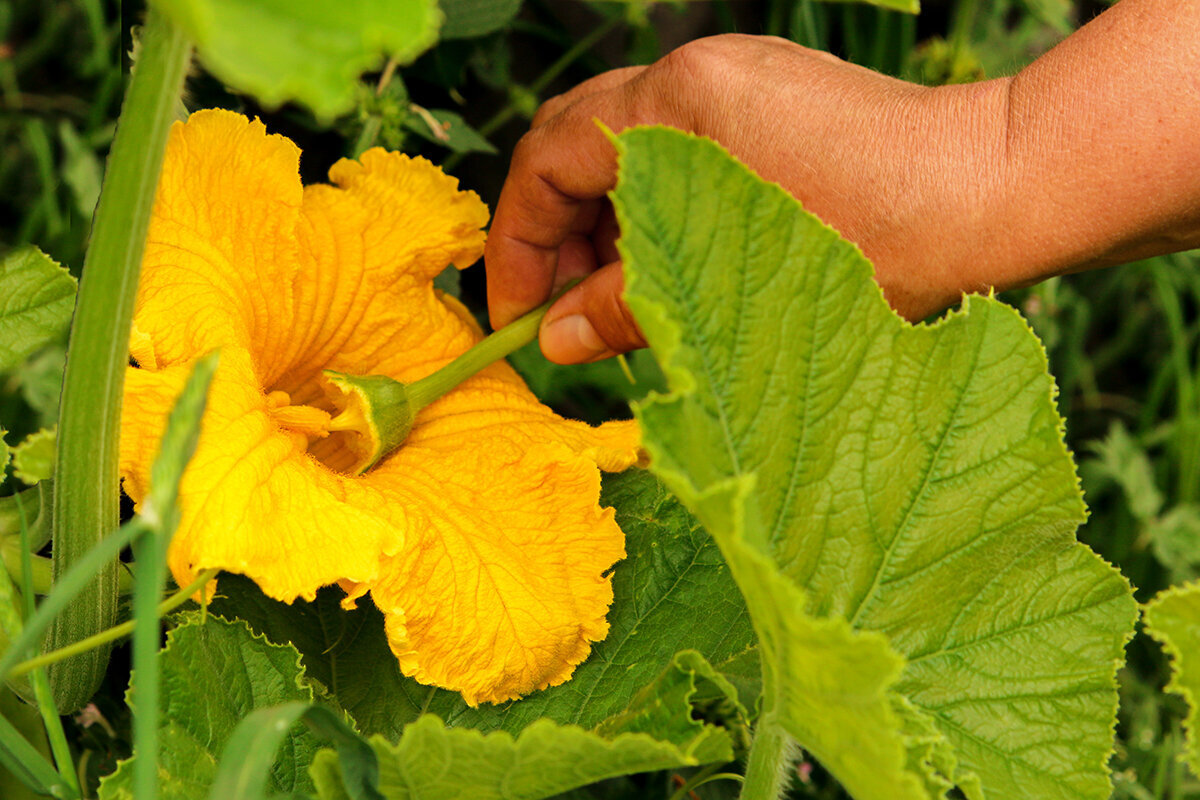
Greenhouse growing / pollen transfer
How to Pollinate Greenhouse Plants Properly
A greenhouse protects flowers but reduces their natural movement. Provide only the pollen transfer that each crop actually needs.
Outdoors, every flower sits in a moving environment: wind bends stems, bees land and depart, and pollen reaches its destination through many brief contacts. Under glass, that choreography is quieter. Sometimes the gardener must replace the missing movement.
That does not mean every greenhouse crop needs a brush, electric tool or bumblebee colony. Pollination is crop-specific. In tomatoes, anthers and stigma sit within the same flower, so a gentle impulse that releases ripe pollen is most useful. Squash plants, including pumpkins and many standard cucumbers, have separate male and female flowers. Here pollen must travel a visible distance. Strawberries can self-pollinate, but benefit from pollen being spread widely across the flower centre for evenly formed fruit.
Plan the climate before the workload. Roof vents, thoughtful shading and an orderly planting layout are not decorative extras during flowering. They limit heat stress, support favourable pollen conditions and make regular checks easier. A carefully designed structure such as the Classic aluminium greenhouse gives home growers a calm, lasting setting where ventilation, access and crop care work together. Explore further versions and design options in the Classic aluminium greenhouse range and the overview of the Classic aluminium greenhouse.
The key sequence
Pollination, fertilisation and fruit set are different processes.
They follow one another. Separating the terms avoids a common greenhouse mistake: intensifying hand pollination even though heat, uneven watering, nutrition or an unsuitable variety is the real problem.
01
Release
Ripe pollen leaves the anthers02
Transfer
Pollen reaches the stigma03
Reception
The pollen tube starts growing04
Set
The ovary starts swellingRelease
Anthers must mature and release usable pollen. Cool nights, intense heat, very humid air and plant stress can disrupt this stage before pollen is moved at all.
Transfer
Wind, vibration, an insect, a soft brush or direct contact between two flowers can place pollen on a receptive stigma. The crop determines which mechanism is suitable.
Reception
After landing, a pollen tube grows towards the ovary. This unseen process bridges pollination and fertilisation and is also sensitive to poor growing conditions.
Set
After fertilisation, ovules develop and the surrounding ovary enlarges. The plant must still nourish and retain the young fruit when later stress occurs.
Use the flower as your first diagnostic tool. If a flower drops without the ovary swelling, pollen transfer may have failed. Hot days, unsuitable night temperatures, sudden water stress or excess nitrogen can also be responsible. Successful transfer does not yet guarantee harvest-ready fruit.
Identify the flower before intervening
One greenhouse, several flower architectures.
The right method follows flower biology, not simply the vegetable name. Tomatoes, peppers and aubergines are largely self-fertile, though their pollen benefits from movement. In squash crops, pollen usually needs to travel from a male to a female flower. Strawberry flowers have many individual fruitlets, so incomplete pollination can later produce an uneven berry.
Some cucumbers bred for greenhouse cultivation are an important exception. They are parthenocarpic and set fruit without pollination. Unwanted cross-pollination can encourage seeds and misshapen fruit. Check the seed packet, plant label or variety description before admitting insects or transferring pollen by hand.
Pollen routes
United flower parts
→
Nightshades: vibrate gently
Male and female flowers
→
Squash crops: transfer precisely
Many reception points
→
Strawberries: encourage insect visits
Fruit set without pollen
→
Parthenocarpic: manage climate
Tomatoes, peppers and aubergines: The anthers and stigma are in the same flower. Controlled movement helps release pollen, so gentle vibration or moderate airflow is usually more effective than brushing every flower.
Pumpkins, melons and standard cucumbers: Fresh pollen must move from a newly opened male flower to an equally fresh female flower. As the opening period is short, close observation and timing matter more than force.
Strawberries: Each flower carries many individual fruitlets. Repeated insect contacts can spread pollen across the centre and contribute to an evenly filled, well-shaped berry.
Parthenocarpic varieties: These varieties change the task completely. Instead of creating more pollen movement, focus on even watering, healthy roots, air exchange, temperature management and the specific guidance from the seed or young-plant supplier.
United flower organs
Tomato-type flower
Anthers surround the central stigma.
Separate flowers
Squash flower
Male pollen meets the female stigma.
Many reception points
Strawberry flower
Many fruitlets form one berry.
For tomato-type flowers, pollen can be released by briefly tapping the support string or gently vibrating a flower truss. This leaves delicate individual flowers untouched and unbruised.
In squash crops, the small immature fruit immediately behind a female flower is the clearest identifying feature. Male and female flowers must both be freshly open for transfer.
A misshapen strawberry can indicate incomplete pollination. Pests, frost damage, disease, overcrowding and root-zone stress may, however, create a similar appearance.
A practical workshop
Choose the smallest effective intervention.
Clean tools, dry hands and a light touch protect delicate flowers. Work deliberately rather than vigorously: crushed flowers, bent trusses and repeatedly worked blooms do not improve yield.
≈
Tomatoes, peppers and aubergines: vibration
These crops can usually pollinate within the same flower. In a still greenhouse, the necessary movement may be missing. On a dry, mild day, tap the support string or the flower truss stem carefully. An electric toothbrush or small pollinator can also provide a brief impulse. Apply it lightly at the stem base and never press directly against an individual flower.
- Work on open flowers, not closed buds or young fruit.
- A brief, gentle movement is enough. Vigorous shaking damages stems and can cause flowers to drop.
- In favourable conditions, a fine yellow pollen dust may be visible on tomatoes, but seeing it is not essential.
- Provide air exchange without exposing plants to a harsh current that damages flowers or dries the crop unnecessarily.
↔
Pumpkins, melons and standard cucumbers: direct transfer
Choose a newly opened male flower whose anthers visibly carry pollen. Carefully fold back or remove its petals. Alternatively, collect pollen with a clean, soft artist’s brush. Dab it gently onto the stigma of a freshly opened female flower. The small ovary directly behind the female flower makes identification straightforward.
- Work in the morning while both flowers are fully open and the pollen and stigmas are fresh.
- One male flower can serve several female flowers, but only while enough pollen remains available.
- Loosely mark a hand-pollinated flower if you want to track its development.
- Do not hand-pollinate a cucumber labelled parthenocarpic.
✦
Strawberries: spread rather than merely touch
A strawberry is not pollinated at one single point. Its flower has numerous fruitlets, and patchy distribution can contribute to small or unevenly shaped berries. Where access, weather and crop management allow, repeated visits by natural pollinators are usually more effective than brushing every flower once.
- Open access only when weather, pest pressure and crop management make it sensible.
- Avoid bee-harmful treatments during flowering and always follow the product label.
- Reserve a brush for a few plants, controlled crosses or brief periods of low insect activity.
- Check malformed berries for pest, frost and growth stress as well as pollination problems.
○
Herbs and seed: define the harvest goal
Basil, coriander, dill and many other herbs do not need pollinated flowers when you are harvesting leaves. If you want to save seed, flowering, pollination type and possible crosses become important. If needed, keep flowering herbs separate from productive leafy plants so energy continues to go into fresh foliage rather than seed.
- For seed saving, establish whether the species self-pollinates or crosses readily.
- For controlled propagation, use suitable separation, isolation or deliberate hand pollination.
- Do not mistake flowering in leafy herbs for failed pollination; it is often bolting.
A lasting framework for varied crops is provided by the Classic aluminium greenhouse with an accessible interior for plant care, watering and carefully managed ventilation.
A time window, not a fixed hour
Use the morning and read the weather and crop.
Freshly opened squash flowers offer only a limited window each day, often in the morning. Tomatoes can often be moved later in the morning when flowers are dry and pollen releases well. No clock replaces observation: a cool, humid morning behaves very differently from a bright, dry July day with rapidly rising temperatures.
Start of dayCheck squash flowers and condensation.
MorningTransfer fresh pollen precisely.
Later morningGently vibrate tomato trusses.
AfternoonVentilate, shade and observe.
EveningCheck water status and temperature.
Squash flowers are best handled shortly after opening. Tomato-type flowers can often be gently vibrated later in the morning, when humid air binds pollen less strongly. If flowers look wet, the crop already seems heat-stressed or air exchange is lacking, correct the internal climate first. Return to the flowers at a more suitable time.
- Humidity Very humid, still air can make pollen clump instead of falling freely from the anthers. Do not spray flowers. Improve air exchange and water as close to the root zone as possible.
- Heat Sharp temperature peaks can stress flowers and fruit set. Open roof vents and the door in good time, and use suitable shading where needed. Ventilation and heat protection matter as much during flowering as the pollen transfer itself.
- Cool nights Low night temperatures can impair pollen formation, fertilisation and growth. Do not assume more frequent vibration can compensate for an unsuitable temperature pattern. Assess several flower trusses over several days.
- Water balance An evenly moist root zone supports stable plant function. Alternating drought and waterlogging can encourage flower drop and later fruit problems, even when pollen successfully reached the stigma.
A calm, forward-looking climate strategy is more effective long-term. The Classic aluminium greenhouse creates a controllable setting for ventilation, shading and watering routines through Malta’s bright spring and summer weather.
Read the signs correctly
Check fruit set: not every shape defect starts with pollen.
The flower is a moment; the fruit is a record. Observe whether a flower drops without visible swelling, whether a young fruit first grows and later stops, or whether distortions affect individual fruit or the whole crop. Also check whether the pattern matches a hot spell, dry days, pest damage or a sudden fertiliser change.
Stable transferOvary grows evenly.
Flower dropsCheck climate and transfer.
Uneven shapeCheck pollination and stress.
Young fruit stopsInvestigate later crop stress.
Read the sequence like this: Fading petals followed by steady swelling of the ovary are a good sign, but crop care is not over. A cleanly dropped flower can point to poor transfer or stressful temperatures. A misshapen strawberry, cucumber or squash fruit can result from incomplete pollination, but pest feeding, water stress and other growth disorders also deserve attention. If young fruit grows first and only later stops, the clues point more towards subsequent heat, watering or vigour problems.
When insects are part of the answer
Allow access thoughtfully and manage it carefully.
Bumblebees can pollinate tomato flowers effectively through vibration. Repeated insect visits are also valuable for strawberries and pollination-dependent squash crops. In a small private greenhouse, an open door and vents can admit natural visitors in mild, dry weather, provided this neither disrupts temperature management nor raises pest pressure too much.
Introducing a bumblebee colony is a specialist crop decision, not an automatic improvement for a home garden. It requires a suitable source, correct placement, a coordinated plant-protection strategy and attention to supplier guidance. Never catch wild bees to release in the greenhouse. For every plant-protection product, the label and directions are decisive. In particular, avoid treating open flowers or spraying during active flight times unless the use is expressly permitted and compatible with pollinator protection.
Good access begins outside the greenhouse. A varied flowering garden managed with restraint offers food through the season. Keep indoor paths clear and do not close every opening in suitable weather. The Classic aluminium greenhouse offers a high-quality setting for different garden situations. The carefully planned construction of the Classic aluminium greenhouse supports clear plant arrangement and considered adjustments to ventilation and access during flowering.
A repeatable flowering routine
Ten calm minutes, three times a week.
In a mixed greenhouse, consistency is more helpful than one large effort. Give every crop exactly the transfer it needs, then return to climate, water balance and plant health.
- Check at the right time. See which crops have freshly opened flowers. Morning is usually favourable for squash crops; tomatoes often benefit from movement later in the morning, once flowers are dry.
- Determine the flower mode. Are you looking at a self-fertile flower, separate male and female flowers, a strawberry flower with many reception points, or a parthenocarpic variety needing no pollen transfer at all?
- Carry out the right measure. Lightly tap or vibrate tomato-type trusses. Pollinate standard squash varieties precisely. Make strawberries accessible to visitors. Leave parthenocarpic cucumbers alone.
- Check the climate before leaving. Read the thermometer, inspect the root zone and adjust ventilation. Pollination cannot be separated from the environment in which pollen and stigma remain functional.
- Assess fruit again later. Watch for swelling ovaries, repeated flower drop and characteristic distortion patterns. Change crop management only when several observations provide reliable clues.
Frequently asked questions
Greenhouse pollination explained clearly.
Can I pollinate all greenhouse plants with a brush?
No. A soft brush suits pollen transfer between separate male and female flowers in squash crops and, where needed, a few strawberry flowers. For tomatoes, peppers and aubergines, it is usually not the most efficient choice; gentle vibration of the flower truss better suits their biology. For parthenocarpic cucumbers that set fruit without fertilisation, hand pollination would be the wrong approach.
How often should I vibrate tomato flowers?
A moderate routine during active flowering is normally enough. Treat freshly opened flower trusses several times a week with a short, gentle impulse. More frequent or stronger shaking does not guarantee greater yield. If fruit set remains weak, check temperature, humidity, ventilation, water supply, nutrition and variety suitability rather than continually increasing mechanical action.
Should I spray flowers for better pollination?
Usually not. Wet conditions can make pollen clump and permanently damp foliage increases disease risk. If the greenhouse is very humid, improve air exchange and avoid overhead watering during flowering. Water directly at the root zone where possible and keep open flowers dry.
Why do greenhouse cucumbers flower but produce no fruit?
First check whether the variety is pollination-dependent or parthenocarpic. Standard varieties usually require transfer from a male to a female flower. Parthenocarpic greenhouse cucumbers set fruit without pollination. If they fail to set, temperature, light, root conditions, water stress or general plant vigour are more likely causes than missing pollen.
Can the greenhouse remain closed during flowering?
Yes, if you provide the necessary pollen transfer in another way. Tomatoes can be vibrated by hand and pollination-dependent squash crops can be pollinated precisely. A closed greenhouse still needs effective ventilation to control temperature and humidity. If you rely on insects, they need safe access and a clearly findable exit.
Sources and further reading
Knowledge behind pollen transfer.
More from Bloomcabin: Premium aluminium greenhouses for Maltese gardens · Classic aluminium greenhouse · Frequently asked questions about aluminium greenhouses
- Chamber of Agriculture North Rhine-Westphalia – low tomato yields, ventilation, humidity and fruit set in small greenhouses:Low tomato yields in small greenhouses
- Chamber of Agriculture North Rhine-Westphalia – tomato flowering, vibration and climate influences:All about tomatoes
- University of Minnesota Extension – pollination needs of different crops and parthenocarpic cucumbers:Fruits and Vegetables That Require Pollination
- University of Minnesota Extension – identifying male and female cucumber flowers and growing guidance:Growing Cucumbers in Home Gardens
- Royal Horticultural Society – additional guidance on tomato growing and pollination under glass:How to Grow Tomatoes
- Chamber of Agriculture North Rhine-Westphalia – practical advice on tomato problems in small greenhouses:Low tomato yields in small greenhouses
- Chamber of Agriculture North Rhine-Westphalia – tomato flowering, fruit set, watering and climate management:All about tomatoes
Complete the transfer
The greenhouse protects the flower – you provide the right movement.
Identify the flower type, choose the lightest effective transfer and check young fruit set before changing course. This calm, repeatable rhythm is the basis for rewarding greenhouse harvests.
01
Identify the flower
Identify the flower
02
Choose the transfer
Choose the transfer
03
Check fruit set later
Check fruit set later
