
LED Strips or Spotlights Under a Pergola: Key Differences
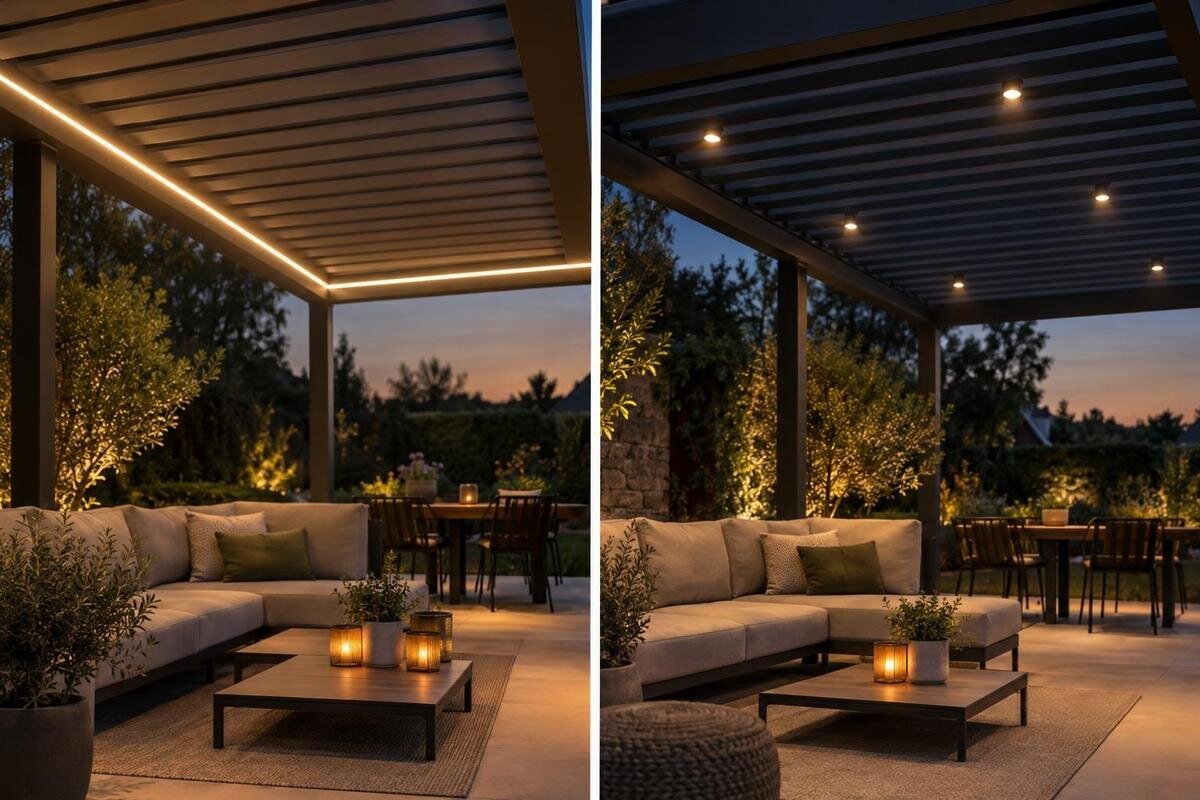
Pergola lighting guide
Choosing between LED strips and spotlights under a pergola is mainly a question of how light reaches the table, seating and circulation areas—and which fitting positions the structure actually supports. A strip gives a continuous linear source; spotlights make separate beams. Neither guarantees even, comfortable light: optics, spacing, mounting direction, roof geometry and where people sit all matter. Ask to see the proposed layout with the exact fittings identified, rather than relying on a product photograph or the words “strip” and “spotlight”. This comparison focuses on spread, glare and replacement access, differences that are easy to overlook before ordering.

Before you choose 1
The basic difference: a continuous line or separate beams
An LED strip is a linear light source, often seen as a line along an edge or inside a channel. Light is emitted along the run, but the result beneath it depends on the lens or diffuser, profile and orientation; a continuous-looking line does not mean the whole seating area receives uniform illumination. Without a diffuser, individual LEDs may be visible. A lens can soften their appearance, but it also affects how light leaves the fitting. A spotlight is a separate fitting that directs light into a beam. That beam may be broad or narrow, and the fitting may be fixed or adjustable. These details belong to the exact fixture, not to its general label.
The practical contrast is one extended source versus separate points, not simply “ambient” versus “task” lighting. A strip can be visually prominent if it is directly visible, while several spotlights may provide more even coverage if their beams overlap. Either option can leave bright and dim patches if its position or spacing is unsuitable. Also distinguish the source you see from the light arriving at the table: a bright line may not illuminate the intended surface as expected. When considering the Bloomcabin Pergola, compare the proposed lighting configuration rather than assuming that either fixture type is included. Establish which fittings are offered before comparing their effects.
How each option spreads light across a seating area
Begin with the surfaces, not the fixture count. Mark the table, chairs, sofa and walking route on a plan, then decide which areas need usable light. A strip along one perimeter beam may illuminate a long edge while leaving the table centre or opposite side less well lit; its direction and distance from the target matter. A spotlight aimed at a tabletop can create a distinct pool but leave the route between seats darker. Consider faces as well as horizontal surfaces: light that makes the floor visible may still leave faces in shadow, or the reverse.
Request a drawing that shows each strip run, its ends and joins, or every spotlight position, beam direction and intended target. Ask for distribution information for the exact fitting if the manufacturer provides it; a similar-looking product image is not a substitute. Avoid comparing wattage alone, since power consumption does not describe where or how broadly light is distributed. For a lighting proposal alongside the bioclimatic pergola model, relate the proposed positions to the table and seating rather than judging the fittings in isolation. The drawing should show whether the proposal works with the furniture arranged as it is normally used, including chairs pulled out from the table.
Before you choose 2
Which fitting positions the pergola can support
Mounting suitability is separate from optical preference. A strip may require an approved continuous channel, a particular orientation or a specific driver position; a spotlight may need an approved fixing point and clearance around its body. None of these allowances can be inferred from a generic pergola picture. Ask the manufacturer or supplier to identify permitted light positions for the exact model and roof layout. Keep the position drawing with the fixture instructions so the electrical professional can review the proposed design before work begins. An arbitrary position chosen on site should not be treated as equivalent to documented approval.
If any part of the roof moves, ask how each fitting and associated cable will remain clear through its full range of movement, and how access for maintenance will be preserved. This matters near blades or sliding parts: a static rendering cannot demonstrate clearance. Do not assume a profile can be drilled or that an underside is designed to carry a light. A wall-mounted format may also affect the positions available because its wall-facing edge and supports differ. If considering the Bloomcabin Wall Pergola, have the permitted positions marked on the plan for the exact model and site, including any restrictions along the wall-facing edge.
Glare depends on sightlines as well as fixture type
Judge glare from real sightlines, not only from how a fixture looks when standing directly beneath it. From a chair, a spotlight can appear as a concentrated bright point if its source is visible; a strip can create a long bright line across the view. A diffuser, recess or shield may alter what people see, but it needs to be part of the chosen fitting and approved mounting arrangement. Position, brightness, orientation and surrounding contrast all matter. The same fixture may be comfortable from one seat and distracting from another, so include normal seating positions, entrances and approach views in the comparison.
Mark seated eye positions on the proposed layout and assess whether the light source would be visible from those directions. Consider reflections from glossy tableware, glass doors or other surfaces; these may be distracting even when the fitting itself is out of direct view. Compare the strip and spotlight at similar useful light levels rather than dimming one much lower and declaring its fixture type better. Dimming may help manage output when the exact components are compatible, but it cannot correct a poorly placed source. For the regular pergola model, use the intended seating plan to compare these views, rather than relying on a photograph taken from outside the seating area.

Before you choose 3
Even coverage depends on beams, gaps and shadows
Uniformity is about how brightness changes across neighbouring areas, not simply whether a beam lands in the middle. With a strip, breaks at run ends, corners or joins may show, and a run beside one beam may leave the other side less illuminated. With spotlights, beam angle, mounting distance, direction and spacing determine whether pools overlap or leave darker gaps. A broad beam may spill beyond its intended target; a narrow beam may emphasise one object and increase the contrast around it. Ask for information about the exact optics rather than assuming all strips or spotlights behave alike.
Shadows matter too. A line source on one side can cast a long shadow; several spotlights aimed from similar directions can repeat or reinforce it. Posts, roof slats, furniture and plants also interrupt light, while open sides provide less reflected light than an enclosed room. If the roof can change position, compare the light pattern in the setting you expect to use after dark; a changed angle may shift what the fixture illuminates. When reviewing a lighting layout for the Bloomcabin Bioclimatic Pergola, identify the roof position used in the comparison so that differences in coverage are not mistaken for differences between fixture types.
Replacement parts and access for maintenance
Replaceability is a system-design question, not an automatic advantage for either type. A strip might be a replaceable tape seated in a channel, a sealed linear module or part of a custom assembly. A spotlight might accept a replaceable lamp or use an integrated LED unit. Similar-looking fittings can differ, so check the exact installation and maintenance instructions: which component can be replaced, whether a damaged section can be changed independently, and whether the driver or control gear can be reached. A visible diffuser or trim does not prove that the light source is user-replaceable. Do not base future repair plans on the words “strip” or “spotlight”.
Ask who the manufacturer says should service the system, how they will reach it and whether access requires removing roof parts, furniture or other fittings. Check that component references are recorded so a compatible replacement can be identified later; a generic substitute may not match the driver or controls. A long channel may require access along its run, while an individual spotlight may still be sealed or difficult to reach. For the wall-mounted pergola model, pay particular attention to maintenance access at the wall-facing edge. Compare access to the light source, driver and controls separately: reaching the visible fitting does not necessarily mean every component is accessible.
Before you choose 4
Controls and dimming depend on the exact system
Do not assume strips dim and spotlights do not, or that two types will work with the same control. Dimming depends on the exact LED driver, fitting and control system being compatible. Ask which controller is specified, what dimming method is supported and whether the stated low and full settings apply to all selected fixtures. If low-level light or gradual adjustment matters, request a demonstration of the actual configuration or written confirmation from the supplier. A generic feature list for a similar product is not enough: changing one component may affect the rest of a linked system. The manuals should identify compatible parts.
Separate switching can let you use a line source or selected spots independently, but only if the fittings, controls and electrical design provide separate zones. A mixed arrangement may offer flexibility, yet it adds components and questions about matching brightness, colour, control behaviour and future service. Ask which lights operate together, whether the controls can be changed later and what would need attention if a driver failed. Electrical design and connection decisions belong with a qualified professional using the exact manuals. Alongside the Bloomcabin Pergola product page, review an itemised lighting proposal that identifies the fittings, drivers and controls included, rather than assuming they form part of the pergola package.
Check outdoor suitability and maintenance requirements
Outdoor suitability covers the full lighting system, not only the visible fitting. Even beneath a pergola, a light may face wind-driven rain, dust, strong sun or water running off nearby surfaces; a roof does not automatically make the area dry. Check the exact fixture’s outdoor rating and permitted exposure in its instructions, including its driver, power supply, connectors and cable entries. A strip’s end caps and connections deserve the same attention as its illuminated length; a spotlight housing alone does not describe the whole system. At a coastal or particularly exposed site, ask whether the manufacturer addresses salt deposits and suitable maintenance. Do not choose on a generic “outdoor” label alone.
A fitting that is difficult to reach may also be difficult to inspect or replace. Ask how to clean it, what must remain accessible and whether maintenance could interfere with moving roof parts. Follow the product instructions rather than wetting or opening a fitting based on its appearance. Conditions can differ across one pergola: an outer edge may receive more sun or driving rain than a sheltered point, so an approved location should match the actual exposure. When considering the bioclimatic pergola product page, assess the proposed lighting separately for these conditions. Have the supplier and a qualified electrical professional match the complete lighting system to the intended positions.

Before you choose 5
Make a fair side-by-side comparison
Use one drawing and two exact fixture schedules. Mark the pergola outline, supports, seating, table and normal circulation route; then show the full strip run or each spotlight, its direction and its intended surface. Note where each source will be visible from seated positions. Ask for exact fixture names, quantities, output and beam information where supplied, outdoor rating, mounting approval, and whether the driver or controller is included. Record anything unconfirmed as unknown rather than filling gaps with a photograph or a familiar-looking product. This keeps the comparison focused on actual configurations, not idealised renderings.
Use the same practical tests for both options. Is the table visible without a bright source in the main sightline? Is there useful light on the route between seats? Do spotlight pools meet where needed, and does a strip leave a darker area opposite its run? Can a technician reach each fitting and associated driver later? Does the light clear any roof movement? If possible, review the exact fitting under comparable conditions after dark; otherwise ask for a lighting layout based on documented data. A demonstration with different fittings, settings or positions will not isolate the real difference between strips and spotlights.
Choose according to the intended light pattern
A strip is a reasonable candidate when a confirmed continuous mounting position lines up with the area to be lit and you want the source to read as a linear feature. It may suit a long edge where separate points would be visually busy, provided the exact beam and output reach the intended surfaces. It is not automatically better over a long table: one-sided placement, a visible bright line or a channel too far from the target can defeat that aim. Ask the supplier to show the proposed run on the exact pergola and in relation to the usual furniture layout.
Spotlights make sense when approved positions and documented beam patterns correspond to selected areas, and you prefer separate points of light. They can leave gaps, create bright pools or cause glare when spacing and aiming are wrong. Fixed fittings will not follow furniture if the layout changes, so consider whether the same targets remain useful for different gatherings. If neither approach alone meets the brief, ask whether a combination is approved and how it will be controlled and serviced. The better option is the one whose actual position, light pattern and access match the way you use the pergola, not simply the one with broader claims.
Frequently asked questions
Do LED strips give more even light than spotlights?
A strip creates a continuous line of light, but that does not guarantee even illumination across a table or seating area. Its position, lens, output and direction all matter. Spotlights can overlap to smooth out separate pools, or leave darker gaps. Compare the proposed layouts using the exact fittings.
Are LED strips less likely to cause glare?
Neither type is automatically more comfortable to look at. A spotlight can appear as a bright point, while a strip can form a bright line if it is directly visible. Check the view from the places where people sit, and confirm any diffuser or shielding is part of the chosen fitting.
Are spotlights easier to replace than LED strips?
Not necessarily. Some spotlights have replaceable lamps; others use integrated LED units. Strips also vary: a section may be replaceable, or the light may be part of a sealed assembly. Check the exact maintenance instructions, service access and replacement-component details before choosing.
Can I combine LED strips and spotlights?
A mixed arrangement may be possible, but the exact fittings, mounting positions, controls and electrical design must support it. Ask whether each type can be controlled independently and how the system will be maintained. Do not assume that a combination shown in a photograph is approved for your pergola.
Can lights be added after a pergola is installed?
Possibly, but do not assume that any beam or profile can take a fitting. Check the pergola manufacturer’s approved mounting positions and the light’s instructions, including access for future service. Ask the supplier and a qualified electrical professional to confirm the proposed arrangement for the exact model.
LED strips and spotlights shape light in different ways; neither guarantees a particular atmosphere or coverage. A strip creates a linear source, while spotlights create separate beams. Judge those patterns against the pergola’s verified mounting positions, the exact fixture instructions and real seating sightlines. Future access matters as much as the first evening’s appearance. Once the layout shows where light falls, what people see and how the fittings can be serviced, the choice becomes a practical comparison rather than a guess based on fixture labels.
