
How Does a Louvred Pergola Perform in Heavy Rain?
Pergola rain performance
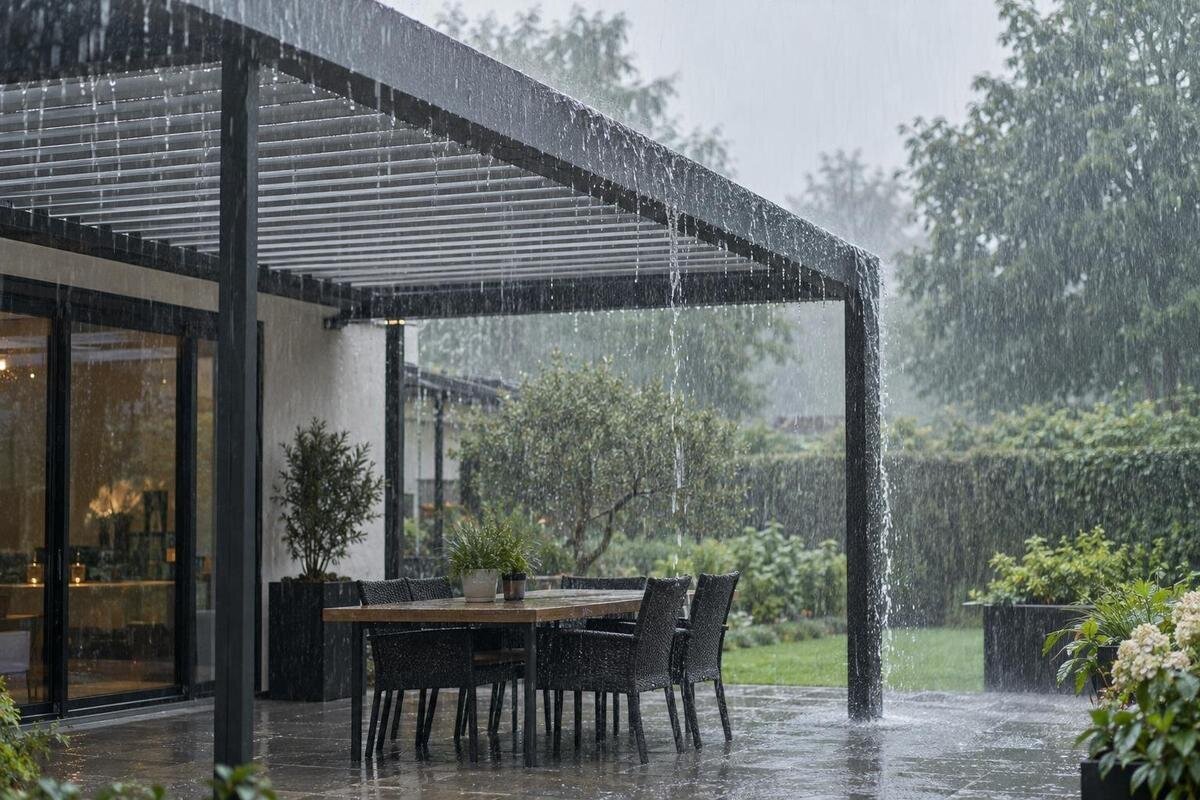
Closed louvres can direct rain towards a pergola’s drainage system, but “watertight in heavy rain” is not a promise to take at face value. Performance depends on the particular roof, how it is closed and installed, rainfall, wind direction, exposed edges and whether water can leave through its intended outlets. A roof that manages rain from above does not necessarily keep an open-sided seating area dry. Before buying, look for information that covers the exact model and configuration rather than relying on a general weatherproof label.
What “watertight” means for a pergola
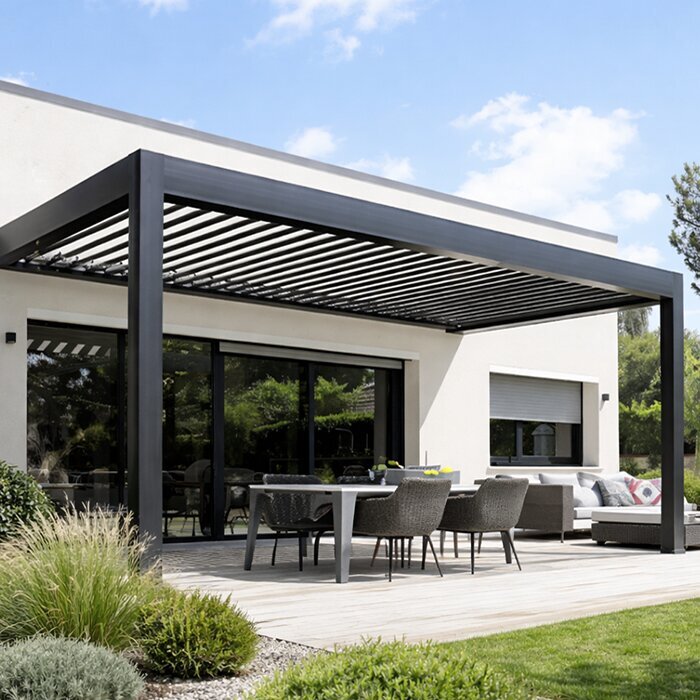
“Watertight” can sound like a clear promise, but it may refer to different outcomes. A roof might be designed to shed rain when its louvres are fully closed; that is not the same as a sealed room that prevents water entering from every direction. Many pergolas have open sides unless a compatible enclosure is fitted, so wind can carry rain beneath the roof edge even when the roof is working as intended. A claim about the roof alone does not mean that the full seating area, its furnishings or the paving will stay dry.
Ask what the claim covers and under which conditions: the rainfall rate and duration, wind direction, roof position, size and whether the sides were open or enclosed. Also ask how the result was judged. Was water entry at the perimeter included, or was the assessment limited to the roof surface and drainage? A controlled observation is useful only when its limits are clear. Without those details, a general phrase such as “weatherproof” does not tell you how the same setup will behave in a prolonged downpour or changing gusts.
How closed louvres guide rain
When louvres are shut, their surfaces can direct rain towards channels or gutters designed for that particular roof. The blades must meet and close as intended; their edges, end pieces and contact points affect where water travels. Collection channels may be part of the design, but their layout and route differ between systems, so do not assume that every louvred canopy drains in the same way. If you are considering the Bloomcabin Wall Pergola, use its drainage drawing to understand the intended sequence: where water leaves the blades, where it is collected and how it reaches an outlet. These are separate stages, rather than a single action described by “the roof drains”. Distinguishing them also makes an explanation of rain performance more useful: it should be clear whether it concerns the closed louvres themselves, the channels that receive the water or the complete route to discharge.
Rain still has to pass through each channel and outlet without backing up. A cloudburst brings a large amount of water in a short time; if it arrives faster than the route can carry it away, water may overflow or escape at an unintended point. An obstructed outlet can also interrupt the route. Ask for a drawing that shows collection points, outlet locations and any intended overflow path, and check whether its guidance assumes the roof is fully closed. Directing rain off the louvres is only one part of managing it.
Why heavy rain tests drainage capacity
“Heavy rain” does not describe one fixed set of conditions. A brief downpour, steady rain lasting for hours and rain pushed beneath an edge by gusts all put different demands on a roof. The amount arriving over time matters, as do the roof area and the route that carries water to an outlet. Two sales descriptions using the same phrase may therefore refer to quite different conditions. Do not infer a universal capacity from words such as “rainproof” or “weather-resistant”; they need an explanation tied to the model and its installed configuration.
Ask for model-specific observations or limits that state the rainfall conditions, duration, roof position, size and drainage arrangement. If a test or demonstration is mentioned, establish what was assessed, where water was observed and whether wind was included. A controlled shower does not automatically show how a roof performs in a gusty storm, and a short observation does not establish its behaviour over a longer period. When considering the Bloomcabin Pergola, read any performance information alongside the configuration it describes. Separate the conditions applied from the result reported: “louvres closed” describes the setup, while an account of where water appeared describes the outcome. Also distinguish an observation of the roof from an observation of the area beneath it. This helps you compare like with like without treating every use of “heavy rain” as an equivalent test or assuming that a product listing establishes a rain limit.
Wind-driven rain can enter from the sides
Rain falling vertically onto a closed roof is different from rain carried sideways by wind. Gusts can send water beneath an exposed edge, through the open sides or towards joints between the roof and a wall. The roof may still direct water from above into its drainage route while wind-driven rain enters the space from the side. This is why a statement about rain handling by the canopy alone cannot confirm how sheltered the seating area will be.
The direction of exposure can change with the site: one side may face a building while another is open to the weather, and nearby structures may affect where rain is driven. Relate that exposure to the area you want to use beneath the roof. A sheltered seat near a wall and a table beside an open edge are not the same question, even though both sit under the canopy. If the Bloomcabin Bioclimatic Pergola is on your shortlist, ask whether its performance information covers rain and wind together, which edges were exposed and whether the assessment used an open-sided or enclosed setup. Describe your intended seating position when discussing those details, rather than asking only whether the roof keeps rain out. The useful distinction is between rain passing through or around the roof and rain entering below its perimeter; a roof-level result does not answer both questions.
Edges and wall junctions need separate checks
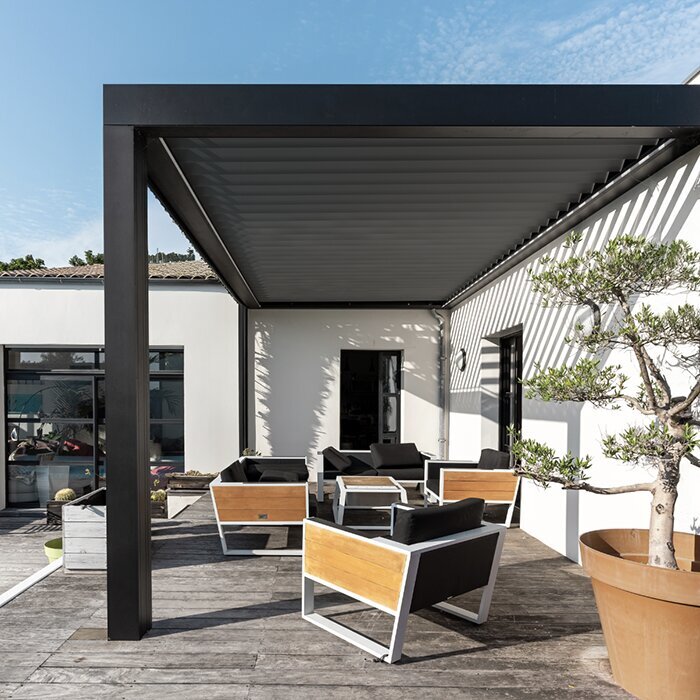
Rain can enter at the perimeter even when the roof is closed. Relevant details may include the ends of the louvres, the roof edge, gaps between components and the junction where a roof meets a wall. The exact details depend on the design, so do not assume that a nearby wall seals the connection or prevents water getting underneath. Rain running down a wall can also reach the junction. Ask to see how the manufacturer intends the edge and wall connection to be finished for the proposed configuration.
Look at where people will sit in relation to the open edges, but do not treat moving furniture inwards as proof that the roof is watertight. A wall may shelter one side while leaving another exposed, and an edge detail can affect where water is discharged. When comparing the wall-mounted pergola option, distinguish the roof-to-wall connection from the roof's other edges. Ask how each junction is intended to be finished and where water reaching it should go. This keeps the discussion specific: shelter provided by the building, the treatment of the connection and drainage from the canopy are different matters. On the proposed layout, identify which edge faces the seating area and which meets the building. That gives the supplier and installer a clear location to discuss, rather than leaving “water at the edge” to mean several possible places. The product listing alone cannot resolve that site-specific detail.
Trace the full drainage route
A useful drainage drawing should show more than where rain lands. It should let you trace water from each roof section into a channel, along the collection route and to an outlet or final discharge point. On some designs, part of that route may be concealed within a support; on others, it may be arranged differently. Ask which components are part of the system and where water is intended to emerge. The drawing should also make clear what happens if the usual route cannot carry all the water, rather than leaving you to assume that excess will drain in the same way.
Consider the surface receiving the runoff as well as the roof. An outlet directed towards a doorway, a narrow strip of paving or the seating area could leave those places wet even if the roof sheds water as intended. For a layout using the Bloomcabin Pergola model, ask the installer to mark the discharge point and explain how outlets can be reached for routine checks. Follow the route all the way to where the water emerges; a concealed section should not leave the final destination unclear. Keep the normal discharge point separate from any intended overflow route when discussing the drawing. Both concern water leaving the structure, but they describe different circumstances. Also identify any outlet whose access could be obstructed by the planned furniture or side panels. The aim is a layout in which the water's destination and the access needed for maintenance are clear before installation.
The exact model and installation matter
Performance information applies to a particular design and set of conditions, not automatically to every product that looks similar. Model, size, roof arrangement, side configuration and installation details can all affect whether the information matches the pergola being considered. If you are comparing the bioclimatic pergola option from Bloomcabin, record the exact model reference alongside the proposed dimensions and configuration. Keep those details together when comparing quotations, rather than relying on a shared product name or a similar appearance. Check whether each quotation describes the same roof arrangement, enclosure and wall connection; otherwise, the proposals may not represent equivalent setups. Where performance information covers a different version, ask which parts apply to your proposal and which remain unaddressed. A model name is useful for identifying the product, but it does not by itself establish a rain limit, drainage arrangement or suitability for a particular site.
The intended closure, joints and drainage route need to work as shown in the relevant instructions. Ask the installer to confirm that the proposed assembly follows the manufacturer’s guidance and that outlets remain accessible. If the finished setup differs from the one covered by the performance information—for example, because of a different enclosure or connection—the original assessment may not apply. Avoid assuming that an adjustment or added component will preserve the same result; check the documented configuration with the supplier and installer before treating it as part of a rain-protection system.
How side enclosures affect rain protection
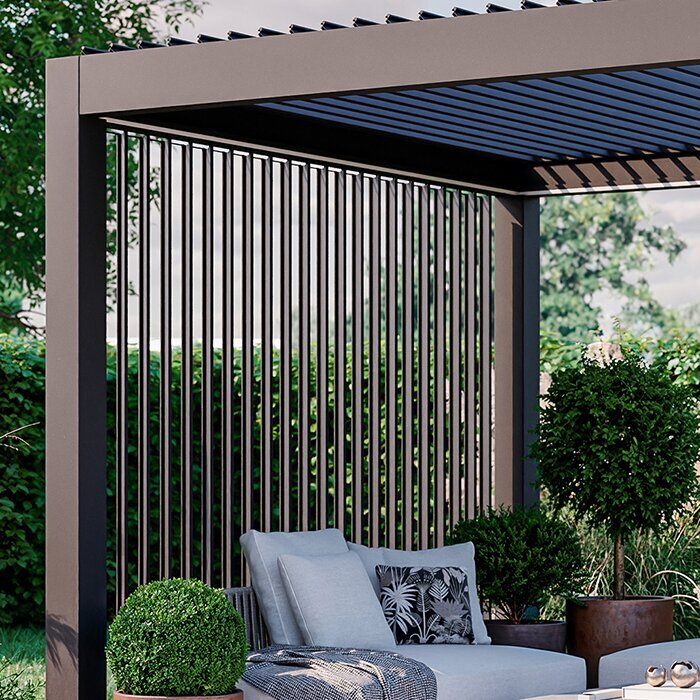
Screens, doors or other side panels may reduce the amount of rain entering from a particular direction, but they do not automatically turn an open pergola into a watertight room. Water can still pass through gaps, meet a panel at a joint or reach the floor around an edge. How much protection an enclosure provides depends on the product and the way its parts meet. Treat the roof, sides and junctions as separate parts of the weather question rather than assuming that a roof-level claim covers them all.
Ask whether the exact roof-and-enclosure combination has documented performance, and whether that information covers the positions in which the panels will be used. A description of an enclosed setup does not necessarily address how you intend to use it with a side open. Adding panels changes how wind and rain interact with the structure, so do not treat an unrelated screen as proof of improved performance. If your proposal includes the Bloomcabin wall-mounted model, establish which enclosure options are compatible before comparing their rain protection. Describe which sides you want enclosed and which openings you expect to use during wet weather. Then discuss the joints between the roof, panels and surrounding edges as part of that same configuration. This avoids treating the enclosure as a separate accessory whose presence alone settles the weather question. The relevant comparison is between complete proposed setups, not simply between a pergola with panels and one without.
Operation and maintenance in wet weather
A louvred roof can only manage rain as intended when it is in the position specified for that purpose. If the louvres are open or partly open, rain may fall through the roof area; moving them after a shower starts may not prevent water entering while they are changing position. Follow the model’s operating instructions, including any guidance for wet or windy conditions, and do not force a mechanism that is not moving normally. Do not assume that a control or automatic feature will close the roof unless the product documentation confirms how it works.
Routine care helps keep the intended water route available. Check which channels and outlets the manufacturer expects you to inspect, and remove debris only in the way its instructions allow. After a heavy shower, note whether water appeared beneath an edge, at a joint or near an outlet; the location can help distinguish wind-driven entry from a drainage issue. Make observations from a safe position, and do not climb onto the roof to inspect it. If water behaviour differs from the documented guidance, record the conditions and seek advice from the supplier or installer.
Questions to ask about rain performance
Bring the main questions together in a short comparison of the models you are considering. For each proposal, record the roof position, size, rainfall conditions, duration and wind conditions covered by its performance information, along with whether the sides were open or enclosed. Use the Bloomcabin Pergola product details to identify the product in that comparison, then keep the information for the proposed configuration alongside it. Distinguish what was assessed from what was observed: did the assessment concern water passing through the roof, the drainage route or the usable space below? If one proposal describes only the roof and another includes the perimeter, do not treat their results as directly equivalent. Leave any unanswered point clearly marked as unknown rather than filling it with an assumption. This makes the comparison useful without reducing several different aspects of rain performance to a single “watertight” label.
Then ask for the drainage drawing and confirm where water exits, how excess water is handled and which parts need routine access. Check how the roof edges and any wall junction are treated, and whether the proposed screens or doors are covered by the same information. A clear answer should distinguish water shed from above from protection against rain driven in from the sides. If those points are not documented, you cannot reliably infer that an open-sided pergola will keep the whole area dry in heavy rain.
Frequently asked questions
Do closed louvres make a pergola watertight?
Not automatically. A closed roof may guide rain into its drainage system, but the roof edges and open sides can still admit water. Check what conditions and parts of the pergola a specific performance claim covers.
Can wind blow rain under a closed louvred roof?
Yes. Rain driven sideways can reach the open perimeter or gaps, even when the louvres are closed. The result depends on wind direction, the site and the pergola’s edge details.
Can heavy rain cause a pergola roof to overflow?
It can, if the water arriving at the drainage route exceeds what that particular system can carry, or if an outlet is obstructed. Ask for the model’s drainage diagram and the conditions covered by its performance information.
Will adding screens or doors keep the whole area dry?
Do not assume so. Side panels can change how rain enters, but gaps and junctions remain relevant. Ask whether the exact roof and enclosure combination has documented performance for the conditions you expect.
What documents should I request before buying?
Ask for model-specific rain-performance information, the conditions used to assess it, a drainage diagram and guidance for the exact side configuration. Check that the information applies to the size and installation being proposed.
The practical question is not simply whether the louvres close. It is whether the exact roof, drainage route and exposed edges have documented performance for the conditions you expect. A pergola may direct rain away from above while still allowing wind-driven rain to enter at the sides; those are different outcomes. If the available information does not explain the test conditions, drainage and side configuration, do not treat a broad “watertight” claim as a guarantee that the whole space will stay dry.
