
Planning Outdoor Sockets Under a Pergola for Everyday Use
Pergola electrical planning
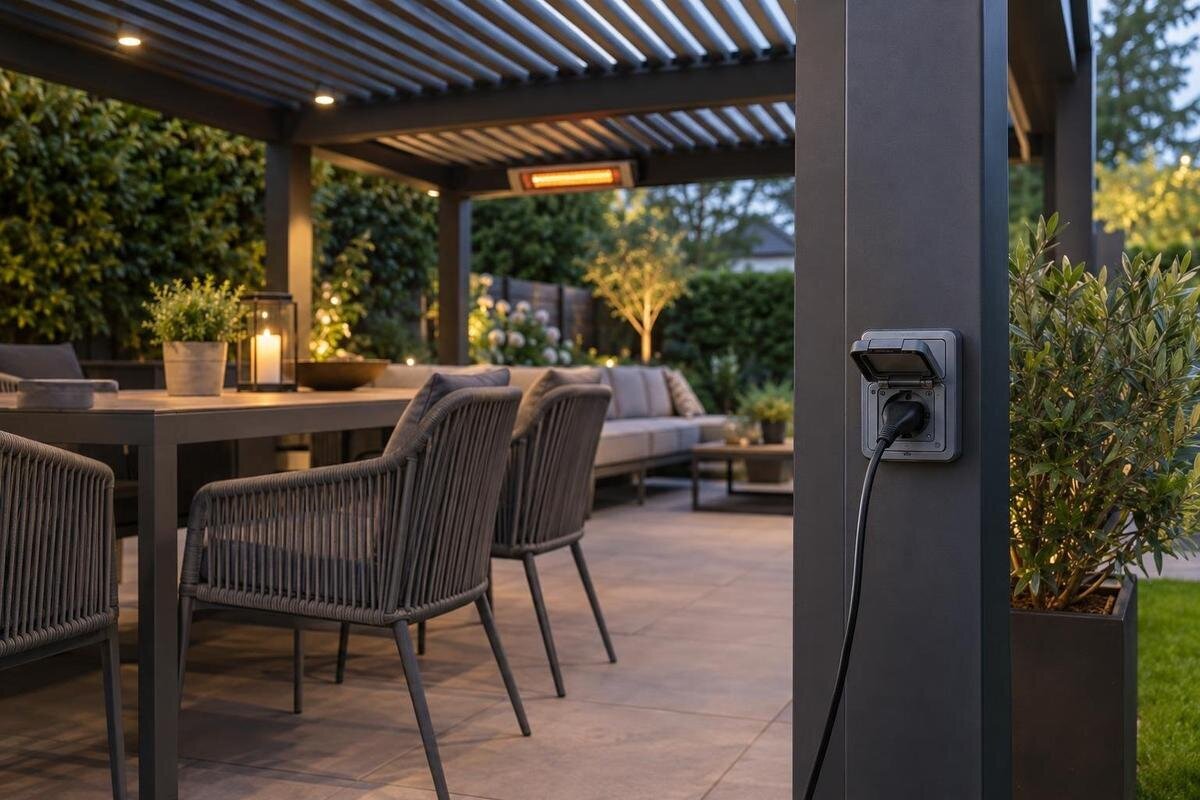
Outdoor sockets beneath a pergola are useful only when their number and position match the way the space is used. Chargers and lamps differ from a fridge, cooking appliance or heater in both location and electrical demand. An open-sided roof does not make the area an indoor room: wind-driven rain, direct sun, dust, cleaning splash and, where relevant, sea spray may affect fittings. Prepare an electrician’s brief with an appliance list, a marked plan and the relevant manuals. The aim is a practical design for a qualified professional to assess, not a DIY wiring plan.

Electrician briefing checklist 1
List every appliance that may need power
Start with a list of everything that may need a connection, separating fixed equipment from items you carry in and out. Everyday examples include phone and laptop chargers, a table lamp, speakers, and power for planned lighting or controls. Occasional use might include an electric cooking appliance, an outdoor fridge, a heater or a garden tool. These are prompts, not assumptions about what belongs beneath your pergola. Record each item’s make and model where known, where you expect to use it, and whether it stays connected or is plugged in only when needed.
Mark whether each appliance is intended for outdoor use and check its instructions for the conditions it allows. A kitchen appliance used under a roof is not automatically suitable for an open-air space, and an outdoor socket cannot make an indoor-only appliance weather-safe. Separate daily use from occasional and future plans so the electrician can distinguish essential locations from optional ones. If lighting or heating is planned, identify the exact fixture or heater and have its manual ready. Do not assume an accessory is included with a pergola or can be added to any frame.
Mark the pergola layout and activity areas
Draw a simple plan showing the pergola and the nearby house or garden. Mark walls, posts, entrances, opening doors, seating, dining or preparation areas, walkways and any nearby water outlets or irrigation. Add the places where portable appliances will actually sit: a socket plan based only on convenient-looking supports may leave someone carrying a lead across a route. If furniture moves, show its usual and occasional positions, or note which arrangement matters most. Include the intended pergola orientation and any fixed features that affect access. For a dining area, show where chairs stand when occupied, not just when tucked beneath the table. For a work or preparation surface, mark the part you expect to use for the appliance. This makes the drawing more useful than a plan showing only the pergola’s outline.
Mark possible socket positions and note which equipment each would serve. Add whether a lead might cross a walkway, whether furniture could hide the point, and any preferred height as a question for the electrician rather than an installation instruction. When considering the Bloomcabin Wall Pergola, put the exact model name on the drawing and ask the supplier or installer to confirm permitted mounting locations. Number the proposed points so everyone can refer to the same position without relying on descriptions such as ‘the socket on the left’. Use those numbers in your appliance list and mark alternatives clearly; the electrician can then distinguish your preferred layout from positions still open for discussion.
Electrician briefing checklist 2
Use appliance labels and manuals for load details
For each appliance, copy the electrical input and connection details shown on its rating label or in its manual. Do not estimate from its appearance or from a similar product. If the instructions describe different operating conditions, pass those details on rather than trying to translate them into a circuit design yourself. Keep the manual for equipment that may have a higher demand or run for long periods, such as a heater, cooking appliance or fridge. A simple table can record the make, model, label details, intended socket position and corresponding manual. If you photograph a label, check that its text is legible and that you can identify the appliance it belongs to. Leave missing information marked as unknown rather than filling it with an estimate. The electrician can use these records to assess the proposed equipment.
Keep the appliance records separate from the pergola details: the Bloomcabin Pergola listing can identify the selected structure, but it is not a source for an appliance’s electrical demand or an accessory’s suitability. If you are still comparing appliances, mark them as provisional and say so. That helps prevent an early sketch from being treated as a final specification. Add the final make and model before the electrical plan is agreed, especially where the use or connection requirements differ between candidates.
Plan for appliances that run at the same time
Describe ordinary combinations rather than counting appliances in isolation. For example, note whether lighting and chargers will be used alongside a fridge, or whether cooking equipment and a heater might be on during the same gathering. Include appliances that run continuously as well as those used briefly. This gives the electrician a realistic picture of demand and avoids a plan based on the assumption that only one item will ever be connected. You could describe a quiet evening, a meal with guests and time spent working outdoors, listing the equipment used on each occasion. Distinguish combinations you genuinely expect from possibilities you have not decided on. If a use is occasional but important, include it rather than leaving it out of the discussion.
More sockets improve access to power, but they do not increase the capacity of the existing supply. Ask the electrician to assess the expected combinations and whether the proposed supply and circuit arrangement suit them. If you are considering the Bloomcabin Bioclimatic Pergola, distinguish any planned powered features from portable appliances in your list. Mark each item as confirmed, optional or a possible later addition, without assuming that it is included with the structure. For a heater or another substantial appliance, provide its exact instructions. This lets the electrician discuss future provision without treating every undecided purchase as part of the agreed design.

Electrician briefing checklist 3
Socket positions and everyday access
Assess possible socket positions against the way people move through the space. A point should be practical for the appliance it serves without encouraging a lead to run across a doorway, the main route between seating and the house, or a place where people prepare food. Note whether it would be easy to reach when the usual furniture is in place. Also mention fixed cupboards, screens or other items that might block access. Consider where a charger and the device being charged would rest, rather than marking only the connection itself. Check the proposed position against both the everyday furniture arrangement and any larger gathering you regularly host. These observations help the electrician judge the location; they do not determine the final mounting height or method.
Think about how people will plug in and unplug items, not just where an appliance sits when it is in use. A point hidden behind a bench may be inconvenient for a charger, while a point near a food or drink preparation area may face a different kind of splash. Do not rely on an extension lead as the permanent answer to a poorly placed socket. There is no universal number or position that suits every pergola: mark your priorities and ask the electrician to resolve them against the site and the equipment.
Assess rain, sun and other exposure at each point
A pergola roof does not make every area beneath it dry. Wind can drive rain through open sides, and water may reach a point through runoff, cleaning or nearby irrigation. Sun, dust and temperature changes can also matter to the selected equipment. If the site is exposed to sea spray, mention that as well. Describe the conditions for each proposed socket rather than writing only that it is outdoors; two positions beneath the same roof may face different exposure because of their orientation and surroundings.
Ask the electrician to select outdoor equipment for the actual position and intended use, including whether a plug will be connected when the point is exposed. An ingress-protection marking relates to specified conditions; it is not a blanket guarantee for every installation or every plugged-in arrangement. A cover is not a substitute for a suitably selected and installed socket. If you are planning around the wall-mounted pergola model, mark the relationship between the wall, open sides and proposed sockets on your exposure sketch. Note any positions whose conditions you are unsure about. Ask the electrician to explain how the selected equipment suits both its unused state and the way you expect to use it.
Electrician briefing checklist 4
Electrical supply and protective devices
Ask the qualified electrician to assess the existing supply and protective arrangements before finalising an outdoor socket plan. Provide any records you already have, but mark anything you do not know; do not assume that an existing indoor circuit can simply serve the new points. Ask how the proposed equipment and expected use affect the design, and whether the outdoor sockets, lighting and higher-demand appliances need different provision. The electrician should base the decision on the actual installation and applicable requirements, not on a general socket-count rule.
Ask which protective measures apply, including residual-current protection, commonly called RCD protection, and appropriate overcurrent protection. Request a plain-language explanation of their roles and which parts of the planned installation they serve. If you are selecting the Bloomcabin Pergola, include that model reference alongside the appliance list so the electrician can relate the electrical proposal to the structure under discussion. At handover, ask how you will identify the protection associated with the outdoor points and what you should do if it trips. Keep those user instructions with the installation records. Fault investigation belongs to the electrician: do not open a socket or attempt electrical checks yourself.
Confirm mounting points and routes with the pergola supplier
Do not assume that a beam, post or other part of the pergola is an approved place to mount a socket, light or other electrical fitting. Ask the supplier or installer for documented confirmation of permitted mounting positions and any relevant requirements for the chosen equipment. Give that information to the electrician so the proposed position can be checked against the actual structure. A convenient-looking surface does not, by itself, prove that an attachment is approved or suitable. Resolve any uncertainty before the electrical work is planned around that location.
If the chosen design has moving parts, a motor or other powered components, tell both professionals and provide the relevant manuals. Ask them to check that the proposed fittings and routes are compatible with the particular model and its operation. When discussing the bioclimatic pergola model, distinguish questions about the structure from questions about electrical equipment: the supplier or installer needs to address permitted attachments, while the electrician assesses the electrical arrangement. Record who will resolve each outstanding point. If an agreed mounting position changes, make sure the drawing and proposal are updated together, rather than leaving the electrician and pergola installer working from different versions.

Electrician briefing checklist 5
Give the electrician a complete written brief
Bring together the site sketch, appliance list, rating-label details, manuals and notes about expected simultaneous use. Add photographs if they help show the surroundings, but label them as context rather than proof of a suitable mounting point or route. Include the pergola’s exact name and configuration so the electrician and supplier are discussing the same structure. If you have chosen the regular Bloomcabin Pergola, include its product reference with the brief. Date the drawing and give the electrician one clearly identified current version. Keep unresolved questions in a short list, with a name against each where responsibility has been agreed. This helps separate decisions already made from details that still need an answer before the proposal is finalised.
Ask for a written description of the proposed socket positions, the equipment selected for each exposure, the protective arrangements and any assumptions about appliance use. Clarify which lighting or other accessories are included in the electrical plan and which are not. Ask what information or approval is still outstanding and what records you will receive at handover. This makes it easier to compare the proposal with your marked plan and reduces the risk of overlooking a future use that you already know matters.
Keep handover information for future use
When the work is complete, keep the electrician’s records, equipment instructions and supplier confirmation with your pergola documents. For a Bloomcabin wall pergola, retain the exact model reference so later enquiries concern the same structure. Ask the electrician to explain the intended use of the sockets, any relevant limits, and what to do if a protective device trips or a fitting is damaged. Make sure you know which points serve which planned uses. Compare the completed positions with the agreed drawing and ask for any changes to be recorded. Keep the final appliance list alongside it, including assumptions about which items may run together. Anyone using the space should be able to find the relevant user instructions without having to reconstruct the original planning discussions.
Take note of visible damage, a loose cover, signs of water ingress or recurring trips, and contact a qualified electrician if these arise. Do not open an enclosure or try to repair a connection yourself. Before adding a heater, cooking appliance or other substantial item later, check its instructions and ask whether the existing design is suitable for the new use. Keeping the appliance list current is a simple way to avoid treating a changed setup as if it were the one originally assessed.
Frequently asked questions
How many sockets do I need under a pergola?
There is no useful fixed number for every layout. Count the appliances you expect to use at once, mark where they will sit and note which points need to be convenient for regular use. Ask the electrician to assess the supply as well as the number and position of sockets; extra outlets do not increase the available electrical capacity.
What weather rating should an outdoor socket have?
The suitable rating depends on the precise position and exposure, including whether rain can reach the point and whether a plug will be connected. Ask the electrician to select equipment for the conditions and to explain what its rating covers. A cover or pergola roof alone is not proof that a socket is suitable.
Can I use an indoor appliance with an outdoor socket?
Do not assume that you can. The socket does not change the appliance’s own suitability for outdoor conditions. Check the appliance instructions for its permitted location and use, and ask the electrician if anything is unclear before planning to use it beneath the pergola.
Do a heater and cooking appliance need separate circuits?
That cannot be decided from the number of sockets alone. Give the electrician the exact appliance models, their manuals and a realistic account of which devices may run together. The electrician can assess the existing supply and decide what circuit arrangement and protection suit the actual equipment and installation.
Can sockets be fixed to pergola posts?
Only if the proposed fixing and location are approved for the particular pergola and confirmed as suitable by the electrician. A post that looks convenient is not automatically an approved mounting point. Check with the pergola supplier or installer before the electrician finalises the position.
A useful socket plan connects everyday routines with the conditions at each point and the actual appliances you intend to use. Give the electrician that information alongside the pergola supplier’s mounting guidance, and revisit the plan before adding equipment that could change the expected electrical demand.
