
Rotating or Retractable Pergola Louvres: How Each Roof Opens
Pergola roof guide
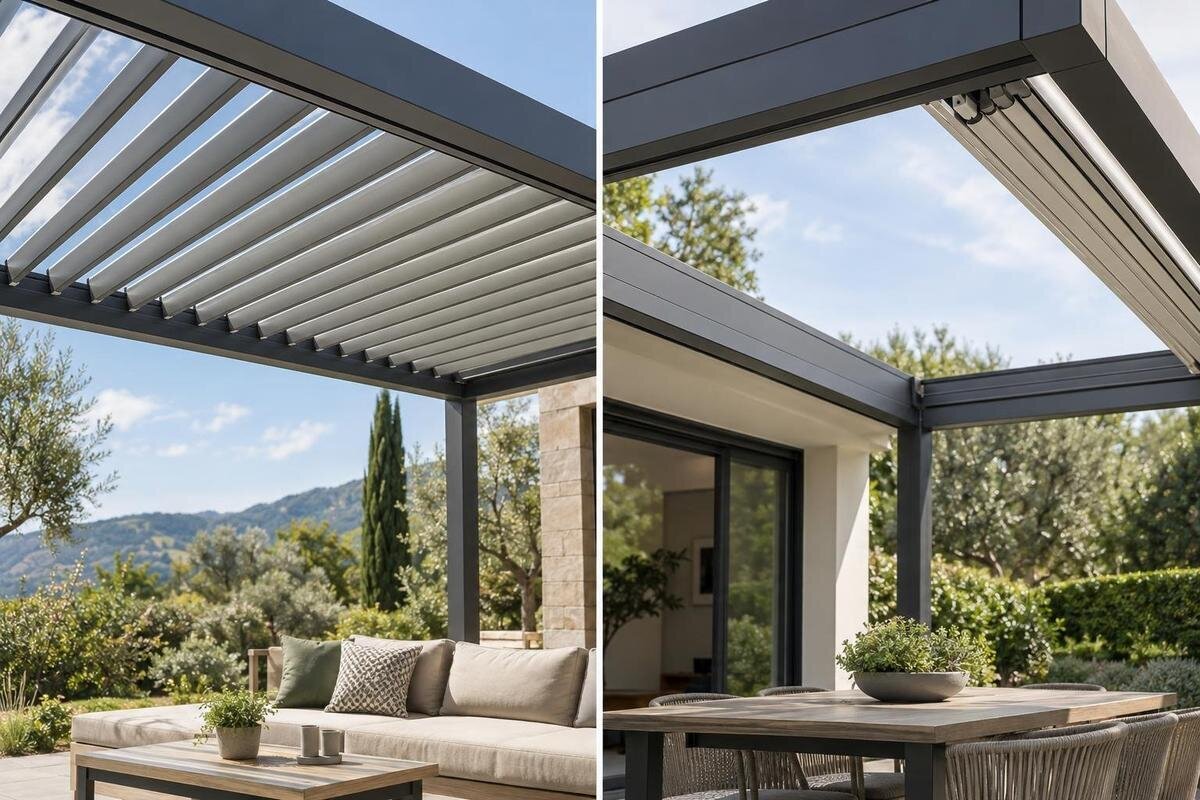
Rotating and retractable pergola roofs both move, but they do not create the same opening. Rotating louvres pivot while remaining over the roof area; retractable elements travel away from part of it. That difference affects how much of the sky is visible, where the moving parts finish and how shade changes over a table or seating area. Here is how to read each mechanism and what to confirm in the drawing for the exact model.

The difference is where the roof elements move
The defining difference is what moves overhead. In a rotation-only louvre roof, each blade turns around a pivot but stays within the roof area; its changing angle alters the gaps between blades. A retractable roof moves elements away from some part of that area, leaving a patch where the covering has been drawn back. So 'open' can mean angled blades with spaces between them, or a roof area that has been cleared. Retractable systems may slide, fold or use another arrangement; only the model’s drawing shows which. Neither term alone tells you how far the roof opens or how much remains above. If a product page is unclear, ask for an open-position view rather than guessing from a closed roof.
Keep the roof element separate from its movement. A louvre is a blade; 'retractable' describes movement and does not guarantee that the moving elements are louvres. Some systems may combine pivoting and travel, but do not infer that from a product name or photograph. A 'bioclimatic' label is not a mechanism diagram either. When comparing models, ask what moves, along what path and where it finishes in the open position. Two roofs may both be described as open even though one still spans the terrace with blades and the other clears part of the span. The operating method is another separate detail to confirm.
Rotating louvres change angle and stay overhead
In a rotation-only system, each blade turns around an axis without travelling to a storage point. Blades in a model may be linked to move together, but the linkage and available positions depend on its design. At one setting, the blades cover more of the overhead view; at another, the gaps between them reveal more sky. The frame and blade array remain over the same general roof footprint, so this gives adjustment within the roof rather than an empty opening. Do not assume 'fully open' means that no elements are overhead: the drawing should show the most open position, including any beam across the roof. Blade spacing and angle also affect the view from below, so a section can be more informative than a photograph.
When considering the Bloomcabin Bioclimatic Pergola listing, distinguish the blade angle from the amount of roof left uncovered. For your chosen size, a section showing the pivot axis and the blades at their maximum tilt helps explain the view from below. Check whether intermediate angles are available or only specified stopping positions. The useful comparison is between the positions you can actually select, rather than between descriptions such as 'open' and 'closed'. Keep the frame and any cross-beams in view when assessing the illustration: the blade position is only one part of what you will see overhead.
Retractable elements move out of the roof area
With a retractable system, roof elements move out of the area they cover. They may slide, gather, fold or follow another route, depending on the mechanism; the important point is where the moving parts go. Ask whether the whole roof moves or only a section, in which direction it travels, and how much remains in place. Elements may occupy a parked zone, so 'retractable' does not mean that every beam, panel or louvre disappears from view. Some models may allow partial travel, so check where the elements can stop. A drawing with arrows and both closed and open positions is more useful than a photograph; it should also show whether fixed members interrupt the opening.
The Bloomcabin Pergola name does not establish whether its roof retracts. When comparing it with a roof explicitly described as retractable, separate three questions: which elements move, how far they travel and where they finish. A roof that uncovers one end of the terrace creates a different opening from one that clears most of the span. Also distinguish partial travel from partial retraction: an intermediate stopping point and a limit on how much roof can move are different details. If a description says 'retractable louvres', establish whether the blades travel across the frame, pivot in place or combine both movements.
Compare the clear opening, not just the roof footprint
Compare the roofs in their most open position, looking up from the terrace. With rotating blades, the overhead view remains interrupted by those blades; the gaps between them create the opening. A retracting system may leave a larger continuous patch of sky where its elements have moved away, but only if its travel clears that zone. Cross-beams or a parked stack can still sit overhead, so the clear opening may be narrower than the frame. A patch can be clear over one seat while the rest of the terrace remains covered. Mark the area above the table or seats you use, then compare it with the drawing rather than relying on overall roof dimensions.
The Bloomcabin Bioclimatic Pergola model page lists areas from 9 to 24 m². Use that range to compare overall size, not to calculate the opening visible from below. For the selected configuration, distinguish the frame’s outside dimensions from the clear width and length shown in the open position. Then relate that opening to the seating layout: a broad opening elsewhere in the roof may not provide direct sky above your table. A top view helps locate the uncovered zone, while a section shows the blades or other parts that remain above it. Together, these views answer more than the total area alone.

The two openings change shade differently
Rotating louvres change the angle of the roof surface, so the balance of shade and daylight can change without moving the covering aside. The result at a seat depends on the sun’s direction, blade orientation, nearby walls and time of day. A position that gives useful shade at one hour may admit more direct sun later; 'half open' is not a standard shade level. Angled blades may leave gaps, but that is not the same view as removing the roof over an area. Compare the available positions at the times you expect to use the terrace instead of judging from one styled photograph.
With a retractable roof, moving the covering exposes the area it clears to the sky and sun; leaving it partly across the frame divides covered and uncovered zones. The result depends on where the opening falls, not just how far the roof can travel. If you want to alternate between shade and direct sky, ask which intermediate positions are supported and how they are shown in the operating information. A wall-mounted model such as the Bloomcabin Wall Pergola still needs to be considered alongside the shade from the adjoining wall. Its mounting category does not specify sun exposure, roof travel or how the louvres move.
Check the movement path and parking space
Rotating blades move within their roof zone, but their edges and linked parts still need the clearance intended by the design. Check what sits above or close to the frame: a light, heater, screen or beam could matter if the manufacturer permits such fittings. Do not guess a clearance or treat this as a retrofit instruction; use the drawing and manual for the exact arrangement. The practical question is whether the full blade movement is unobstructed in the proposed layout. A pivoting roof may not need a side parking zone for the blades, but it is not automatically free of clearance requirements.
A retractable roof needs a route for its moving elements and a place for them when drawn back. Depending on the design, that space may be at one edge, at an end or elsewhere shown on the plan. When considering a wall-mounted layout alongside the Bloomcabin Wall Pergola listing, distinguish the attachment position from the roof’s movement path; the model name does not establish retraction. For any retractable option, locate the parked elements in relation to the wall, doorways and other overhead features. Check both whether they reduce the clear opening and whether their movement requires space beyond their final position.
Rain performance needs separate confirmation
Movement type does not establish rain performance. Rotating blades may have a closing position, but that alone does not tell you whether water is kept out at the joints, where it is directed or how the roof handles rain. A retractable covering must also be assessed in the position in which it is intended to provide cover; where it has retracted, the area is exposed. Ask for the exact specification on rain use and water management, including any limits on open or closed positions. If you may leave the roof partly open, check whether the guidance covers that position too. Do not read waterproofing into the word 'closed' or into a picture of blades meeting.
When reviewing the Bloomcabin Bioclimatic Pergola product page, keep the rain-use specification separate from the description of roof movement. The relevant details are the position intended for rain cover, how water is routed and any restrictions on adjustment in wet or windy conditions. These answer different questions: whether the roof provides cover when stationary and whether it may be moved as the weather changes. Apply the same distinction to a retractable option, including any guidance for a partly extended position. If the instructions cover only the fully closed roof, do not assume that they also describe performance or permitted operation at an intermediate setting.
Manual or powered control is a separate feature
How the roof moves and how you operate it are separate choices. A pivoting or retracting mechanism may be operated by hand or by a powered control, depending on the particular model; one control type should not be assumed for a whole category. Sensors, app control and automatic responses to weather are additional features only where explicitly stated. If you expect to adjust the roof often, check where the control is, whether it can stop at intermediate positions and what the instructions require. If power is important to your choice, confirm that it is part of the exact configuration. A motor does not make a roof retractable, and a handle does not prove its blades rotate.
For a model on the Bloomcabin Wall Pergola page, check the included control and operating instructions as part of the exact configuration you are comparing. Keep routine care separate from the choice between manual and powered operation. Pivots, tracks or other moving parts may have different care requirements, so use the model’s instructions rather than assuming that all movable roofs need the same attention. Consider access for normal cleaning and inspection as well as access to the control. These are practical ownership questions whether the roof rotates or retracts; neither the mounting style nor the movement label answers them.

Use a mechanism drawing to compare models
A useful comparison document shows the roof closed and at its most open position, with arrows identifying the movement. For louvres, find the pivot axis, blade orientation and widest opening shown. For retractable elements, follow the travel path and see where they stop; the drawing should make the remaining covered area visible. Use a plan to assess the footprint and a section to understand what remains above you. If a page has only one still image, do not infer the opening from a slatted appearance; request a mechanism diagram or operating manual. Check that every drawing applies to the exact model and size you are considering.
Use the Bloomcabin Pergola model listing to identify the product, then make sure the comparison drawing corresponds to the selected size and configuration. Compare like-for-like views: a closed roof in one photograph and an open roof in another cannot show the difference in maximum opening. Record the movement, the remaining overhead parts and the final position of the moving elements separately. If two descriptions use 'fully open' differently, compare their illustrated positions rather than treating the wording as an equivalent specification. This keeps the comparison focused on what each mechanism does, without assigning a roof type or feature on the strength of a model name.
Choose by the opening you want over the terrace
Rotating louvres may suit you if changing the blade angle is the priority and you are comfortable with blades staying overhead. A retractable arrangement may suit you if you want a larger clear patch of sky and the travel path and parked position fit the site. Neither is automatically the better choice: maximum tilt varies, and not every retractable system clears its full span. If the terrace is used at different times, consider whether you prefer to adjust shade within the roof outline or uncover part of it. Focus on the view and cover wanted over the furniture, not on the label alone. If a description appears to promise both movements, confirm that they are available in the same configuration.
Compare each system against three concrete needs: the opening above the main seating area; the location of roof parts at the most open position; and the cover expected when closed. Confirm the actual operating positions, weather guidance and control method in the model documents. If a requirement is not shown—such as a completely clear opening—treat it as unconfirmed instead of filling the gap from an illustration. This gives you a fair comparison even when one product is described as louvred and another as retractable.
Frequently asked questions
Do rotating louvres create a completely open roof?
Not in the same way as a retractable roof may. In a rotation-only system, the louvres stay over the roof area and create gaps as their angle changes. Check the open-position drawing to see how much sky is visible and whether any fixed members remain overhead.
Are all retractable roofs made of louvres?
No. Retractable describes how roof elements move, not what they are made of. Depending on the model, the moving covering may be louvres or another type of element. Check the product details and mechanism diagram for both the roof element and its movement.
Which type offers better protection from rain?
The movement label alone does not establish that. Check the exact model’s specification for rain use, water management and any position required when it rains. Guidance for a fully closed roof may differ from guidance for one left partly open.
Can either type be opened in rain or wind?
Do not assume that it is permitted. Follow the instructions for the particular model and the positions in which it can be operated. If the guidance is unclear, ask for model-specific information before moving the roof in those conditions.
Does a motorised pergola have a retractable roof?
No. Motorisation describes how movement is controlled, not the direction of movement. A motor may operate a pivoting or retractable mechanism, depending on the model. Confirm the roof movement in its diagram and the control method in its product information.
The central difference is physical: rotating louvres change angle while remaining overhead, whereas retractable elements move out of some or all of the roof area. That affects the view of the sky, the location of the moving parts and the way shade falls. Compare the actual open-position drawing and confirm weather guidance separately. The useful choice is the mechanism that creates the opening you want over the part of the terrace you use.
