
Replacing Pergola Seals: Finding the Correct Profile
Pergola replacement parts
Pergola seals are shaped to suit particular joints, channels and ways of being held in place. A strip that looks similar or can be cut to the same length may still have the wrong cross-section or attachment. Before ordering, identify the exact pergola and the seal’s position, then gather photographs and any part references that let the supplier verify the match. If the profile is hidden, do not remove an intact strip just to inspect it; ask what evidence is needed.

Identify the exact pergola model
Before looking for a replacement, identify the pergola from its order confirmation, invoice, product label or original documents. Write down the product name exactly as recorded, along with any model, serial or reference number that is actually shown. Note the purchase date and installation date if you know both; do not fill gaps by guessing. If a label is faded, photograph it rather than reconstructing unclear characters. A broad description such as aluminium pergola or wall-mounted pergola may not distinguish the exact unit. The Bloomcabin Wall Pergola product page can help you use a catalogue name in an enquiry, but it is not a seal diagram or a compatibility check.
Record the configuration stated in your paperwork and the exact joint where the seal sits; do not infer a version from colour, overall appearance or a similar current listing. Mention any previous seal replacement or alteration, since what is installed may no longer be original. If you have a manual, parts list or technical drawing, note its title, document number and revision, and mark the page that appears relevant. When the model is uncertain, send a clear photograph of the whole pergola and ask the supplier to identify it against their records before selecting a part. If there are several labels, photograph each without removing it.
Find the seal’s location and function
Locate the seal on the structure, not just the general area where a problem appears. Note the joint it follows and, if visible, the two surfaces it meets. Describe its side from a consistent viewpoint, such as facing the wall or the garden, and use a simple sketch marked front, left and right when there is no obvious reference. If it lies beside a guide, panel, frame or moving assembly, name that neighbouring part only when you can identify it confidently. Different pergola designs can place sealing components in different joints. For an enquiry about the Bloomcabin Bioclimatic Pergola, include the seal’s precise location alongside the model name.
Describe only what you can see: a missing section, split, loose edge, changed shape or visible gap, and the approximate length of the affected run. Say when you first noticed the condition and whether it was photographed before any cleaning or adjustment. Do not conclude that the seal is the cause just because moisture appears nearby; water may emerge away from the entry point, and the path may involve another joint or drainage feature. If more than one area is affected, mark each separately on the sketch instead of calling them all the left edge. Note whether the problem runs along the full length or is confined to one end. Keep the suspected area undisturbed while you document it.
Describe the seal profile without removing it
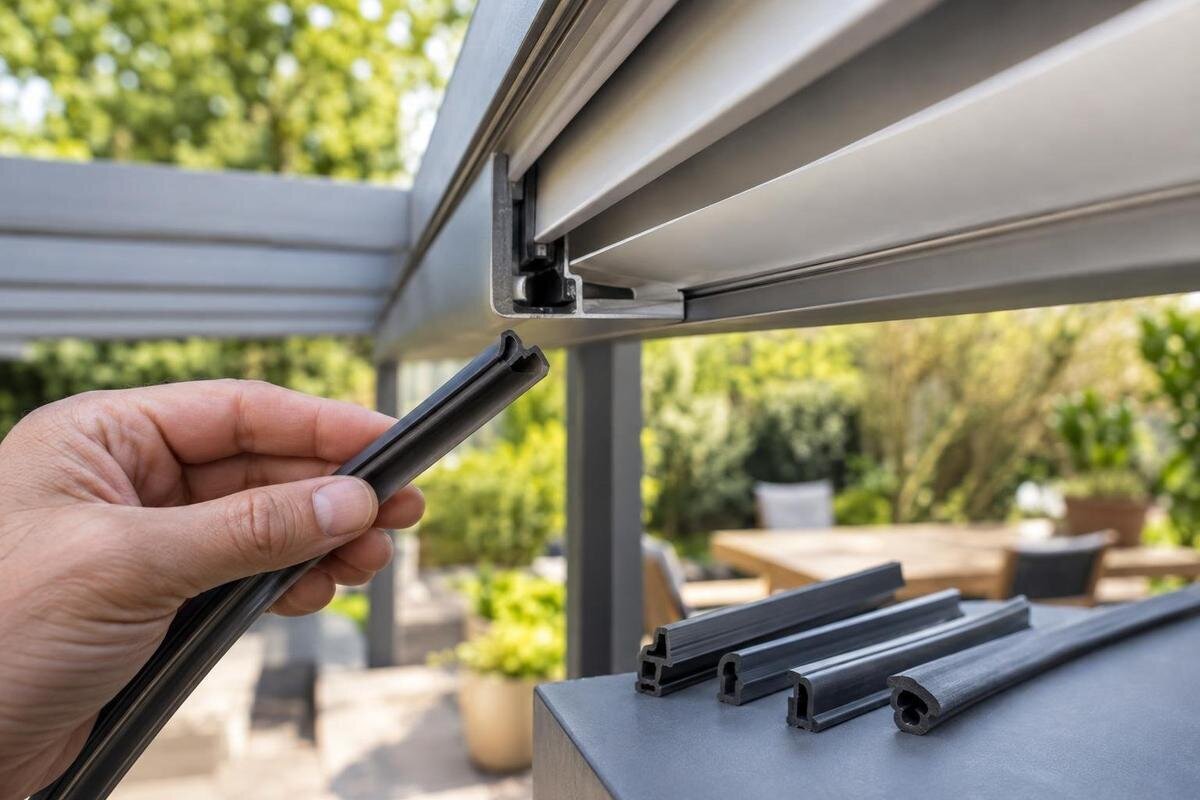
A seal profile is its cross-sectional shape, not simply its length, colour or one visible width. The outline, lips or channels, any retaining edge, and the way it sits in its mounting position may all distinguish one component from another. Note whether it appears to fit into a groove, rest against a flat face or sit under a retainer only if that feature is visible. When requesting a seal for the Bloomcabin Pergola, describe these visible features alongside the joint location. Write that the profile is hidden when a cover prevents a reliable view. Catalogue labels such as brush or lip are useful descriptions, not proof of a compatible part number.
Do not pull out an intact length, peel an edge back or cut a sample merely to obtain a cross-section. If an end is already exposed during normal use, photograph it without moving the part; if no end is visible, ask support what evidence is acceptable or have a service professional inspect it. If an original piece is already detached, keep it as found, avoid stretching or straightening it, and label its location and orientation before storing it. A worn or compressed sample can help show the profile, but may not preserve its original shape. Keep it until a replacement is confirmed rather than relying on memory or discarding it. Do not take a sample from an undamaged section.
Take photos that show context and detail
Take a separate set of photographs for each suspected location. Begin with an overall view showing where the joint sits on the pergola, add a middle-distance view of the adjoining parts, then take a close-up of the damaged area or any profile already visible. Leave enough framing in the close-up to show orientation, and include another angle if the first hides the edge or channel. If you refer to the Wall Pergola listing in your enquiry, also attach photographs of your own structure. The supplier needs to see where the part is fitted on your unit, not only a product image. Avoid combining views into a collage that obscures which joint each image shows.
Use even light and hold the camera steady; glare, shadow and tight cropping can hide a retaining lip or a gap. Include a ruler beside the seal only if it can be placed safely without pressing on or covering the part, and do not use the image as a substitute for a requested measurement. Keep the original files unedited, with captions that identify the location and direction of view. If you add an arrow to a copy, retain the untouched original as well. Label separate locations consistently across the images and sketch. Do not climb, lean over the structure or operate a roof mechanism to get a better angle. If the joint cannot be photographed safely from the ground, arrange an appropriate professional inspection.

Measure only what can be accessed safely
Separate the length of the run from the dimensions of the cross-section. Identifying a replacement may require the profile, its attachment and the number of lengths or pieces as well as the overall run; one visible width cannot describe all of these. If a dimension is safely accessible without touching or compressing the seal, record it in millimetres and state exactly where you measured. Note whether the seal appears continuous or divided into sections, without assuming how it is supplied. Do not use the overall product size on the bioclimatic pergola product listing to infer seal dimensions. Ask the supplier which measurements are useful before sending estimates. A photograph with a scale can provide context, but include the actual numbers in your message.
Do not measure a hidden channel by removing trim or dismantling a panel. If the profile is inaccessible, mark it as unknown and send a location view; a clear limit is more helpful than a guessed figure. An already-detached piece can help indicate the length of its original run, but do not stretch it, flatten it or treat a deformed sample as an exact section specification. Follow the supplier’s requested method for any profile measurements, record the units and point measured, and distinguish a measurement taken on the installed seal from one taken on a loose piece. Do not cut an installed strip to make measurement easier or assume a tolerance that has not been specified.
Use the correct manual and parts reference
Look for the manual, technical drawing or parts list issued for the exact pergola reference rather than a general guide for a similar product. A document may identify the seal by a part number or show its position, so send the title page and the relevant drawing together; a cropped diagram without its model or revision can be difficult to verify. If you recognise your model on the regular pergola product listing but no longer have its manual, give the original supplier your order details and ask for the relevant document. Do not treat a diagram from another category as a match merely because the outline looks familiar.
Ask the supplier to confirm in writing the replacement part number and the exact position it serves on your model. If the original number has changed, ask whether the manufacturer’s or supplier’s records identify the proposed reference as its replacement, and whether that confirmation applies to your variant and document revision. Request a profile illustration or description, and confirm how many pieces or what length the stated quantity covers. Ask whether the part is intended for the whole affected run, and request the applicable fitting instructions or the route to a qualified service visit. A reply that says only same size leaves the main questions unanswered. Keep the answer with your model records and photographs.
Why a generic strip can be the wrong replacement
An off-the-shelf strip can look close and still be the wrong part. A different cross-section or retention shape may stop it seating in its channel, leave a gap, work loose or interfere with an adjoining component. A cut-to-length offer addresses only the run length; it does not establish the seal’s profile, attachment or approved use. Avoid choosing by colour, one width measurement or a marketplace label such as universal. Even a strip advertised alongside a pergola resembling the wall-mounted Bloomcabin Pergola needs confirmation for your exact model and joint. The same caution applies to adhesive-backed alternatives and unlabelled offcuts. Where a seal borders another designed feature, a different shape may affect how the parts meet.
If a supplier proposes a standard profile, ask them to identify the exact drawing or part number and confirm that it is intended for your model and the joint shown. Request an outline or technical description that you can compare with an already visible section, without removing it. Ask whether trimming is part of an approved instruction rather than assuming a roll is suitable because it can be cut. If the answer rests only on approximate width or a photo from a different pergola, pause and provide more evidence. Do not improvise an adhesive, filler or makeshift strip while waiting for confirmation. If the original profile is no longer supplied, ask what replacement the supplier confirms for that location. The goal is a documented match, not the closest-looking substitute.
Make a precise spare-parts enquiry
Make the first message easy to answer. Give the exact product name and any model or serial reference; describe the seal’s position; attach an overall view, a location image and a close-up; and include a part number or manual page if known. State what is visibly wrong and what you could not inspect. If your order identifies the regular Bloomcabin Pergola, use that name in the subject line and include the order reference in the message. Say whether you have an already detached sample and how many distinct locations are affected. Mark each location on a sketch. Ask the recipient to identify the component, not merely suggest a size.
Use a direct request such as: “Please confirm the replacement part for the seal at the marked location, and tell me which photograph or measurement you still need.” Keep the model reference and location labels consistent in subsequent replies so that new information can be matched to the original enquiry. If several similar runs are affected, number them on the sketch and ask separately whether they take the same component. This avoids ordering one part for several joints on an assumption. When the supplier requests another view or dimension, identify which location it relates to. Ask for clarification if the response names a component but does not say which marked joint it serves.

Use an approved replacement method
A confirmed profile is only one part of a safe repair; it does not show that the component is intended to be replaced by the owner or explain how to reach it. Follow the instructions for the exact model and component, not a generic demonstration of a similar strip. If access requires work above ground level, removing covers, dismantling an assembly or reaching near a moving part, stop and arrange inspection by a qualified service professional. Do not move a roof or other mechanism simply to expose the seal. Work involving electrical or powered components, or wiring, should be left to qualified service personnel. A photograph cannot establish a safe dismantling sequence.
Do not assume that glue, lubricant, heat, stretching or trimming is an acceptable method. These can change the shape or fit of a particular profile, and the correct procedure depends on the product and part; use any such method only when the exact manufacturer’s instructions allow it. If fitting guidance is unavailable, ask who can inspect the joint instead of testing a substitute. If a replacement does not sit as confirmed, do not force it into place or operate a mechanism against resistance; stop and request a review. Identifying the correct component and establishing how it should be fitted are separate parts of the repair.
Check the supplied part before fitting
Before fitting, compare the delivered part’s label and part number with the written confirmation, then check that the named model, position and profile match the enquiry. If a drawing was supplied, compare the cross-section and orientation rather than relying on colour or a package photograph. Check the quantity and stated length against the number of confirmed runs; do not assume that one piece or roll covers every joint. If the label, shape or reference differs, leave the part unused and ask the supplier to reconcile the discrepancy. Do not cut or modify it to make it appear to fit. Keep the packaging until the identification is settled, and check that any instructions correspond to the same part.
Keep a record of the final part number, the exact location it was confirmed for, who confirmed it, and the manual or drawing used. Store the enquiry photographs with that record so a future request can distinguish this joint from another that only looks similar. If several seals appear alike, confirm each position rather than assuming a verified replacement fits all of them. After the work has been completed by the appropriate person, note the date and any remaining issue without changing the service instructions. If the original seal was removed under the approved procedure, keep its labelled piece until the replacement is accepted. A concise record makes follow-up specific and avoids starting again from memory.
Frequently asked questions
Can I order a replacement using only the seal’s width?
No. Width describes only one dimension; the profile, how the seal is retained, its location and the exact pergola reference also matter. Send the supplier the model details, location and photographs, then measure only the dimensions they request. If part of the profile is hidden, say so rather than guessing.
Should I remove an intact seal to photograph its profile?
No. Do not pull, peel or cut an installed length solely to get a sample. Photograph any edge already exposed, then ask the supplier what other evidence is useful. If access requires dismantling or working at height, arrange an appropriate qualified service inspection.
Can I use a universal rubber strip as a temporary replacement?
Do not assume it is suitable. A similar appearance or a cut-to-length claim does not confirm the profile or attachment. A substitute may not seat correctly or could interfere with an adjoining part. Use a replacement confirmed for that model and location, with an approved fitting method.
Do pergolas with the same product name necessarily share a seal?
The product name alone is not enough to establish this. Confirm the exact version, joint location and part reference against the relevant documents or with the supplier. A matching brand or broad product category does not establish that a seal fits another unit.
What should I include in my first spare-parts enquiry?
Give the exact product name and any model or serial details. Attach an overall image, a view showing the seal’s location and a close-up; describe what you can see and include the manual or part number if available. Ask the supplier to confirm the profile, position and replacement reference, and state which dimensions remain unknown.
The dependable replacement is the one confirmed for the exact pergola, joint and profile—not the nearest-looking strip. Bring the model records, a clearly marked location, useful photographs and any safe measurements together in one enquiry. If the profile or fitting method remains uncertain, leave the part undisturbed and ask for a confirmed replacement or a qualified inspection. Keeping the confirmation and part reference on record will make the component easier to identify for future repairs.
