
How to Assess Whether a Restaurant Pergola Can Pay for Itself
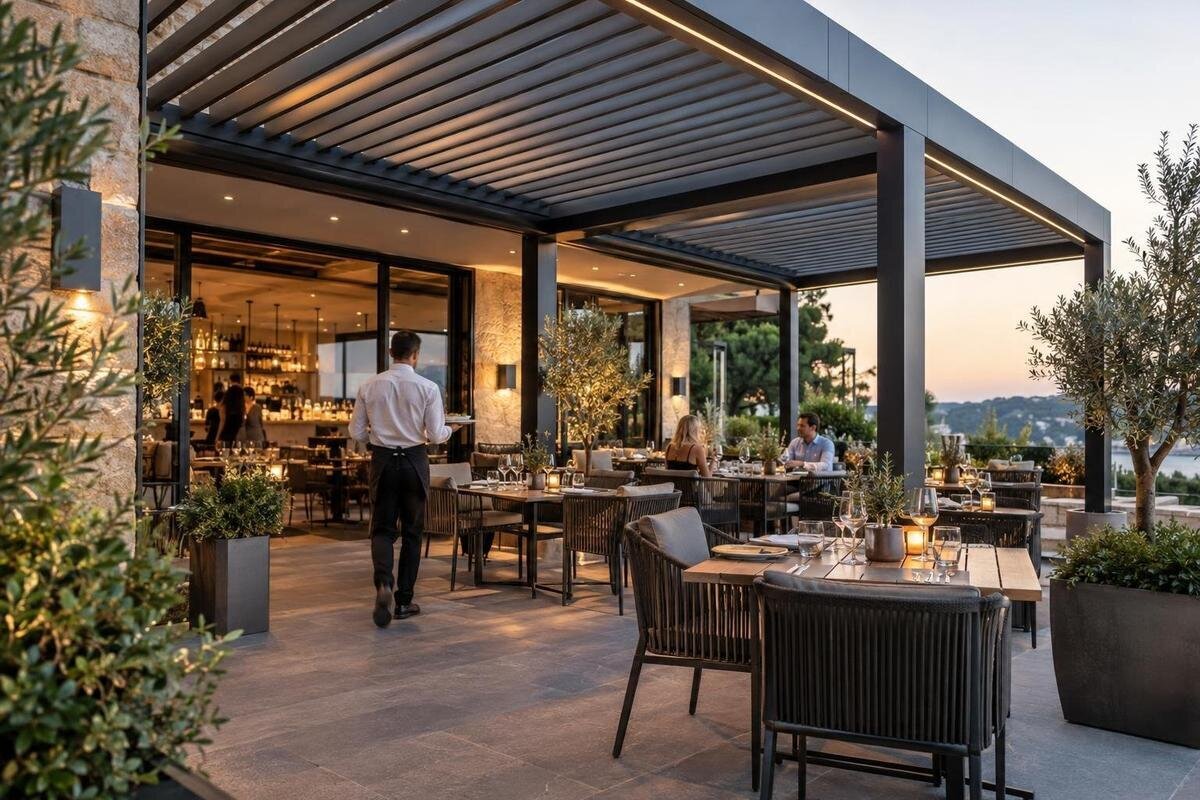
Restaurant terrace planning
A restaurant pergola is a capital project, so its business case should rest on contribution the restaurant can reasonably attribute to additional outdoor service—not on gross sales or an assumption that every period affected by adverse weather becomes usable. Work from your own terrace records, count only genuinely additional paid covers, and compare the result with the complete installed cost and ongoing expenses. The calculation is an estimate to test, not a promise of higher revenue.

Define what payback means for the restaurant
Decide first what “pay for itself” means for the business. Simple payback asks how long annual net contribution takes to recover the initial outlay. It is not the same as total profit over the pergola’s useful life, a return on capital or a comparison with other uses for the money. A more usable outdoor area may support service or guest experience, but benefits that do not appear in cash receipts should be recorded as separate objectives, not converted into assumed sales. Choose the test before comparing options, so the target does not shift to make a preferred project look viable.
Set a clear project boundary. Decide whether the initial figure includes only the pergola or also delivery, ground preparation, installation, professional reviews, electrical work or other additions, furniture, financing and any trading disruption. Include items that are part of the proposal, even if a separate contractor will invoice them. Keep one-off costs apart from annual running costs and avoid counting existing expenses twice. When considering the Bloomcabin Wall Pergola, use a project-specific scope and quote to establish the investment. Give each option the same cost categories so that a lower headline price does not conceal omitted work. Keep optional additions separate from the core proposal: this lets you see whether the basic project meets the target and how each addition changes the amount that needs to be recovered.
Build a baseline from terrace records
Use your own point-of-sale, booking and operating records, ideally across comparable periods rather than a single busy month. For each weekday, month and meal period, record when the terrace was open, how many covers it served, bookings refused or redirected, and closures or reduced service linked to conditions. Add notes on staffing, opening hours, events and unusual disruptions. Separate a terrace closed by weather from one open with spare seats: the first may represent recoverable capacity, while the second may show that demand, not shelter, is the constraint. Flag exceptional periods rather than treating them as a normal pattern.
Keep outdoor covers distinct from guests who would have been seated indoors anyway. If records do not identify the seating area, start using a consistent booking or service note rather than trying to reconstruct every visit from memory. Record covers and revenue by meal period where available; a lunch-only opportunity should not be treated as a full day’s sales. Keep the current terrace plan alongside those records when considering an option such as the Bloomcabin Pergola. This gives you a starting point for comparing existing service with the proposed arrangement. For each refused booking, note the party size, requested time and reason where known. An unavailable table and an unavailable kitchen slot represent different constraints, so neither should automatically become a projected pergola booking.
Estimate the service periods a pergola could add
Translate weather and closure history into service periods the project could plausibly add. Make a calendar by daypart, then label each period: outdoor service already operated; the terrace was closed or constrained; the restaurant itself was closed; or staffing, demand, deliveries or another operating limit would have prevented service regardless. Count only periods in the second group that could realistically change. Do not count a full day because conditions affected one meal, and do not count a period you already serve under current arrangements as new capacity.
Use conservative, central and optimistic estimates for added periods, with reasons beside each assumption. Historic weather can inform a range but cannot guarantee future conditions, and a covered area should not automatically be treated as usable in every kind of weather. When assessing the Bloomcabin Bioclimatic Pergola, confirm the proposed system’s operating conditions, exclusions and project suitability with its supplier and relevant professionals before counting periods. Keep the calendar entries visible in the calculation rather than replacing them with an unexplained annual total. If a period remains uncertain, show whether it is excluded from the conservative estimate or included only in the optimistic one. This makes clear which assumptions account for the difference between the estimates and avoids presenting uncertain availability as established capacity.
Translate usable periods into additional covers
Estimate added covers from a measured layout, not from the covered floor area alone. Mark tables, chairs, service routes and access points on the actual plan, then assess how many places can operate without obstructing staff movement or reducing existing capacity. The wall-mounted pergola listing states a range from 9 to 24 m², which provides an area reference for the layout comparison, not a seating count. Show any existing tables that would need to move or be removed, as well as the proposed new places. Compare the net capacity with the current arrangement rather than treating every seat beneath the pergola as an addition. The actual arrangement and relevant operational reviews determine what can be served; the financial model should use that reviewed layout.
Compare expected covers with what the restaurant would have served without the project. Booking enquiries, waitlists, recorded turnaways and comparable service periods can inform unmet demand, but distinguish a genuinely additional customer from someone moved from indoor seating. A moved booking may change table allocation without adding a cover or the full spend of a new customer. Apply a realistic service pace and kitchen or bar capacity; maximum seats multiplied by assumed turns is not a sales forecast. Where lunch and dinner behave differently, estimate them separately.

Use contribution per cover, not gross sales
For each additional cover, estimate the contribution left after costs that rise with that sale. Start with the expected average spend for the likely food and drink mix, apply the relevant tax treatment used in the restaurant’s accounts, then subtract food and beverage costs, card fees and other variable costs such as disposables or laundry where applicable. Use your own figures, and calculate by meal period if spend or margins differ materially between lunch and dinner. Match the spending assumption to the customers and service periods you expect to add, rather than using the restaurant’s highest-spending bookings as the norm. Keep a note of what each margin includes. Gross spend is not the amount available to recover the project cost.
Give labour its own line in the calculation. If additional covers can be handled by the existing team, include any extra hours or per-cover costs that arise. If service requires another staff member or a longer shift, include the full additional shift rather than a small per-cover allowance. Account for kitchen, bar and cleaning capacity too. When assessing the Bloomcabin Pergola option, test the proposed service pattern against the rota, not just the table plan. A quiet lunch and a busy dinner may need different staffing assumptions. Record which staffing costs apply whenever the terrace opens and which arise only once bookings reach a particular level, so the model reflects the service you intend to run.
Add up the complete project cost
Build the initial outlay from the full proposed scope. It may include the pergola, delivery and installation where quoted, ground preparation, drainage, professional design or reviews, furniture and any specified electrical or other additions. Include only work that is relevant to the actual proposal, but account for every contractor or supplier involved. If installation temporarily prevents terrace trading, estimate the lost contribution for that period rather than treating gross sales as lost profit. Keep that disruption in the right place in the calculation so it is not counted twice.
Compare quotes on the same scope. Ask what is included, what is excluded, what site assumptions have been made and which items need a separate quote. For the Bioclimatic Pergola option, use the written project quote rather than treating the product listing as an itemised restaurant installation price. Show a cost range if the final scope is not settled, and identify the unresolved items responsible for it. Keep the quote date and the version of the proposal beside the figures so that later revisions do not leave the model using an earlier cost. If the project is financed, decide whether finance costs belong in the test and handle them consistently rather than comparing a financed option with an unfinanced total.
Allow for running costs and downtime
Estimate additional annual costs that would arise after installation. Depending on the proposal, these might include cleaning or servicing, inspections, repairs, an allowance for future replacements, energy for specified additions, or staff time spent setting up and managing the area. Ask for estimates relevant to the actual proposal instead of applying an arbitrary percentage. Separate costs that occur regardless of covers from costs that rise with each service, and include each cost in only one part of the model.
Downtime affects the number of periods that can actually be served. Account for installation disruption once, then consider any later periods when maintenance, repairs or other operating limits could interrupt service. Do not assume continuous availability throughout the year. For a proposal based on the Wall Pergola model, ask the supplier about the care, inspection and servicing requirements and associated costs. Put any expected interruptions into the same service calendar used for the revenue estimate, so the model does not count income from periods already set aside for maintenance. Record how the restaurant would handle affected bookings, including whether they could be accommodated indoors. Count any resulting loss of contribution consistently rather than also charging the same loss as a separate operating expense.
Check the layout and site before relying on capacity
Use an actual floor plan and show the current arrangement as well as the proposed one. Mark walls, doors, fixed features, table edges, service routes, waiting areas and the paths staff use between the terrace and the kitchen or bar. Check the restaurant’s operating requirements against the space available rather than assuming every covered area can be used for dining. A seating count that looks possible on a rough sketch may not work once circulation and service access are considered.
Have the plan and proposal reviewed by the appropriate professionals, including any applicable access, fire-safety and planning review. Give them the operator’s requirements and the actual site information. When discussing the regular Bloomcabin pergola, assess it against the real floor plan and the project-specific information supplied, rather than assigning it a guessed capacity. Make clear which proposed seats depend on an unresolved layout decision and keep them separate from the capacity you can already use in the calculation. If a review changes a route, table position or usable area, update both the seating plan and the financial model. Resolve layout or approval constraints before relying on the related seats or service periods in the investment decision.

Compare scenarios and calculate a break-even threshold
Write the annual estimate as usable service periods multiplied by additional paid covers per period and contribution per cover, then subtract added annual operating costs. If dayparts have different demand or margins, calculate them separately and add the results. Keep step-change labour and other costs either in the contribution figure or the annual-cost line, not both. Prepare low, central and high cases by changing inputs for which you can state a source or a reason; label judgement calls and note whether each came from restaurant records, a quote or a professional review.
Simple payback in years equals the initial project outlay divided by annual net incremental contribution, provided that contribution is positive. For a target payback period of H years, required additional covers per service period equal (initial outlay divided by H, plus annual added operating costs) divided by (usable service periods multiplied by contribution per cover). This assumes one average margin and a stable service pattern. Use the same definition of a service period throughout: if the calendar counts lunch and dinner separately, the threshold must do so too. Treat the result as a threshold, not a forecast, and compare it with measured capacity and demand for those periods. Do not round a demanding threshold down simply to fit the seating plan. If annual net contribution is zero or negative, simple payback does not exist. For changing cash flows or financing, build a year-by-year view with an accountant.
Agree decision criteria and track performance
Agree the decision criteria before choosing a proposal. A case that works only under the most optimistic assumptions, or requires more service periods and covers than the records support, needs revising rather than more generous inputs. Identify which uncertain input has the greatest effect on the result and whether a realistic change would move the project outside the restaurant’s target. This helps distinguish a proposal with room for variation from one that only just meets the threshold. Decide separately whether guest-experience or operational aims justify costs that the revenue calculation does not recover. Have the restaurant’s decision-makers review the assumptions, and seek accounting or professional input where the financial treatment, site information or project requirements need specialist judgement.
If the project proceeds, track the same measures used in the estimate: terrace opening periods, additional paid covers, contribution, incremental labour and other added costs, plus the reasons for closures. Compare like with like by daypart and season, and note other changes such as opening hours, prices or promotions that could affect results. Review performance after a period that captures the seasonality on which the case depends. This gives the restaurant a way to test its assumptions and adjust operations without treating the original forecast as guaranteed.
Frequently asked questions
Can I count every rainy or hot day as an extra service day?
No. Count only service periods that could realistically be added, considering the proposed system’s confirmed operating conditions, restaurant opening hours, staffing and likely demand. A structure does not automatically turn every weather-affected day into a viable service.
Should payback be calculated from sales or profit?
Use the contribution from genuinely additional covers after the costs that rise with those sales, then subtract added annual operating costs. Gross sales overstate the amount available to recover the project cost.
What if customers would otherwise sit indoors?
Do not count a customer moved from an indoor table as a new cover. Include only the net change in covers and contribution compared with what the restaurant would have served without the project. A different seating arrangement may have value, but it is not automatically additional revenue.
How should I choose a target payback period?
There is no universal number that suits every restaurant. Set a target that reflects the business’s investment priorities, financing and expected cash flows, and include any future costs that matter to the decision. An accountant can help test the financial assumptions.
What if the break-even covers exceed the layout’s capacity?
Treat that as a warning that the current proposal does not meet its own target. Recheck the cost, the measured layout and the demand assumptions; do not increase projected covers simply to make the calculation work. Consider the project only if its separate operational or non-financial aims justify it.
A defensible payback case connects a quoted project scope to service periods the restaurant could actually add, covers supported by its own demand and layout, and contribution after added costs. If the required covers exceed credible capacity, the arithmetic is signalling a problem to resolve—not a reason to raise the forecast.
