
Buying a Second-Hand Pergola: Parts and Relocation Risks
Pergola buying guide
Buying a second-hand pergola is not simply a matter of checking that the frame is still standing. The kit may be missing small but essential connections, have undocumented changes, or depend on supports that do not exist at the new property. Before agreeing a price, identify the exact model, compare the parts with its documentation, inspect condition and confirm who will assess the new site. This guide separates those checks so you can judge the full relocation project rather than the apparent bargain.
Before you buy 1
Identify the exact pergola before judging the price
Begin by separating the seller’s description from evidence. Ask for the manufacturer, exact model or range, serial number or order reference if available, approximate purchase date, original configuration and any later changes. A broad description such as ‘pergola’ or a product range name is not enough: sizes, orientation, accessories and revisions may differ. Compare labels on the frame with order paperwork and the maker’s parts list; do not assume two units with similar names share interchangeable components. Record the product name accurately, whether it is Bloomcabin Pergola or another model, then establish which version the seller owns. Ask for clear label photographs as well as a wide view.
Get an itemised statement of what the seller is including: frame members, posts or wall-side parts, roof elements, covers, drainage components, controls, remotes, accessories, fixings and documents. Mark each item as present, absent or unconfirmed; a bundle photo does not prove that every item is included. Clarify whether loose items stored elsewhere are part of the sale and whether the price includes dismantling, packing or loading. If any part was repaired or replaced, request the date, description and photographs. Establishing this scope early gives you a reliable basis for the physical count and avoids paying for an assumed package that is not actually being transferred.
Documents that help verify a second-hand kit
Ask for paperwork tied to this particular unit: invoice or order confirmation, assembly manual, dimensioned drawings, parts schedule, installation record and warranty information if available. Check that references and dates match labels on the pergola; a document for a similar-looking model may describe another size, version or revision. If there is no original set, ask the seller to request identification from the maker using model details and photographs. A product page can help confirm a name, but it is not a substitute for a parts list or assembly instructions. Check whether the manual describes the same roof arrangement, orientation and optional equipment, and record discrepancies rather than guessing. Ask whether exact parts can still be identified or supplied, and keep any written reply with the paperwork.
For a wall-mounted model such as the Bloomcabin Wall Pergola, the records should identify the original layout, attachment points and any installer changes. These details help distinguish the supplied configuration from alterations made at the property. If the seller cannot supply those records, send the dimensions, labels and clear photographs to the maker or a qualified installer before valuing the kit as reusable. Ask which details remain uncertain and whether they can be resolved before dismantling. Also ask whether any warranty still applies to the buyer; do not assume it transfers with the sale.
Before you buy 2
Count every component against the parts schedule
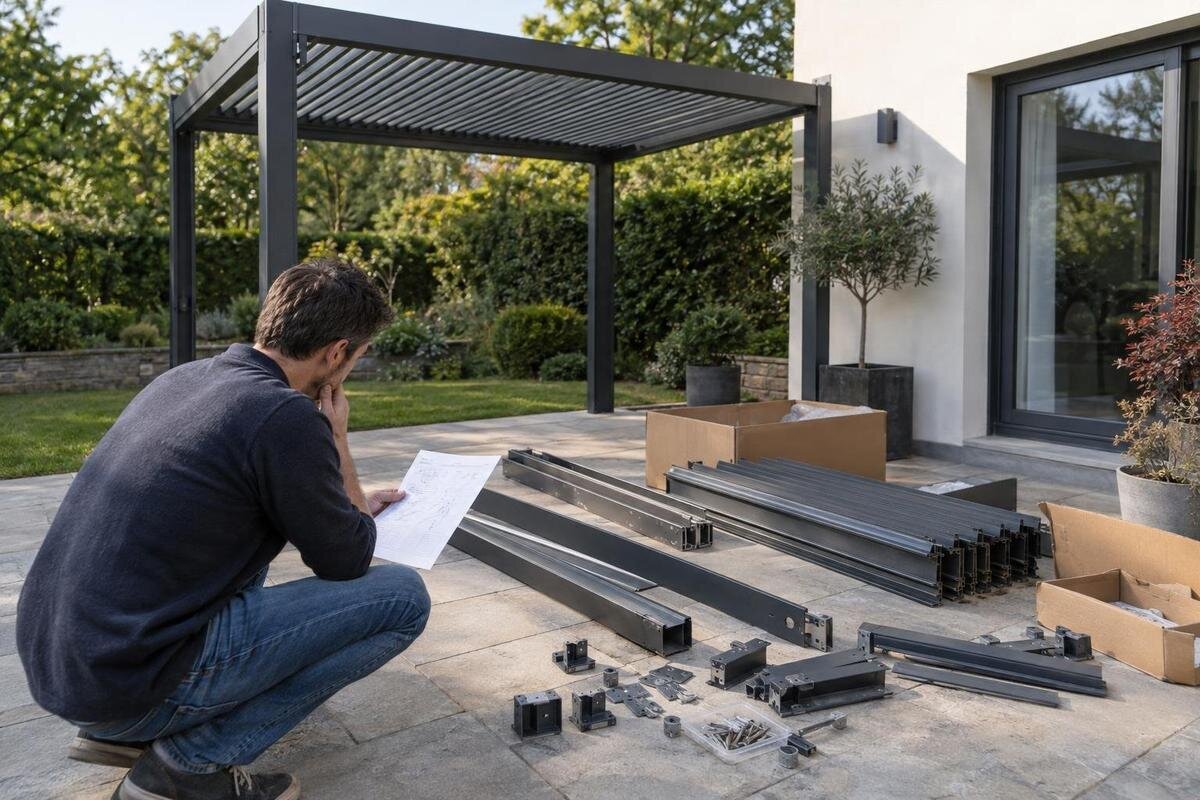
Use the maker’s version-matched parts schedule as your checklist, not the seller’s memory. Record frame members, connectors, caps, panels or roof elements, seals, drainage pieces, brackets and small fittings, with part numbers and quantities where available. Include items that are easy to miss: end pieces, cover strips, spacers, clips, locks, templates and any controls or wiring listed for that configuration. For a used Bloomcabin Bioclimatic Pergola, as for any other model, distinguish the catalogue name from the exact kit being sold. Count the actual components against its schedule. Ask for close-up photographs or a chance to lay out the parts before collection, especially where components have been stored separately.
Make a three-column record of expected quantity, quantity seen and condition or comments. Photograph each group with a readable label, and save the files with the inventory rather than relying on messages that may be hard to find later. Write ‘unknown’ when the seller cannot confirm an item; do not mark it present because a box is sealed or a photograph shows similar pieces. Separate included accessories from items used only to stage the listing. Ask the seller to keep loose hardware and packaging together until the count is finished. A small unidentified connector can hold up assembly, while a missing panel or support component may change whether the kit can be reused at all.
Check fasteners and connection parts separately
Check fasteners and connection hardware as their own category. Count bolts, screws, washers, nuts, plates, brackets and any special locking pieces against the correct parts schedule; note labels or markings if visible. A mixed container of leftovers is not proof that the right set is complete. Do not assume a general-purpose screw or visually similar bolt is an acceptable substitute: thread, size, finish and intended connection can matter, and the parts may have been selected for one specific configuration. Ask the manufacturer or a competent installer which items are replaceable, which are site-specific and whether any must be renewed after removal.
Inspect removed anchors and brackets for bending, damaged threads, corrosion, enlarged holes or signs that a fixing has been pulled out of its support. Even if they served at the original property, they do not prove that the same approach is suitable on a different surface. Do not drill, cut or improvise a connection to make the kit fit. Have the proposed supports and anchoring method assessed by a qualified professional, using the drawings and condition record. Where insurance or property consent is relevant, verify the requirements for this particular site with the insurer, owner or relevant local authority rather than relying on what was accepted at the previous address.

Before you buy 3
Compare the original supports with the new site
Establish whether the old arrangement was wall-mounted, supported on posts or configured in another way, and match that description to the drawings. A wall-mounted design has a defined relationship between its frame and attachment points; a post-supported arrangement has its own base locations. When considering a used unit alongside a new wall-mounted pergola, make this support arrangement part of the comparison. Compare measured attachment points with the original drawings and inspect wall-side parts for distortion, repairs or substituted hardware. A different wall, corner, surface build-up or orientation may make the old layout unsuitable without an approved design change.
Measure the actual footprint and relevant heights rather than relying on a rounded listing description. Note the outside dimensions, projection, post positions and any difference between the drawing and the frame as it stands. Record your reference points clearly, such as an outside edge or a fixing line, so an installer can interpret the measurements. Then check whether doors and windows can open, access routes stay clear, and drains, lights or other existing features conflict with the frame. Map the supports against the proposed location, but treat this as an initial fit check, not approval of the structure. A qualified person must determine whether the supporting surface, fixing approach and any proposed alteration are suitable.
Exposure, access and property requirements
Compare the old and new settings, not just their footprints. Orientation, exposure to wind and rain, nearby walls or overhangs, surface levels and drainage routes can differ, changing what the manufacturer or installer needs to assess. Ask what site conditions and configuration the original drawings cover, and whether the unit can be approved for the proposed location. If you are also considering the Bloomcabin Pergola as an alternative, provide the same site information when enquiring about it. That keeps both options focused on the intended location. The fact that the used structure stood at one address does not establish its suitability elsewhere.
Consider how the relocated pergola will fit around nearby thresholds, doors and paths, including access for maintenance and the route for moving long parts into place. If the new position is on a balcony, shared area or property subject to management rules, ask the owner or association and check any applicable local requirements before committing; the seller’s permission at the old site does not carry over. If you need insurance confirmation, provide the proposed arrangement and ask the insurer what it requires. Include these property-specific checks in the decision timetable rather than leaving them until after collection.
Before you buy 4
Inspect condition and any moving features
If possible, inspect the pergola while assembled, before dismantling hides the relationships between parts. Look for bent or cracked members, dents at joints, corrosion or staining, flaking finish, loose connections, worn seals, damaged drainage parts and signs of past repairs. Look under caps and around holes, not only at the surfaces visible from the garden. Take close-up photographs and ask when each defect appeared or was repaired. A cosmetic mark and damage near a structural connection are not equivalent; if the cause or significance is unclear, ask an installer to assess it before treating the frame as ready to reuse. Keep a written defect list for price discussions.
Where the design has moving elements or electrical controls, request a demonstration using the supplied instructions; do not force a stuck part or accept an unverified claim that it worked recently. Check that each listed remote, control unit, sensor, key or manual is present, and write down faults, intermittent operation or missing identification labels. If the seller identifies the unit as a Bloomcabin bioclimatic model, record the operating equipment actually fitted rather than assuming it from the name. Have damaged wiring, a motor or any uncertain electrical component assessed by a qualified person before transport or reuse, and include any needed repair in the project estimate.
Plan dismantling, transport and storage
Agree how dismantling will be carried out and who is responsible before collection day. Ask whether the pergola has been taken apart before, whether any parts were modified and what the maker’s instructions say about removal. A structure that appears modular is not automatically designed for repeated dismantling. Forcing a joint, cutting a piece or rushing a stuck connection can damage components that looked sound in place. Use the correct manual and qualified help where needed. Agree the removal sequence and who will handle any fault discovered during dismantling before work begins. Photograph each stage, label parts against the inventory and keep matching hardware together.
Plan transport and temporary storage around the longest components, the route into and out of each property, and the ability to keep parts secure and dry. Make sure the vehicle and handling arrangements will not bend, crush or scrape the pieces; follow maker guidance for protecting finished or delicate surfaces. Keep small parts in labelled bags with their related components, and store the inventory and photographs separately from the load. Agree who packs and loads the kit and who is responsible if it is damaged in transit. For stairs, lifts, narrow gates or several handling teams, plan access before disassembly so parts are not left exposed while a route is worked out.

Before you buy 5
Price the full relocation before making an offer
Calculate the full project cost, not just the seller’s asking price. Include inspection, dismantling, packing, transport, temporary storage, confirmed replacements, reassembly and any preparation required at the new site. Request written estimates based on the model identifier, drawings, parts count, defect photographs and measurements; ask each provider to list unknowns separately. Replacement parts may require identification before a supplier can quote, and a change to the support arrangement may need a professional review. Do not assign a zero cost to an item simply because the seller says it is easy to replace. Keep known costs, provisional allowances and unanswered questions distinct.
For comparison, ask for a separate quote for a new configuration that meets the same brief. If the wall-mounted Bloomcabin option is on your shortlist, request a quote for the proposed property rather than treating the listing as the project price. Compare like-for-like scope: included parts, drawings, installation, delivery, after-sales support and any stated warranty terms. A used kit may still make sense if its identity, condition and replacement route are clear; it may be poor value if a key part or fixing method remains unresolved. Keep the purchase on hold until those uncertainties are resolved and the total is realistic.
Record the sale and prepare the installation handover
Turn the agreed sale into a dated handover record before payment or collection. Identify the model as precisely as possible; list included and excluded parts, mark uncertain items, describe visible defects and attach photographs. Record who dismantles, packs, loads and transports the pergola, where responsibility changes, and whether the seller will hand over manuals, drawings, receipts and controls. Agree what happens if the inventory differs at collection or a part is damaged during removal. Confirm that the seller is authorised to transfer the item, and obtain a receipt. These steps do not replace advice on the transaction, but they make its practical scope clear.
Send the reinstaller the same evidence before booking: drawings, part counts, labels, damage log, photographs and site measurements. Ask for a written assessment separating usable items, required replacements, alterations awaiting approval and points needing further review. If the design has been altered or the kit cannot be verified, do not treat its earlier installation as a guarantee of safe reuse. Keep this assessment with the sale record so the agreed work is clear. If you choose a new Bloomcabin pergola instead of the used kit, retain the same site brief and record the configuration and installation scope in its quote.
Frequently asked questions
Does a listing that says ‘complete’ mean the pergola is ready to reinstall?
No. Treat ‘complete’ as the seller’s description until you have compared a physical count with the parts schedule for the exact model and version. Even a complete kit may need replacement fixings, repairs or a different support arrangement at the new site. Have uncertain parts and site suitability assessed before you commit.
What should I ask the seller for before viewing?
Request the manufacturer and model details, any serial or order reference, original drawings, manual, parts list, purchase record and installation history. Ask for close-up photographs of labels, connections and known damage, plus a written list of what is included. If the pergola is still assembled, arrange to inspect it before dismantling.
Can the original bolts and anchors be reused?
Do not assume so. Their condition, purpose and suitability for the new support surface need to be confirmed for the specific kit. Ask the manufacturer or a qualified installer which items may be reused, which need replacement and whether the new site calls for a different fixing approach.
Can I adapt a wall-mounted pergola for a different wall?
A different wall may have different attachment points, surface conditions and obstructions. Do not move brackets or alter the frame on the assumption that the old layout will work. Ask the manufacturer or a qualified professional to assess the exact drawings, parts and proposed location before buying or arranging reinstallation.
How do I compare the asking price with the cost of a new pergola?
Compare the full project, including inspection, dismantling, transport, storage, missing parts, site preparation and professional reinstallation. Ask for written estimates with unresolved items shown separately. Then compare them with a quote for a new configuration that meets the same brief and includes a clearly defined scope.
A second-hand pergola is worth considering when you can identify its configuration, reconcile the parts with the maker’s schedule, understand its condition and get a clear assessment of the new site. If an important component is missing, do not treat it as an inexpensive replacement until the correct part and fitting method are confirmed. Put dismantling, transport and reinstallation responsibilities in writing, then compare the complete project with a suitable alternative. A decision based on verified details is more useful than one based on a photograph that merely looks complete.
