
Strong Winds and Pergola Louvres: Which Position?
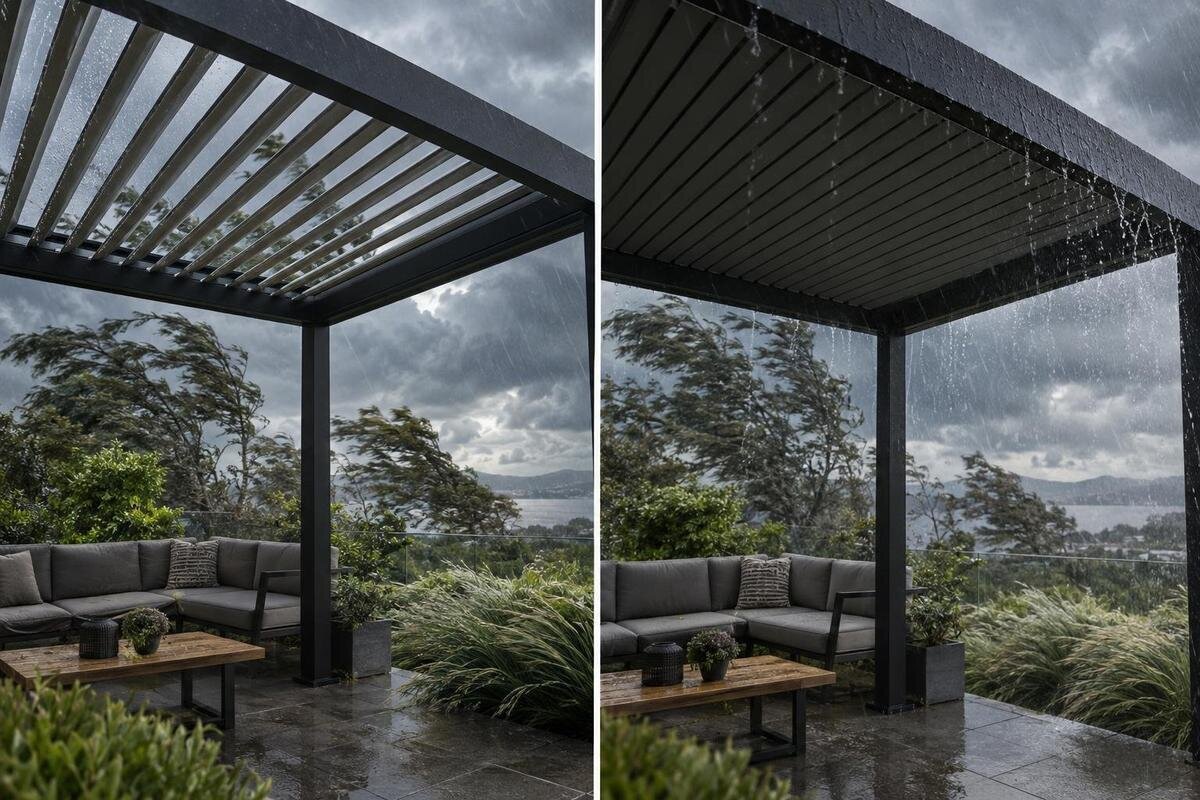
Pergola wind guidance
When strong winds are forecast, the choice between open, closed or partly angled louvres can feel urgent. There is no reliable rule that applies to every pergola: blade design, frame, installation and side enclosures all matter, and the same position may not suit every model. The useful answer is the one stated in the operating and weather documents for your exact setup. This guide explains which records to find, what wording to look for and what to ask if the guidance is missing.
Documents to request 1
There is no universal louvre position for strong winds
A louvred pergola does not have a universal strong-wind setting. Open, closed and intermediate positions alter the gaps between blades and the surface presented to moving air, but that does not identify one reliably safer position for every design. Wind direction and gusts, the roof system, installation and any side enclosure all affect the situation. A rule copied from a different pergola may be wrong even when its roof looks similar. The answer is specific to the model and its installed arrangement, rather than a general choice between open and closed.
Use the operating instructions and weather guidance for the exact model and configuration. They may specify a position to set before wind arrives, a limit on operating the louvres, or separate conditions for a stationary roof. Those instructions are not interchangeable. If the documents do not say what to do, ask the manufacturer or supplying retailer for written guidance that names your model and setup. Do not fill a gap in the instructions with an online rule or treat either end position as a universal wind-safe choice.
How louvre angle affects wind exposure
With the blades apart, air can pass through the gaps; with them nearer together, the roof can present a different surface to the wind. Neither observation by itself predicts how the whole system will respond. Gusts can change direction, while nearby walls or buildings may affect local airflow. Feeling air move beneath the pergola, or watching the roof during a calm spell, is not a dependable way to decide which position to use. Familiar advice such as ‘open it to let the wind through’ cannot be applied to every design and installation.
The louvres are only one part of the assembly. Posts, beams, fixings and the connection to a wall or supporting surface are relevant to how wind acts on an installed pergola. A setting discussed for an open-sided arrangement may not apply once screens, glazing or other panels are fitted. When comparing a wall-mounted pergola with a freestanding model, keep their mounting arrangements distinct in your questions about wind operation. Do not use a neighbour’s position, a photograph or the apparent stiffness of the frame as proof that the same setting suits yours. Direct structural questions to the manufacturer and an appropriately qualified professional.
Documents to request 2
Identify the pergola and its installed configuration
Start with the paperwork rather than the roof’s appearance. Check the order confirmation, product label and installation handover for the model name, code or serial reference where supplied, roof type and document revision. Keep any drawing that shows the orientation and whether the pergola is wall-mounted or freestanding. If your paperwork names Bloomcabin Pergola, the Bloomcabin Pergola product page can help you check the product wording; it does not replace the operating instructions for your unit. A matching photograph alone is not enough to establish which manual applies. Copy the identifiers exactly when making an enquiry, and distinguish the product name from the name of a fitted control or accessory. If two records use different descriptions, flag both rather than choosing whichever looks closest. This gives the supplier a clear identification question to resolve before discussing settings.
Record details that the documents may distinguish: the installed size and roof orientation shown on the plan, the type of control, and any side screens, doors or panels. Note changes made after installation. If a control system or enclosure was supplied separately, keep its instructions with the pergola documents. A simple configuration summary can list each side of the pergola and whether it is open, screened or glazed, using the same orientation as the installation drawing. This avoids an ambiguous description such as ‘the panel on the left’, which depends on where someone is standing. Separate the original arrangement from later additions so the supplier can see what has changed. Do not guess a model code from appearance or assume one manual covers a whole product family. If a label is missing, ask the supplier to identify the unit from the purchase and installation records.
Gather the documents that address wind operation
Bring together the current operating instructions, any model-specific wind or weather note, and the installation or configuration drawing. Where supplied, include records of controlled observations, drainage diagrams and instructions for fitted enclosures. Document names may vary, and some guidance may appear in a separate supplement, so check revision references and configuration details. Operating instructions describe use; weather guidance sets relevant conditions; installation drawings show the intended arrangement; drainage diagrams trace water paths. Make a short index with each document’s title, revision and relevant page, leaving unanswered questions visible. This helps distinguish a missing instruction from one that has simply been filed elsewhere. If two versions give different advice, identify the conflicting passages when asking which applies. Do not assume that the newest file in your inbox is the applicable revision, or that a document answers a question beyond its stated purpose.
The Bloomcabin Bioclimatic Pergola listing can help you use the exact product-family name when requesting documents, but a product name alone is not the operating answer. Ask the supplier to identify the document and passage that cover your roof and fitted sides. Be specific about the position to use before wind, any limit on moving the louvres, and whether the advice changes with the enclosure or mounting arrangement. A reply such as ‘close it’ or ‘wind-resistant’ leaves important conditions unclear; ask which model and operating state the advice refers to.
Documents to request 3
Read wind limits in their stated context
If a document gives a wind limit, first establish what it describes. A limit for operating the louvre mechanism may differ from a performance statement about a pergola left stationary. Check the assumed roof position and enclosure arrangement, whether it refers to gusts or another wind measure, the units used, and any specified method of assessing wind. Keep the value beside its full description when taking notes: a number copied without its conditions is an incomplete reference. Separate ‘may be operated under these conditions’ from ‘must be placed in this position beforehand’ if the instructions make that distinction. Do not compare figures with different definitions or configurations, or treat a forecast figure as equivalent without checking what the guidance requires. A model name, even when matched to the regular pergola listing, is not the wind limit itself.
Read controlled observations just as carefully. Note the model and configuration, louvre position, conditions and outcome described, and do not extrapolate to a different site, side-panel arrangement or wind direction. An observation is useful evidence for its stated context, not a guarantee for every storm. Do not turn a test value into a live-weather instruction unless the manufacturer’s guidance makes that connection. If a document does not define a term or cover your installed setup, ask the manufacturer or supplier to explain its scope in writing.
Check side enclosures and mounting arrangements
Side screens, sliding panels, glazing and fixed walls can alter how air moves through and around a pergola, so the wind guidance may depend on whether they are fitted and how they are positioned. Do not carry over a roof setting from an open-sided arrangement without checking. If your paperwork identifies the Bloomcabin Wall Pergola, use that exact name when requesting its documents; the product name alone does not say which louvre position is permitted in strong wind.
Check the mounting type and as-installed details too. A wall-mounted installation and a freestanding one are different configurations, so make sure the wind guidance matches the arrangement shown in the installation documents. Ask whether it covers your attachment and any fitted screens or panels, and whether those components have separate instructions. Keep the roof position and the position of each enclosure component as separate questions: an answer about louvres does not necessarily answer what to do with a screen or sliding panel. If the instructions describe a combined arrangement, record the whole arrangement rather than extracting only the roof angle. This makes the answer usable without filling in the remaining settings yourself. If an enclosure or mounting arrangement changed after purchase, ask the supplier or installer which instructions cover the current setup rather than assuming the original advice still applies.
Documents to request 4
Keep rain and drainage instructions separate
If the manual shows a louvre angle for shade or rain, do not assume it is also the correct position for strong wind. Rain guidance may explain how water is directed, while wind guidance concerns a different condition. A bioclimatic pergola product entry can help you check the model name, but the relevant operating and weather documents must answer how its louvres should be positioned in wind. A drainage diagram maps water channels and outlets; by itself, it is not a wind setting or proof that the roof is watertight.
Read diagrams alongside their captions and accompanying text. A sketch may show the path of water, louvre movement or the installed configuration without stating which position to use when wind rises. Identify what the arrows and labels actually describe before treating the illustrated blade angle as an instruction. For example, a drawing that traces a water route answers a drainage question; it does not, without supporting text, answer when the mechanism may be operated. Look for a separate passage naming wind, the relevant conditions and any permitted position. If a rain diagram and a wind note seem to conflict, quote both passages in your enquiry rather than asking only whether the roof should be open or closed. Ask which current instruction applies to your model and assembly, then keep the clarification with both documents.
Operating the roof as wind increases
If the instructions say to set the roof before particular wind conditions, treat timing as part of the instruction. Read the sequence as a whole: the required position, when it should be selected and any restriction on moving the roof once conditions change. These are separate parts of the same operating guidance, not interchangeable choices. Only operate the roof within the stated conditions and if you can do so safely; do not wait until a gust makes access or operation unsafe just to carry out a routine change. Equally, do not assume that a last-minute closure is the right response. If the pergola is already exposed to strong gusts, do not go out to test positions or demonstrate the mechanism.
If model-specific advice is not available, do not improvise an angle, force the mechanism, climb onto the structure or attach makeshift restraints. A product listing is not an emergency operating procedure, and uncertainty about the setting is not a reason to experiment during strong winds. Keep away from any area that seems unsafe, follow official weather advice and seek guidance from the supplier or installer when conditions permit. The aim is to avoid turning an uncertain roof adjustment into another hazard, not to assess structural safety during a storm.

Documents to request 5
Questions to ask before buying or adding an enclosure
Request the operating instructions and wind guidance before buying a model or adding side enclosures, rather than relying on a general sales description. Ask for the documents that apply to the exact model and quoted configuration, the position the manufacturer specifies before high winds, any limit on moving the louvres, and any separate guidance for a roof left stationary. Ask whether screens, panels or mounting change that advice. If considering Bloomcabin Bioclimatic Pergola, use the product name to make the request precise, then ask for documents for the actual configuration.
One useful question to put in writing is: ‘For this model and configuration, which louvre position does the manufacturer specify before strong winds, and what operating conditions and limits apply?’ Ask for the document reference and how any stated wind value is defined, including the setup covered by any controlled observation. When comparing quotations, use the same questions for each model and keep each answer attached to its own configuration. Separate unanswered points from explicit restrictions; silence in a sales description is not an operating instruction. This also makes it easier to see whether a proposed enclosure changes the information you still need. If the site or attachment needs assessment, consult a suitably qualified installer or engineer with the manufacturer’s documents. A general product description cannot assess an individual location, so keep the written answer with the quote and installation records.
Keep the applicable instructions accessible
After installation, keep the operating manual, any model-specific wind note, installation drawing and enclosure instructions together where users can find them. Match the manual to the model name in your purchase documents; the Bloomcabin Pergola model entry can be a wording cross-check, while the manual revision and any written clarification identify the guidance to follow. Store records of later changes to screens, wall attachments or controls with the file, and ask the supplier or installer whether those changes affect the applicable instructions.
Before unsettled weather, make sure users know where the relevant passage is and what it says: the specified louvre position, its timing and conditions, and any restriction on operation. A short reference note can point to the document title, revision and page without trying to replace the manual. Keep the manufacturer’s wording for the actual instruction rather than shortening it to ‘always open’ or ‘always closed’; a conditional rule can lose its meaning. Include any linked enclosure instruction so readers do not see the roof setting in isolation. If a replacement manual or written clarification is received, update the reference and clearly distinguish older copies. Where the documents leave a question unanswered, mark it as unresolved rather than adding an assumed setting. The accessible record should preserve the applicable guidance, not gradually become a collection of informal rules.
Frequently asked questions
Should I always close the louvres before strong winds?
No. A closed roof is not a universal wind setting. Follow the instructions for your exact model and installed configuration; if they do not specify what to do, ask the supplier or manufacturer rather than relying on a general rule.
Are open louvres safer because wind can pass through?
Not necessarily. Air passing through the gaps does not, by itself, show that the position is safer for the roof or its supports. The effect depends on the design, wind conditions and installed setup, so check the model-specific guidance.
Which documents should I ask for?
Request the current operating instructions, any model-specific wind or weather guidance, and the installation or configuration drawing. Ask for instructions covering any fitted screens or panels too, and make sure the documents match the exact model.
Does a wind limit tell me which position to use?
Not necessarily. A stated value may concern operating the louvres or conditions for a pergola left stationary. Check the position and configuration it covers, how wind is described, and whether the instructions specify when to move the roof.
What if the wind has already picked up?
Do not guess at a position or put yourself in an unsafe situation to change it. Follow the model's instructions if they cover those conditions; otherwise keep clear of areas that seem unsafe, follow official weather advice and seek guidance when conditions permit.
Strong winds do not have one safe louvre setting for every pergola. The reliable answer comes from instructions that match the exact model, installation and enclosure; photographs, rain guidance and another owner’s practice cannot fill in missing wind advice. Keep the applicable instructions accessible before the weather changes, and ask for clarification if a condition or setting is unclear.
