
Opening Pergola Louvres After Rain: Why Water Drips
Pergola rainwater and louvre operation
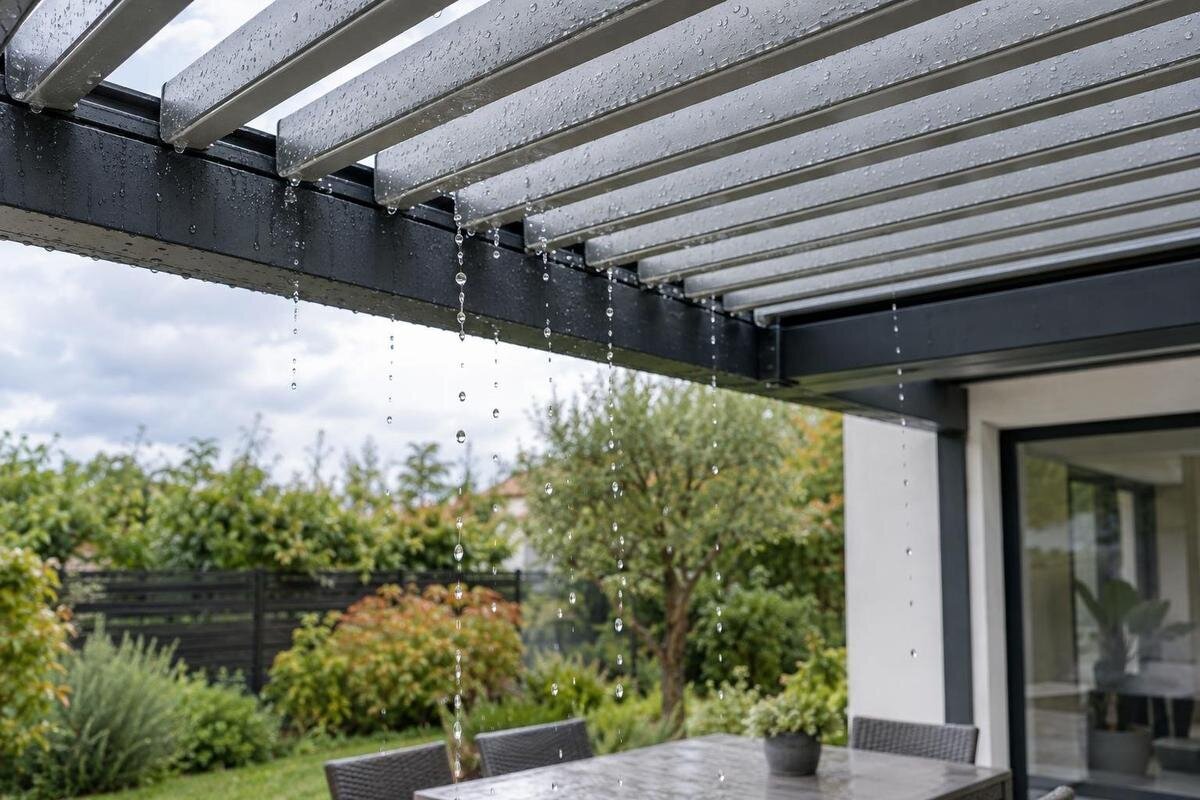
If the rain has stopped and droplets appear when you open a pergola’s louvres, water retained on the blades or elsewhere in the roof may be shifting as the angle changes. The timing alone does not prove a fault. The useful clues are where the drops first emerge, whether they stop when movement ends, and whether the pattern matches the drainage route and operating instructions for the exact roof design.

Before you buy 1
Why louvres can drip as they open
With the louvres closed, rain follows the path set by their angle and the surrounding frame. A thin film can cling to a blade, while separate droplets may gather at an edge, joint or underside. When a blade turns, its angle and edge position change, so water can move to a new point and fall. Several drops close together may reflect movement across several wet surfaces rather than a new leak at each point. A visible pool is not necessary: a small amount held along an edge can still produce a visible drip. The exact locations depend on the louvre profile and frame, so this is a possible explanation, not universal behaviour.
Look at the pattern, not just the first drop. A brief release during movement that stops afterwards is consistent with water shifting from a wet surface, but it cannot be called normal for every model without its instructions. Dripping that continues while the louvres remain still, returns from the same point after separate rain events, or changes noticeably over time deserves closer review. There is no universal number of drops or waiting period that separates residue from a defect. Use the manufacturer’s guidance; if the pattern is unclear, give the supplier or installer a clear description of when it starts and where it appears.
Where water may remain in the roof
Water can be retained elsewhere in the roof as well as on the blades. Depending on the design, it may run from louvres into a channel, along a perimeter beam or through a concealed route. Small amounts can remain at a seam, corner, channel end or around an outlet. Other systems guide water differently, so a beam that looks like a gutter may not be the intended collector, and a drip below it does not identify its source. Check the drainage diagram for the precise roof: it should show how water leaves the blades, where it is collected and where it is meant to discharge.
Read the drawing as a route map: locate the blade edges, any collection channel, joints, outlet and the direction in which water should travel. Identify which features belong to the moving blades and which belong to the fixed frame; this helps you describe where water first appears during opening. From ground level, compare the route with the first place where you see a drop emerge. A drip beneath a beam is not proof that the beam itself leaked; water may have crossed another surface first. Do not remove a cap or cover to trace a hidden path. When considering the Bloomcabin Bioclimatic Pergola, request a drawing for the roof configuration you intend to buy rather than inferring outlet positions from its appearance.
Before you buy 2
What the timing and location can tell you
Note whether the rain has stopped, the interval since it ended and whether wind is blowing. Then distinguish three moments: before the blades move, while they turn and after they reach their new position. This gives a clearer account than simply saying that the roof drips after rain. Record the first point where water emerges, not only the place below where a drop lands; water can run along a frame before falling. If you cannot see the starting point from a safe position, record that uncertainty rather than guessing. A drip at one corner and a line of drops from moving edges describe different patterns, although neither identifies a fault on its own.
Describe the extent of the pattern as well as its timing. Is it one isolated point, several points along a blade edge or a line beneath a beam? Does the release end when movement stops, or does water continue to emerge afterwards? Keep those observations separate from an explanation such as a leaking joint or blocked channel: the location of a drop alone does not establish its cause. If you are discussing the Bloomcabin Wall Pergola, use that product name and the fitted model reference to identify the roof, but describe the observed position precisely too. A mounting description cannot tell an installer which corner or blade edge you mean.
Follow the instructions for the exact roof
Post-rain operation should follow the instructions supplied for the installed roof, not a general rule for all louvred pergolas. The manual may state how to move the blades, which positions are permitted or when operation should pause. Follow that wording rather than advice for a different brand or design, and use the current instructions for your fitted model. There is no universal waiting time, and opening fully, opening in stages or leaving the blades partly open is not automatically right for every system. If the document says nothing about operating after rainfall, ask the supplier or installer before creating a routine of your own.
Use the controls as supplied and do not push or force a blade if resistance feels unusual. Stop if the blades jam, move unevenly or behave differently from the instructions, and seek model-specific advice rather than using movement as a drainage test. Keep hands, head and other people clear of moving parts; do not climb onto the frame to inspect it. If you are considering a wall-mounted pergola option, request operating instructions for the exact roof configuration: the mounting description alone does not define a post-rain sequence.

Before you buy 3
Distinguish retained water from a drainage restriction
Residual water on a blade is often noticed as that blade changes position; a restricted drainage route may instead show as water taking longer to leave a collection point or emerging farther along the frame. The distinction is not absolute, because a channel can carry water away from where it entered. Compare the first wet point with the drainage drawing and the intended discharge location. Do not infer a blockage solely because no stream is visible: the roof may discharge through a hidden route or only under particular conditions. If the diagram is unclear, ask which outlet should be visible in ordinary operation.
Look only at outlets and surfaces that are safely accessible from the ground, and remove debris only if the manual describes a simple owner-maintenance task. Do not take covers off, push rods or hoses into channels, use ladders to reach the roof or wash hidden routes under pressure. Those steps can damage components or make the original path harder to assess. If water stands, overflows or continues at an unexpected point, leave concealed parts untouched and request an inspection. For the Bloomcabin Pergola, ask for the channel and outlet diagram that applies to the chosen configuration rather than assuming the model name explains the drainage.
When repeated dripping needs inspection
An inspection is sensible if drops persist after the louvres stop moving, recur from the same frame or post after separate rain events, or appear where the drawing does not show a discharge path. Also note changed movement, a blade that stops short, visible standing water or new staining. None of these signs on its own identifies a failed seal or blocked drain; movement, drainage and joints may need to be considered together. A few drops during one opening do not establish a defect, but a repeatable pattern is worth documenting and referring to someone familiar with that model.
For a useful service request, summarise the event in order: the rain ended, the blades were in a particular position, movement began and water appeared at a stated point. Include how long the dripping continued and whether it has happened on other occasions. Distinguish what you saw from what you suspect; saying that water emerged beneath a joint is more precise than declaring that the joint has failed. Include the product identification, any fitted enclosure and a short video if you can record it safely. If your order is for Bloomcabin’s bioclimatic pergola, give the model or order reference as well. Ask the supplier to explain whether the observed release matches the roof’s intended operation or needs inspection, and keep the response with your service record.
Before you buy 4
How rain, wind and timing affect the pattern
Rainfall and surroundings alter how much of the roof gets wet and where water travels. A long spell of rain wets more surfaces than a short shower; wind can drive water towards parts of the frame that are less exposed in calm conditions. The interval before opening also matters: surface water may have drained or dried, while a channel may still contain water. Different blade positions can change the route water takes. Record these factors before comparing one occasion with another, or a change in wind or timing may look like a change in roof behaviour.
If rain is still falling, fresh water entering the roof can overlap with retained water released by movement. Record that as a different situation from opening after a dry interval, rather than treating the two events as equivalent. Likewise, distinguish a calm shower from wind-driven rain when comparing where drops appear. Note the blade position before and after movement so a change in position is not overlooked when reviewing the weather conditions. There is no single weather threshold to apply across models, and a different result does not by itself show that the roof has deteriorated. Use observations from ordinary operation; do not stage a test in unsafe weather. These details help explain why apparently similar openings may produce different drip patterns.
Record the event from a safe position
Observe from a safe position on the ground or through a nearby opening. Take a wide photo that shows the location beneath the roof, then a closer image only if it is reachable without climbing; mark the side or corner on a simple sketch. If recording video, keep everyone clear of the blades and do not stand directly under a moving roof to catch or trace drops. Never place fingers in joints or channels while the louvres are moving. A view of where a drop starts is more useful than a close-up of a wet surface alone.
Make the images easy for someone unfamiliar with the site to interpret. Label the wall side, garden side or another fixed reference on your sketch, and use the same viewpoint in any later recording. Show which point is visibly wet and which point is only where a drop lands; do not mark an unseen source as confirmed. Note whether side screens or panels were open or closed when the recording was made. If the roof is the Bloomcabin wall-mounted pergola, identify it by the product and order details alongside the images. Keep original photographs as well as annotated copies, so labels do not obscure the area being discussed. There is no need to dismantle roof parts to obtain a closer view.
Before you buy 5
What to check before choosing a louvred pergola
Before choosing a louvred pergola, request the operating instructions and a drainage diagram for the exact model and roof arrangement. Ask for the route from the louvre surface to any collector and outlet, and for an explanation of what the instructions say about opening after rain. Make the question specific: you want to understand what happens when a wet roof moves, not only how it sheds rain while closed. Confirm whether the guidance changes with the selected configuration or side enclosure, and which drainage parts owners can check without dismantling anything. Ask where discharged water is intended to emerge in the proposed layout, so you can relate the drawing to the space beneath and around the roof. A general statement about rain performance does not answer these operating questions.
Ask for a written clarification if a sales description and instruction sheet appear to differ, and keep the version supplied with your order. The Bloomcabin Pergola product page identifies a catalogue option, but the model name alone does not establish the drainage layout, post-rain sequence or suitability of an added enclosure. Check that the documents refer to the product actually quoted, including the selected roof arrangement, rather than another model shown in the same brochure. Clarify maintenance limits before purchase, particularly the distinction between accessible owner checks and work requiring an installer. The useful outcome is a clear explanation of the designed water route and operating procedure, not a general promise that no water will ever drip.
Check the roof-and-enclosure combination
Side enclosures deserve a separate check because the roof and surrounding panels form one installed arrangement. A screen, sliding panel or fixed wall may alter where wind-driven rain enters or how water is noticed, but its presence does not show whether the roof drainage path changes. Do not assume that enclosing the sides stops all drops, or that an enclosure is compatible with every louvred roof. Ask whether the exact roof-and-enclosure combination is documented and which openings or operating positions are covered by that guidance.
For an existing pergola, compare the installed side configuration with the manual before changing how you open the louvres. For a planned purchase, ask the retailer or installer to confirm the proposed roof-and-enclosure combination in writing and explain whether the drainage drawing applies to it. If you are comparing Bloomcabin’s bioclimatic pergola option, request information for the complete arrangement being quoted, not just the roof shown on the product page. Keep questions about water released by moving blades separate from questions about rain entering through the sides. They concern different parts of the installation, and an answer about side protection does not explain post-rain dripping from the roof.
Frequently asked questions
Does a brief drip after opening mean the pergola is leaking?
Not necessarily. Water can shift from a wet louvre edge as it moves, but that alone cannot confirm whether the behaviour is expected for your model. Check the exact instructions, and note any repeated or continuing drips for review.
How long should I wait after rain before opening the louvres?
There is no universal waiting time for every roof design. Follow the instructions for the pergola you have. If they do not explain post-rain operation, ask the supplier or installer rather than adopting a rule meant for another model.
How can I tell whether water is retained or a channel is blocked?
Timing and location offer clues, not a definite diagnosis. Drops during movement may come from wet blade surfaces; water emerging later along a frame may have travelled through a drainage route. Compare what you see with the model-specific diagram.
Should I open and close the roof repeatedly to test it?
Do not cycle the louvres just to provoke a drip. Follow the supplied operating guidance and record what happens during normal use. Keep clear of moving parts, and ask a qualified installer or supplier for advice if the roof sticks or behaves unusually.
Can side panels or screens change what I should check?
They can affect how rain enters or is noticed around the roof, but their presence does not establish how the roof drains. Confirm that the guidance covers the exact roof-and-enclosure combination you have or are considering.
A drip as the louvres move can come from rainwater shifting off a blade or travelling through another part of the roof’s drainage route. Timing and location help narrow down where to look, but they do not replace the diagram and operating instructions for the exact design. Note what happens during normal use, follow the supplied guidance and seek an inspection if the pattern persists or recurs while the blades are still.
