
ZIP Screens or Outdoor Curtains for a Pergola?
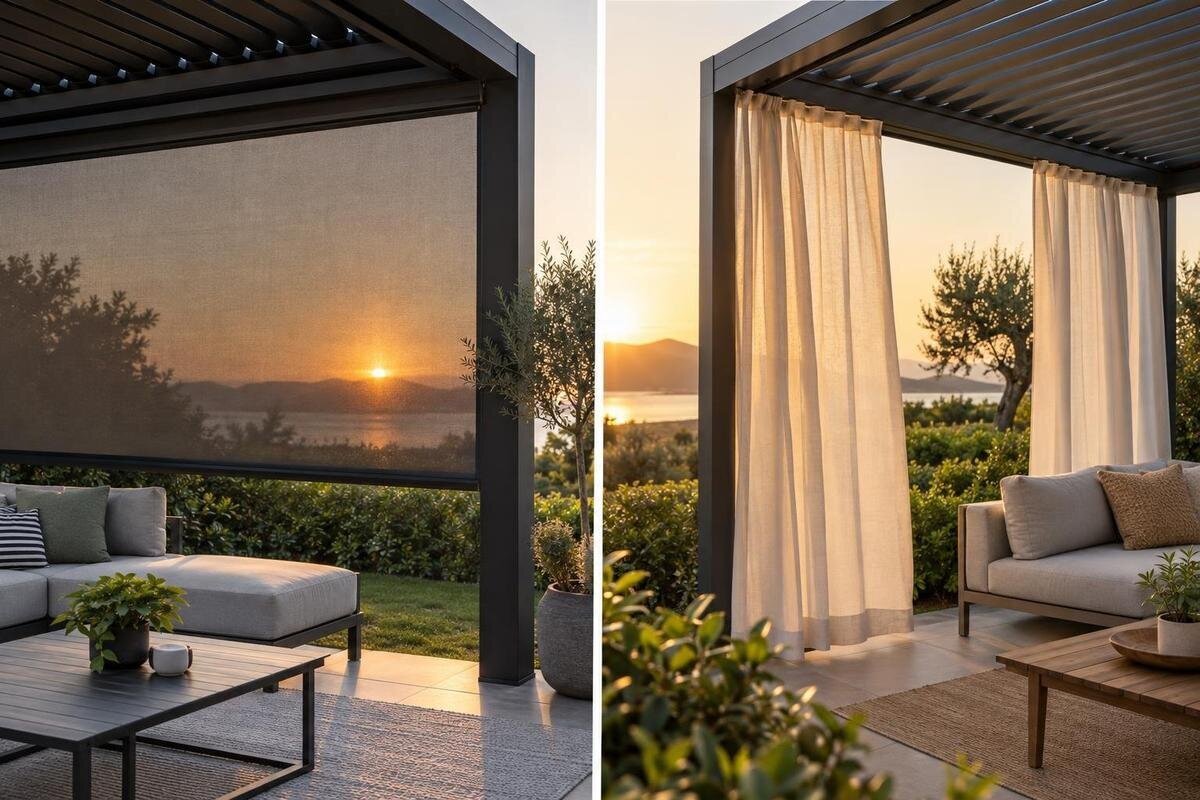
Pergola side shading
ZIP screens and outdoor curtains both provide side screening for a pergola, but they behave differently. A ZIP screen runs in side guides; a curtain hangs and gathers. That affects how much of the opening remains clear, the way air passes and the care involved. The choice depends on whether you prefer a more defined, guided panel or fabric that can be drawn aside. It must also suit the exact pergola model, opening and documented operating limits. Neither should be treated as an included feature unless the quotation states that it is included.

How the two side treatments behave when closed
A typical ZIP screen has a fabric panel whose zipped side edges run in guides. As the panel is lowered, the guides keep its edges aligned, creating a more defined plane across the side than loose drapery. That describes the mechanism, not a sealed boundary: the bottom clearance, corners, joins between panels and fit to the opening still matter. Ask for a drawing that shows those details, especially if the aim is to reduce direct sightlines or low sun. The word ZIP alone does not tell you how transparent the fabric is, how much air passes through it or what weather limits apply.
Outdoor curtains generally hang from a rail or track and move as fabric panels. When drawn, they may overlap or leave gaps at the edges and between panels; when open, they gather into a stack that takes up some of the side. Their softer outline can make it straightforward to change between open and screened positions, but the clear opening depends on panel width, stack-back space and track layout. With either option, ask what remains visible when the panel is raised or the curtains are gathered. Neither is equivalent to glazing or a sealed room, so compare the whole opening in both its open and closed states.
Map the sun, views and access before choosing
Note which side receives direct sun at the time you actually use the pergola, where people approach from and what you want to screen. Sun moves during the day and across the year, so a side that shades low afternoon glare may be unnecessary at breakfast. A simple plan showing usual seating, neighbouring windows or balconies, paths and the main view helps separate shade needs from privacy needs. If possible, take photographs from seated and standing height at the relevant time. A panel may block the most obvious view from your chair while leaving another sightline open.
Keep the pergola’s exact base model and side opening with that plan. If it is the Bloomcabin Bioclimatic Pergola, use that name when asking which screen or curtain configuration is documented for your particular frame and side. A model name helps identify the base product; it does not by itself confirm that a given accessory fits. Mark any door swing, wall return or post that affects the opening, and note whether you want the panel down throughout a period of use or only at a particular time. This makes the comparison about a real layout rather than an abstract choice of fabric.
Privacy depends on fabric as well as coverage
Privacy depends on both the fabric and the viewing conditions. An open-weave screen can leave more of the view visible than a denser weave; the ZIP edge does not determine this. Outdoor curtain fabrics also range from sheer to closely woven. Ask for a sample or a clear demonstration outdoors against light and dark backgrounds, since a small catalogue swatch can make transparency hard to judge. Check the view from the neighbour’s likely position as well as from your chair. For curtains, panel width and overlap matter too: a fabric that looks opaque straight on may leave a sightline at a join or edge when drawn.
Light changes the result. During the day, a bright exterior and a shaded pergola may make it easier to see out than in; at night, lighting inside the pergola can make people more visible from outside. Avoid relying on a general promise of privacy. Ask what the proposed fabric does in the conditions in which you will use it, and whether it still leaves a view when fully deployed. When discussing side screening for the Bloomcabin Wall Pergola, explain whether you need daytime screening, evening privacy or both. This gives the supplier a clearer basis for comparing the available fabrics and their coverage.
Airflow depends on the fabric and the open sides
Airflow depends on what remains open and how permeable the fabric is. An open mesh screen differs from a dense screen, even though both may be called ZIP screens. For curtains, drawing panels aside can restore a broad opening, while closing them across the side reduces the free area, especially if the fabric is closely woven. Ask whether the supplier can provide a fabric specification or sample; the category name alone is not an airflow rating. Think about whether you need a side fully open, partly open or screened during normal use, rather than comparing fabrics in isolation.
Consider airflow across the seating area rather than looking at one screened side in isolation. If several sides are closed, the positions of the remaining openings and the direction of the breeze can change how the space feels. When enquiring about side options for the Bloomcabin Pergola, describe which sides you intend to keep open and where people will sit. Ask about the proposed fabric rather than expecting the base pergola specification to describe its permeability. A fabric sample viewed in the planned position can also help you judge how much of the view and daylight it retains, alongside the airflow information supplied.

Compare operation and clear access
Compare how each option changes from closed to open, and who will operate it. A ZIP screen can be raised or lowered as a panel, but the operating method and whether it can be stopped at intermediate positions vary. Do not assume a manual or powered control from the product category. Ask to see the control, how it is reached and what position the supplier recommends for everyday use. If one side is an entrance, check how it is cleared and whether the screen can be left in the open position specified for that system.
Curtains usually slide along a rail, but opening them fully requires somewhere for the fabric to gather. Check that the stack will not obstruct a door, walking route or seating, and ask whether tie-backs are included or a separate item. If you are considering the bioclimatic pergola, describe which sides you expect to open most often and ask how any compatible screen is operated. A drawing should show the clear width as well as the deployed width. If you will switch between shade and an open view several times in a day, ease of operation may matter more than how neat either option looks when closed.
Plan care around tracks, guides and fabric
Both arrangements need care outdoors, but the tasks differ. On a ZIP system, check how accessible the side guides and lower edge are for removing loose grit or leaves; debris can interfere with smooth movement. Curtains have folds, seams and attachment points where dust can settle, and their care depends on whether the panels can be removed and what the fabric instructions allow. Ask for cleaning guidance for the exact fabric and hardware before using detergents, abrasive tools or a pressure washer. Do not infer that a curtain is machine washable, or that a screen fabric can be removed by the owner.
Ask whether the textile can be cleaned in place, whether it needs to dry before being gathered or retracted, and how the track or guides should be checked. Keep access to the full track length in the layout so the fittings can be inspected and cleaned. If the site is exposed to salt spray or fine dust, ask whether the supplier gives specific care advice for those conditions. You can also ask whether replacement fabric or panels are available if something is damaged; do not assume that parts are stocked. Ease of access and the care routine are part of the long-term comparison, not an afterthought.
Ask for a documented wind limit
Wind is the comparison that most needs written, model-specific evidence. A curtain may move or billow, while guides keep a ZIP screen’s edges aligned, but that mechanical difference does not establish that one option is safe at a higher wind speed. The fabric, span, fixings, opening and pergola structure all matter, and a product photograph cannot supply a limit. Treat a general description such as wind-resistant as incomplete unless it is tied to an identified accessory and configuration.
Request the documented limit for the accessory when deployed, the conditions behind that figure and the instructions for operating or retracting it as wind rises. Check whether guidance changes with size, side or degree of deployment, and ask whether it applies to the accessory alone or to the pergola with that accessory fitted. For the wall-mounted pergola, make sure the answer covers the proposed side accessory, opening size and fixing arrangement together. An account of a similar installation or the apparent tension of a fabric is not a substitute for the relevant document. For an exposed site, have the supplier or a qualified installer confirm the proposed configuration in writing.
Check dimensions and model compatibility
Compatibility starts with the clear opening, not the pergola’s overall footprint. Record the opening width and height, and note posts, walls, beams, handles, lights, cables, door swings, uneven paving or other obstructions. If the opening varies, ask the supplier which measurements they need and how they should be taken. Screen guides may need particular fixing surfaces, while curtain rails have their own support requirements; a frame that looks convenient is not proof that it is suitable for an attachment. Have the final measurements confirmed by the supplier or installer responsible for the accessory.
Ask whether the proposed accessory is approved for the exact pergola model, size, opening and side, and whether it is supplied as a compatible system. Also ask whether the same configuration is available for the particular freestanding or wall-mounted version you have. For an enquiry about the Bloomcabin bioclimatic model, include the exact variant and measurements, along with a note of any obstructions around the opening. For an existing structure, provide clear photographs and any previous order details, but ask whether an on-site check is needed. Photos may not show every fixing point or obstruction, so they should support rather than replace the requested measurements.

Confirm availability and what the quotation includes
Availability needs checking as carefully as fit. A pergola model name does not establish whether a compatible ZIP screen or curtain is currently offered for your opening, which sides can be ordered or whether a particular fabric is available. Ask for confirmation against the exact base model and requested configuration. If you are considering an accessory from another supplier, request its compatibility statement for the frame rather than relying on visual similarity. This is especially useful for retrofit orders and openings that do not match a standard layout.
Before paying, request an itemised quotation stating exactly what is included: the pergola, side panels, tracks or guides, controls and fitting, as applicable. Ask for the accessory’s product name, fabric description, care instructions, wind guidance and compatibility confirmation, as well as current availability and delivery terms. If you are comparing packages for the regular pergola, keep the base structure and each side accessory listed separately so you can see what each quotation covers. Confirm whether the price covers one side or several, and whether any control or fitting is separate. Do not assume that a screen or curtain shown in a photograph is part of the quoted product.
Choose by the trade-off you are willing to make
A ZIP screen may suit you if you want a more guided, defined fabric panel and a repeatable way to cover an opening, provided the proposed fabric, operation and documented wind guidance fit your site. Outdoor curtains may suit you if you value being able to gather fabric away and change the look of the side, and are comfortable checking how much space the stack uses and how the panels move. Neither option automatically provides better privacy or airflow: look at the actual textile and coverage. Compare a drawing of each option both deployed and open.
For a pergola used in different ways through the week, one screened side and another left open may work better than closing every side. Only combine screens and curtains if the supplier confirms that the mix is compatible with the particular frame and fixings. If you are planning a layout around the Bloomcabin wall-mounted model, compare how each proposed arrangement affects the entrance, seating and view when open as well as closed. If you are undecided, rank the two things that matter most, such as privacy from a particular seat, airflow, a clear entrance or easy cleaning. Judge each arrangement against those priorities rather than choosing from a product photograph alone.
Frequently asked questions
Are ZIP screens more wind-resistant than outdoor curtains?
Not automatically. Guides keep a ZIP screen’s edges aligned, but that does not establish a safe wind limit. Curtains may move or billow, but the comparison depends on the exact fabric, size, fixings and pergola. Ask for written limits and operating instructions for the proposed combination.
Will a ZIP screen or curtain keep rain out?
Neither should be treated as a sealed wall. Fabric, overlaps, clearances and the way the side is fitted all affect what passes through. Ask the supplier what the specific accessory is intended to do, and do not assume that a side treatment makes the pergola weatherproof.
Can a ZIP screen provide privacy at night?
It depends on the fabric and the lighting on both sides. A mesh that limits views in daylight may be less private when the pergola is lit after dark. Check a sample or demonstration in similar conditions, and assess views from outside as well as from your seat.
Can I add a screen or curtain to an existing pergola?
Only if the supplier confirms that the particular accessory is compatible with your exact model, opening and fixing arrangement. Provide the model name and measurements, and ask whether the accessory is approved for that configuration. Do not assume that a visually similar frame will accept the same fittings.
Which option allows more airflow?
There is no universal winner. An open-weave screen may pass more air than a denser fabric, while gathered curtains can leave a wide opening. Compare the fabric and the side positions you will actually use, rather than relying on the terms ZIP screen or outdoor curtain.
Choose according to how the side works in both positions, not just how it looks when closed. A ZIP screen offers a guided panel; curtains offer fabric that can be gathered away. In either case, the exact fabric, opening, operating method and documented wind limits matter. A measured layout and a fabric sample make the comparison more useful than a generic promise of privacy or airflow.
