
Buying a Wood-Burning Sauna: Heater, Flue and Site Planning
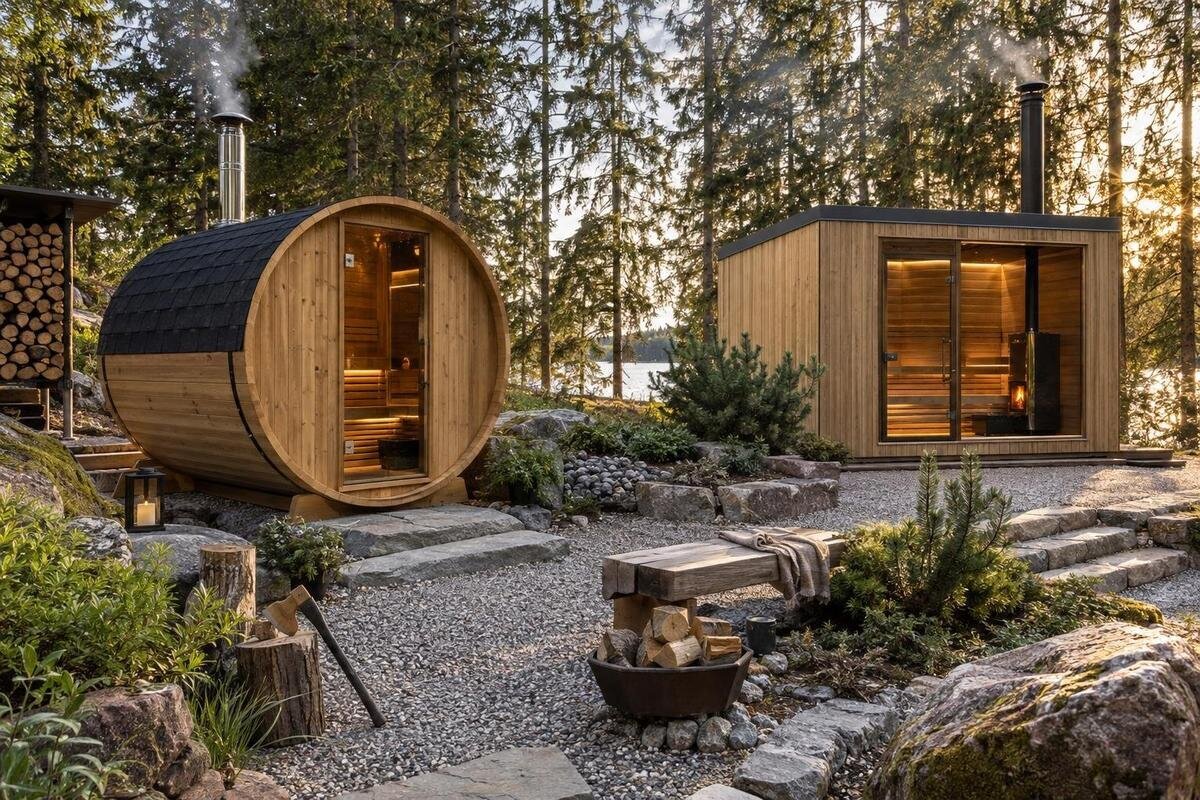
Sauna buying guide
Choosing a wood-burning sauna is a package-and-site decision, not simply a choice of cabin style. The heater must be suitable for the sauna and confirmed for that pairing; the flue needs a feasible route; and the proposed position has to work for access, smoke dispersal and everyday use. Before committing to a model, establish what the sale includes and what a qualified installer needs to assess. This guide focuses on decisions that can change the order, so you can compare listings without assuming that any particular sauna includes or accepts a wood-fired heater.
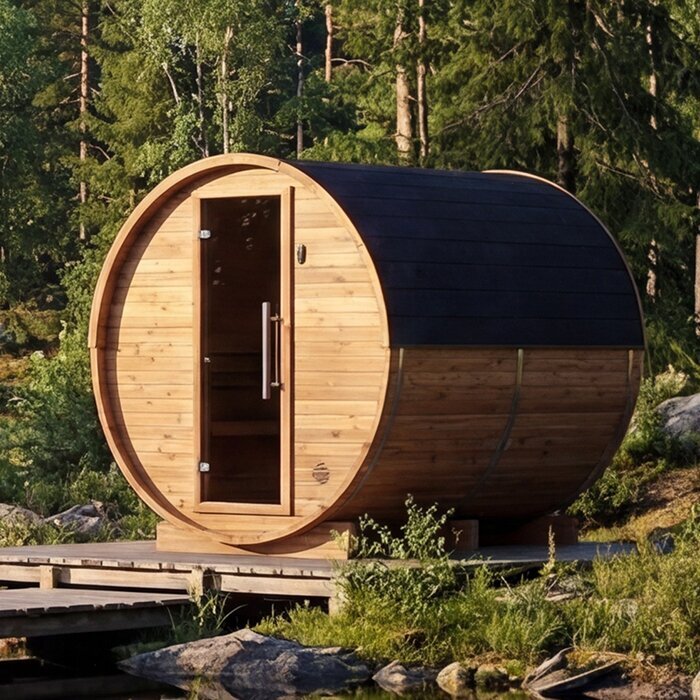
Confirm exactly what the sauna package includes
A product page may describe the sauna cabin alone, a cabin with selected accessories, or a wider package; do not assume the scope from the title or photographs. Ask whether the order includes the wood-burning heater, a complete flue or chimney system, weatherproofing parts for any roof penetration, stones, a guard, assembly and delivery. Clarify which required items are excluded, who supplies them, and whether unloading or site preparation is included. Request an itemised list naming the components and their models, rather than a broad line such as “heater package”. A clear scope makes quotes comparable and shows where a separate supplier or installer must be involved. It also helps distinguish materials supplied with the sauna from work that must be arranged after delivery. Ask whether the quote is based on a particular installation layout, because changing the heater position or flue route later may change the required components.
Use catalogue pages to identify the exact sauna under discussion, not to infer its contents. For example, the listing for thermowood barrel sauna S 140 gives you a model reference to include in an enquiry; its name alone does not establish that a wood-fired heater or flue is supplied or compatible. Ask the seller to put the sauna model, proposed heater and included flue components on the quote. If parts come from different suppliers, agree who will confirm compatibility and the complete installation arrangement before you pay, and get exclusions recorded too. Keep the written version alongside any separate installation quote.
Match the heater to the sauna
Choose heater capacity from the sauna maker’s information, not from a visual guess. The relevant inputs may include internal dimensions or volume and details that affect heat loss, such as glazing and construction; the heater maker’s published guidance should explain what it can serve. Give suppliers the exact sauna model and configuration, then ask them to identify a compatible heater in writing. If an input is missing from the listing, request it rather than estimating from an outside measurement. A qualified solid-fuel installer can flag questions the product documentation does not resolve. Record which version of the sauna the recommendation relates to, including any options that alter the interior or openings. This prevents a recommendation for a standard configuration being carried over to a different one without confirmation. Keep the heater maker’s guidance with the supplier’s pairing confirmation so both can be compared if the proposal changes.
Output is not the only comparison. Ask where fuel is loaded, how ash is removed, what access is needed for routine cleaning, and where the heater is intended to sit relative to the benches and entrance. Those details affect the usable layout and practical route for bringing in firewood; they are not settled by a heater’s headline rating. If you are reviewing thermowood barrel sauna HC150, use its exact name when asking which heater configurations, if any, its manufacturer supports. Do not treat a model code or product image as proof of a match, or assume a firebox layout will suit your preferred entrance.
Get the sauna–heater pairing confirmed
Check compatibility information for the exact combination, not just the words “wood-fired sauna” in a description. A cabin and a heater can each be marketed for sauna use without that proving they can be fitted together as proposed. Confirm the heater model, permitted installation arrangement and any linked components through relevant manuals or written supplier guidance. Where two manufacturers are involved, ask who will confirm the complete pairing and whether the installation professional has reviewed it. The check should cover the configuration you plan to buy, not just the general product family. Keep confirmation with your order documents if options change before delivery.
When asking about a specific cabin, quote its full listing name: for example, thermowood barrel sauna HC 225. Ask the seller to point to supporting instructions or written compatibility confirmation, rather than offering a verbal assurance based on a similar-looking model. Have the installer review the same sauna and heater references; a change in configuration can affect the route, clearances or access. Also check whether any separate guard or connector forms part of the confirmed arrangement. If compatibility cannot be established before purchase, pause the order or choose an option for which the documentation is clear.
Plan the flue route before siting the sauna
Flue planning starts with the proposed heater and sauna layout. The route has to match the heater’s instructions and the sauna’s design, while allowing the products and any roof or wall penetration to be assessed as one installation. A qualified solid-fuel installer should review the proposed route, terminal position, nearby structures and the materials it passes, along with manufacturer-specified clearances. Do not assume that a generic drawing, product photo or simple line on a site sketch settles the details. Bring the exact model information and your intended sauna position into that conversation before the order is fixed.
Ask which parts make up the flue system and whether all are included, such as the sections, supports and weatherproofing specified for the chosen arrangement. Confirm whether a separate roof trade or builder is needed for the penetration, and who coordinates that work; do not leave it as an assumption in the delivery quote. When discussing thermowood barrel sauna N 210, give the installer the precise model reference and request advice based on its documentation and your actual roof layout. The site plan should show the proposed route and nearby features, not just the cabin footprint. Mark access points and overhead obstacles on that plan as well, since they can affect how materials are brought to the site and where work can be carried out. A simple sketch with measurements gives the installer a more useful starting point than a description of the site.
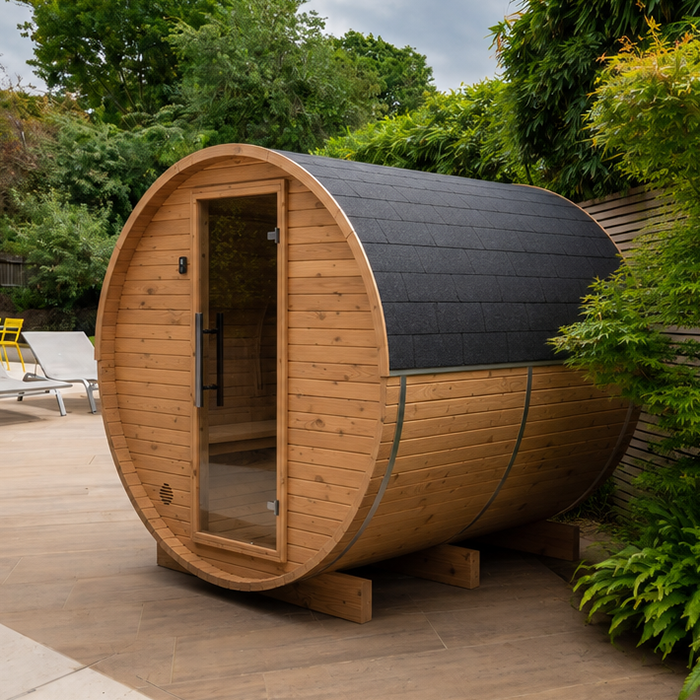
Assess the ground and outdoor position
A sauna site needs room for its actual footprint and routine use. Check the door opening, approach path, space to load fuel and reach components for cleaning or service, as well as access for the installer. The seller should provide assembled dimensions and any manufacturer-stated clearances; do not derive them from a photograph or model code. If more than one position seems possible, sketch each with fences, buildings, trees and the likely flue route marked. A plan that looks roomy on screen can still be awkward when people move around the entrance or carry wood. Think about the route from the house or wood store in wet weather, and whether it remains practical when the ground is slippery or the light is poor. These everyday movements can make one otherwise suitable position noticeably easier to use than another.
Check ground conditions and water flow as well as footprint. Ask what base or support the sauna maker requires, and have a suitably qualified builder assess whether the chosen area can provide it; this guide cannot establish foundation design for an individual site. Look for places where surface water could collect, consider how rain drains away and allow for maintenance access. For a candidate such as thermowood barrel sauna N 250, ask the seller for confirmed dimensions and support requirements before setting out the base. Do not assume every sauna format needs the same preparation.
Consider smoke, wind and nearby properties
Smoke dispersal deserves a separate site check. Consider nearby doors, windows, outdoor seating, neighbours’ living areas and places where people regularly gather, then think about likely wind directions across the year. The point is not to predict every gust but to avoid choosing a position without considering where smoke may travel. Trees, fences and adjacent buildings form part of the setting around the outlet; an installer must assess the proposed terminal against the appliance guidance and site conditions. Discuss concerns early, while the position can still be changed.
Local rules or restrictions may affect whether and how a wood-burning appliance can be used at a particular address. Check with your local council or relevant local authority before ordering, and ask the installer what information they need for that discussion; do not assume another property’s arrangement sets a precedent for yours. If you are considering thermally modified wood barrel sauna LC 260, treat the page as a model reference only: ask for the actual heater-and-flue proposal and have its smoke outlet assessed at your site. This separates the product choice from unsupported assumptions about emissions or suitability.
Check delivery access and assembly arrangements
Measure the access route from the unloading point to the installation area, not just the patch of ground where the sauna will stand. Check gates, turns, slopes, overhead obstructions and narrow sections, then ask the seller for packaged dimensions, delivery method and unloading requirements. The assembled footprint does not tell you whether a package can pass through a side gate or around a tight corner. If a vehicle or lifting equipment is needed, have the supplier confirm what access they require and who arranges it. Do not assume delivery includes moving the sauna to its final position. Take clear measurements at the narrowest points and note any temporary obstacles that cannot be removed. Share photographs and a basic access sketch with the supplier if requested, but rely on their confirmation rather than deciding that access is adequate yourself. Clarify where the delivery vehicle can stop and whether the route crosses ground that could be affected by wet conditions.
Assembly can also change the practical order. Confirm whether the sauna arrives assembled or in components, who carries out assembly, what tools or trades are outside the supplier’s scope, and whether flue installation is included separately. Put site-preparation expectations, access limits and customer responsibilities in writing. When checking thermally modified wood barrel sauna HCF 300, use the listing name to request package details and assembly instructions; a model number cannot tell you its packed size or delivery method. Resolve tight access before paying, when another location may still be possible.
Compare timber details and ongoing care
Ask what the sauna’s timber and finish actually are, how exposed faces are treated, and what routine care the manufacturer expects. Names such as “thermowood” or “thermally modified wood” are a reason to request product documentation, not to assume durability, weather resistance or maintenance needs. Find out whether an exterior finish is supplied, whether it has to be applied after assembly, and what care remains the owner’s responsibility. Compare those instructions with the exposure at your site, including sun, rain and wind, and decide whether the expected upkeep suits the position you have in mind.
Ask about the roof covering, joints and any components that need periodic attention, particularly around the flue penetration. Keep the sauna maker’s maintenance guidance separate from the heater and flue manuals, since different parts of the installation may have different care requirements. The page for thermowood barrel sauna LCF 300 is a way to identify a model to ask about; confirm its material specification and care requirements from current documentation. If instructions are vague, ask for clarification before placing the order, as future maintenance can influence both positioning and the work involved.
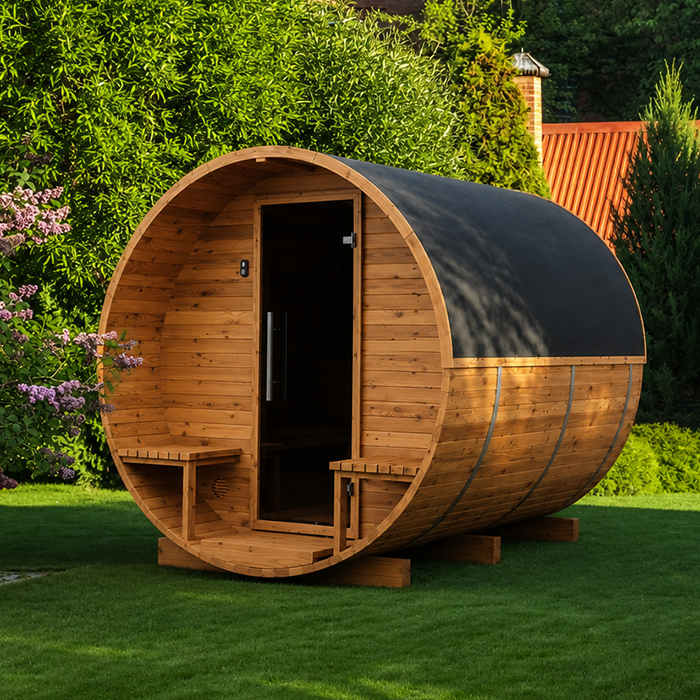
Compare complete project quotes
Compare fully scoped quotations rather than the cabin figure alone. List the sauna, heater, complete flue arrangement, any required weatherproofing work, delivery, unloading, assembly, base preparation and professional installation as separate lines where possible. Depending on the property, more than one trade or quote may be needed; ask which items are allowances and which are part of a defined scope. Include any local approvals or site work you have been advised to investigate, without assuming they are included in a supplier’s price. The aim is to see what remains to be paid for and arranged, not to predict a total from a product listing.
Compare the documents on like-for-like terms: the same heater model, flue components, assembly scope and delivery assumptions. Ask about payment stages, cancellation or change terms, warranty coverage and who handles missing or damaged components, then read those terms rather than relying on a general promise. If a seller recommends a different heater after you have received an installer’s advice, pause and have compatibility checked again. A cheaper proposal can become a different project if it leaves out parts or work that another quote includes.
Settle open questions before ordering
Before checkout, bring the supplier and installer to the same final details: exact sauna model and configuration, named heater, documentation for the pairing, proposed flue route and site position. Ask them to identify any open issue that still depends on an on-site measurement, roof assessment or local confirmation. Set out who will answer it and when, and do not treat an unresolved question as settled simply because a product can be added to the cart. If an answer changes a required component, revise the quotation before committing.
Save the product specifications and manuals that apply to the versions you are buying, along with the itemised order and installation scope. Re-check that delivery and assembly assumptions match the access you measured and that no substitution has altered the confirmed heater or flue arrangement. If you are still choosing among sauna models, compare those for which the seller can provide clear inclusion details and compatibility information. The aim is one documented plan naming the sauna, appliance, flue and work involved, rather than separate purchases whose fit is left for the installer to discover.
Frequently asked questions
Does a wood-burning sauna package include the heater and flue?
Not necessarily. A listing may cover the sauna alone or include selected components. Check the current order details for the named heater, flue parts, assembly and delivery, and ask for any exclusions in writing before comparing quotes.
Can I fit a wood-burning heater to any outdoor sauna?
Do not assume a universal fit. Ask the sauna maker to confirm that the exact heater model and proposed installation arrangement are compatible with the exact sauna model. If different suppliers are involved, have a qualified solid-fuel installer review the relevant documentation.
How do I choose the right heater capacity?
Use the sauna maker’s internal dimensions and construction information with the heater maker’s published guidance. Ask the supplier to identify a compatible model in writing, then take unresolved sizing or installation questions to a qualified solid-fuel installer. Do not estimate from the exterior alone.
Does the flue always need to pass through the roof?
Do not assume a route either way. The permitted flue arrangement depends on the heater’s instructions, the sauna design and the site. Ask a qualified installer to assess the proposed route, penetrations and terminal position before you choose a location or buy components.
What should I check at my property before buying?
Measure the intended footprint and delivery route, confirm the required base with the supplier, and have an installer review the flue route, clearances and smoke dispersal. Check whether local restrictions apply, and confirm that the package includes the parts and assembly you expect.
A wood-burning sauna purchase is easiest to assess when the cabin, heater, flue and site are treated as one coordinated project. Compare package contents first, keep the exact model details in the compatibility and flue discussions, and have qualified professionals review the site-specific questions. A decision is ready to move forward when the order scope, delivery arrangements and installation plan are clear enough to put in writing.
