
How to Choose an Outdoor Sauna for a Coastal Property

OUTDOOR SAUNA BUYING GUIDE
Coastal exposure can place an outdoor sauna’s materials and exposed fittings under a different maintenance burden, but a seaside address alone cannot tell you how demanding a site is. The useful comparison is between the exact position and written evidence for the complete model: materials, fittings, wind and rain limits, siting instructions, upkeep and warranty wording. This guide sets out what to resolve before choosing a sauna for a coastal property.
Before choosing 1
Assess salt and wind at the proposed site
A coastal address does not describe one exposure level. Salt carried in the air, wind-driven rain and persistent damp can reach a site in different combinations. Distance from the shoreline is only one clue: open beaches, headlands, elevated ground, sheltered inlets and nearby buildings can change what reaches a particular corner. Assess the proposed sauna position rather than relying on a broad label such as seaside. Note which directions bring rain, whether salty spray reaches existing surfaces, how quickly the ground dries and whether any shelter is permanent, seasonal or likely to change.
Sketch the proposed position against the house, boundary, planting, drains and access route. From a safe place, observe conditions after ordinary unsettled weather; corrosion or salt deposits on nearby fittings can flag a demanding spot, but their absence does not prove low exposure. Record where you noticed them and which surfaces were affected, rather than describing the whole property as equally exposed. If you have two possible positions, note the same details for both so that the comparison is useful. The Sauna S-140 listing shows a 1.93 m² figure. Keep that catalogue information alongside your site notes, but separate from your assessment of exposure: the figure does not establish coastal suitability. Your notes should describe what happens at the proposed position, while the product information should explain what conditions the sauna is intended to accommodate.
Get a component-by-component material schedule
Ask for written details of the exposed materials, rather than relying on a single description such as treated timber or weather-resistant finish. Find out what is used for the exterior, frame, floor and roof, and ask which treatments or coatings are applied. Check whether the instructions cover cut ends, joints and areas exposed when doors are open, and whether a finish needs renewal. A timber treatment and a surface finish are different pieces of information; neither one alone establishes how the complete sauna will fare in salt-laden air.
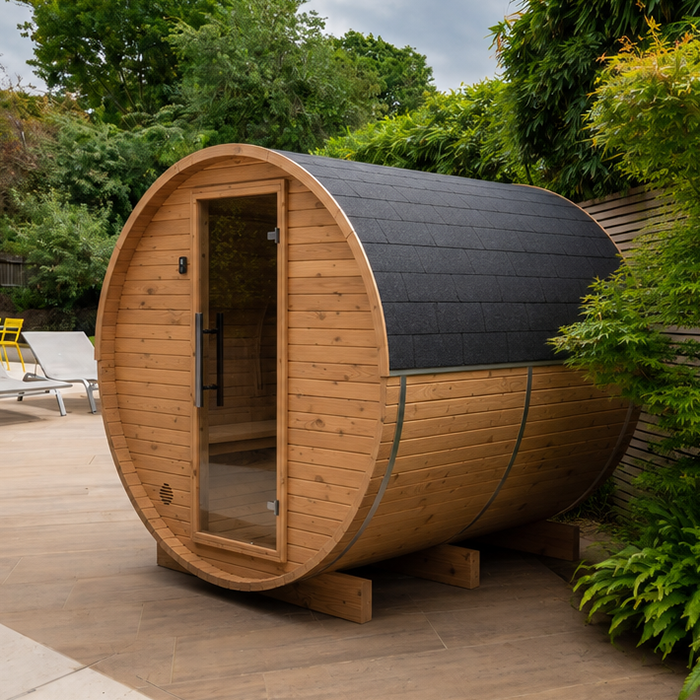
Apply the same scrutiny to metal parts. Ask for the stated material or grade and finish for exposed fasteners, bands, hinges, latches, brackets and vents, where fitted, along with their care instructions. Broad terms such as stainless or marine-ready do not describe every component or prove suitability for your site. The LC-260 product page uses the wording Thermally Modified Wood Barrel Sauna. Treat that as a way to identify the advertised model, not proof of which parts use that timber or how the complete assembly performs in salt exposure. Keep the material information organised by component, with a separate entry for its finish and required care. This makes it easier to spot an unanswered question, such as a specified timber treatment paired with no description of the exposed door hardware, without assuming that one specification covers everything.
Before choosing 2
Ask for wind and rain limits in writing
Request the manual and dimensioned drawing for the exact model and installed configuration. Ask whether the manufacturer specifies limits for wind, wind-driven rain, water entry or exposed locations, and which parts those statements cover: the shell, roof, doors, joints, seals and external fittings. Find out what conditions or exceptions apply, and whether a stated test or rating actually applies to the complete assembly. An outdoor label, barrel shape or solid-looking frame does not establish storm or marine suitability. If the documentation is silent, treat exposure performance as unknown rather than assuming that no warning means approval.
Match any stated conditions to the position you have mapped, including the surrounding terrain and nearby shelter. Send the manufacturer or installer a site plan and photographs, and ask an appropriately qualified local professional to review the installation where needed. Make clear which way the door would face and identify any shelter on which the proposal depends. If the response recommends a different position or configuration, record that change against your plan rather than applying the answer to every location on the property. Do not calculate or improvise anchoring from a product photo. The HCF-300 listing shows a 6.89 m² figure; use the model identifier when requesting its drawing and installation advice. Keep any stated exposure limits with those details so that you can compare the proposed installation with the conditions the manufacturer actually describes.
Plan drainage, base dimensions and clearance
Coastal water can reach a sauna as direct spray, rain, roof runoff, ground flow or splash from hoses and irrigation. Mark downpipes, drains, taps and low points on your site sketch. A position that stays wet or carries runoff may add to maintenance, even if it is not the closest spot to the sea. Use the manufacturer’s instructions for the base and installation, and ask an installer to assess the actual ground and drainage. Do not choose supports or change the foundation arrangement based on general advice that is not for the exact model and site.
Plan from the external outline and installation drawing, not from an unexplained area figure. The HC-150 product page shows 2.97 m²; do not use that number to set base dimensions unless the manufacturer explicitly identifies what it measures. Apply the same distinction when comparing other listings: an area figure is not a substitute for the outside footprint, door opening or manufacturer-specified clearances. Mark these separately on your plan, together with the route for delivery and assembly. Check where components would be brought in and where assembly work could take place without blocking drains or the route through the property. Leave inspection access in the positions required by the instructions, rather than counting every unused strip beside the sauna as spare space. Before accepting a layout, confirm that both access routes and drainage remain usable once the complete installation is in place.

Before choosing 3
Balance shelter with access
A boundary wall, hedge or nearby building may interrupt direct wind, but it does not prove that a space is free from salt. Obstacles can also change the airflow around their edges, while dense planting may keep surfaces damp or make them harder to inspect. Assess the actual proposed position instead of treating a fence or row of trees as tested protection. If you are considering a screen, ask the manufacturer whether it is compatible with the siting instructions rather than assuming it will reduce exposure.
Consider how you will reach and use the sauna in wet, windy weather. Check that the door can open safely and that the route is not blocked by planting or furniture. Trace the everyday route from the house as well as the approach to the sauna door, noting where you would need to move items before using it. A position should not depend on keeping a frequently used doorway or shared path blocked. The N-210 listing shows a 4.43 m² figure; use its model drawing to compare possible layouts rather than treating that figure as the space required around it. On each layout, distinguish the route people will use from the areas that must remain accessible for inspection. This helps you compare a sheltered position with a more open one without overlooking the practical compromises of either.
Make fittings easy to inspect and replace
Small exposed parts deserve attention alongside large panels. From the drawings and included-parts information, identify the external fasteners, metal bands, door hardware, vents, brackets and any heater or flue fittings in the chosen configuration. Ask what material and surface protection are specified for each, and whether their care differs from that of the surrounding timber. A general description of the cabin does not explain every fitting or how it should be maintained in salt exposure.
Choose a position where you can inspect the areas the manufacturer says to check, including accessible joints and the sides of the structure. Ask which parts can be inspected without removing panels, how replacement fittings are identified and whether parts can be ordered for the exact model. For the HC-225 product page, record the model identifier and its listed 4.4 m² figure separately from the hardware information you receive. Ask for a parts diagram or reference numbers where available, so that a later enquiry identifies the fitting rather than relying on a description such as the door hinge. Clarify whether replacement work is an owner task or requires an installer, and how access would be gained in your proposed layout. Do not apply oils or coatings to fittings unless the maker approves them; include the approved care method alongside the relevant part details.
Before choosing 4
Agree on a practical maintenance routine
Ask for written care instructions covering the exterior timber and finish, exposed hardware, joints, roof and any heater or flue components in the selected setup. Find out what to rinse or wipe, which cleaning methods and products are approved, how surfaces should be dried, and whether or when finishes need renewal. Do not assume that pressure washing, household detergent or a protective oil is suitable for every surface. If the instructions do not explain how to remove salt without damaging the materials, ask for guidance for the exact configuration.
Turn the instructions into a routine you can realistically keep up. Check the visible parts at the intervals the manufacturer recommends, and after rough weather only when conditions are safe. Look for changes to exposed fittings, finishes, seals and water paths, and keep dated notes or photographs if that will help you describe an issue. Organise the routine by task: cleaning, visual inspection, finish renewal and work requiring professional help. For each task, note the approved method and the access or equipment it needs, so you can judge whether the proposed position makes upkeep manageable. Do not climb or open service equipment just to inspect it; use qualified help for work reserved for an installer or technician. Avoid inventing a fixed cleaning interval if the maker has not provided one.
Confirm the heater and service configuration
Check what the exact sauna package includes before planning services. Do not assume that a heater, controller, lighting, cables, chimney, stove or flue is part of the listing; ask for an itemised description and the make and model of any supplied equipment. Request the relevant manuals for the configuration you intend to buy. Heater choice and installation details can affect service requirements and clearances, so a sauna shell’s product description is not enough to plan connections or determine what other components are needed.
Have an appropriately qualified local electrician and sauna installer review the proposed location, service requirements and the relevant manuals before committing to an installation. Ask a qualified professional to assess any fuel or flue arrangement; do not rely on online wiring or clearance advice for a different model. The N-250 listing shows a 5.27 m² figure, but does not by itself identify the heater package. Separate the proposed purchase into the sauna structure, supplied equipment and any components or work still to be arranged. Ask who is responsible for each part of the installation and whether the quoted work covers the configuration you have selected. If equipment changes during the buying process, have the service plan reviewed against that equipment rather than carrying forward assumptions from the earlier option.

Before choosing 5
Read the warranty for coastal exclusions
Read the written warranty terms rather than relying on a general promise that the sauna is weather-resistant. Check how the terms address salt air, sea spray, coastal or marine exposure, corrosion, wind-driven rain, storms, finishes and water entry. Look for conditions relating to routine care, installation, repairs and changes to the product. Ask which components are covered, what evidence is needed for a claim and whether the stated terms apply to the exact model and configuration you are considering.
Get unclear answers in writing before treating the sauna as suitable for the site. Use the model identifier shown on the LCF-300 product page when requesting terms; its listed 6.89 m² figure does not explain what coastal exposure the warranty covers. Ask directly whether the written terms include your conditions or exclude salt-related corrosion, and how required maintenance affects cover. Distinguish a statement about suitability from a statement about warranty cover: one should not be substituted for the other. Keep the response with the applicable terms and the description of the configuration you intend to buy. If an answer refers to a different model, finish or installation arrangement, ask for clarification rather than assuming the same wording applies. This keeps the comparison focused on the purchase you are actually considering.
Compare installation and ongoing costs
Compare what each option asks of the site and its owner, not just its catalogue description. Include preparation of the location, access for delivery and assembly, any base work, qualified installation and service work, regular cleaning, finish renewal and possible replacement fittings. Ask which tasks you can carry out and which require professional help. Request separate estimates where needed, rather than assuming that installation or ongoing maintenance is included in a product listing. Separate one-off work from recurring tasks, and distinguish confirmed inclusions from items still awaiting a quote. Where two options have different maintenance requirements, compare both the likely expense and the time you would need to set aside. Do not fill gaps with assumed prices or replacement intervals; leave them clearly identified until you have enough information to compare the options fairly.
A useful shortlist brings together the site assessment, the selected configuration, its care requirements and the applicable warranty terms. Compare the options against the same proposed position, or clearly record why a different position is needed for one of them. An option with fewer unanswered questions may be easier to plan for, but the remaining requirements still need to suit your property and the upkeep you can manage. If no option addresses the exposure satisfactorily, reconsider the position or seek professional advice before deciding. The aim is a sauna whose installation and ongoing care fit the coastal setting, rather than a purchase that depends on unresolved assumptions.
Frequently asked questions
How close to the shoreline can an outdoor sauna be?
There is no single distance that establishes suitability. Wind direction, terrain, shelter and salt carried through the air can make exposure vary between nearby sites. Ask the manufacturer about any coastal limits for the exact model, then assess the proposed position rather than assuming that moving a little farther inland will resolve every issue.
Does a thermowood description mean a sauna is suitable for sea air?
No. A product description can help identify a model, but it does not show which parts use the named timber or establish how the complete sauna performs in salt exposure. Request a component and finish schedule, care instructions, and written information about the model’s exposure limits.
Will a fence or hedge protect a sauna from salt?
Not necessarily. A barrier can change how wind reaches a spot, but it is not proof that salt will be kept away. Planting can also make areas harder to inspect or keep dry. Assess the proposed position and check with the manufacturer before relying on a screen as protection.
How often should I clean a sauna in a coastal location?
Follow the maintenance instructions for the exact model; there is no universal interval that suits every material and site. Ask what cleaning method and products are approved for the timber, finish and fittings. Do not assume pressure washing, household cleaners or protective coatings are suitable.
What warranty details matter for a coastal sauna?
Check the written terms for salt air, sea spray, corrosion, wind-driven rain, storm exposure, finishes, maintenance and installation. Ask whether the terms apply to the exact model and configuration, and get a clear written response if coastal exposure is not addressed.
For a coastal property, the decisive question is whether the sauna’s documented materials, fittings, installation limits, care routine and warranty match the precise position you can use. A site sketch and model-specific written answers help you assess salt, wind and moisture more carefully than a seaside label, product name or photograph. Where those answers are missing, coastal suitability remains unproven.
