
How to Compare Outdoor Sauna Roofing and Maintenance Needs
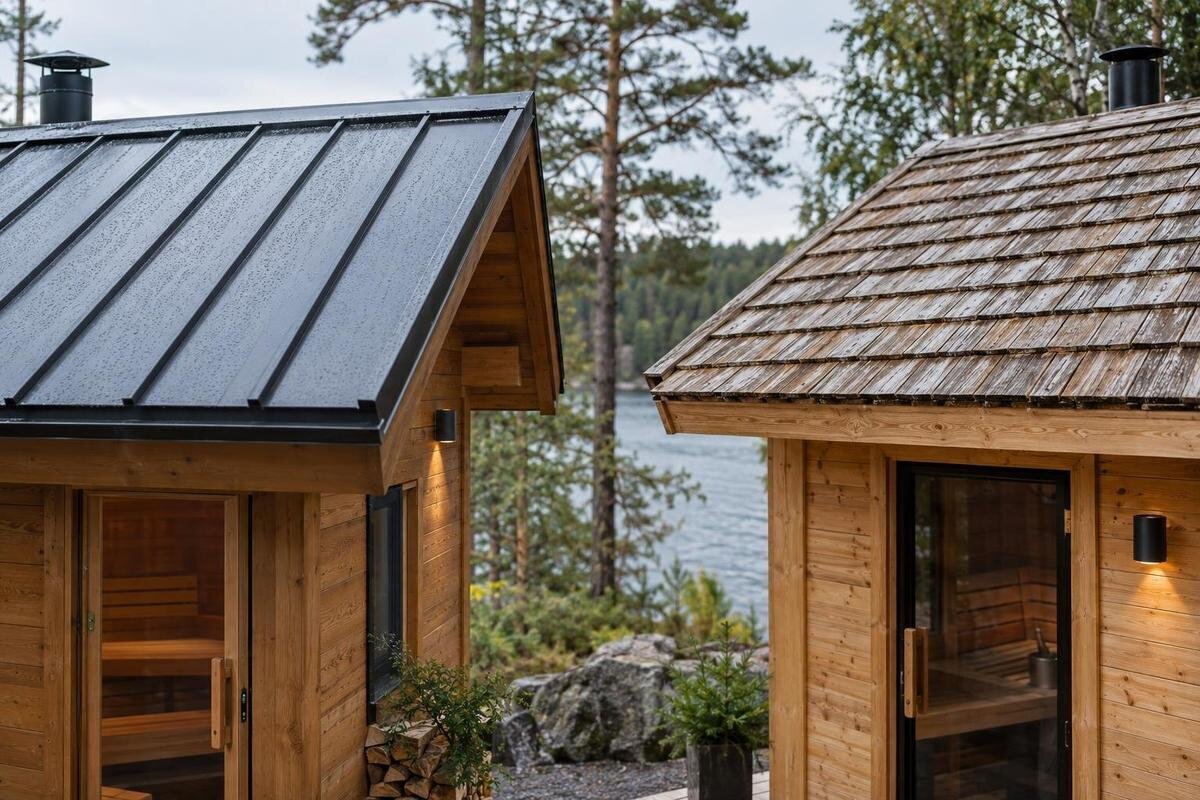
Outdoor sauna roofing
An outdoor sauna roof is more than the surface visible in a product photo. Its covering, joints, edges and rainwater run-off all interact with wind, nearby trees and the way the cabin is installed. A model name or image rarely answers those questions on its own. Compare the information for the exact model and configuration, then relate it to the proposed site. This guide explains which drawings and care instructions to request, what to observe around the installation area and how to separate a documented feature from an unanswered question. It does not assume that every outdoor sauna uses the same roof build-up or has the same weather limits.
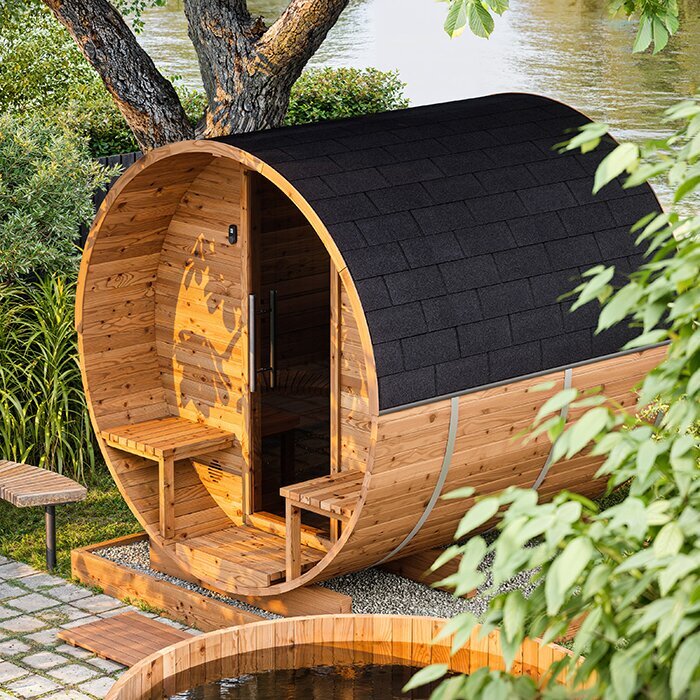
Identify the roof covering and what is included
Start by separating the cabin’s roof shape, the visible outer covering and any sealing or flashing beneath or around it. A photograph can show appearance, but it cannot establish the material, layer build-up, fixing details or whether a pictured cover is included in the supplied configuration. Ask for the covering’s material name, a drawing showing how it meets the cabin, and a written list of what is included. If the supplier offers options, ask which one applies to the exact model and configuration rather than relying on a category image. That distinction matters because care instructions and replacement parts depend on the actual covering.
Record the answer precisely: material and product name, whether it is included or optional, the drawing or manual version, and any exposure limits the manufacturer states. If the documents use a broad phrase such as “weather-resistant”, ask whether it describes the covering, the joints or the assembled cabin. When comparing Thermowood Barrel Sauna LCF-300, keep the included roof components separate from optional additions in your notes. Also ask whether selecting a roof option changes the assembly or care instructions, so that you compare the complete configuration rather than the covering alone. Mark each point as documented, clarified in writing or still unknown.
Relate rain exposure to the proposed site
Rain reaches a sauna differently depending on its position. Wind can drive it against sides and joints; a sheltered courtyard can behave differently from an exposed spot, while nearby buildings or planting may change the airflow around the cabin. These observations do not replace the manufacturer’s limits, but they help you describe the setting when asking about the selected covering and assembly. If it is safe, observe the proposed position during or soon after rain. Note which direction water arrives from, whether nearby surfaces splash it back, and whether trees or structures keep parts of the site shaded. One visit on a dry day says little about rain exposure.
Give the supplier a short site description and photographs from more than one side. Include relevant constraints such as open exposure, overhead branches or close walls. For Thermowood Barrel Sauna S-140, ask how the installation instructions and any stated exposure restrictions relate to that setting, rather than relying on the word “outdoor”. Keep your observations separate from the supplier’s assessment: photos describe the site but do not establish a wind or rain rating. If the site is unusually exposed or affected by nearby roofs, ask a suitably qualified building or roofing professional to assess how the sauna’s position relates to those structures.
Review the roof joints and openings
A roof drawing should show more than the outer silhouette. Ask for a drawing that identifies the roof-to-end-wall junction, any longitudinal seam or overlap, transitions at the edges, and every opening that passes through the roof. Not every design has the same joints; the point is to see the details that the selected model actually uses. Ask how those junctions are intended to shed water and whether seals or flashings are integral, supplied separately or fitted during assembly. If the configuration includes a flue, vent or other roof opening, request the manufacturer’s specific detail and installation instructions. Do not treat a generic image as evidence that an opening is present or that its weather protection and fire-safety requirements have been addressed.
When asking about Thermowood Barrel Sauna HC-150, check that the drawing and instructions match the exact configuration being considered. Find out which junctions the manufacturer expects to be inspected, whether any seals or components have identified replacement parts, and who should handle a repair. A generic bead of sealant may not match the intended detail, so do not modify a joint or apply a product without checking the instructions. If a seller cannot confirm that a drawing applies to the selected version, ask the manufacturer for the correct document rather than assuming that a similar-looking model uses the same roof construction.
Check the roof edges and run-off route
Roof edges determine where water leaves the covering. Ask for a plan or section identifying the edges and any drip detail, and whether gutters or downpipes are part of the supplied design or optional. Then consider where the run-off would land at the proposed position: near the entrance, on a path, against the cabin base, or alongside water from a nearby roof. A narrow strip that remains damp or is difficult to inspect may also affect how practical maintenance is. These are questions about the site layout, not proof that a particular edge detail is defective. A drawing that shows only the roof outline may not provide enough information to plan water discharge.
Use Thermowood Barrel Sauna HC-225 as a specific model reference when asking for the matching installation drawing, including any supplied drainage components. Check whether the instructions describe free run-off or another arrangement; do not assume a gutter is included because one appears in a lifestyle image. Compare the stated discharge position with paving, nearby structures and the route you use to reach the sauna. If run-off needs to be managed alongside a house, retaining wall or other roof, seek advice on the site interface rather than devising a diversion from a photograph. The drawing and the actual layout both matter.
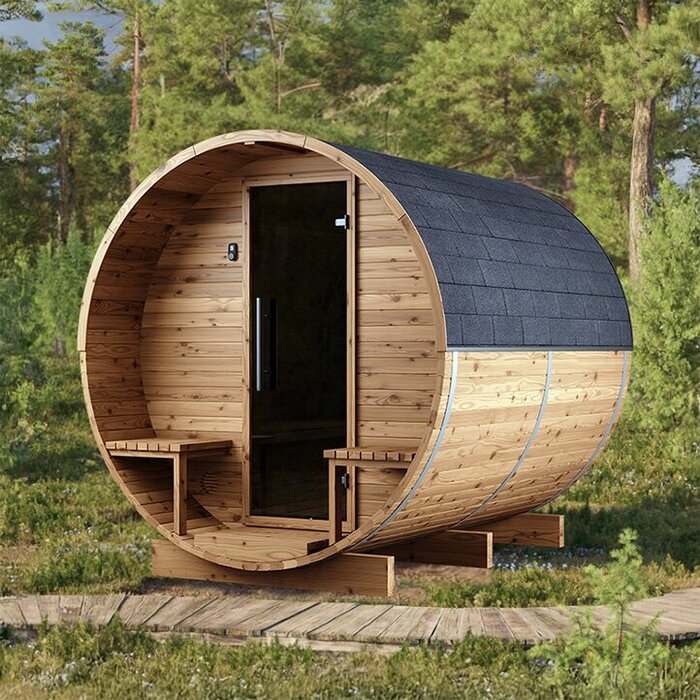
Account for sun, trees and debris
Sun and vegetation affect what you need to inspect, even when they do not change the roof’s shape. Direct sun can affect exposed finishes over time, while persistent shade may slow drying after rain. Leaves, needles and pollen can collect at an edge or obscure a seam; where a gutter or drainage component is fitted, debris may also gather there. Treat these as reasons to ask about care, not as evidence that a particular covering will fail. Consider the full year: which branches may drop debris, whether plants could grow into inspection space, and whether a coastal or dusty setting is relevant to your site. Ask what cleaning or treatment, if any, the manufacturer allows for the actual roof surface.
Note whether you can safely see the roof perimeter and clear loose debris without moving the sauna. Do not assume that a coating, pressure-cleaning method or solvent suitable for nearby decking is also suitable for the roof. When reviewing Thermowood Barrel Sauna N-210, ask which cleaning methods are permitted and whether the guidance distinguishes the roof covering from exposed timber. If tree cover is part of the site, ask how concealed edges should be checked and who should inspect them when access is difficult. Relate these questions to the places where debris is likely to collect. Seasonal debris may call for attention, but use the manufacturer’s guidance rather than inventing a fixed cleaning interval.
Compare maintenance instructions, not just appearance
Maintenance depends on the covering and its detailing, so compare specific tasks rather than relying on labels such as “low maintenance”. Ask for the written schedule, recommended inspection points, cleaning products or methods to avoid, and any coating or sealant guidance. Find out whether each instruction applies to the roof surface, a junction seal, exposed cabin material or a combination. A general timber-care sheet may not cover a separate roof layer. Ask whether routine work is intended for the owner or a specialist, what signs should prompt an enquiry, and whether the manufacturer identifies replacement components. If no interval is stated, do not invent one; ask for the recommended approach for the exact product.
Put the answers into comparable fields: task, stated timing or trigger, approved materials, who performs it, access needed and any replacement parts identified. For Thermowood Barrel Sauna N-250, ask for instructions that match the selected version rather than transferring a routine from another sauna or a shed. A clear task list is more useful for planning than a vague “easy care” claim, but do not assume it means less work until you understand access and replacement requirements. Ask whether roof components can be identified and replaced separately, if that is relevant to the design. If inspection requires access from an unsafe position, plan for a qualified person rather than improvising.
Record damp patches and other roof changes
During an inspection, record changes rather than diagnosing their cause. Look for new marks near roof joints or the ceiling, damp patches after rain, peeling finishes, persistent wetness, softening, or material that appears to be lifting. Note when the change occurs: after wind-driven rain, after repeated showers, or during use when condensation may be present. A mark inside the sauna can have more than one explanation, and visual signs alone cannot confirm a roof leak. Photograph the location and compare it over time. If possible, note whether the mark appears after rain even when the sauna has not been used, as that gives the supplier useful context.
If you notice dampness or a new mark, avoid immediately filling every seam with generic sealant or painting over it. That could hide the route of any water entry without addressing it, or conflict with the intended detailing. Check the manual for approved drying or cleaning steps, document the condition, and ask the supplier or manufacturer which inspection or repair is appropriate. In your query about Thermally Modified Wood Barrel Sauna LC-260, give the exact model and configuration, the location of the mark, recent weather and photos. Describe what you observed without presenting a suspected cause as a confirmed fault.
Request documents for the exact configuration
Useful comparison documents include product-specific assembly or installation instructions, roof or assembly drawings, a current list of included components, and maintenance guidance. Check that the model code and configuration match the version being offered, and that any pictured or quoted optional cover is named. Drawings should let you locate the roof edges and joints; instructions should explain the manufacturer’s approved assembly and any relevant exposure limits or care requirements. If a document is missing, ask whether it exists and who can supply it. Do not treat silence in a product listing as confirmation that a detail is unimportant or that a roof option is included.
Keep the documents and written answers together, noting their date or version. For Thermally Modified Wood Barrel Sauna HCF-300, ask the seller to confirm current local availability and identify the configuration covered by each document. Keep information about optional roof components with the relevant drawings, rather than combining details from different listings. If an answer is given verbally, request a written follow-up that identifies the model and the drawing or manual in question. Where two documents appear to describe different versions, ask which applies to the offered sauna. This keeps the comparison record clear without treating an incomplete product page as a technical document.
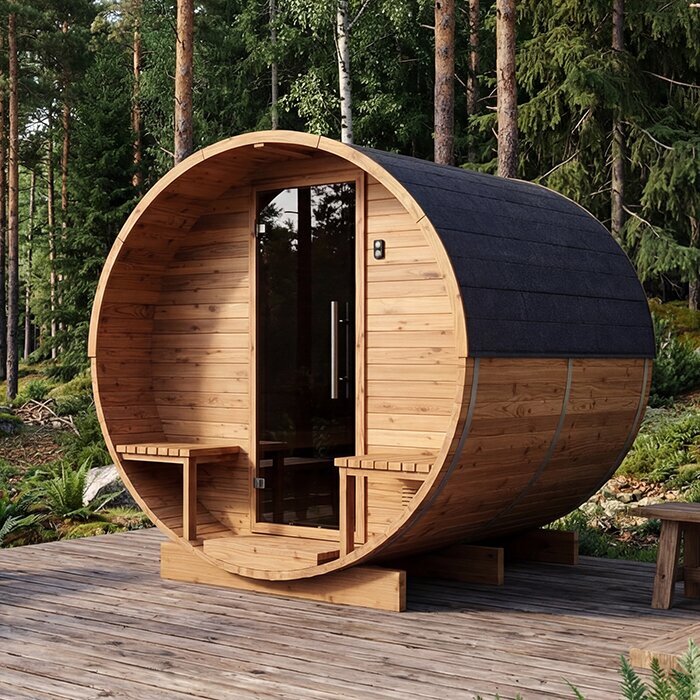
Plan access for inspection and upkeep
Maintenance is easier to plan if you consider it before choosing the sauna’s position. Check whether you can view the roof perimeter and the ground where rain lands from a safe place, and whether an installer can reach assembly points without moving fences, outdoor furniture or planting. Everyday access and service access are not always the same: a route that works for users might leave no practical way to inspect an edge or clear debris. Follow the manufacturer’s stated clearance and access requirements, and ask before positioning the sauna close to a wall or under a tree. The aim is to understand the needs of the exact design, not to guess a universal distance.
Mark the planned position on a simple site sketch, noting walls, trees, nearby roof edges, slopes and hard surfaces that may affect splash or run-off. Add how inspection will be done and who will carry it out. If the roof cannot be seen or reached safely from the ground, plan for a qualified person to check it rather than climbing onto an unverified structure; do not assume the sauna roof is a working platform. Resolve any conflict between the layout and the manual’s access requirements before installation. Keep photos and maintenance notes with the product documents so that later changes can be compared with the original condition.
Make a like-for-like roof comparison
A useful comparison sheet can have six rows: covering and layers; joints and openings; edge finish and run-off route; documented exposure limits; maintenance tasks; and access for inspection. For each design, record what the manufacturer documents, what the seller confirms in writing, and what remains unclear. Add the document date or version and the exact configuration, so a roof option for one version is not accidentally compared with a different version of another model. Label missing information as unknown rather than awarding it a neutral or positive score. This keeps the comparison grounded in evidence instead of the amount of detail in a product photograph.
Then consider that evidence against your actual site and the maintenance you are prepared to manage. A roof that looks more substantial in a photo is not necessarily the better match, and an “outdoor” description is not a weather rating. Give greater weight to a relevant drawing and clear care instructions than to an appearance-only claim. If two designs remain difficult to compare, ask the manufacturer the same specific questions about both, or seek advice from a qualified roofing or building professional about a site interface. A sensible choice is one whose documented detailing, stated limits and upkeep make sense for its intended location.
Frequently asked questions
How can I tell whether an outdoor sauna roof is waterproof?
Do not rely on “waterproof” or “weather-resistant” as a stand-alone description. Ask which roof layers are supplied, what the drawings show at joints and edges, and what exposure conditions the manufacturer supports for the exact configuration. A product photograph or model name cannot confirm this.
Does every outdoor sauna need an extra roof?
There is no universal answer; the roof design and any additional covering are model-specific. Check the included-parts list, drawings and instructions for the configuration you are considering. Ask before adding a shelter, cover or coating, as an unapproved change could conflict with the intended design or care guidance.
How often should I maintain an outdoor sauna roof?
Follow the manufacturer’s schedule for the actual covering rather than transferring intervals from a different roof. If no interval is stated, ask for guidance for the exact model. You can also check the condition after unusual weather when it is safe, using the maker’s approved inspection and access methods.
Can I assume all barrel sauna models have the same roof details?
No. A similar shape or product category does not establish that models have the same covering, joints, edge details or configuration. Compare the manufacturer’s drawing and maintenance instructions for each exact model, and ask which roof option applies to the version being offered.
What should I do if I notice a damp patch inside the sauna?
Record where it appears, when you noticed it and what the weather or sauna use was like, then take a photo. A damp mark can have more than one cause, so do not assume it proves a roof leak. Follow the manual’s drying guidance and ask the supplier or manufacturer about an approved inspection.
Outdoor sauna roofing is easiest to compare when you move from appearance to evidence: identify the covering and included components, understand the joints and run-off, relate the manufacturer’s guidance to the site, and work out whether the roof can be maintained safely. A useful answer is not a promise that no water can ever enter; it explains the design, stated limits and care requirements for the exact configuration. Keep unknown details visible in your comparison. That makes roof protection and maintenance part of the buying decision, rather than surprises after the sauna is in place.
