
Sauna Kit vs Fully Assembled Sauna: What to Consider
Sauna buying guide
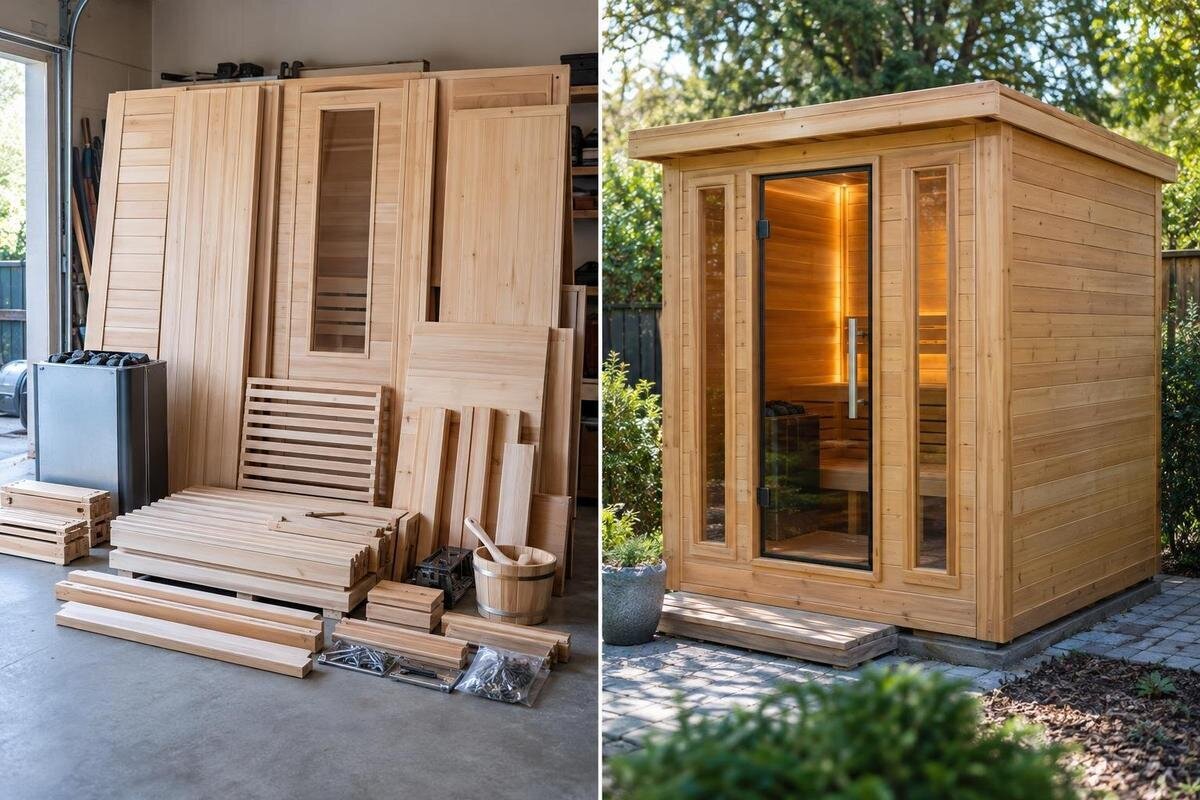
Choosing a sauna kit or a fully assembled sauna changes more than how much building you do. It affects the shape and size of the load arriving at your property, the access needed from the delivery vehicle to the final site, who can move it, and who takes responsibility for assembly and connections. A kit can still contain long or heavy components; an assembled unit may be divided into modules for transport. The labels alone do not tell you what is included or whether delivery reaches the prepared base. First confirm the current format for the exact model and configuration, then check it against the route, site and help available. This guide focuses on delivery and work responsibilities, rather than assuming either format is always easier or cheaper.
01
What “kit” and “fully assembled” mean
The terms “kit” and “fully assembled” do not describe a standard shipment. A kit might mean individual components to put together, pre-assembled panels or several larger modules. “Assembled” might describe the main structure while separate fittings or final positioning remain; a supplier may also divide a largely completed unit for transport. So the label alone does not tell you whether the delivery is a collection of manageable packages, a bulky load or a structure ready for use. It also says nothing by itself about the base, connections or services. Treat the wording as a starting point for questions, not a complete delivery specification.
Ask what arrives for the exact model and current New Zealand configuration: how many packages or sections there are, what is already joined, which parts need fitting and whether assembly at your property is included. Clarify whether “assembled” means factory assembly, assembly after delivery or just some sections put together. Options may also change the packing or scope, so check the configuration you intend to order. The Sauna LC-260 page identifies a model, but its name alone does not establish how it is packed or whether assembly is included. Confirm the current format and services with the seller.
Measure the entire delivery route
Begin with the route from the point where the delivery vehicle can stop to the prepared site, not just the driveway or gate. Measure the narrowest clear opening, height above the route and turning space; note steps, slopes, tight corners, low eaves, branches and changes in surface. Include space taken up by gate leaves or door hardware, and check both straight clearance and room to turn a long or rigid load. Mark temporary obstructions, such as stored items or garden furniture, that will remain on delivery day. Take photos from the approach and each pinch point, with measurements where possible. One width measurement at the gate will not describe the whole route.
Separate vehicle access from the last leg to the base. Ask where the truck is expected to stop, how far the load travels from there, whether the service unloads only or carries it across the property, and whether stairs, shared paths or uneven ground affect the method. Confirm clearances for the actual packages or assembled sections, rather than comparing the route with a guessed finished size. A site sketch with widths, heights, steps, surface changes and distances gives the supplier or installer a practical basis for review. If access differs from the plan, agree an alternative before delivery is booked.
02
Check package dimensions and weights
Some kit packages may be easier to move one at a time, but “kit” does not guarantee small or light parcels. Long boards, curved sections or bundled components can still be awkward through a narrow route. An assembled unit may be bulky, although some designs travel in sections. Request the packed dimensions of every package or module, the weight of the heaviest item and any handling instructions. Compare those figures with each narrow point and turn on your route. The finished footprint or floor area is not a substitute for shipping measurements, and a drawing of the completed sauna will not necessarily show how the order is packed.
Ask whether measurements include protective packaging, how many pieces are expected and whether delivery arrives in one load or several. Find out how each piece is intended to be handled and whether any components need protected storage if assembly is delayed. Do not infer this from a different model in the range. If you are considering the Sauna HCF-300, request its current packing details and delivery configuration, including the size of any sections that remain joined during transport. If a piece cannot pass through the planned route, discuss an approved alternative with the supplier before ordering instead of relying on an improvised lift.
Prepare the final site before delivery
Check the selected model’s drawings and instructions for its footprint, base requirements and working space. Do not assume that a lawn, deck or existing paving is suitable just because it looks level. Ask the supplier what surface, drainage or clearance the design requires, including any stated level criteria. If you plan to use a deck or another structure, have a suitably qualified building professional assess its suitability rather than estimating its capacity yourself. Site preparation is separate from the delivery format, but it affects whether the load can be placed and assembly can begin when it arrives.
Include room to put sections together, fit parts and move around the structure, not just the area it occupies when complete. Check whether planting, fences or stored materials need to be moved and how components should be protected if the work is delayed. When enquiring about the Sauna LCF-300, request current installation or base information for the configuration you plan to order, so your site plan allows for both assembly and final placement. Confirm who prepares the site, who checks it before delivery and what condition it must be in for assembly to proceed.
03
Know who is responsible for assembly
With a kit, the buyer or an installer may need to build much of the structure on site. Depending on the design, the work could involve joining sections and fitting panels, doors, benches, roof parts or trim. The instructions should identify the order of work, tools and fasteners required, and any checks to make as assembly progresses. They are a better guide than a product photograph to the skills and effort involved. Ask whether the work needs more than one person at particular stages and whether the quoted assembly service covers every component in the order.
Decide who will do the work and assign each task to you, a sauna installer, a builder or the supplier’s assembly team. Ask whether labour, travel, unloading, packaging removal and any return visit are included, and what happens if a part is missing or the base is not ready. A unit described as assembled may still need parts attached or a final move into position. For the Sauna S-140, clarify which tasks are completed before delivery and which remain for you or your installer. Keep the agreed responsibilities with the order details so everyone understands where their work begins and ends.
Separate assembly from equipment and connections
Structural assembly and installation are different scopes of work. A sauna could be assembled without its heater, controls, lights, accessories or service connections being supplied or fitted; the exact order determines what is included. Ask for an itemised list separating the structure, equipment, accessories, delivery, assembly, positioning and connection work. Check whether any parts are optional or supplied separately, and whether the selected equipment is intended for the structure according to the supplier’s instructions. Do not treat “assembled” as shorthand for operational or ready for use. A clear list also helps you see which tasks need to be arranged before delivery.
Identify any specialist work and who will take responsibility for it. For fixed electrical work, arrange for a suitably qualified electrician to review the equipment requirements; do not assume a delivery crew will make a connection unless that work has been explicitly agreed and appropriately handled. Ask who checks or commissions the equipment, what information they need and whether their work happens before or after assembly. If the Sauna HC-150 is on your shortlist, confirm its current New Zealand configuration and pack list, then identify any separately arranged services in the installation plan.
04
Plan unloading and handling equipment
Treat unloading as a separate task from moving the sauna along your property. Depending on the actual load and route, the delivery may need a vehicle lift, trolley, forklift, crane or another handling method. Ask for the dimensions and weight of each package or assembled section, the proposed unloading method and the access needed for any equipment. Confirm who arranges it and whether handling is part of delivery or a separate booking. Do not hire equipment based on an assumed weight or a general description such as “small sauna”; the supplier or transport provider needs to advise on the specific load.
Check where equipment can stand and move, including the surface, overhead obstacles and space to reach the final position. A method that works at the roadside may not work at a narrow gate or on a soft section of lawn, so give the supplier or handling operator photos and measurements. If mechanical handling is proposed, ask the provider familiar with the load and site to assess the method. For a Sauna HC-225 order, obtain transport details for the version you intend to buy and share them with whoever is arranging the unloading and movement to the base.
Compare the total effort, cost and timing
Compare the whole project rather than assuming a kit costs less or an assembled unit is better value. A kit might avoid a supplier assembly charge but require paid labour, tools, handling equipment or more site preparation. An assembled option may reduce building work on site but still involve specialised unloading, access work or separate connections. Request a breakdown for delivery, movement to the base, assembly, optional parts, trades and packaging removal. Include work you would otherwise do yourself when weighing the effort involved. Quotes are only comparable when they cover the same services and describe the same delivery point.
Timing depends on coordination as well as the delivery date: the base, handling, assembly and any specialist appointments may need to happen in sequence. Ask the supplier for current lead-time information and how long the site needs to be accessible; do not assume a delivery booking includes assembly or connections. When comparing a Sauna N-210 quote, request a breakdown for your chosen configuration and the services you need, with delivery and on-site work listed separately. Record the agreed dates and responsibilities so site access, trades and any equipment hire are organised around one plan.
05
Get the delivery format confirmed in writing
Before ordering, record the exact model and configuration, whether it arrives as a kit, an assembled structure or modules, and the package count, dimensions and weights. Note where the vehicle can stop and what happens between unloading and the prepared base. Add the agreed assembly scope, handling responsibility, equipment needed and any parts or services supplied separately. Ask the supplier to flag assumptions such as clear access or a prepared base. This short written brief makes it easier to spot missing information and resolve it before delivery, rather than discovering on arrival that the planned route or work scope was understood differently.
Request the current packing list, assembly instructions, site drawing and handling notes for the exact order, then check that they match the quote. Keep one person responsible for confirming access and coordinating any installer or equipment operator. If you choose the Sauna N-250, make sure the written confirmation identifies that model and your selected options, rather than describing only a general sauna delivery. If the model, options or route changes, ask whether the packing or assembly plan changes too. Written confirmation gives everyone the same reference for what is included, who should attend and what must be finished first.
Choose the format that fits your property
A kit is a practical fit when its actual packages can reach the site, the base and workspace will be ready, and you have a realistic assembly plan. That may mean doing the work yourself only if the instructions, skills, time, tools and available help line up; otherwise include a professional installer. A fully assembled delivery may suit you when you want less construction on site, but only if the complete or divided load can reach the position and the supplier confirms how it will be unloaded and set down. Think about who will be available on delivery day, not just who might help in theory.
Neither format removes every task. For a kit, the difficult part may be assembling and coordinating the components; for an assembled unit, it may be moving a larger load or arranging the final connections. If a key fact remains unknown, especially the shipment shape, unloading method or assembly boundary, pause the comparison until the supplier clarifies it. Choose the option whose documented delivery, handling and work plan fits your property and the help you can reliably arrange. The most useful distinction is not the label alone, but whether the responsibilities left after delivery are manageable.
Frequently asked questions
Does a sauna kit always arrive in small packages?
No. “Kit” can describe different delivery formats, including long or bulky components and pre-assembled sections. Ask for the packed dimensions and weight of each piece, not just the finished sauna’s footprint, and check those details against your route.
Does fully assembled mean the sauna is ready to use?
Not necessarily. The main structure may be assembled while positioning, separately supplied parts, equipment connections or other work remain. Confirm exactly what is included in delivery and assembly, and who is responsible for each task.
Which format is better if access to my property is narrow?
Neither label is enough to decide. Compare the dimensions of the actual packages or sections with the route, including turns and overhead clearance. A kit can still have long parts, while an assembled unit may be divided for transport.
Can I assemble a sauna myself?
That depends on the instructions, tools, time, skills and help available, as well as the work required for the exact model. Review the assembly information first. Arrange specialist trades separately if the chosen equipment needs professional connections.
Should I hire handling equipment for delivery?
Only after the supplier or transport provider confirms the load details, unloading method and access requirements. Ask who arranges and pays for any equipment, and whether the route and final position have been assessed for the proposed method.
Treat delivery format as a practical specification: match the actual shipment to your access route, prepare the site, and agree who handles unloading, assembly and any connections. Once those details are confirmed for the exact order, the choice is clearer. Choose a kit when you can organise the assembly work as well as delivery; choose an assembled sauna when its load can reach the site and the remaining installation tasks are covered.
