
Traditional vs Infrared Sauna: Choosing Your Experience
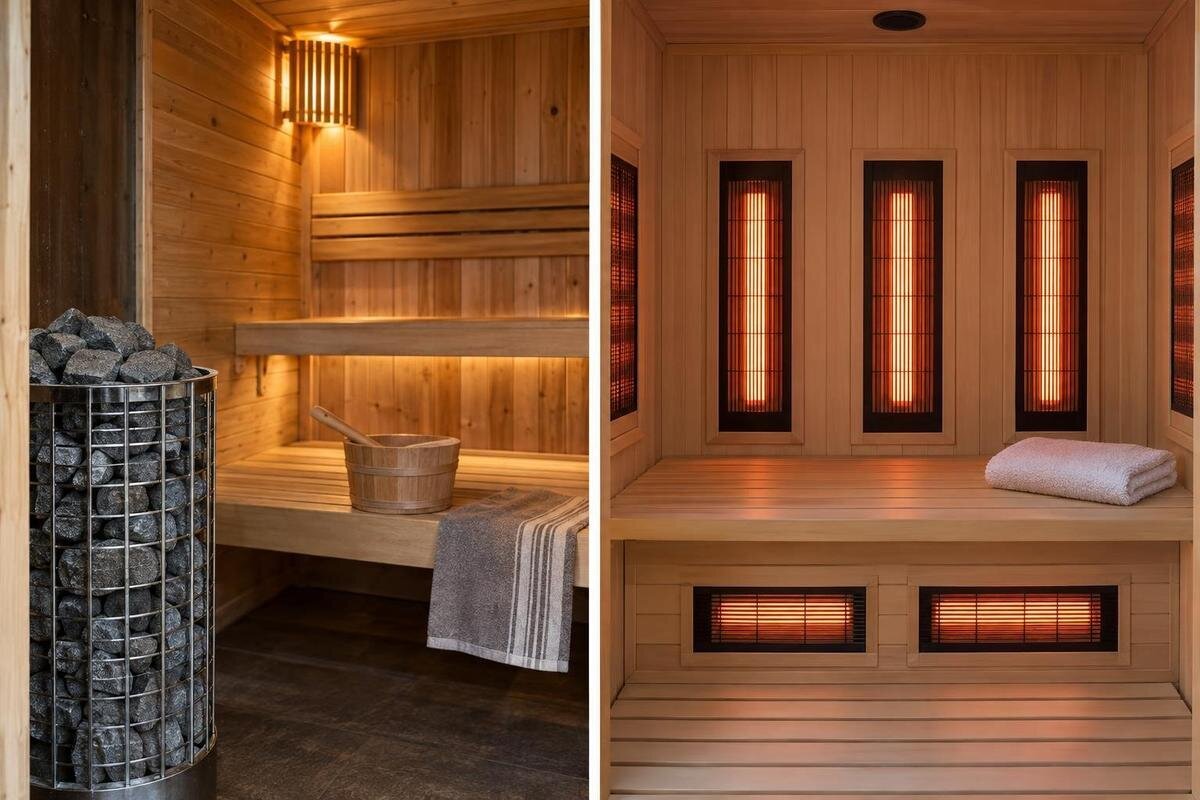
Sauna buying guide
When weighing a traditional sauna against an infrared sauna, the key difference is how each produces warmth—and what that means for the way a session feels. A traditional setup heats the air and stones; infrared equipment relies on radiant emitters. This affects humidity, warm-up, controls and the importance of where you sit, but it does not create a universal winner. This guide compares the typical experience and the equipment questions to ask. It does not assume that a particular sauna listing has a particular heater; confirm the exact local model and configuration before comparing products.
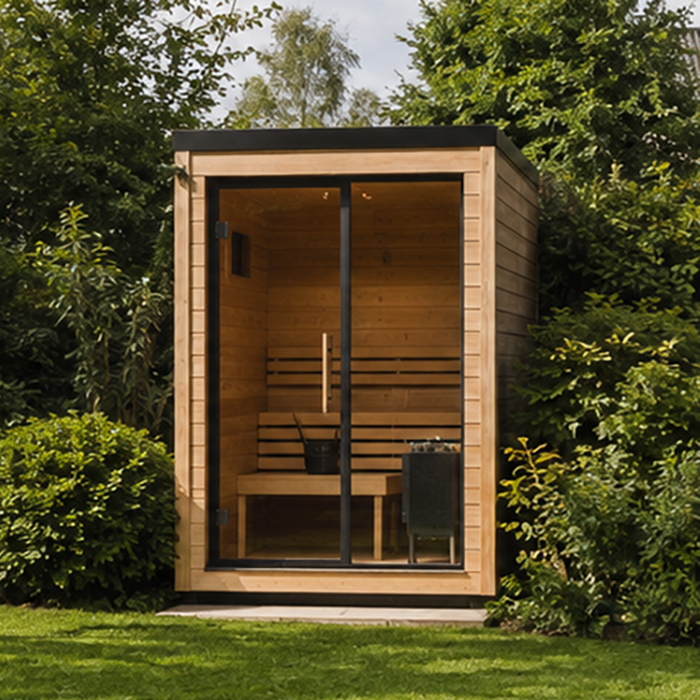
How traditional and infrared saunas produce warmth
Traditional saunas use a heater to warm the room’s air and a bed of stones. The resulting sensation is enveloping: the room itself is hot, with warmth reaching you from the air and surrounding surfaces. Depending on the system, the heater may be electric or wood-fired, and the way it is controlled, installed and maintained changes accordingly. A stone heater also creates the possibility of adding water for a brief rise in humidity, but only when that heater and its manual allow it. Traditional describes a heating approach, not one fixed layout or equipment package.
An infrared sauna uses emitters, often panels, to direct radiant energy towards people and interior surfaces. The air also warms, but the experience does not depend on heating stones and the whole air volume as its main mechanism. How strongly the warmth reaches a seated person depends on the emitter design, its position and the cabin layout, so the word infrared is not enough to predict comfort. Look for the manufacturer’s heater description and placement drawing for the exact model. Think of this as a choice between two ways of delivering heat, rather than two guaranteed temperature levels.
How the two types can feel during use
Many people describe a traditional sauna as a surrounding, hot-air experience. If the heater permits water on the stones, the added moisture changes how that warmth feels; the effect is temporary rather than a permanent setting. Bench height, distance from the heater, air movement and how many people share the room all influence the sensation. Someone who likes tending the heater or adjusting the feel with water may value those options; someone who prefers a consistent, dry environment may not. Those preferences are personal, not evidence that one type is better for everyone.
Infrared warmth can feel more directional: people and surfaces within the emitters’ field receive radiant heat, while the cabin air also warms. Your position relative to the panels may matter, although designs vary. Judge the style using information for the specific model, such as panel arrangement, seat position and operating guidance, rather than a brief product label. Consider whether you like the feel while sitting still and whether the same layout works for everyone who will use it. A description such as gentle or intense cannot tell you exactly how a particular unit will feel.
Humidity, water and heated stones
Humidity is one of the clearest practical differences. In a traditional sauna, a compatible stone heater may let you add water, changing the perceived moisture during a session. That is not permission to pour water onto every heater: some systems or components may not be designed for it. Check the exact manual for whether water is allowed, any limits and the required stones. If you do not want to handle water or care about that adjustable element, it may not add value. If you do, make it an explicit requirement rather than assuming every traditional sauna behaves the same way.
Infrared cabins do not rely on a stone heater for their main warming effect, so they do not offer the same stone-and-water ritual by default. Moisture in the room can still be affected by people and the surrounding environment, but that is different from producing humidity at the heater. The NZ catalogue’s Sauna N-210 listing identifies a Thermowood Barrel Sauna with a listed area of 4.43 m², without establishing its heater, stones or permission to add water. If adjustable humidity is important to you, ask specifically whether the proposed heating package supports it. Separate that question from the cabin’s appearance and size. If you prefer to use the sauna without adding water, explain that preference too, so the comparison focuses on how you intend to use the equipment rather than on a feature you may never want.
Cabin layout, seats and emitter positions
Space is more than the external footprint. Compare internal dimensions, bench length and depth, the height between seating levels, headroom, entry clearance and the position of the heater or emitters. A traditional room can feel different on different bench levels, so check the planned sitting positions in relation to the heat source. For infrared, look at the position and coverage of panels from each normal seat, including whether another person might block a panel or sit unusually close to it. A plan view and elevations reveal more than a product photo.
The Sauna N-250 product page lists an area of 5.27 m². Use that as a catalogue comparison point, not as a substitute for usable interior dimensions, bench measurements or heater clearances. Request drawings for the actual configuration, then mark the door’s opening space and where each user will sit. If you are comparing an infrared cabin with a barrel-shaped model, compare interior plans and seating arrangements rather than treating matching area figures as equivalent comfort. Work through the same questions for both: can you sit in your preferred posture, is there room to enter while another person is seated, and where is the heat source relative to each seat? Keep the drawings side by side and note any missing dimensions. This gives you a clearer layout comparison than choosing by exterior size or the apparent spaciousness of a photograph.
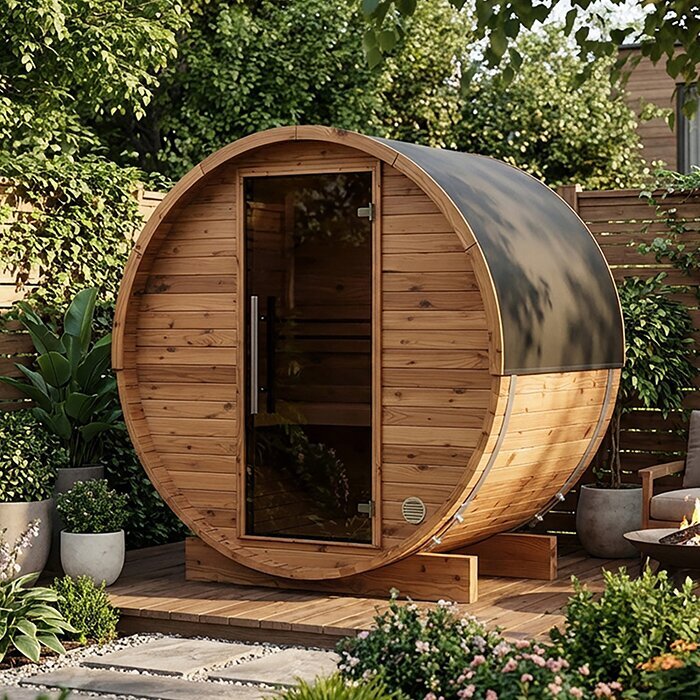
How many people will use the sauna?
Decide how the sauna will be used: one person at a time, a couple or a group. Then check the stated capacity against usable bench dimensions, not just a headline headcount. A maximum capacity may describe how many people fit, while comfort depends on whether they can sit without crowding, adopt a preferred posture and get in or out without disturbing others. If someone wants to recline, is taller or shorter than other users, or needs more personal space, use that requirement to assess the drawing. Capacity is a layout question, not a direct result of the heating technology.
The Sauna LC-260 listing identifies a Thermally Modified Wood Barrel Sauna with a listed area of 5.12 m². That figure is not a seating count or a measure of infrared panel coverage. Ask for bench dimensions and the interior drawing, then compare the same number of users and the same posture across both designs. With infrared equipment, confirm that the intended seats align with the emitter layout; with a traditional heater, check the benches and clearances against the maker’s plan. Consider your usual use separately from occasional group use. A layout that accommodates visitors may still need closer scrutiny for the seat you will use most often. Record which places are intended for regular sitting and whether anyone would need to move when another person enters. This makes the capacity comparison more useful than treating a larger area alone as proof of a comfortable fit.
Power, installation and site requirements
The two types can call for different equipment connections, so confirm the complete installation requirements early. An electric traditional heater, a wood-fired option and an infrared panel system are not interchangeable simply because they warm a sauna. Ask for the exact model’s electrical information, controller requirements, heater or emitter package, ventilation guidance and any siting clearances. If wood fuel is being considered, include the flue and site-specific requirements in the discussion. Have a qualified professional assess the proposed equipment and site; do not use a broad category description to decide whether a home’s services are adequate. Check local requirements for the actual installation.
The Sauna HCF-300 product page identifies a barrel sauna with a listed area of 6.89 m²; it does not provide electrical or installation data through those details alone. For any model under consideration, obtain the installation manual and a drawing for the selected heater, then confirm what work is included and what remains for you to arrange. Also consider access to the location, movement of components, service access and fresh-air arrangements. Exact needs depend on the design. Keep the responsibilities clear: who supplies the cabin and heating equipment, who assesses the site, and who carries out the required installation work? Compare that scope across your shortlisted options so an apparently simpler package does not leave essential work unaccounted for. Establishing these details early lets you judge whether your preferred heating experience fits the proposed location, rather than choosing by appearance and resolving the installation later.
Warm-up time and everyday routine
Warm-up belongs in the comparison because a sauna’s everyday usefulness depends on when it is ready, not only on the sensation once inside. A traditional room needs its heater to bring the air and stones to the model’s operating condition. Infrared equipment follows its own emitter and control cycle. Actual times vary with the unit, room design, starting conditions and the maker’s operating method; neither category guarantees a particular wait. Use manuals or model-specific manufacturer information and compare like with like, rather than relying on a broad claim that one type is always quicker.
The Sauna LCF-300 listing shows a listed area of 6.89 m², which cannot establish its warm-up time. Nor do equal area figures mean two saunas will reach a comfortable state at the same pace. Ask what the manufacturer’s readiness guidance covers: the cabin, the heater or a particular starting condition. Then compare it with your routine. Will you plan ahead, or want to use the sauna at short notice? For a useful comparison, distinguish the time spent preparing the sauna from the time spent using it. Note any tasks the operating instructions require before use and how you would fit them into your day. Timer and control options may also influence that routine, but check the exact inclusions and permitted operation. This keeps the comparison focused on a routine you can realistically follow, rather than a single advertised warm-up figure.
What is included with each sauna?
Compare a complete package, not just the main heat source. For a traditional sauna, clarify whether the heater, stones, controls and required accessories are included; for an infrared cabin, check the emitters and controller. In both cases, confirm what comes with the cabin, such as benches, door, lighting, ventilation elements, wiring, assembly parts and instructions, and what is optional or separately arranged. Names and images do not settle the inclusions. An item-by-item schedule makes it easier to compare quotes and shows whether a headline figure leaves out equipment you would need.
The Sauna S-140 product page lists an area of 1.93 m² for a Thermowood Barrel Sauna, but that does not establish whether a heater, stones, controls or accessories are included. Match each shortlisted configuration to its written inclusion list and confirm that the manuals cover the supplied heating equipment. If alternatives are offered, record the exact model names and options so that drawings, electrical information and care instructions refer to the same sauna. Keep included equipment, optional extras and separately arranged work in distinct parts of your comparison. When considering cost, separate the purchase and installation quote from ongoing running costs; the latter need model-specific operating information and your electricity tariff, not assumptions about the heating category. This is particularly important when comparing a cabin shell with a complete heated unit, because the two prices may cover substantially different purchases.
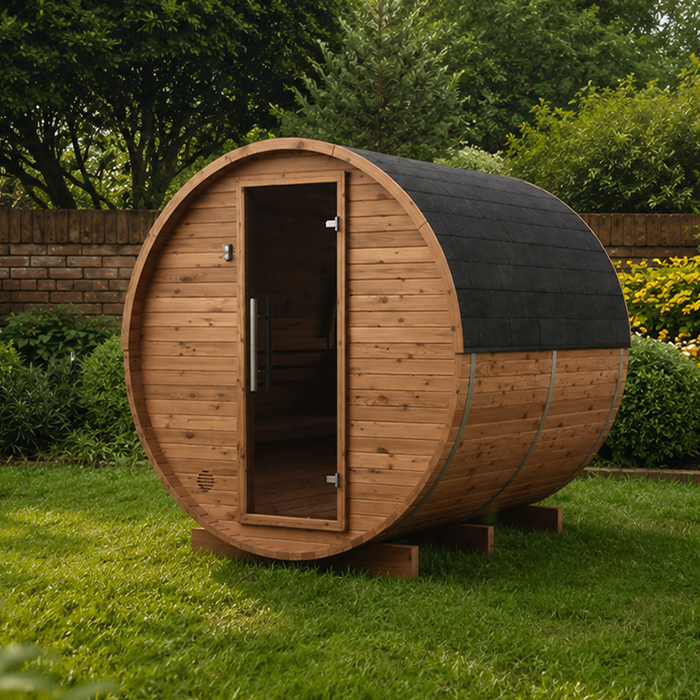
Cleaning, care and where the sauna will sit
Ownership also includes cleaning and care, and the routine depends on the materials and equipment. Ask how the benches, interior surfaces, floor, heater or emitters and controls should be cleaned, how the cabin should dry between uses, and which products to avoid. A traditional sauna that uses water on stones has a different moisture routine from an infrared design without that feature, but neither should be maintained by guesswork. Ask about access for inspection and servicing, and whether any parts need periodic checks. Follow the model-specific manual rather than applying one sauna’s care instructions to another.
The Sauna HC-150 page identifies a Thermowood Barrel Sauna with a listed area of 2.97 m². Neither detail confirms its maintenance schedule or suitability for your proposed location. For an outdoor installation, check that the exact configuration is intended for that exposure and ask about its base, drainage, clearances and weather protection. Indoors, consider access, ventilation and the effect of heat and moisture on the surrounding area. Use manufacturer documentation and qualified local help for the installation-specific questions; do not infer outdoor suitability from the word barrel or a photograph. To compare ongoing care, ask for a clear account of routine cleaning, drying and equipment checks for each option. Consider whether you can reach the surfaces and components that need attention, and where you would keep any permitted cleaning supplies. This helps you assess ownership tasks alongside the heating experience without assuming either type is maintenance-free.
A practical way to compare the options
Make the final comparison with a short, like-for-like brief. State the preferred feel—hot air with optional water on stones, or radiant warmth—the usual number of users and sitting positions, the space available, how much preparation time suits your routine and what the site can support. Then compare exact model drawings, heating system, controls, included equipment, operating information, care requirements and installation scope. Record unanswered questions rather than filling gaps with category assumptions. If a core preference, such as adjustable humidity or a particular emitter layout, cannot be confirmed for a model, it is not yet a meaningful match.
The Sauna HC-225 product page identifies a Thermowood Barrel Sauna with a listed area of 4.4 m², but its name and area do not establish whether it uses traditional or infrared heating. The product information supplied for this NZ catalogue identifies barrel-sauna models without establishing that infrared or hybrid versions are available. Confirm current local options before treating a linked model as an example of either heating type. Keep a distinction between comparing technologies and comparing products you can actually order. If your shortlist contains only confirmed traditional configurations, an infrared option remains a separate research choice, not an assumed alternative within the same range. Return to your preferred feel, usual seating arrangement and daily routine when assessing the available units. The strongest match is the sauna whose confirmed heating system and layout suit those preferences, with outstanding questions identified rather than filled in from its name.
Frequently asked questions
What is the main difference between traditional and infrared sauna heating?
A traditional sauna heats the room’s air and usually a bed of stones. An infrared sauna uses emitters to deliver radiant warmth towards people and interior surfaces. The way each feels, and the air temperature reached, varies by model, so compare the manufacturer’s details rather than relying on one universal temperature.
Can I pour water over the heater in an infrared sauna?
Do not assume that you can. Infrared saunas do not rely on a stone heater for their main heating effect. Add water only if the instructions for the exact unit explicitly allow it; check before using water on any heater.
Is an infrared sauna always quicker or cheaper to run?
No. Warm-up and running costs depend on the exact equipment, cabin, starting conditions, usage and electricity tariff. Compare model-specific operating information on a like-for-like basis, and have a qualified professional assess the proposed electrical supply.
Does a barrel sauna’s shape tell me which heater it has?
No. The shape and product name do not establish whether a sauna uses a traditional or infrared heater. Check the exact model and current configuration, along with its heater information and manual.
Which type suits someone who prefers a drier session?
Infrared may suit you if you want radiant warmth without relying on water on heated stones. A traditional sauna can also be used without adding water, if its instructions allow. Compare the exact system and its operating guidance, as the feel depends on the model.
The choice comes down to the kind of warmth and routine you want: hot air with heated stones and possible humidity adjustment, or radiant warmth from infrared emitters. Neither description guarantees how a particular sauna will feel or what it needs to run. Use the exact product configuration, drawings and operating information to confirm the heater, layout, inclusions and installation requirements. That makes the comparison about the experience you will actually get, rather than an assumption based on a product name.
