
Buying a domestic sauna for a glamping site: key questions
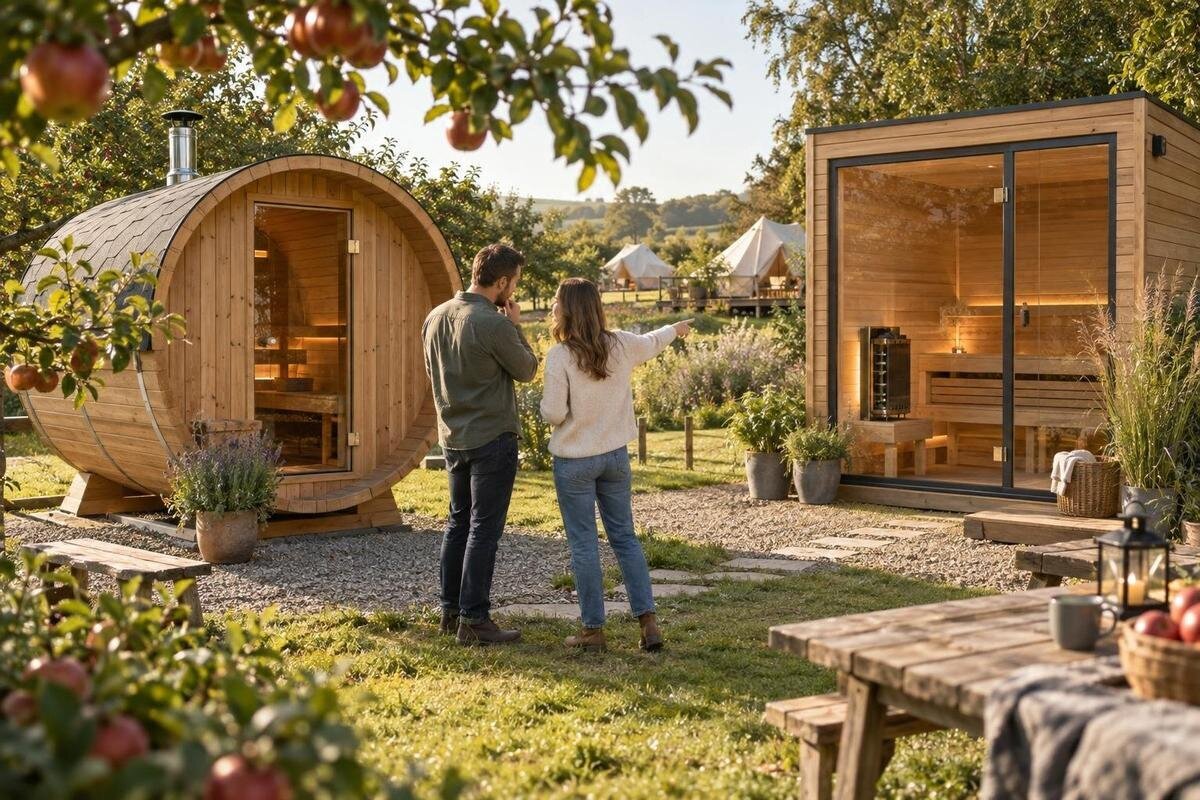
Sauna buying guide
Buying a domestic sauna for a glamping site is a capacity and operating decision as much as a product choice. A model that suits one household may not suit a shared amenity used by guests from several accommodation units, especially when bookings peak together. Before comparing designs, establish who will use the sauna, whether access will be private or shared, how many people may want it at once, and what the site can accommodate. Then check the exact model’s usable capacity, heater and power requirements, installation conditions, and whether the supplier permits the intended guest use. Those answers give you a fair basis for comparing models and quotations.
01
Estimate demand during peak bookings
Use booking records, if available, to sketch a busy period: occupied glamping units, likely group sizes, arrival patterns and when guests might want the sauna. The number of beds across the site is not the same as simultaneous demand, and an average week can conceal busy weekends or seasonal peaks. If the site is new, write down the assumptions behind your forecast rather than treating a guess as a fact. Consider low, typical and high-demand cases so the capacity decision does not depend on one optimistic occupancy figure.
Separate the number of potential users in a day from the number who need access at the same time. A sauna reserved by one accommodation group may serve several parties in succession; an amenity available to everyone may face overlapping demand. Use your planned opening hours and booking pattern to decide which is more likely. Also note whether access will be included with a stay, offered as an optional extra or reserved in advance: that choice may affect take-up. This estimate gives you a practical basis for comparing seating, heating arrangements and the need for one or more saunas.
Choose shared access or private bookings
Decide whether the sauna will be reserved exclusively for one glamping unit, shared by guests from several units, or available through bookable time slots. Each arrangement creates a different purchasing brief. Private access can make it easier to match a sauna’s capacity to the guests in one booking, while a shared facility needs to account for groups arriving from across the site. Be clear about who will have access and when before comparing models; otherwise, you may be sizing the product for a use that your booking plan does not actually offer.
For shared access, consider privacy, waiting and the route guests will take between their accommodation and the sauna. If you plan to allocate time slots, allow for the practical changeover between bookings rather than assuming that the next group can always enter immediately. A larger cabin will not necessarily solve a problem caused by overlapping private reservations or unclear access. Check that the intended arrangement fits the site layout and the experience you want to provide, then use it consistently when asking suppliers about capacity and operating requirements.
02
Check the usable capacity in the exact specification
Look for the stated maximum occupancy, internal dimensions and seating layout for the exact model. External measurements alone do not tell you how many people can sit inside, and a product name is not a capacity figure. When reviewing pages such as the Thermowood Barrel Sauna S 140 listing, record any published dimensions and occupancy information; if a detail is missing or unclear, ask the supplier rather than inferring it. A dimensioned plan can help you compare the cabin with the group sizes in your demand estimate and with the space available at the site.
Ask what the stated maximum assumes: the seating arrangement, the number of people seated at once and whether the figure describes a practical group size for your intended use. Check that guests can get in and out and use the benches in the way you expect; a headline capacity alone cannot show that. If the decision is close, ask for a layout drawing or a chance to inspect a comparable display. Compare every shortlisted model against the same peak-use scenario, not just against the largest number shown in a listing.
Ask how the heater affects guest bookings
Confirm whether a heater is included, which exact heater is supplied or required, and whether the controls are part of the quoted configuration. Ask the supplier for warm-up information for the specific sauna and the assumptions behind it, including whether the estimate refers to a cold start or repeated use. For the HC 150 Thermowood Barrel Sauna listing, as for any candidate, the model name alone does not establish the heating arrangement or how quickly the cabin will be ready. Get those details before deciding how much time to leave between bookings.
Heating arrangements affect the service you can offer. If guests are likely to expect the sauna ready at a particular point in their stay, find out whether your planned timetable fits the supplier’s guidance and whether any staff involvement is needed. Ask what the chosen control arrangement requires of the operator, without assuming that guests will be able to manage it unaided. If different heater types or configurations are available, compare each as a separate option, including any fuel-handling or site-planning questions that apply. Do not base the purchase on a general warm-up claim that is not tied to the exact configuration.
03
Confirm the electrical supply and running costs
If the sauna uses an electric heater, obtain the connection and power requirements for the exact model and heater before ordering. Ask a qualified electrician to assess the site’s supply and whether it can support the proposed installation alongside other expected demands. Repeat those checks for each configuration under consideration, including Thermowood Barrel Sauna HC 225 if it is on your shortlist. Do not choose on the basis of a product name, a general category description or an assumed household supply; the supplier’s information and an electrician’s assessment need to match the actual installation.
Running costs also depend on how the sauna will be used, not just on the product label. Ask the supplier or electrician what information is needed to estimate consumption for your expected schedule, and use your actual energy tariff when assessing the cost. If the shortlist includes other heater types, compare their fuel or operating requirements on the same basis and include any staff time involved. Treat an estimate as conditional on its stated assumptions: a site with different opening hours or booking patterns may have a different cost. Avoid relying on generic figures that are not for the exact heater and planned use.
Check the proposed location and site preparation
Choose a possible position before settling on a model, then check its footprint, access route and relationship to guest accommodation. A product image does not establish that a particular sauna is suitable for an exposed position at your site. Ask the supplier about the exact model’s intended setting, base requirements, clearances, drainage and any conditions for installation. Include the route for bringing the product to its final position in your planning, but do not assume that a listing or photograph shows the dimensions or access conditions you will need. The Thermowood Barrel Sauna N 210 listing can be assessed against those questions like any other candidate.
Ask what ground preparation and installation work are required, and who is responsible for each part. Site conditions vary, so a general foundation suggestion should not replace advice for the actual location from the supplier or an appropriate professional. Consider the guest route, privacy and access for future maintenance as well as the space occupied by the sauna itself. If planning, building-control, insurance or other site-specific questions arise, check them with the relevant authority, insurer or qualified adviser. A domestic label alone does not settle whether the location and intended use suit your site.
04
Verify that domestic use terms cover glamping guests
A product described as domestic should prompt a specific question about use by paying guests; it is not proof that the model is suitable for a glamping business. Ask the supplier or manufacturer to confirm in writing whether the exact sauna can be used in your planned setting, with the expected number and turnover of guests. Include how often it may be used and whether it will be shared across accommodation units. For example, ask directly about the N 250 Thermowood Barrel Sauna listing if you are considering it, rather than assuming that a domestic product category covers commercial operation.
Read the warranty and aftercare terms alongside that answer. Ask whether any limits on use affect cover, service or access to parts, and what maintenance the supplier expects for the proposed pattern of use. If the seller cannot give a clear answer, do not infer permission from the product name, its appearance or a general conversation about domestic use. Compare it with an alternative whose supplier can document the relevant terms, if one is available. Check any insurance implications with your insurer, and resolve uncertainty before paying rather than discovering later that the purchase terms do not match the way the sauna is operated.
Compare the full cost of the chosen configuration
Request an itemised quotation for the exact sauna and configuration, then list what is included and excluded. Depending on the proposal, ask separately about the heater and controls, base, groundwork, installation, electrical work, delivery and unloading. Do not assume that a product page price, if shown, covers everything needed to put a working sauna into service. Apply the same questions to Thermowood Barrel Sauna LC 260 and every other candidate, so you can compare like with like. Where an answer depends on a site visit or a professional assessment, record that as an outstanding cost rather than treating it as included.
Build a separate estimate for ongoing costs using your intended opening pattern. Include the energy or fuel assumptions supplied for the chosen heater, plus any relevant cleaning, upkeep and staff time. Then test the business case against realistic guest demand: consider whether the sauna is included in the stay or booked separately and how likely it is to be used across the seasons you operate. Avoid treating extra bookings or higher guest spending as guaranteed. A conservative estimate of take-up, matched to a complete purchase and operating cost, is more useful than comparing headline product prices alone.
05
Compare one central sauna with multiple units
A site with several glamping units should decide whether one shared sauna can serve its peak demand or whether separate facilities need to be considered. Ask suppliers to assess the same busy-period example for each practical option, including the number of people served at once and the space and site work required. If you are reviewing the listing for the 6 89 m model, record its verified capacity and installation requirements rather than reading them into the label. Use the same assumptions for each alternative; otherwise, a comparison between one central sauna and more than one unit will not be meaningful.
Compare the effects on privacy, booking access, footprint, installation work and ongoing costs, rather than treating a second sauna as a simple capacity upgrade. Separate units may change how guests access the amenity, but they also require their own site and service assessment. If future expansion is possible, ask for costs and requirements for that option as well as for a single purchase, without assuming that later installation will be straightforward. For a new or growing site, this comparison helps distinguish a genuine need for simultaneous capacity from a preference for having a sauna near each accommodation unit.
Get the final specification and responsibilities in writing
Before placing the order, make sure the quotation identifies the exact model and configuration, with the stated capacity, heater, controls and any selected options recorded. Confirm the site requirements, the intended guest-use terms and what the supplier will provide. If Thermowood Barrel Sauna HCF 225 is on your shortlist, ensure the quote refers to that exact listing and configuration rather than a general product description. Written details make it easier to check that the model you have evaluated is the one being ordered and that your installation plan is based on the same information.
Ask the supplier to set out what is excluded and who arranges each outstanding task, including groundwork, electrical work and installation where relevant. Resolve any differences between the product information, the quotation and advice from your electrician or installer before committing. Keep the specification and written answers together so everyone involved in the site work is using the same model details. If a key point such as usable capacity, commercial-use terms or heater requirements remains unclear, pause the order and ask for clarification; those are central parts of the buying decision, not details to leave until after delivery.
Frequently asked questions
How many sauna seats does a glamping site need?
Estimate how many guests are likely to want access at the same time during busy periods, then compare that figure with the exact model’s stated seating capacity and layout. Total bed numbers and a model name do not establish how many people can sit inside. Ask the supplier what its maximum occupancy means in practice.
Can I use a domestic sauna for paying glamping guests?
Do not assume that a domestic model is approved for a paid guest setting. Ask the supplier or manufacturer to confirm in writing whether the exact model and expected frequency of use are covered by its terms. Check any relevant insurance or site requirements with your insurer or an appropriate professional.
How do I find out whether my site has the right power supply?
Get the electrical requirements for the exact sauna and heater configuration from the supplier, then ask a qualified electrician to assess the site. Do not estimate suitability from a product name or a general description. Ask for running-cost estimates based on your planned use and current tariff.
Is a shared sauna or one for each glamping unit better?
Compare peak simultaneous demand, privacy expectations, available space and the way guests will book access. A shared sauna may suit a site where use is spread across the day; separate units change the footprint, cost and servicing needs. Request comparable proposals for the options you are considering.
What should I confirm before placing an order?
Confirm the exact model and configuration, stated capacity, heater and controls, site requirements, and what the quotation includes or excludes. Get written confirmation about guest use, warranty terms, installation responsibilities and any electrical work required. Resolve gaps between the product information and the quotation before ordering.
The right purchase is the exact model whose documented capacity, heater, site requirements and use terms match the way your glamping site will operate. Build the decision around peak demand, confirm the configuration with the supplier and qualified professionals, and compare complete quotations rather than product names alone. If important details about guest use, installation or capacity remain unclear, resolve them before ordering. That approach reduces the risk of buying a sauna that looks suitable on paper but does not fit the site’s actual booking pattern.
