
Buying a sauna for a property with narrow access
Sauna buying guide
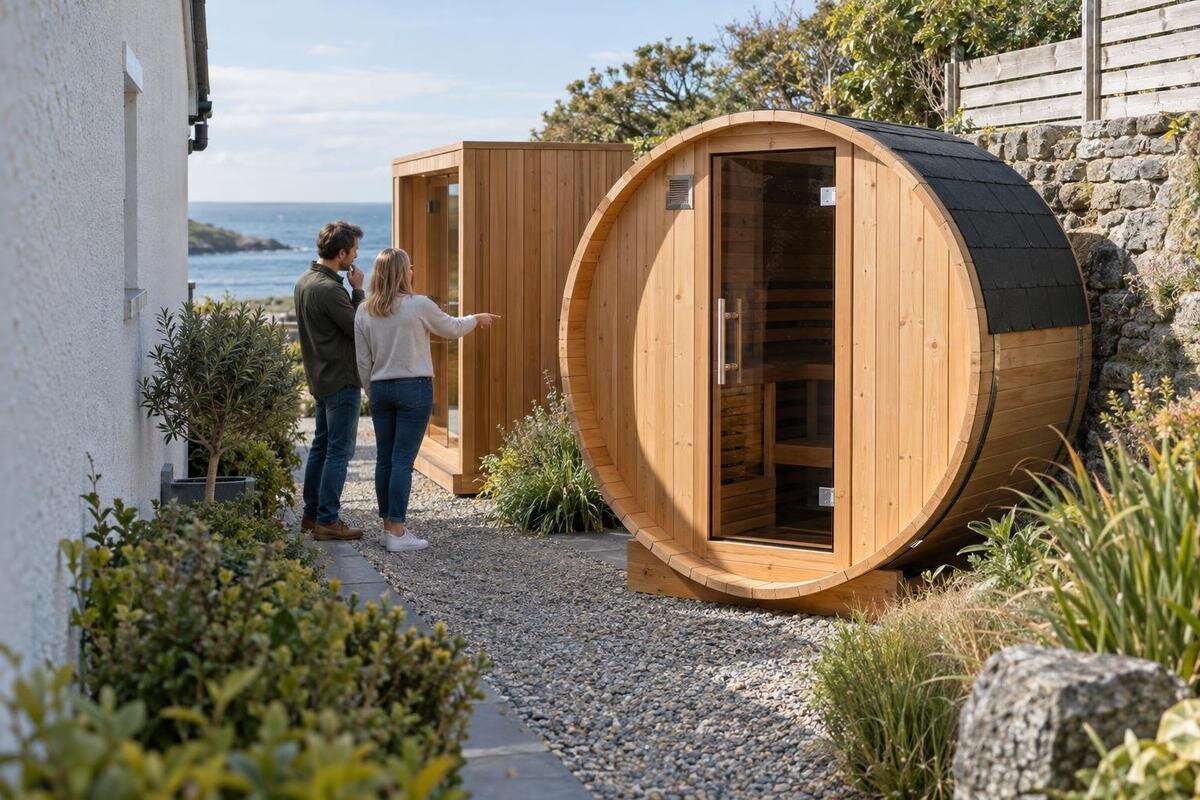
If you’re buying a sauna for a property with narrow access, the cabin’s finished footprint is only one part of the fit. The delivery route may include a gate, a turn, a low passage or a change in level that the product dimensions do not describe. Before choosing a model, map the route from the actual unloading point to the intended position, measure every restriction and ask for the dimensions and delivery format of the exact option you plan to order. Confirm who will move it and whether assembly takes place on site. This can prevent a sauna that suits the available space from being impossible to bring in.
Map the route from the delivery point to the sauna site
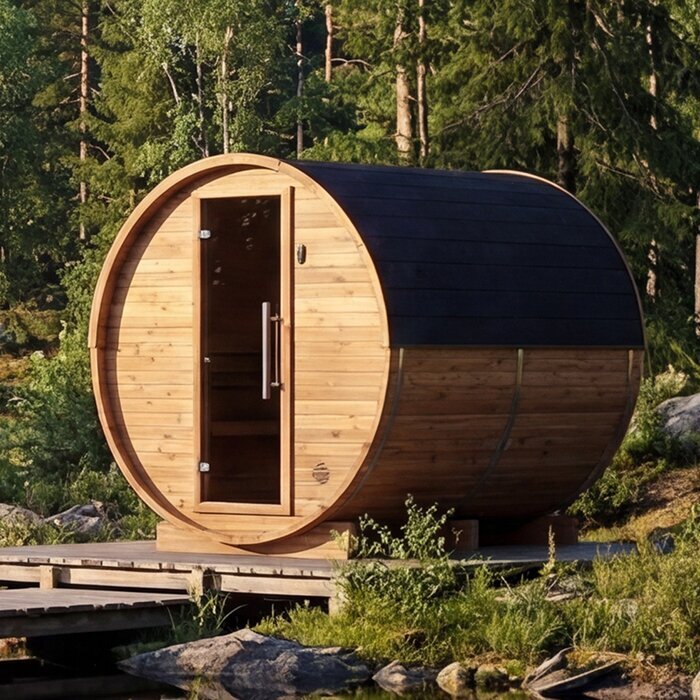
Begin at the point where the delivery team can actually unload, not at the garden door or room entrance. Trace one continuous route to the sauna’s final position: boundary gate, path, external doors, hallways, internal doors and the last turn all count. A wide garden entrance does not help if a side passage is narrower, and a clear doorway does not settle whether a long item can turn beyond it. Treat every narrowing as a constraint to record. If the delivery point may differ from the one you expect, ask where the service reaches and where the supplier’s responsibility ends. Note any shared access and when it is available.
Make a simple route sketch and label each feature in order. Note steps, slopes, thresholds, landings, overhead obstructions and fixed items such as taps, lights, handrails, door closers, fence posts or branches. Record whether an obstacle can be moved, who can authorise that and whether it would need a tradesperson; until confirmed, measure as though it will stay. Take photographs as context, but write the measurements on the sketch rather than relying on perspective. Mark the location of each obstruction and the clearance it leaves, then send the record to the seller when asking whether an option will fit. For shared, rented or managed access, resolve permissions before depending on a change.
Measure every opening and narrow point
Measure the clear opening, not the nominal door or gate size. With the door in the position it would occupy during delivery, measure between the surfaces that actually restrict passage, including projecting handles, hinges, latches, stops and raised thresholds. Check width at more than one height and height across the opening: frames and walls may not be perfectly square, and a pipe or closer can reduce usable space. Record each doorway separately, including which way it opens and whether it can remain fully open. Repeat this for corridors and gaps between permanent objects; the smallest figure is a warning, not a complete fit test. Note if the frame or ground changes across the opening.
Then request the dimensions of the sauna as it will arrive, not only the dimensions of the completed cabin. When comparing the Thermowood barrel sauna S 140 listing, use its name to identify the page, not as evidence of a particular size or delivery arrangement. Ask for the maximum width, height and length of every package or component, including packaging that stays on during the move, and for the permitted orientation. Put those figures beside your route measurements and ask the supplier to assess any close clearance. A small numerical difference is not proof that handlers can safely manoeuvre the item through, so resolve tight points before choosing.
Allow for turns, stairs and overhead clearance
Turns need their own measurements. At each corner, record the width of the approach and exit, the length of the landing, the distance to the opposite wall and the position of any door opening into the space. A package may pass straight through an opening yet have nowhere to swing at the far side. Corridors with a bend, a stair landing or a narrow passage beside a wall can impose a tighter limit than the doorway itself. Do not decide by looking at a plan drawing alone: ask for a route assessment using the item’s full delivered dimensions and the actual sequence of turns.
Include vertical clearance wherever the route changes level or direction. Measure under low beams, lintels, eaves or overhanging branches, and note sloping ceilings and staircases with limited headroom. For stairs, capture the clear width between handrails or other fixed projections, the dimensions of each landing and any turn at the top or bottom. If a lift is part of the route, check its doorway and internal dimensions with the building manager. Do not assume a rail can be removed or that the delivery team will carry a large section on stairs. If the HC 150 Thermowood barrel sauna listing is on your shortlist, request its delivery dimensions and confirm the proposed route with the supplier or installer; the model name cannot answer either question.
Check how the sauna will be delivered
Distinguish finished dimensions from transport dimensions in every quote or product document. A sauna could be supplied as a complete unit, as several large sections or as a kit of smaller components; the seller must confirm which applies to the exact configuration. Ask for a list of the largest items as delivered and the dimensions of the packages if wrapping or crates stay on during movement. You can also ask for package weights if the delivery provider needs them to plan handling. Confirm whether any parts arrive separately. A drawing of the assembled cabin cannot establish whether its components will pass through a gate, and a package list without dimensions cannot establish that the route works.
For the Thermowood barrel sauna HC 225 listing, request the current delivery configuration before comparing it with your route. Ask whether any component can be separated for access and whether that method is specifically permitted by the manufacturer; do not assume a sauna can be dismantled and reassembled simply because it is too large to move intact. Find out whether assembly at the destination is included, what space is needed to work, and who supplies the people and equipment for the move. Check whether packaging is removed before or after the restricted part of the route. These answers determine whether the delivered items can reach the work area and be assembled there.
Compare delivery dimensions, not just footprint
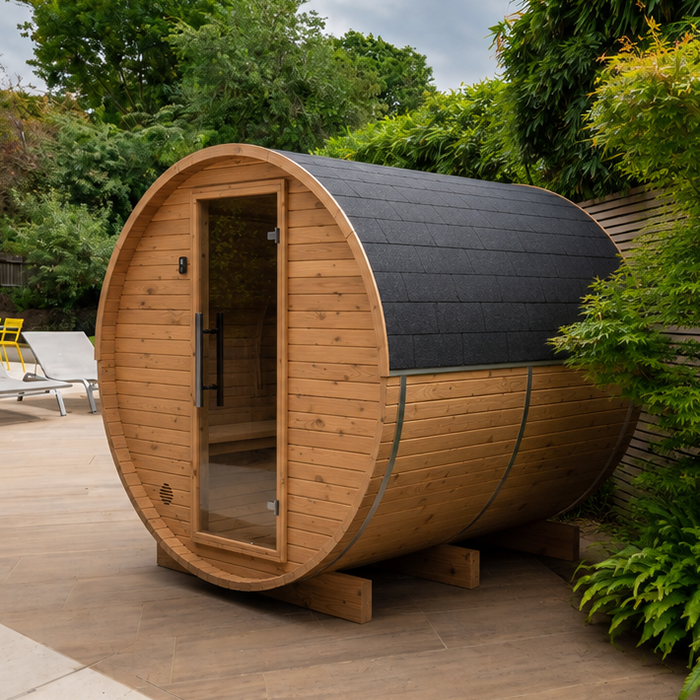
Choose by transport constraints as well as by the area the sauna will occupy. The smallest finished footprint is not automatically the easiest option to deliver: one cabin might arrive in a bulky unit, while another might arrive in sections, but only the seller’s documentation can tell you what applies. Compare the longest and widest delivered pieces, their shape and the route needed to orient them. If the route only works when a component is carried at a particular angle, get confirmation that the supplier permits that orientation and can handle it. Do not infer that an option is easier to access from its appearance, size label or category name.
On the Thermowood barrel sauna N 210 page, as with any candidate, check whether assembly is required and whether the parts can reach the intended work area. A kit may reduce the size of items carried through a restricted entrance, but it still needs room for assembly and a route for tools and people; that does not make it a guaranteed fit. A pre-assembled option, by contrast, needs its complete delivered dimensions checked against turns and headroom. Compare the practical delivery plan, not just floor area or a photograph, and keep your preference for layout separate from the question of whether the item can be brought in and installed.
Confirm the final position and site requirements
Assess the final position as carefully as the route. Check the available footprint and the space needed to bring each section into place, orient it and complete any assembly. A sauna can fit on a plan but still leave no practical access to its entrance, or no room to carry components past a wall or fence. Use the drawing for the exact version to check the entrance orientation and how it relates to the approach. If the site is indoors, include the path inside the building after the last external doorway; if it is outdoors, map the route across the plot rather than assuming the garden is open.
Ask for the installation drawing and site-preparation instructions for the N 250 Thermowood barrel sauna listing or whichever option you are considering. Confirm the specified base or floor arrangement, clearances and any access needed for installation or later maintenance against those instructions; do not assume an existing patio, floor or garden base meets the requirements. If electrical connections or other services are relevant, get the requirements from the supplier and have a suitably qualified professional assess the site before fixing the position. This check covers the work needed at the destination as well as the space available for the sauna itself.
Include the ground surface and level changes
Route width is not the only issue when a sauna has to cross a garden or uneven ground. Steps, slopes, gravel, soft lawn, raised thresholds, drains and changes between paving materials can affect whether a delivery team can move a package by its normal method. Record the surface and level changes on the route sketch, especially just beyond a narrow gate where there may be little room to reposition an item. Do not assume that a hand-carry is possible or that a trolley will suit the surface. Ask the delivery provider what it can handle and whether route preparation or temporary protection is needed.
Before ordering the Thermowood barrel sauna LC 260, send the supplier photographs and measurements of awkward sections and ask whether the service includes moving the goods to the final position or only to a specified drop point. Confirm how steps, slopes, shared paths and surface protection are handled, and who is responsible for arranging any changes. If the ground or a raised structure may not support the handling method or sauna, have a competent professional assess it rather than guessing. A delivery plan that addresses the route can reveal extra work before you commit, instead of leaving an access decision until the delivery day.
Clarify what delivery and assembly include
“Delivery” can mean different things, so read the service description rather than assuming the sauna will be carried into place. Confirm the unloading point, whether the crew will use the narrow route you have measured, whether they will move the packages indoors or across the garden, and whether assembly is part of the service. Ask whether the crew needs a clear route or extra help arranged in advance, and what happens if an access restriction prevents the planned delivery. The practical scope should be clear before an appointment is booked, especially if the route involves stairs, shared access or a long carry. Check who is responsible for keeping the route clear on the day.
The product page for the sauna listing labelled “6 89 m” is only a starting point for these questions; its title does not establish how an item is delivered. Ask the seller to confirm the current arrangement for that exact listing and any selected options, including who moves it, who assembles it and who removes packaging. Read the applicable terms for site readiness, failed access, re-delivery or cancellation rather than assuming these costs or responsibilities are covered. If you need the team to use an unusual route, provide the measurements and photographs before ordering and ask for an explicit response, not a general assurance that delivery is available.
Use the same access checklist for every option
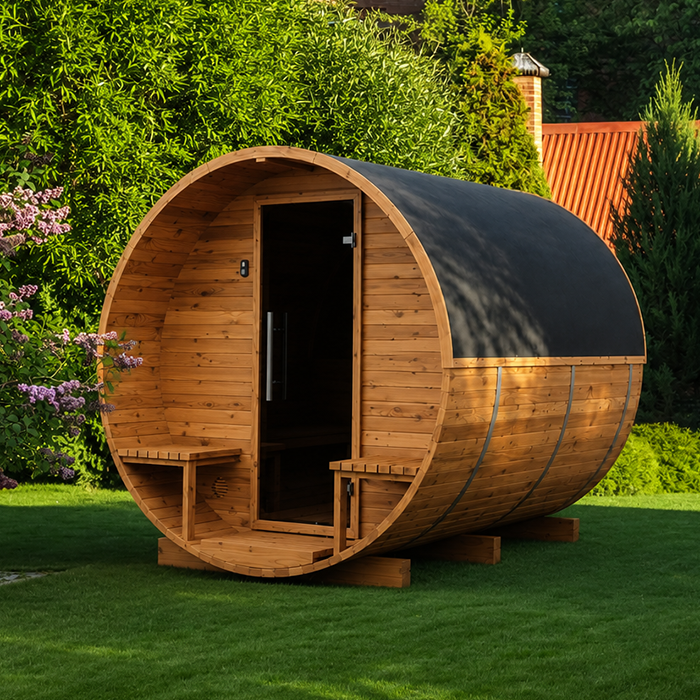
Put the information into a comparison sheet so competing models are judged on the same basis. Record the finished dimensions and the largest dimensions as delivered; the number and size of separate packages; permitted carrying orientation; each tight opening, turn, stair and overhead restriction; and the assembly space and final-position requirements. Add the delivery endpoint and what the service includes. Mark each issue as confirmed, unresolved or incompatible. That status matters: a shortlisted sauna with one unanswered route constraint is not equivalent to one whose delivered dimensions and handling plan have been checked against every pinch point.
Use that same record for the Thermowood barrel sauna HCF 225 entry rather than treating its name or a catalogue image as evidence of fit. Ask for details that match the precise option in your quotation, because a change in configuration can change the delivery information. Resolve hard constraints first: a doorway that is too small, an unmanageable turn or an unconfirmed stair route can outweigh a preferred layout. If the proposed solution involves removing a gate, rail or other fixed item, confirm permission and how the work will be done before treating it as part of the plan. Compare preferences once the access questions are settled.
Get route suitability confirmed before ordering
Before placing the order, send the supplier a concise route pack: a labelled sketch, measurements of every bottleneck, photographs and the intended final position. Ask the supplier to confirm in writing that the delivered dimensions and handling method suit that route, including the turns and any changes of level. Include the exact model and configuration, and request the relevant delivery and installation documents. If a delivery survey or specialist assessment is recommended, arrange it before payment or before reaching a point at which the terms make changes difficult. A verbal estimate based on a single doorway measurement is not a reliable substitute for the full route.
Choose an option only when the access plan and site plan both make sense. The route plan should identify how every delivered part reaches the work area; the site plan should show how it will be positioned, assembled if necessary and used in line with the supplier’s instructions. Check the written terms for what happens if the route is not as described, and keep a copy of any agreed delivery arrangement. If access remains uncertain, ask for clarification, consider a different delivery configuration or pause the order while a qualified person assesses a proposed alteration. That is more useful than hoping a tight turn will be manageable on the day.
Frequently asked questions
How do I check whether a sauna will fit through a narrow gate?
Measure the gate’s clear width and height, then compare them with the largest item as delivered, including any packaging that stays on during the move. Also assess the turn just beyond the gate, overhead clearance and the orientation the supplier permits. The finished sauna’s dimensions alone do not establish whether the delivery route works.
Should I use the sauna’s assembled size or its package dimensions?
You need both. The assembled dimensions help you assess the final position, while the package or component dimensions help you check the route. Ask for the delivery configuration and the dimensions of every item that will pass through the restricted access.
Can a sauna be taken apart to get it through a doorway?
That depends on the exact product and its approved delivery method. Ask the supplier whether it arrives in sections or a kit, and whether any parts may be separated. Do not assume a sauna can be dismantled and reassembled; confirm who will do the work and whether assembly at the destination is included.
Would removing a door or fence panel solve the access problem?
It may change the available opening, but it does not resolve turns, headroom or the route beyond it. Check who can authorise and carry out the work, and measure the opening again with the obstruction removed. Confirm any required removal and reinstatement before relying on it in your delivery plan.
What should I ask the supplier before ordering?
Ask for the exact delivery configuration, the dimensions and weights of the largest items, permitted handling orientations, and confirmation of the delivery endpoint and assembly scope. Share your route measurements and photographs, then check site-preparation requirements and the written terms for access problems or a failed delivery.
With restricted access, the right choice is the sauna whose documented delivery form and handling route suit the property, not simply the one whose finished cabin fits the planned footprint. Measure the complete journey, check the largest delivered items and where assembly will take place, then confirm the service and site requirements for the exact option. If one point remains uncertain, treat it as unresolved rather than assuming the delivery crew will find a way through. A careful comparison gives you a practical basis for choosing and avoids ordering on dimensions that answer only half the question.
