
Buying an Electric Outdoor Sauna: Checking the Power Supply
SAUNA BUYING GUIDE
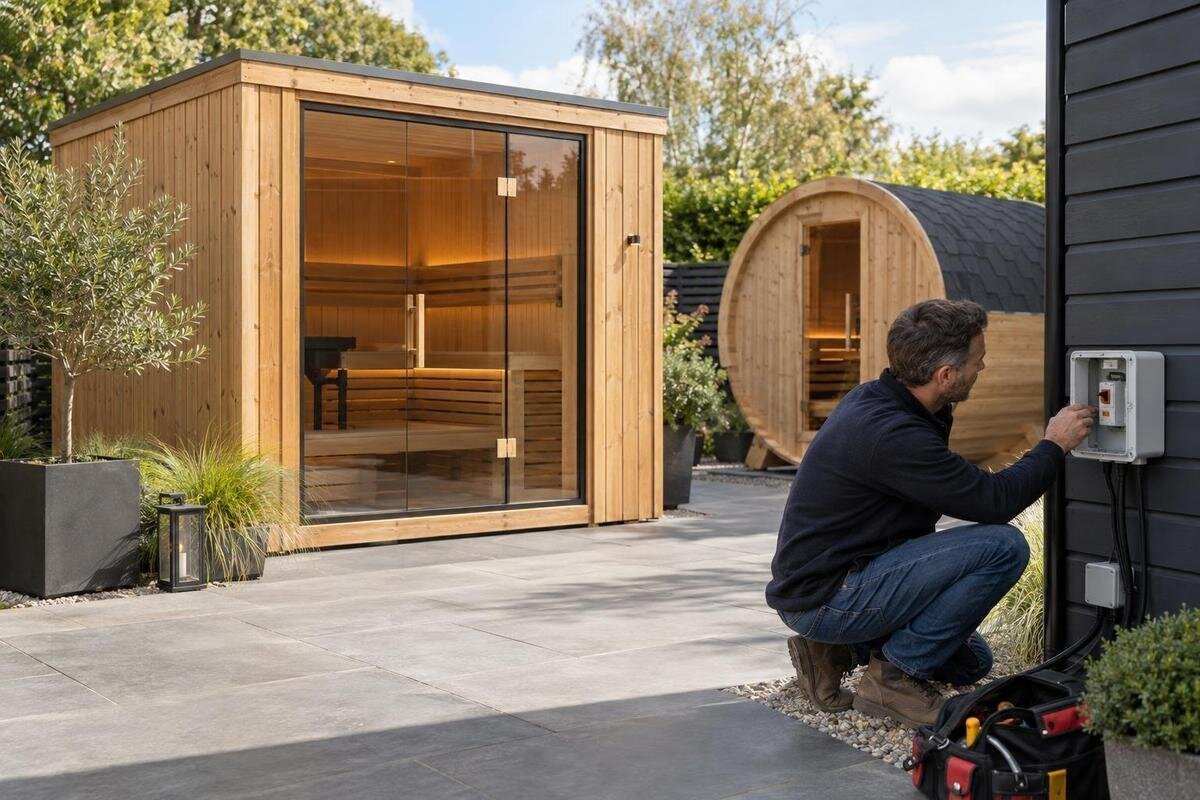
If you plan to buy an electric outdoor sauna, check the power supply before you settle on a model. The heater is only one part of the decision: its documented requirements have to be considered alongside the property's existing supply and the proposed garden location. A product name, photograph or vague phrase such as “standard household power” cannot establish that they match. Ask the seller for specifications for the exact sauna and heater, then have a qualified electrician assess your property and the likely work. This guide sets out what to gather, what to ask and how to compare the complete purchase before you order.
01
Check electrical feasibility before committing to a model
Treat electrical compatibility as an early buying filter, not a detail to leave until installation. A sauna with an electric heater depends on a supply that can meet the requirements of that particular heater at the intended site. Whether your property can do so cannot be read from a product photograph, a general description such as “standard power”, or the name of a model. If the answer comes late, you may need to revise the position, budget for additional electrical work or reconsider the product. Put the supply check on the same pre-order list as footprint, access and package contents, and do it before committing to a cabin or heater.
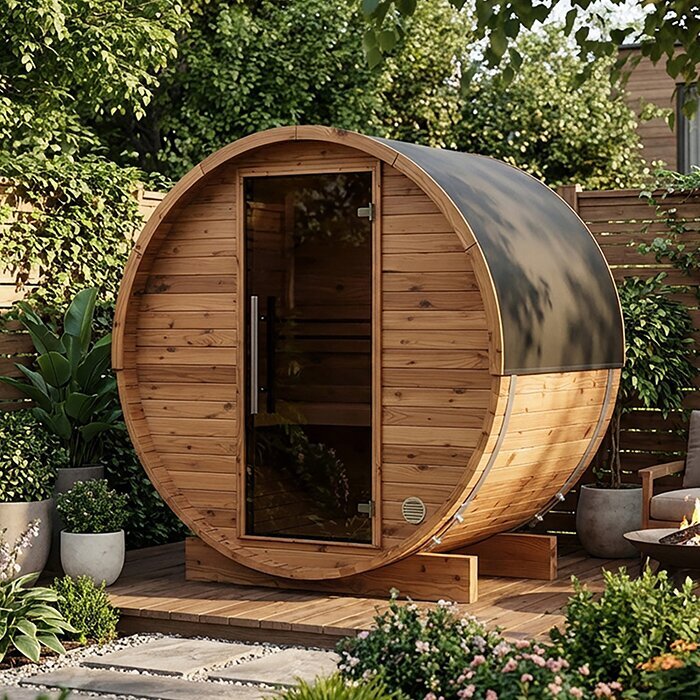
Build a shortlist, but keep each question tied to an exact listing. For instance, record the Thermowood Barrel Sauna S 140 listing as the item you want information about; do not treat its name as proof of a heater type, rating or connection. Ask the seller for electrical documentation for that exact product version and package, then give it to an electrician for a property-specific assessment. A general answer about outdoor saunas may describe a different heater or configuration. Keeping a saved product page, quotation and any supplied document together makes it easier to spot if the details change before you place the order.
Get the heater specifications for the exact sauna
Ask for the heater's own documentation, not only a sales description of the sauna. Useful details to request include the exact heater make and model, its stated input or rated power, required supply characteristics such as voltage and phase, and the manufacturer's connection requirements. Also ask which control unit and other electrical components are required, and whether the cited figures apply to the heater alone or to a specified sauna package. You do not need to interpret those values yourself; their purpose is to let the seller identify the equipment and the electrician assess it. If product information lists only the cabin, request the heater data separately before comparing options.
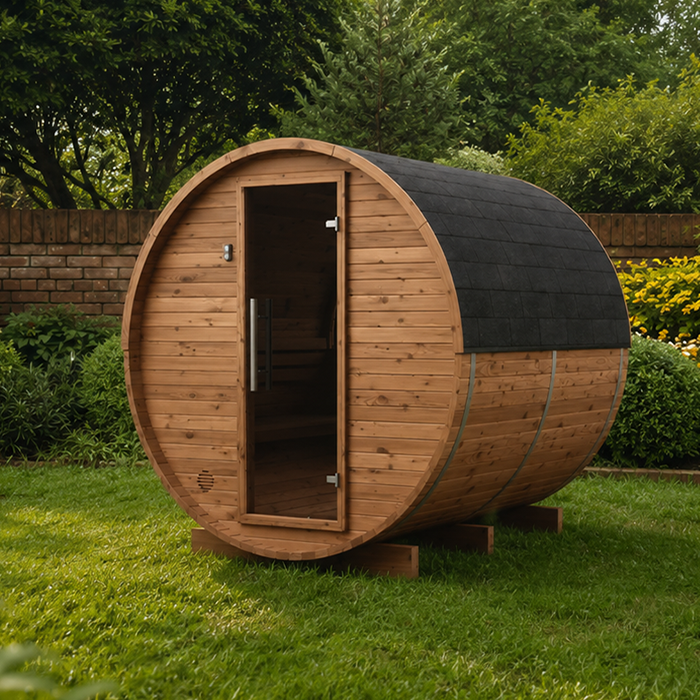
Use a precise identifier when you ask; the HC 150 Thermowood Barrel Sauna page, for example, is a better reference than a message saying only “the barrel sauna”. Confirm whether the quoted configuration includes a heater and, if so, whether the document names the same model as the quote. Ask for a manual or manufacturer sheet rather than relying on a reply that gives no document or version. A product label may distinguish one listing from another, but it does not establish what electrical equipment is included. If a seller cannot match the specifications to the product you are considering, leave the requirement unresolved rather than filling the gap with an assumption.
02
Have the property's existing supply assessed
An electrician needs to assess the property as well as the heater. Share the intended sauna position, the available information about the home's existing electrical supply and the way the space is used. The professional can determine whether the existing arrangement has capacity for the proposed equipment, taking account of other loads and any relevant limits, and whether changes are needed. A visible socket or a statement that the house has electricity is not a substitute for that assessment. Do not open equipment or attempt to test or adapt a circuit yourself; the purpose of this step is to get a qualified person to establish what is feasible and what work, if any, is within scope.
Send the electrician the product specification and quote, rather than asking for a generic estimate for an outdoor sauna. If you are considering the Thermowood Barrel Sauna HC 225, identify it by name and include the exact heater details once the seller supplies them. Ask whether the proposed property supply is suitable for that combination, what information is still missing, and whether an inspection at the property is needed before the answer can be final. Request a written summary of assumptions and any recommended work. This lets you compare a realistic purchase plan with the information on which the sauna seller based the quotation, instead of discovering that each party was considering a different setup.
Plan the outdoor location and electrical route together
Outdoor siting matters to the electrical discussion because the intended route from the property's supply to the sauna can influence the design and amount of work. Tell the electrician where the sauna would stand, roughly how far that is from the likely supply point, and what lies along the possible route, such as paving, planting or other structures. These are planning facts, not instructions for running a cable; the electrician must decide whether a route is suitable and what installation is required for the setting. If the position is not fixed, ask whether moving the sauna within the garden would change the assessment before you settle on a base or pay for preparation.
Prepare a simple site sketch with the proposed location, access points and any obstacles, and label it with the exact product you are asking about. For a candidate shown as the Thermowood Barrel Sauna N 210 listing, ask the retailer whether model-specific siting or installation documents are available, and pass relevant information to the electrician. Do not use an image, assumed footprint or guessed route as a substitute for the manufacturer's current instructions. If either professional needs a site visit, find out what it will establish and whether further information is needed afterwards. The aim is to have the location and electrical plan assessed together, rather than choose a site that later proves difficult to serve.
03
Confirm what the sauna package includes
Read the sales package line by line. A sauna cabin, an electric heater, a controller and the work to connect the equipment are not automatically the same purchase item. The listing or quotation should make clear what is included, what is optional, and which exact heater and control equipment are proposed. Ask whether any required component is sold separately and whether cabin assembly, heater fitting, electrical connection and commissioning are included or arranged by different parties. This is not a claim that a particular item is missing; it is a way to avoid buying on the assumption that a headline description covers every part of a working installation. Keep package scope separate from electrical suitability: both need confirmation.
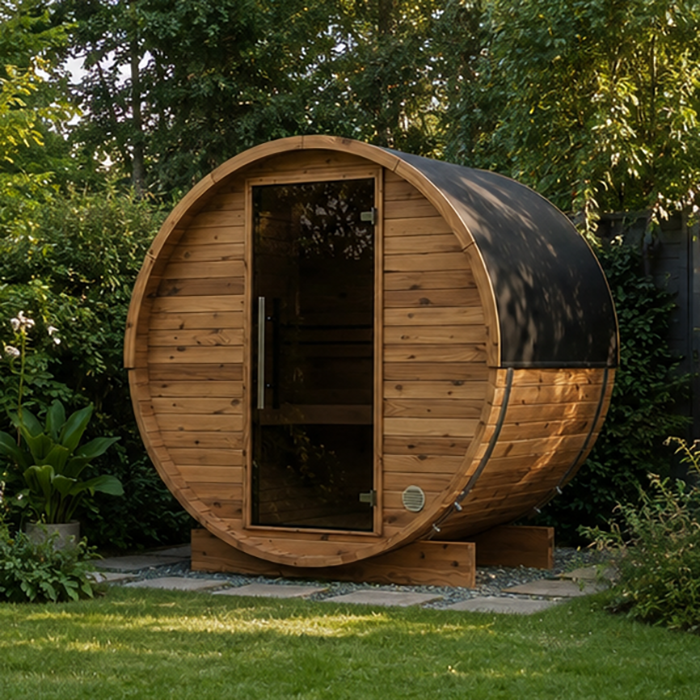
For example, use the N 250 Thermowood Barrel Sauna listing as the identifier in a written question about package contents, not as evidence that a heater comes with it. Request the heater's full model name and documents, then ask the sauna seller to confirm in writing that those documents apply to the quoted configuration. If separate controls, sensors or accessories are mentioned, ask which exact items are supplied and whether they are required for that heater; have the electrician advise on installation implications. Clear, model-specific inclusions make quotes easier to compare and avoid treating a product image or a broad “ready to use” phrase as a parts list.
Match the heater using the manufacturer's guidance
A heater must be selected against the sauna manufacturer's stated requirements for the exact cabin, rather than chosen by a broad size label or visual similarity. The recommended heater can depend on the cabin's stated internal volume and construction details, so use the manufacturer's compatibility information instead of estimating from a model number, seating description or photograph. Ask the seller which heater models are specified or recommended for the selected sauna and what documented electrical requirements go with that pairing. If a manual gives a range or conditions, pass the full guidance to the electrician; do not isolate a single power figure from its context. This is a compatibility check for the supplier and electrician, not a calculation to do yourself.
Keep the sauna and heater identifiers together when comparing candidates. For the Thermowood Barrel Sauna LC 260 listing, request confirmation that the proposed heater is intended for that exact version and whether any options alter the stated requirements. Do not assume that two listings that look similar, share part of a name, or belong to the same general product family use the same heater or supply. If the retailer cannot confirm a match, ask the manufacturer or supplier to provide the relevant specification before you make the electrical decision. A clear match is more useful than simply shopping by the lowest stated heater rating.
04
Compare the full purchase and installation costs
Compare the cost of the whole plan, not only the sauna's listed price. Ask for a written, itemised quotation that separates the product and heater package from any electrician's assessment, connection work and changes to the property's supply. Ask what is excluded, what assumptions the estimate relies on and whether extra work could be identified only after a site visit. This does not predict that an upgrade will be necessary; it makes clear how unknowns are treated before you buy. If you receive separate quotes, check that each refers to the same sauna, heater, proposed location and scope, otherwise a low headline total may omit work that another quote includes.
When a product name is unusual or abbreviated, make sure the quotation identifies the exact candidate, not just a category. For a candidate whose page is labelled “6 89 m”, ask the seller to confirm in writing which model and package that label refers to and attach the matching specification. Get the electrician's estimate against the same equipment details, and ask whether it includes assessment, installation, testing or other stated tasks, without assuming that one trade's quotation covers another's work. With the scope visible, you can compare total commitments and decide whether the purchase still fits your budget if additional work is needed.
Keep the seller's and electrician's specifications aligned
Before ordering, assemble one specification pack and check that every document describes the same proposed setup. It should identify the sauna, heater and any control unit by exact product names or model codes; include the relevant manufacturer's electrical instructions; and note the assumptions about the installation location. Compare the pack with the seller's quote and the electrician's written assessment. If the sauna page says one thing, the heater manual another, or a quotation uses a generic description, ask the responsible supplier to reconcile them rather than deciding which version to trust. Keep the final answers with your order records so that later changes can be checked against what was actually agreed.
Use the Thermowood Barrel Sauna HCF 225 listing only as one precise product reference, and ask the seller to carry its exact identity into the quote and supplied instructions. The electrician should be working from the heater specification that belongs to that same quote, not from an assumed equivalent. Ask who will tell you if a component or version changes and whether that change requires a fresh assessment. Written confirmation is especially useful when ordering involves separate suppliers: it shows which details are settled, which remain conditional, and what still has to be decided before work begins. If essential documents are unavailable, postpone the choice until the seller can provide an answer.
05
Confirm the order, delivery and installation sequence
Clarify the sequence of supply, delivery and installation before you agree dates. Ask the sauna seller what site preparation must be complete, who assembles the cabin, whether heater fitting is part of that service and who arranges the electrical connection. These responsibilities may sit with different providers, so do not assume that a sauna delivery includes electrical work or that an electrician will handle assembly. Confirm which documents and site details each party needs, and whether the professional assessment must happen before the seller can confirm an installation plan. A clear hand-off reduces the chance of each party expecting the other to provide a component or complete a task.
Check practical ordering details alongside the power decision: access for delivery, where components will be stored if relevant, what must be ready at the location, and who is your contact if the agreed product or heater changes. These points are not electrical specifications, but they can affect whether the installation plan is ready when the sauna arrives. Ask for any prerequisites and exclusions in writing, and compare them with the site plan and electrical quote. If dates depend on an inspection or unresolved work, keep that dependency explicit instead of treating a provisional arrangement as confirmation. The goal is a sequence in which the product, site and people responsible are all aligned before installation.
Keep an alternative if the supply is unsuitable
If the electrician cannot confirm that the proposed arrangement is workable, do not treat a product description as a workaround. Ask what is unresolved: the existing supply, the site route, missing heater information, or the scope of possible changes. A second assessment or a different location may clarify the position, but only a professional with the relevant details can say whether either changes feasibility. If the necessary work is not appropriate for your property or budget, pause and revisit the selection rather than ordering a heater on the basis of an assumed lower demand. The right comparison is between documented requirements and a confirmed supply, not between unverified claims.
Keep alternatives within the same evidence standard. A different electric sauna or heater is worth considering only when its manufacturer documentation identifies the exact pairing and the electrician confirms it for the proposed site. Changing the location, configuration or package can also mean that earlier advice no longer applies, so send the updated details back for review. Record what would make you switch: an unavailable specification, a supply alteration you do not want to undertake, or a total quote outside your budget. Then compare the remaining candidates on cabin fit and intended use, as well as the electrical plan. This turns uncertainty into a clear buying decision instead of leaving it to be solved after delivery.
Frequently asked questions
Can I run an outdoor sauna from a standard socket?
There is no universal answer. Check the instructions for the exact heater and ask an electrician to confirm that its stated connection suits your property's supply and the proposed location. Do not treat an existing socket or a general online description as confirmation.
What electrical details should I request before buying?
Ask for the heater's exact make and model, its stated power, the required supply characteristics and the manufacturer's electrical instructions. Also establish which controls and other components are included, and whether the information applies to the sauna and heater package you are considering.
Who can confirm whether my home's supply is suitable?
A qualified electrician can assess your property's supply against the exact heater details and proposed location. The seller can identify the product requirements, but a general product description cannot establish whether your home's supply and site are suitable.
Should I order the sauna before checking the supply?
It is sensible to obtain the product documents and arrange an electrical assessment before committing. If you are considering ordering sooner, read the seller's terms and clarify what happens if the proposed installation is not feasible; do not assume the supply will be adequate.
Does an outdoor sauna package include an electric heater?
Do not assume so. Check the written package contents for the exact heater and any required controls, and confirm whether fitting and electrical connection are included or arranged separately. A product name or photograph is not a parts list.
An electric sauna purchase is easier to assess when the cabin, heater and property's supply are treated as one proposal. The manufacturer's documents establish what the selected equipment needs; a qualified electrician establishes whether and how the proposed site can provide it. With both answers, plus a clear package and itemised work scope, you can compare options on a sound basis. If an essential detail remains unknown, pause before ordering rather than treating a model name or general assurance as confirmation.
