
Home Sauna vs Spa Membership: Compare Costs
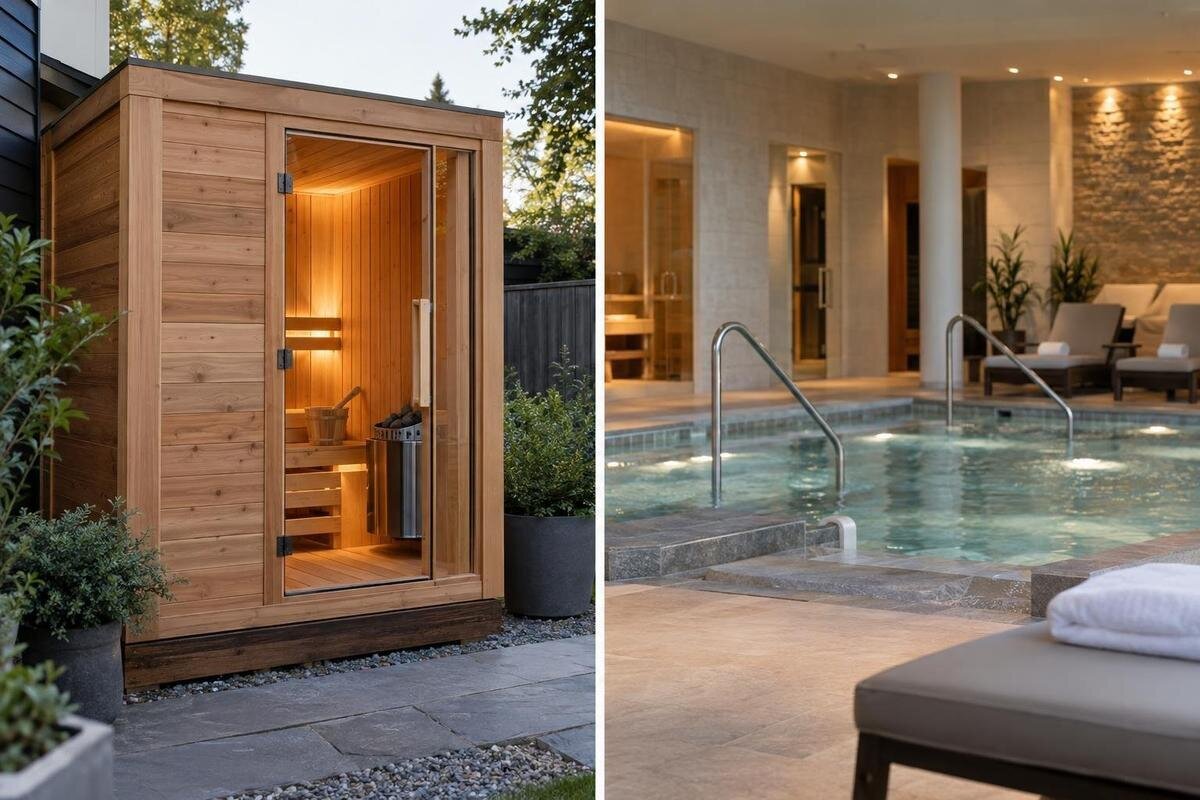
Sauna costs
Whether a home sauna costs less than a spa membership depends on how often your household would use it, what the membership includes and the cost of travelling there. Ownership is not just the purchase price: delivery, site preparation, installation, energy and upkeep may all matter. A home sauna replaces only the parts of a spa routine you are willing to give up; it does not automatically replace a pool, gym or other facilities. A useful comparison covers the same period for both options, distinguishes unavoidable bills from costs you can eliminate and shows how the answer changes with usage. The guide below helps you build that comparison around your own routine rather than a generic payback claim.
Set one comparison period
Choose one comparison period for both options. It might be a single year for a household budget or the number of years you realistically expect to keep and use a home sauna; apply the same dates to membership fees, travel and ownership costs. If a contract has a minimum term or you are part-way through it, compare future costs you can still change, not charges already paid as though they were refundable. Keep a separate line for money due upfront, because an annual average can hide a substantial initial cash requirement. You can show both annual and full-period totals if cash flow matters.
Set up two totals. Spa total = membership and joining fees + charges not covered by membership + travel. Home total = purchase + delivery, site work and installation + energy + routine upkeep and repairs + any financing fees and interest. Include only costs incurred within your comparison period, and identify any financial commitments that continue beyond it. For an average yearly figure, divide the period’s total by its number of years, but also show the upfront payment. Do not deduct expected resale value without a defensible basis. Label confirmed quotes, contract figures and estimates separately, and keep assumptions beside each number so you can update them.
Count spa visits and home sessions
Build the visit count from the routine you expect, not the number that would make ownership look favourable. Check recent calendars, booking history or bank statements, then adjust for foreseeable changes such as a move, a new work pattern, a change in household routine or seasonal variation. Create lower-use, likely-use and higher-use estimates rather than treating one month’s pattern as a promise for every month. Count each person’s spa entry separately if the fee is per person, but count a shared car journey once. For home use, record sessions as well as people: energy and preparation may be tied to a heating cycle, not to each occupant. Do not treat an untried habit as guaranteed.
Keep spa visits, home heating sessions and individual uses in separate rows. For example, two people attending together once a week represent one weekly home session but two individual uses; at a spa, they may incur two entry charges. This distinction matters when calculating costs per session and per person. Alongside your usage estimates, record the purchase option being considered, such as the Sauna LC-260 listing, so the calculation refers to a specific quotation rather than an unspecified home sauna. Use individual uses to compare household access and heating sessions to estimate running costs. Neither measure alone captures the whole household budget.
Check what the spa membership covers
Read the membership terms and the price you would actually pay. Include any joining fee, recurring monthly or annual charge, minimum commitment, cancellation notice, household add-on and separate booking or entry fees that apply to your plan. Check whether you can pause membership and whether access or prices vary by time or location; use the current contract or written terms, not a headline rate. If membership continues for some months after a decision, include those unavoidable payments in the relevant period. A saving starts only when a fee can genuinely be stopped, so do not treat the full annual charge as avoidable if the terms say otherwise. Note renewal dates and any applicable exit costs.
Ask what else the membership gives you. A spa may bundle sauna access with a pool, gym, classes, treatments or relaxation areas. If you cancel the package, include the cost of any replacement facilities you would actually buy. If you retain it, compare membership alone with membership plus home ownership: the home sauna is then an additional expense. A purchase option such as Sauna HCF-300 belongs in the ownership column, not as a direct equivalent to a wider leisure package. Where sauna access is not priced separately, avoid assigning it an arbitrary share of the membership fee and presenting that share as a saving.
Include the cost of getting to the spa
Work out the extra cash cost of a spa visit from your actual route. Include the transport you pay for, such as fares, fuel, parking charges or a taxi, and use round-trip travel for the number of visits you forecast. If you combine the trip with work, shopping or another regular journey, include only the additional cost caused by going to the spa; charging the whole journey to sauna use can exaggerate the difference. When several household members travel together, separate any per-person fares from costs shared across the car trip. Use recent receipts or your own journey calculation, and note the date because fares, parking fees and fuel costs can change.
Time matters, but it is not automatically a cash saving. List journey and waiting time in hours alongside the monetary total, then decide whether you personally want to assign it a value; there is no universal hourly rate for a leisure trip. Compare this with home preparation, heating, cleaning and upkeep. Travel costs accumulate with journeys, whereas the purchase quotation for an option such as Sauna HCF-225 is an upfront expense. Keep those different cost patterns visible: fewer spa trips reduce travel spending, but fewer home sessions do not recover the purchase price. You may still prefer home access for convenience even when it costs more.
Build the home sauna’s initial budget
Use a current product price or written quote for the exact configuration you would buy. Add delivery, unloading or assembly only where these are not already included, and list any separate base or ground preparation, electrical work, site access or landscaping that the project needs. Ask which costs are excluded before adding a contingency, so the same job is not counted twice. The Sauna S-140 product page can be one starting point for recording a specific option, but confirm its current contents and configuration before relying on a figure. A product price is not a complete quote for work at your property, so keep a date against each price and estimate.
Separate the purchase from any financing. If you pay cash, show the full one-off amount and when it is due. If you borrow, include the deposit, fees and interest in the total cost, while showing instalments separately for cash-flow planning; adding the full purchase price and all loan repayments together would double-count the principal. Include site or professional work only from quotes or clear provisional estimates. A home option may be affordable over time yet difficult to fund upfront, so keep the cash requirement visible beside the annual comparison rather than smoothing it away. If comparing several products, use the same cost-inclusion rules for each.
Budget separately for site work and installation
Do not assume installation is a standard add-on. The actual scope can depend on the chosen model, where it will sit, ground conditions, access for delivery, existing services and the manufacturer’s requirements. Check drawings and manuals for the exact configuration, then ask qualified installers or relevant tradespeople to quote the work needed at your home. A garden location that looks straightforward may still need preparation or professional work, while a product page cannot confirm that a particular site is ready. Include checks, professional fees and excluded work only where they apply to your project. A generic allowance is not a substitute for an assessment of the site.
Request an itemised scope that distinguishes the product, delivery, assembly, site preparation, electrical work and any commissioning or handover. Ask who is responsible for each part and whether one contractor’s quote assumes another job has already been completed. If Sauna HC-150 is on your shortlist, identify the exact configuration in each request for a quotation so contractors are pricing the same project. Record exclusions beside the quoted amounts rather than leaving them in separate correspondence. This makes it easier to spot a missing job, an overlapping charge or an allowance that still needs confirmation before comparing the ownership total with membership.
Estimate electricity and routine upkeep
For an electrically heated configuration, estimate electricity costs from relevant consumption information and your own tariff. Use a manufacturer’s or installer’s estimate of kilowatt-hours per session if available, then multiply by the unit rate and the number of home sessions. Rated power multiplied by operating time is only a rough estimate: a heater may not draw its full rated power throughout a session. Ask the supplier or a qualified professional how to interpret the figures for your configuration, including preparation and any other electricity use. For a different heat source, obtain the corresponding fuel estimate instead. Record the tariff or fuel-price date and test a higher rate for a multi-year comparison.
Add routine costs such as cleaning products, laundering towels, manufacturer-specified care and a reserve for maintenance or repairs. Separate expenses that rise with use from occasional work that may be needed even during a quiet year. When investigating Sauna HC-225 care requirements, request the relevant manual and ask which tasks owners are expected to carry out and which may require paid help. An allowance for uncertain repairs is a budgeting assumption, not a prediction that a component will fail. Show a lower and higher allowance where reliable figures are unavailable, and account for any equivalent laundry or extra towel charges on the spa side.
Compare household use and wider spa access
One membership may be priced per person, while a household home-sauna purchase is a shared cost; compare these on the same household basis. Calculate spa entry for everyone who would go, and note whether travel is shared. On the home side, do not assume that a household will attend in one session, or that every person will want to use the sauna as often as another. Model the actual pattern: some people may use it regularly and others rarely. If adults decide to split the cost, show that as a household budgeting choice, not as a reduction in what the project costs overall. Include anyone who would genuinely use the home option.
Household members may also value access differently. One person may prefer the spa’s wider facilities while another wants to avoid travelling, so a mixed arrangement can be more realistic than assuming everyone switches. Price that arrangement explicitly, including any membership retained by one person. For a shortlisted home option such as Sauna N-210, check the layout and seating information against who expects to use it together; the model name does not establish suitability for your household. If people need or prefer separate sessions, reflect those sessions in the running-cost estimate. Sharing the purchase cost does not necessarily mean sharing every heating session.

Test the result at different levels of use
Run at least three versions of the calculation using your own plausible lower, expected and higher visit patterns. Change one uncertain input at a time—visits, energy tariff, travel spend, installation estimate or maintenance allowance—so you can see what moves the result. Compare the full cash needed at the start, the annual average and the cumulative total over your chosen period. A fixed membership can have a low average cost per visit when used often, while its fee may remain payable if you go less; home ownership has its own fixed costs even in a quiet month. A single break-even figure hides these differences and how sensitive the outcome is.
A useful threshold calculation asks when cumulative home costs would equal the spa costs you could actually avoid. For each year, add ownership running costs to the initial purchase and setup total, then compare that figure with accumulated avoidable membership, entry and travel costs. The lines may cross within your chosen period, or they may not. If you obtain a quotation for an alternative such as Sauna N-250, rerun the calculation with its own purchase and project costs rather than changing only the model name. Any crossing point remains conditional on the inputs; it does not establish a guaranteed lifespan, resale value or payback date.
Interpret the cost difference alongside flexibility
Read the result as a range. For example, suppose your lower, likely and higher forecasts are 24, 40 and 60 household spa trips a year. These are illustrative counts, not recommended usage levels. If membership has a fixed annual fee, changing the trip count changes travel spending and cost per visit, but not necessarily the membership bill. At home, changing session numbers affects running costs while leaving the initial purchase unchanged. If ownership costs less only in the highest-use case, the result depends heavily on maintaining that routine. If it costs less across all three cases, the cost comparison is less sensitive to usage, though the upfront commitment still matters.
Consider what happens if your plans change. With membership, your remaining commitment depends on the contract; with ownership, much of the spending has already happened, and any resale proceeds are uncertain. Compare the financial exposure if you stop using either option part-way through your chosen period, without assuming a refund or resale amount. This is particularly useful if a move or change in work pattern is foreseeable. Your final comparison should state the expected cost difference, the upfront cash required and the assumptions most likely to alter the result. If the estimates are close, flexibility and the effort involved may matter more than a small calculated saving.
Frequently asked questions
Will frequent use always make a home sauna cheaper?
No. More use can spread the purchase cost over more sessions, but it can also increase electricity and some upkeep. The result depends on fees you can actually cancel, travel avoided, installation costs, household use and what else the membership provides. Test several visit levels; no universal number of visits guarantees savings.
Should I count the full journey to the spa?
Only if the journey is caused by the spa visit. If it is combined with work or errands, use the additional transport cost. Count shared car costs once and per-person fares separately. Record travel time as a separate, non-cash factor unless you have a personal reason to value it.
How do I estimate a home sauna's cost per session?
Over a stated period, add the purchase and setup costs to attributable energy, care, maintenance and repair costs. Divide by a realistic number of home sessions in that same period. Show the full cash cost as well as any annual average, and keep financing instalments separate to avoid double-counting.
What if the spa membership includes a gym or pool?
Treat it as a wider package, not simply the price of sauna access. If you would cancel the whole membership, include the cost of any alternative facilities you would then buy. If you would keep the membership for the gym or pool, include it in a combined-cost scenario: the home sauna is an additional expense, not a replacement.
Can an online calculator tell me the break-even point?
It can calculate an outcome from the figures you enter, but it cannot verify them or predict your future routine. Use current membership terms, quotes, travel and energy figures, then test changes in usage and installation costs. Treat the result as conditional on those assumptions, not as a guaranteed payback date.
A home sauna is not simply a membership fee exchanged for a one-off purchase. It is a different bundle of access, effort and costs. Put the spa terms and travel beside a model-specific purchase price, site work, energy and upkeep, then repeat the calculation at realistic levels of use. If the answer changes sharply, consider how confident you are about those visits and whether you would genuinely cancel the wider membership. If the totals stay close across plausible cases, access, flexibility, upkeep and upfront affordability may matter more than a small calculated difference.
