
Hot Tub Delivery: Gates, Access Routes and Lifting Arrangements
Hot tub delivery planning
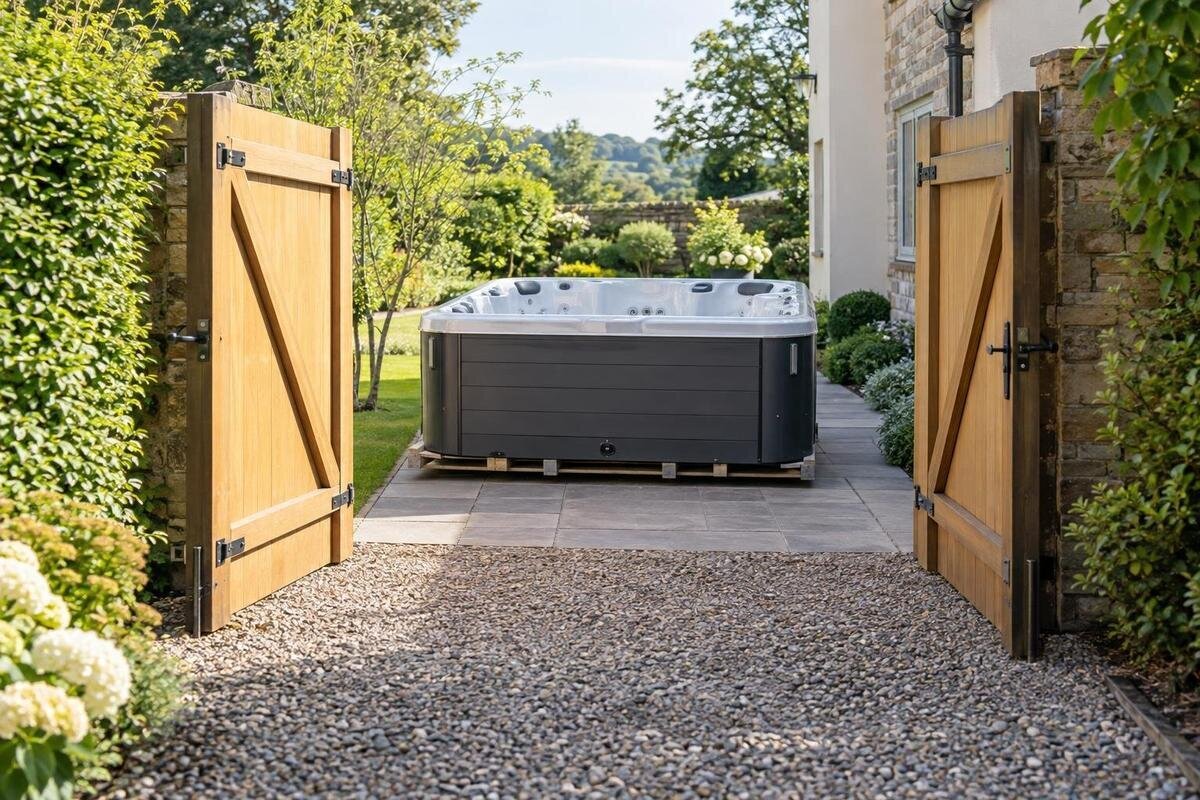
A hot tub can fit its planned position and still be impossible to deliver by the route you assumed. The limiting point might be a gate, a tight turn, a step, a low branch or the space available to unload. The dimensions that matter may also differ from what you picture. Map the journey from the delivery vehicle to the set-down point, then compare it with the supplier-confirmed package and handling information before ordering.
01
Map the route from the delivery vehicle to the final position
Start at the place where the delivery vehicle is expected to stop, not at the garden gate. Sketch the route in order to the intended set-down point, marking every gate, doorway, narrow passage, turn, step, slope and overhead obstruction. Include the approach from the stopping place: a route that looks clear inside the garden may pinch at a side entrance or just beyond a gate. Note the distance the load would travel and any point where it must change direction. The aim is to map one continuous journey, rather than assess the gate and final position as separate spaces.
Clarify precisely where the supplier’s delivery service ends. Unloading from a vehicle, bringing a package onto a drive and moving it to the final position are different tasks; do not assume one includes the others. On your sketch, mark the likely vehicle stopping point, property boundary, final position and any alternative route. Add photographs looking both ways along the route, not just a picture of the destination. Label measurements on the plan rather than relying on estimates, and ask the supplier or delivery provider to confirm what service is included and who moves the tub beyond the unloading point.
Measure the usable gate opening, not the gate itself
A gate leaf’s stated width is not automatically the usable opening. With the gate open as far as the site allows, measure the gap between the nearest fixed or protruding points, including posts, hinges, latches, handles, stops, walls and fence returns. Check the opening at the points where anything projects into the route, and record the vertical clearance as well. Note which way the gate swings and whether it can stay in that position while the package passes. If the opening narrows or has an irregular shape, sketch its profile instead of reducing it to a single measurement.
Check the passage immediately before and after the gate, and measure any second pinch point. Record the smallest clear width and height, along with thresholds and the space available to approach the opening. Compare these measurements only with transport dimensions confirmed for the exact model; a straight-through comparison still may not account for handling equipment or manoeuvring. Ask the delivery provider what allowance its method needs rather than applying a guessed margin. If you are considering the Cove 2 hot tub, send these gate measurements with your enquiry so the provider can assess the opening in relation to the complete package and proposed handling method.
02
Get the packed dimensions and handling instructions
The dimensions that matter are those of the item as transported, not the footprint or height after installation. Ask the supplier or manufacturer for the overall length, width and height of the complete packaged unit, and whether a pallet, skid, crate, protective wrapping or transport frame affects its size. Request the packed weight, permitted handling orientation, any designated lifting points and the current handling restrictions. Confirm that the information applies to the exact model and version you intend to order, and ask whether it changes with the delivery arrangement offered for your address.
Keep a record of the model and version, package dimensions, weight, allowed orientation, handling information and who supplied the details. Ask whether the delivery provider uses equipment that adds to the width or height of the load along the route. Do not plan to remove packaging, rotate the tub or handle it by a particular edge unless the supplier’s instructions permit it and the provider accepts the method. Use the Haven 6 product page to identify the model when requesting this information. Keep the supplier’s response with your route plan so the delivery provider can assess both together.
Check turns and the space beyond each corner
A route can have generous straight sections and still fail at a tight turn. For each corner, record the width of both approaches and the space available at the turn. Note nearby walls, fences, door leaves, planting beds or other features that restrict movement, and whether the route makes a sharp turn, a dog-leg or opens into a wider area only after the corner. Include the swing of any gate or door and any change in level at the turning point. The package’s shape and permitted orientation affect how it can be manoeuvred, so ask for its transport outline rather than relying on an image of the installed tub.
Draw the route from above, showing the space around each turn, and send photographs taken before, within and after the corner. An outline made to the confirmed package dimensions may help identify an obvious problem, but it cannot prove that delivery is possible: the delivery provider must assess the equipment, handling method and clearance required. A diagonal measurement or one width figure does not show whether a load can pivot. If your shortlist includes the Fjord 8 model, ask the provider to assess its confirmed transport outline against each corner on the plan. Include the approach and exit, rather than showing only the space at the turn itself.
03
Record steps, slopes and surface conditions
Steps and slopes affect how a delivery team can move a package, even when the path is wide. Count the steps and note their approximate height and width, landing space, handrails and thresholds. Mark sloped sections, where each one starts and ends, and any abrupt transition between levels. Describe the surface along the route, such as firm paving, loose gravel, grass or uneven slabs, and note damaged or soft areas. These details are observations, not a pass-or-fail judgement. A photograph can conceal a slope or an uneven patch, so combine images with measurements and written notes.
Do not assume that a trolley or a particular crew can manage a step, incline or surface just because the package could be moved across a flat driveway. What is possible depends on the confirmed package and the delivery team’s method. Ask the provider to assess every change in level and state any route limitations before booking. If you are comparing the Aurora 10 hot tub with another model, give the provider the same surface and level information for both enquiries so neither assessment overlooks a difficult section. Keep this assessment focused on the journey to the final position; evaluating that position itself is a separate question.
Look for overhead obstructions along the whole route
Check above the full route as well as across it. Note low eaves, gutters, porch roofs, arches, balconies, branches, signs, cables, lights and canopies. Record the lowest point relative to the path and how far the obstruction extends. A load may need extra room while turning, not only when passing straight beneath something. Ask the supplier for the transport height in the permitted orientation and the delivery provider whether its handling equipment needs more space. Do not estimate from the height of the installed tub. If a cable or other service crosses the route, do not touch or move it; ask the relevant service provider and lifting specialist for guidance.
Photographs should show both the obstruction and the route beneath it, with enough context to reveal whether the load approaches straight on or must turn. Do not assume that an awning, umbrella or branch can be moved: establish who owns it, whether changes are permitted and who can make them safely. For the Cove 2 model, ask the provider to compare the confirmed transport height and handling method with the lowest clearances you have recorded. Include overhead obstacles in any enquiry about a crane or other specialist lift, even if the proposed route changes; roofs, trees and cables still need to be considered in the assessment.
04
Separate removable obstacles from fixed constraints
List possible obstructions separately from features that should be treated as fixed. Bins and movable garden furniture may be straightforward to relocate, while a gate leaf, fence panel, door or handrail may need an owner or installer to approve and carry out work. Treat boundary features, shared access, utility enclosures and built-in structures as fixed until the responsible person confirms otherwise. For each proposed change, record who will arrange it, when it will be done, where removed items will go and who will reinstate them. A wider opening on paper helps only if it will be available for the agreed delivery.
Removing a gate leaf does not necessarily solve an access problem: the approach, turn immediately beyond it, overhead clearance and room to handle the package still matter. If an alternative route depends on temporary changes, measure it in that exact configuration and send the revised sketch to the delivery provider. Agree permissions and reinstatement before ordering rather than relying on a last-minute alteration. When discussing the Haven 6 hot tub, distinguish the existing opening from the proposed altered opening on your plan. Ask the provider to state which arrangement its assessment covers, so you know exactly which changes the delivery depends on.
Ask early whether a specialist lift is feasible
Ask about a crane or another specialist lifting arrangement when a measured ground route appears impossible, or when stairs, sharp turns, slopes or fixed obstacles leave the delivery provider unable to confirm a normal route. A lift is an option to assess, not an automatic workaround. The lifting company needs to determine whether the load, vehicle access, reach, set-down point and surrounding obstacles suit a method. The supplier must also confirm that the tub can be handled in the proposed orientation and at any specified lifting points. Do not work out lifting capacity yourself or assume a crane can reach over a building.
Give the supplier and lifting specialist the exact model and version, confirmed package dimensions and weight, permitted orientation, and handling instructions. Include a route sketch, measurements and photographs of gates, turns, steps, slopes, overhead obstructions and the likely vehicle position. Show the distance to the set-down point and nearby buildings, boundaries, trees and cables. If you are enquiring about the Fjord 8 hot tub, include its product reference alongside the supplier’s transport information so both providers are discussing the same shipment. Ask whether the information is enough or a site survey is needed, and get feasibility confirmed before placing an order.
05
Agree who arranges delivery and any lifting work
Agree responsibilities before treating a delivery description or lift quote as a complete plan. Ask the supplier exactly which delivery service is offered for your address and what it includes: route assessment, unloading, movement to the final position and specialist lifting may be separate tasks. If another company is involved, confirm who books it, shares the technical information and coordinates dates. Ask who is responsible for moving the tub from the lifting set-down point to its final position. Do not assume the supplier and carrier will coordinate automatically; name a contact for each provider and confirm the handover in writing.
Ask who will check whether any site, road or neighbouring-property permissions or traffic arrangements are needed. Where appropriate, confirm this with the lifting provider, relevant local authority or property owner rather than assuming an approval is or is not required. Request a written, site-specific quote and scope covering items such as a survey, equipment, crew, vehicle access, distance, traffic arrangements, extra handling, waiting and cancellation or rescheduling. Prices depend on the proposed arrangement and location, so compare what each quote includes. For an order of the Aurora 10 model, keep the agreed delivery scope with the product and transport details, and record who handles each outstanding approval.
Choose a model and delivery method that fit the confirmed route
Before ordering, choose between options supported by evidence: a model whose supplier-confirmed package and permitted handling method suit the measured route; an access change made with consent and suitable help; or a specialist lift that the provider has assessed as feasible. The tub’s in-use footprint, product photograph or number in its name is not a delivery measurement. Compare each candidate against the same bottlenecks, including the narrowest clear opening, turns, overhead height and changes in level. Have the supplier confirm that its information applies to the exact version and shipment. If transport data is unavailable or the delivery provider cannot confirm the route, do not treat a guess as approval.
Compare the practical implications of the options that have been confirmed as feasible. A different model needs its own transport assessment; an access alteration needs agreed arrangements for removal and reinstatement; a specialist lift needs coordination between the providers involved. Use current, site-specific quotes to compare the cost and disruption of each option, rather than comparing a product price with an incomplete delivery estimate. Check that each proposal addresses the same final position and includes any movement after unloading or lifting. Keep the chosen plan together in writing: model-specific package information, route measurements, the confirmed movement method and named responsibilities should all describe the same delivery.
Frequently asked questions
Is the gate’s stated width enough to plan from?
Not on its own. Measure the usable opening with the gate in the position it can actually reach, including posts, hinges, handles and other projections. Then compare it with the supplier-confirmed dimensions of the complete package and ask the delivery provider what extra room its handling method needs.
Can a hot tub be turned on its side to get through a gate?
Do not assume that it can. The permitted orientation depends on the exact model and its handling instructions. Ask the supplier or manufacturer for written guidance, then check that the delivery or lifting provider accepts the proposed route and method.
When should I ask about a crane or specialist lift?
Raise it before ordering if the ground route has a fixed bottleneck, difficult turn, steps or overhead obstruction and the delivery provider cannot confirm that the tub can pass safely. The supplier and lifting specialist need the transport details for the exact shipment to assess whether a lift is feasible.
Who books the lift and checks whether permissions are needed?
That depends on the service being arranged, so ask the supplier and lifting provider who books, coordinates and obtains any necessary approvals. Check with the relevant local authority or property owner where appropriate, and record responsibilities and the agreed scope in writing.
What information will a lifting provider need?
Give them the exact model and version, supplier-confirmed package dimensions and weight, permitted orientation and handling instructions. Include a route sketch, measurements, photographs, likely vehicle position, overhead obstructions and the proposed set-down point. Ask whether they also need a site survey.
Access problems often begin when the space for a hot tub in use is mistaken for the space needed to deliver it. Get the transport details for the exact model, compare them with the measured route and put any specialist lifting arrangement and responsibilities in writing. If the route cannot be confirmed, resolve the access question or obtain a professional assessment before committing to the order.
