
Can You Move an Outdoor Sauna When You Move House?
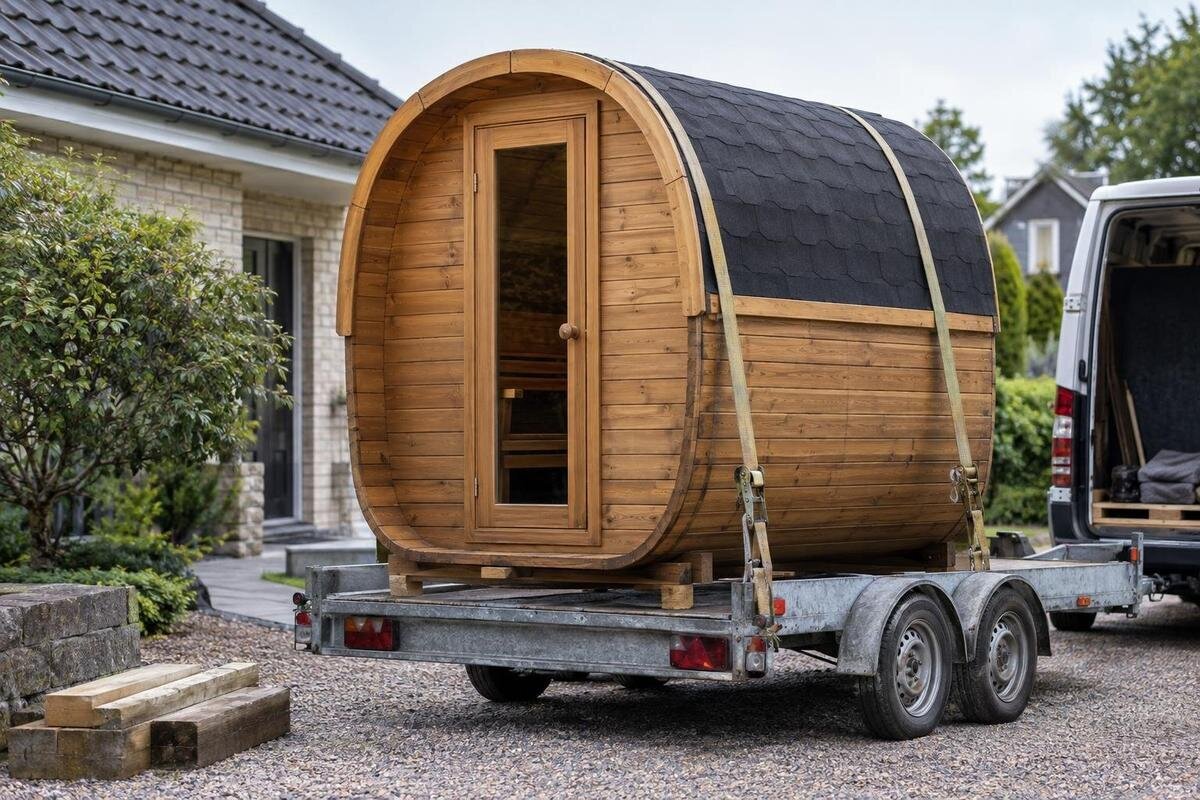
Outdoor sauna relocation
Moving house does not automatically mean your outdoor sauna can come with you. The answer depends on the exact model, how it is assembled and equipped, its condition, access at both properties and the maker’s reinstallation requirements. Before booking a mover, confirm whether relocation is permitted, what may be dismantled, how the sauna must be handled and what needs checking at the new site.

Is your outdoor sauna designed to be moved?
An outdoor sauna is not automatically a portable garden building. Arriving in panels or being assembled on site does not establish whether its connections can be undone, whether the complete structure can be lifted, or whether it can be rebuilt elsewhere. Identify the exact model, any serial or production label, the original paperwork and any alterations or added equipment. Establish whether you intend to take the sauna or leave it at the property, and make that intention clear when discussing the house move. Before committing to removal, ask the manufacturer whether relocation is permitted for this version. Even a recently installed sauna needs this confirmation: its age alone says nothing about the approved handling method. If you bought the property with the sauna already in place, gather its installation history from the previous owner where possible.
Describe the proposed move rather than asking only whether the sauna can be moved. Explain its current condition, fitted components, any repairs or additions, and whether the destination or access differs from the existing site. Ask for model-specific handling and reassembly instructions, including any conditions on who should do the work. If you are choosing a sauna ahead of a possible future move, include the Sauna N-250 by its exact name in your enquiry and ask about relocation before purchase. Keep the response with the installation papers so the mover and installer can work from the same information.
Get the manufacturer’s guidance in writing
Locate the manual and assembly records, then send the manufacturer the model name and any serial or production label, clear photographs of the complete unit, and a description of its equipment, alterations and visible damage. Ask for a written answer covering permission to relocate, the approved method, dismantling and reassembly limits, handling instructions and any inspection required. If the manual covers several versions, ask which one applies. Keep the original installation records as well as any updated instructions: the manufacturer may need both to identify changes between versions. If the model is no longer sold, ask whether technical guidance and replacement components remain available. A current model with a similar appearance is not a substitute for instructions for your sauna. Missing documentation is a gap to resolve before choosing a removal method, rather than a reason to copy another owner’s procedure.
Separate permission to move the sauna from the effect on its warranty. Ask whether conditions apply to removal, transport, professional reassembly or installation at the new site, and whether a specified installer must carry out any work. Do not treat a verbal assurance, online comment or another owner’s experience as confirmation for your unit. Save the reply, manual and correspondence with the move paperwork, and ask whom to contact if a part is damaged. For the Sauna LC-260, use the full model name in the enquiry and request the instructions for the exact version before accepting a booking.
Choose between moving it assembled and dismantling it
There are two separate questions: whether the manufacturer permits the move and which permitted method works at these addresses. Moving the sauna assembled avoids the dismantling and rebuilding stages, but may require more clearance and a different professional handling plan. Taking it apart may make sections easier to route through a narrow space, yet creates joints to reassemble and components that must not be mixed, lost or damaged. Neither method is automatically gentler. A sauna that works normally in place is not thereby proven suitable for lifting or transport intact, and a convenient-looking joint is not proof that it is designed to be taken apart and reused.
Ask the manufacturer for the approved sequence and which components, if any, may be removed. Have the mover assess the route and the proposed method, then clarify who handles benches, glazing, the heater, controls and other fittings; some may need a separate professional or may not be user-removable. If dismantling is allowed, ask how parts and fixings should be identified, packed and checked before reassembly. If the unit is a Sauna HCF-300, make the enquiry about that exact model rather than inferring its dismantling method from another barrel sauna.
Give the mover reliable handling information
Ask for the manufacturer’s current handling information: the sauna’s dimensions and weight in the state being moved; dimensions and weights of sections if dismantled; designated lifting points or method; and any restrictions on orientation or components that must be removed first. These are details for a moving plan, not figures to estimate from a photograph, model name or comparable sauna. If the manual does not provide them, ask the manufacturer and professional mover how they will establish a safe plan before equipment is booked. Do not let a crew choose attachment points by appearance or assume that trim, roof or floor parts can carry lifting forces.
Have the mover explain how the sauna will be moved from its base to the vehicle, secured for travel, protected from impact and weather, then unloaded at the new property. Clarify who supplies packing materials, whether glazing or detachable fittings need separate handling, and how loose components will be identified. Do not improvise lifting gear, straps or protective covers that differ from the maker’s instructions. Where more than one method is permitted, ask for each option to be described and quoted separately. If your records identify a Sauna HCF-225, include that exact model and configuration when requesting transport drawings.

Check access at both properties
Survey the full route out of the old property and into the new one, not just the sauna’s final position. Check narrow gates, corners, doorways, steps, slopes, overhead branches or eaves, soft ground and the space needed to turn or position moving equipment. Compare pinch points with the manufacturer’s dimensions for the assembled sauna or each permitted section, and let the mover confirm its own clearance needs. Measure more than the apparent width of a gate: a tight turn or an obstruction above it can also affect the route. Do not infer access dimensions from a product photograph.
Ask the mover to inspect either property if the route, surface or equipment position is uncertain. Confirm how a vehicle can approach and where loading and unloading can take place, including any shared access that needs agreement from the owner or manager. Access to the garden is a separate matter from whether the intended installation site is suitable. Do not assume that the original delivery route is still available: fences, planting, extensions or neighbouring access arrangements may have changed since installation. At the destination, confirm that the measured route will remain clear on the moving day, especially if other deliveries or landscaping work are planned. Photos can help explain the route, but include measurements and known constraints and arrange a site visit if needed. For the Sauna S-140, request dimensions for the exact version and give them to the mover alongside the route measurements.
Record the sauna’s condition before removal
Make a visual record while the sauna is still in its normal position. Photograph the exterior, base contact, roof, door, windows, visible joints, interior and any heater or controls. Note existing movement, gaps, water staining, cracked glazing, loose fittings or other damage. This is not a structural inspection, but a dated record can help distinguish pre-existing defects from transit damage and gives the manufacturer or installer useful context. If anything appears unstable or significantly damaged, or has been recently altered, pause and seek a professional assessment before a mover attempts to handle it.
Make an inventory of removable fittings, manuals, labels and loose parts. Agree with the manufacturer which items should be taken off, by whom and how they should be packed. Identify small fixings only if the approved procedure calls for it; do not assume visually similar hardware is interchangeable. If there will be a gap between dismantling and reassembly, ask how the components should be protected in storage rather than leaving them exposed or choosing packaging without guidance. If you have a Sauna HC-150, include its model label and condition photographs in any enquiry about checks or parts.
Check the new site and base separately
Treat the new base as a separate installation question. Obtain the current siting requirements for the exact sauna and compare them with the proposed location; do not assume that a level-looking patio, an existing pad or the old base will automatically be suitable. Check the manufacturer’s requirements for support, dimensions, level, drainage and clearances. Do not copy measurements from another model or decide by eye that a base can be adjusted. If the ground, base or supporting surface needs assessment, involve an appropriate builder or other qualified professional, using the manufacturer’s instructions to inform that discussion.
Check that the new position allows the access and clearances specified by the manufacturer for doors, maintenance and any fitted equipment. Plan service routes before delivery rather than relying on improvised extensions. If you hope to reuse a base or place the sauna on a different surface, get that arrangement checked against the installation requirements. A base that worked at the old address may have settled or may not suit the new ground. For the Sauna HC-225, request the drawings for the precise model and configuration before the new base is prepared.
Arrange professional disconnection and reconnection
List the services and fitted components before the sauna is dismantled: an electric heater and controls, lighting or other electrical equipment, and a flue or other connection if the particular unit has one. Do not disconnect wiring, remove a heater or alter a flue on the strength of general online advice. Arrange for a suitably qualified electrician to handle electrical disconnection and reconnection, and for the manufacturer’s recommended or otherwise suitably qualified specialist to deal with any relevant heater or flue work. Confirm who is responsible for identifying, protecting and checking each component.
At the new address, the fact that the sauna was connected at the old home does not prove that the existing supply or connection is appropriate there. Ask the electrician to assess the requirements for the actual heater and controls and complete any necessary checks before use. Get the maker’s reassembly and commissioning requirements in writing, including who is to carry out the work, and retain any relevant handover or test records. If you are checking the Sauna N-210, ask which service and heater configuration applies to the version in question rather than assuming it matches another sauna.

Agree the work, quote and timing
Ask for a written quote that matches the manufacturer-approved method, not a broad description such as garden-building removal. Set out whether it includes disconnection, dismantling, packing, loading, transport, unloading, temporary storage and reassembly, and identify any work for an electrician, installer or builder. Ask which access equipment and site visits are included, and what could change the plan. Request a condition or inventory record and written details of how the mover’s cover applies during loading, transit, storage and unloading. Ask about exclusions, any excess and the process for reporting damage; do not assume that every stage is covered in the same way. Where separate firms handle removal, transport and rebuilding, agree when responsibility passes between them. Make sure their quotes describe the same handover points so that an apparently cheaper transport price does not leave unloading or placement unassigned.
Coordinate the move with the property handover, preparation of the new base, service work and the time needed for approved reassembly. Agree what happens if the route proves unsuitable, the destination is not ready, a component is damaged or a part needs assessment. If storage may be needed, establish who arranges it, who pays for an extended stay and whether the stored unit or components can be inspected. The storage provider also needs the manufacturer’s protection requirements; a space large enough to hold the sauna is not, by itself, confirmation that the conditions are suitable. Avoid scheduling removal on the assumption that every later stage will happen immediately. Build any agreed contingency into the timetable, particularly when different contractors must attend in sequence. Compare the full relocation scope with replacement only after considering base preparation, professional work, repairs and storage where relevant. This makes it easier to assess a transport quote that may cover only one part of the project.
Inspect and reassemble before using it
At unloading, compare what arrives with the inventory and photographs taken before removal. Record visible damage before parts are mixed or stored, and report it to the mover promptly in line with the agreed process. Check that the manual, removable fittings and identified fixings are present. Have the sauna reassembled in the manufacturer’s stated sequence by the person or trade specified in the instructions. Do not force a joint that will not line up, substitute a part because it looks similar or rely on an unverified online repair; a fit problem may indicate damage, a missing part or an incorrect assembly step.
Before use, arrange any inspection, service reconnection or commissioning required by the manufacturer and relevant qualified trades. Ask the installer to check the rebuilt unit against the instructions, including doors, glazing, fittings, ventilation and heater equipment where fitted. Keep the handover, relevant electrical records and any damage correspondence with the sauna’s documents. If an inspection identifies outstanding work, record who will complete it and whether a further check is needed before use. Do not treat arrival at the new address or completion of the timber assembly as the end of the installation. The sauna should remain unused until reassembly and any required professional checks are complete; retain the move file for future maintenance or another change of address.
Frequently asked questions
Can I move an outdoor sauna without dismantling it?
Possibly, but only if the manufacturer permits intact transport and a professional mover confirms a suitable handling plan for the exact model. The sauna’s appearance is not proof that it can be lifted whole. Its dimensions, weight, lifting method and access at both properties all need to be considered.
Will I have to take the sauna apart?
Not necessarily. Follow the manufacturer’s instructions and compare the permitted methods with the access route and mover’s assessment. Dismantling can make parts easier to move through restricted spaces, but it creates reassembly work; moving the sauna assembled may need more clearance and a different handling plan.
Will moving my sauna affect its warranty?
There is no single answer for every model. Check the warranty terms and ask the manufacturer in writing whether relocation, dismantling, transport or reassembly has any conditions. Do this before work begins, and do not assume that moving the sauna either leaves the warranty unchanged or automatically ends it.
Can I reuse the existing base and electrical connection?
Do not assume so. Check the new site and base against the manufacturer’s requirements for the exact sauna. Ask a suitably qualified electrician to assess the connection at the new property for the actual heater and controls. A base or supply that worked at the old address may not be suitable for the new installation.
Is it worth moving the sauna rather than replacing it?
Compare the complete relocation plan with replacement, not just the transport quote. Include dismantling and reassembly, any base preparation or professional service work, repairs and storage where relevant. The sauna’s condition, the availability of model-specific instructions and access at both homes can all affect whether moving it is practical.
A successful relocation depends on more than getting the sauna from one address to another. Confirm that the manufacturer permits the chosen method, give the mover reliable model-specific information, and check the new base and services before delivery. If any part of the plan is still uncertain, resolve it before dismantling or transport begins. The sauna is ready for its new home only when it has been reassembled and checked as required.
