
How Long Does an Outdoor Sauna Take to Heat Up?
Outdoor sauna heating
An outdoor sauna does not have one dependable warm-up time. A figure in minutes only makes sense alongside the weather, the cabin’s starting temperature, its construction and heater, the target being measured and the point at which the clock starts and stops. This guide explains what changes the result and how to assess a measured test without treating a headline time as a promise for every garden.
What counts as “heated up”?
“Heated up” can describe several different milestones: the heater has been switched on, a controller shows its setpoint, a separate thermometer reaches a chosen air temperature, or the cabin has had time to warm beyond the first reading. These are not interchangeable. A recorded time needs a clear start event and an end point. For example, a test might time from heater start to a stated reading at a fixed probe; that says what happened at that point, not that every surface or seat has reached the same condition. If a report only says “ready”, it is hard to compare with another. A comfort-based claim should also explain how readiness was judged rather than treating one number as a complete description.
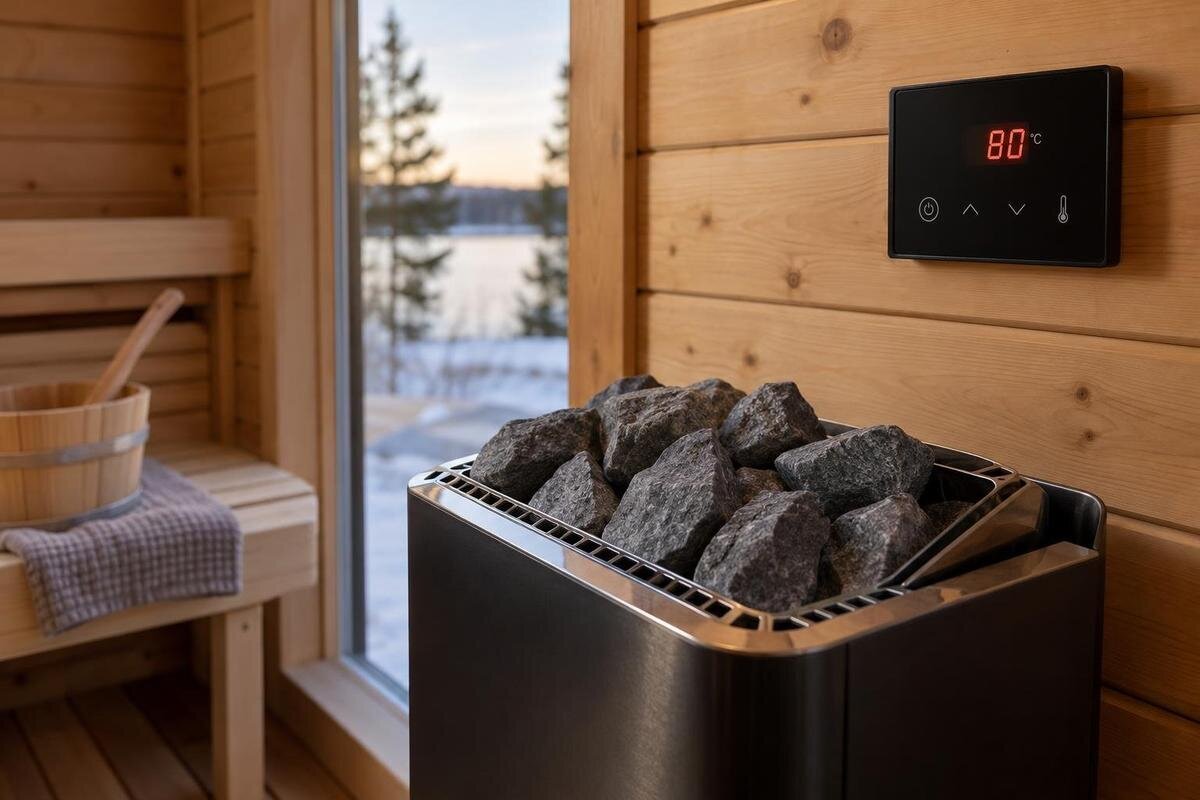
Check how the temperature was measured as carefully as the number. A built-in control sensor may be in a different place from a separate thermometer, and temperatures can vary within the cabin, so location and height matter. A reading near the heater, door or ceiling may differ from one taken elsewhere. When considering the Sauna S-140 product details, ask how any accompanying temperature measurement was obtained. Was it a controller display or a separate thermometer, and was its position recorded? For repeated comparisons, use an instrument suitable for the conditions and keep its position constant without moving the heater’s control sensor. Follow the manufacturer’s guidance for any measuring equipment. Also distinguish the first reading at the target from a reading maintained for a stated period: these are different endpoints. Recording both can explain why two reports describe the same sauna as ready at different times.
The cabin’s starting temperature
Initial temperature changes how much heating is needed before a test reaches its endpoint. A cabin that has been unused overnight and has cooled through its surfaces starts differently from one used earlier that day, even if outdoor air readings now match. Residual warmth in the interior and heater can affect a restart; the initial air reading alone may not describe that history. A recently switched-off heater can also behave differently from a fully cold system. For that reason, “from cold” is not enough unless the report explains what cold means and whether the sauna had been used recently.
Record both the cabin-air temperature and the outdoor temperature before the heater starts, then note whether the cabin was cold-soaked, recently used or partly cooled. If known, include the time since previous use and whether the door stayed closed. Outside temperature is useful context, not a substitute for an inside baseline. A fair comparison needs similar cabin starting readings and a consistent history. If those differ, a simple ratio will not reliably correct the elapsed times: surface temperatures, materials and heat loss also play a part. Use the same thermometer and starting procedure for repeated runs.
Weather around the sauna
Outdoor conditions affect heat loss while the sauna is coming up to temperature. Colder air increases the temperature difference between the cabin and its surroundings; wind may increase cooling where air can move through joints or openings. Rain and damp conditions can also mean a different set of circumstances from a dry, sheltered day. How much each factor matters depends on the actual structure and siting, so there is no single adjustment that converts a summer observation into a winter prediction. Sun on the cabin may also leave its exterior warmer at the start of one trial than another.
A distant weather-station reading does not fully describe conditions at the sauna. For a useful record, note the temperature near the unit at the start and during the run, and whether the site was windy, exposed or sheltered, wet or dry, and in direct sun. Screening from buildings or fences can change local exposure. Record what you observed rather than relying only on a forecast. When looking at published or reported times, give less weight to comparisons that omit weather and siting, particularly if they also omit the cabin’s starting temperature.
Cabin size and construction
The cabin determines how much air and material the heater has to warm. Floor area is only one part of size: internal height and shape affect volume, while the door, glazing, wall build-up and joints affect heat loss. Different construction can therefore produce different results even where two listings show similar area figures. A square-metre label is not a substitute for internal dimensions, construction details or the heater maker’s sizing guidance. Avoid ranking models by area alone or assuming that a particular outline guarantees a particular warm-up pattern.
Use catalogue figures to identify scale, then check drawings and specifications for the configuration you are considering. The listed Sauna HC-150 carries a 2.97 m² area figure, but you need to establish what that figure covers before using it to compare heated spaces. Does the drawing distinguish the sauna room from any other part of the structure? Internal dimensions are more informative for heater selection than an unexplained area label. Check the amount of glazing and the stated wall and roof construction too, rather than turning square metres into a time prediction. If two test reports describe different layouts, their results cannot isolate the effect of size alone. A smaller heated room with one construction and heater combination is not a controlled comparison with a larger room built differently. Keep those differences visible when deciding whether a published result is relevant to your shortlist.
Matching the heater to the cabin
Heater type, output and correct pairing with the cabin are central to warm-up performance. The selected heater needs to suit the sauna’s dimensions and construction under the heater manufacturer’s instructions. The maker may account for glazing or other features in its sizing method, so do not apply a universal formula. Control behaviour matters as well: the time a control sensor registers the set temperature may differ from the moment a separate cabin thermometer reaches its target. A higher output number on its own does not predict a particular warm-up time.
When checking heater options for the Sauna HC-225, first establish what the actual purchase configuration contains. Its supplied catalogue description lists an area of 4.4 m², but does not identify a heater or control package. Ask for the exact heater model, its rated output and the applicable manual, and confirm whether it is included or selected separately. Then check the maker’s stated room range and any adjustments required for the cabin’s construction. A timed result from another heater option should not automatically be applied to the one you intend to buy. Even within one cabin model, the test needs to identify the fitted equipment and settings. Have selection and installation requirements confirmed by an appropriately qualified installer where needed; do not choose a larger heater simply to chase a shorter quoted time. The relevant question is whether the documented combination is appropriate for that cabin.
Different start points for electric and wood-fired heaters
Electric and wood-fired heaters need clearly defined timing start points. An electric test may begin when heating is activated, rather than when a timer is programmed; a wood-fired test may begin at ignition, excluding the preparation beforehand. Two quoted times cannot be compared fairly unless these rules are stated. A wood-fired report should identify the fuel and operating approach, while an electric report should state the control setting and when heating began. Separate preparation time from measured heating time so the reader can understand both. This describes the test method, not instructions for operating either heater.
Compare results within the same heating method first. For a comparison between methods, distinguish the measured heating interval from the total preparation needed before use. If you are reviewing the Sauna N-210 configuration, obtain confirmation of its heater rather than inferring the heating method from the model name or its listed 4.43 m² area. For an electric setup, note whether a programmed delay was excluded from the reported interval. For a wood-fired setup, check whether fuel preparation was excluded and whether the report describes how the fire was managed during the run. Those details help explain the practical difference between a timed test and your own preparation routine. They do not establish that one method is universally faster. Use the operating instructions for the selected equipment, and compare elapsed times only after checking that both reports describe equivalent starting and finishing events.
Ventilation, door opening and occupancy
Ventilation is part of the sauna’s intended operation, not something to close off casually to shorten a test. Air movement can affect heat loss and how evenly temperature is distributed. Keep vents in the positions specified for the tested configuration and do not block them; a run with altered ventilation may no longer represent normal operation. Opening the door exchanges warm cabin air with cooler outside air, while people entering, moving around or adjusting controls can interrupt a controlled measurement. If a control changes ventilation automatically, include that in the test description where relevant.
State whether the door stayed shut, how often it was opened, whether anyone entered and what ventilation setting was used. An empty-cabin test and a routine involving repeated entry measure different situations. When examining the Sauna N-250 product information, request the operating guidance for its actual ventilation arrangement rather than assuming a setting from the photograph or listed area. During a recorded run, note the time of each interruption and its reason, such as checking a thermometer or entering the cabin. If the temperature reading changes afterwards, that log provides context without requiring an invented correction for each door opening. A measurement visible without entry may reduce interruptions, provided the equipment is suitable and used as instructed. Do not delete an interrupted run merely because it took longer: label it accurately. It may be less useful for a controlled comparison but more representative of how the sauna was actually used.
How to make warm-up tests comparable
A useful comparison keeps the setup constant wherever possible and reports what cannot be held constant. Record the exact sauna and heater configuration, cabin and outdoor starting temperatures, time since last use, weather, target and thermometer position. State whether timing starts at switch-on or ignition, whether the door remains closed and which ventilation setting is used. For repeat runs on one sauna, use the same instrument, location and controls. When comparing different saunas, use each maker’s specified heater configuration and record the differences rather than forcing an identical setting.
As an illustration of a test record, not a product result, imagine two runs that each start after an overnight cold soak, with cabin air at 8 °C and outdoor air at 6 °C. They use the same heater setting and probe position, and time from heater start to a chosen 70 °C air reading. These figures demonstrate how to state conditions; they are not a recommended setting or a measured warm-up claim. No measured warm-up results are supplied here for the Sauna LC-260, whose catalogue description lists 5.12 m². A real comparison would add the elapsed time from each run and identify any differences in weather or operation. Record intermediate readings at consistent intervals as well: they can show whether the two runs followed similar heating patterns before reaching the endpoint. Repeated runs provide a firmer basis for comparison than a single observation, but retain the individual conditions rather than presenting their average as a universal result.
What a published warm-up time should report
Treat a published time as a measurement only if it identifies the endpoint and gives enough context to interpret it. Look for the exact model and heater, cabin starting temperature, outdoor conditions, target reading, sensor location, timing start, ventilation and door use. A maker’s estimate, an independently measured test and an owner’s recollection are different kinds of evidence. Each can offer context, but their methods may differ; a precise-sounding figure is not automatically a like-for-like comparison. A range from repeated runs may describe variable conditions better than one rounded time.
Where a report supplies only some details, separate what was measured from what remains unknown. If it names the Sauna HCF-300 model, check whether the cabin and heater configuration match the version under consideration. A shared model name does not establish that the glazing, fitted equipment or controls are identical. Look for the test date, who carried it out and whether the record includes individual runs or only a summary. A table of elapsed times is more useful when each row has its own starting conditions; a range without that information may combine unlike tests. Photographs can help identify the setup but cannot replace readings or operating records. If the report omits a material detail, ask for it rather than filling the gap from another model’s documentation. Where it cannot be recovered, describe the result as limited evidence, not as proof of the model’s usual heating speed.
Using a warm-up time for planning
Use a properly documented result as a guide to that configuration under similar conditions, not as a guaranteed countdown. A cold start, different season, greater exposure, changed heater setting, door opening or different sensor can all alter the time. Follow the heater’s instructions and account for the preparation your routine requires rather than planning around a number from another installation. Avoid adding an arbitrary percentage to a quoted time: without comparable tests, the information rarely supports a reliable universal adjustment.
For a buying decision, consider whether the available evidence resembles the starts you expect to make. A result from a recently used cabin may be less relevant if yours will usually stand unused between sessions. If the Sauna HCF-225 is on your shortlist, check the exact heater option and ask whether any timed evidence covers a comparable cold start. Its listed 5.2 m² area alone cannot answer that question. If no comparable test exists, leave warm-up time as an unknown rather than assigning the model a place in a speed ranking. After installation and commissioning, properly recorded observations can help you plan around your own setup. Keep separate records for materially different conditions, such as cold starts and restarts, rather than combining them into one expected time. Allow for the preparation required by the operating instructions, and use actual readings instead of assuming that the sauna is ready because a predicted interval has elapsed.
Frequently asked questions
Is there a standard warm-up time for an outdoor sauna?
No single time applies to every outdoor sauna. The cabin’s starting temperature, weather, construction, heater and chosen measurement point all affect the result. A quoted time is useful only when its test conditions and endpoint are clear.
Does a smaller sauna always heat faster?
Not necessarily. Size is one factor, but construction, glazing, heat loss and the heater configuration matter too. A listed area figure alone cannot establish how quickly a particular sauna will reach a measured temperature.
Should a warm-up test record the outside temperature or the cabin temperature?
Both. The cabin reading shows the starting point for the air being heated; the outside reading gives context about the conditions around it. Neither reading by itself tells the full story, so also note recent use and exposure.
Why might the controller and a separate thermometer show different temperatures?
They may use sensors in different locations, and temperatures can vary within the cabin. For a comparison, record which instrument and location you used, and keep them the same between tests.
Can I compare warm-up times for wood-fired and electric heaters?
Only with care. A test may start at switch-on for an electric heater and at ignition for a wood-fired one. Compare the clock-start rule, heater setup and measurement method before treating the elapsed times as comparable.
The most useful answer is not a fixed number but a clear record of what was measured. Read any warm-up time alongside the cabin’s starting temperature, outdoor conditions, heater setup, target, sensor position and clock definition. When those details are similar, recorded times can help with planning. When they are missing or different, treat the result as one observation rather than proof that another outdoor sauna will heat at the same rate.
