
Does an Outdoor Sauna Need a Water Supply or Drain?
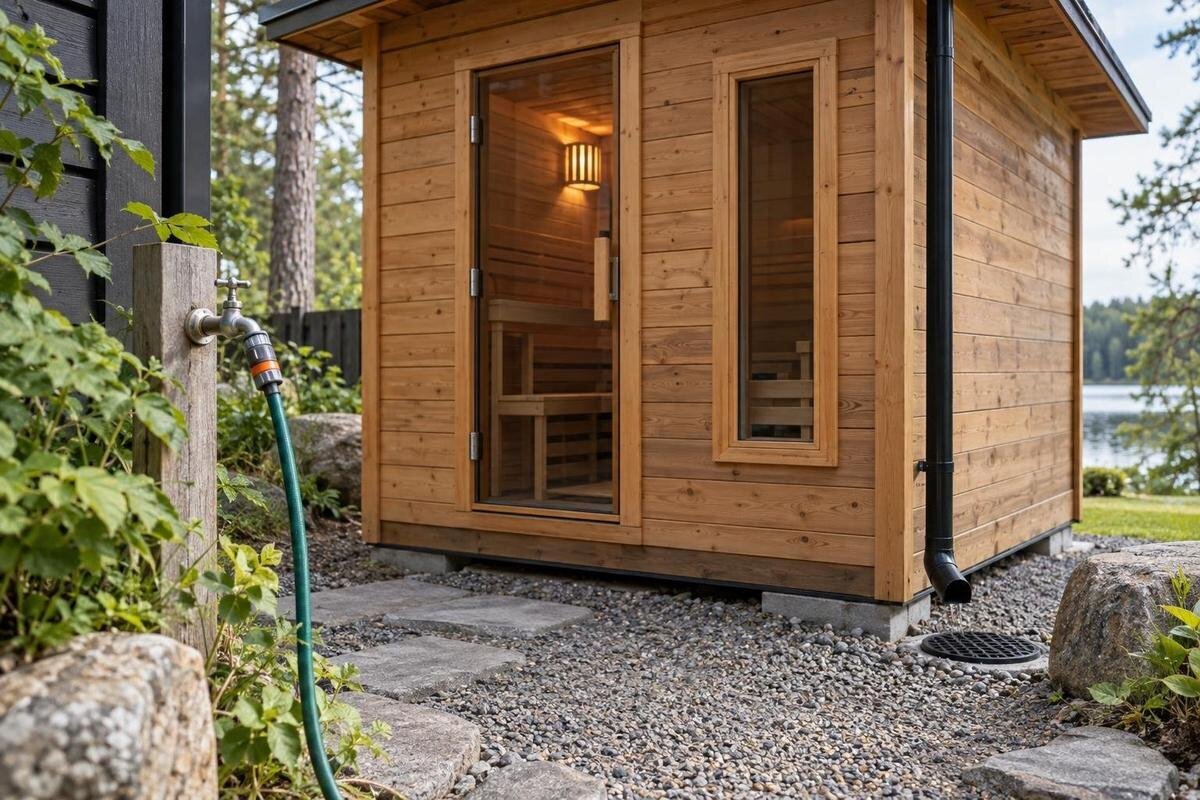
Outdoor sauna planning
An outdoor sauna does not automatically need a plumbed water supply or a drain. The answer changes if you add a shower, basin, toilet or another facility that brings water in and sends wastewater away. It also depends on the selected cabin and heater instructions, cleaning method and services available at the site. Keep three questions separate: what the sauna cabin itself requires, whether you want washing facilities, and how any used water will be managed. This guide sets out the checks to make before choosing a model or preparing the garden, including when a qualified plumber or installer should confirm the plan.
Before you buy 1
Does the sauna cabin itself need plumbing?
Treat an outdoor sauna as a cabin plus any optional services, rather than assuming every design has the same connections. A cabin used only as a sauna may not need a fixed water inlet or drain, but the instructions for the exact model take precedence. A product name, photograph or stated area cannot tell you whether a tap, drain or pipe connection is included or required. For example, the Sauna S-140 product listing identifies a cabin with a listed area of 1.93 m²; that area alone does not answer the plumbing question. Request the current specification and installation documents instead of inferring connections from the product category.
Separate requirements from conveniences. If the instructions call for no incoming water and the cabin has no fitting that discharges wastewater, plumbing may not be needed for the cabin itself. That does not settle the rest of the garden plan: the heater has its own instructions, and a future shower or basin brings separate service needs. Water services are also distinct from an electrical supply, flue arrangement or other heater requirements; one does not prove the need for another. Before ordering, ask whether the exact configuration has any water-related provision or requirement, and what its installation drawing shows. If the documents are unclear, ask the supplier or installer to confirm.
Water for use on sauna heater stones
Some sauna heaters are designed for water to be poured on the stones; others may limit or prohibit particular uses. Check the instructions for the selected heater rather than assuming every heater, stone arrangement or cabin is suitable. Where water is permitted, it may be brought in by hand in an appropriate container. That occasional use is different from a plumbed supply and does not automatically call for a floor drain. The HC-150 sauna model is a useful example of why the exact equipment matters: a model name or stated area does not identify the heater’s water-use instructions. Verify the heater supplied or selected for the configuration you intend to buy.
Use only the amount and method permitted by the manufacturer, and do not improvise a direct feed or add products to the water. Water that reaches a floor, bench or nearby equipment is different from water used as directed on the stones, so keep use within the heater and cabin instructions. If you are comparing heaters, match each one to the precise sauna configuration rather than relying on general advice about saunas. A supplier or qualified installer can clarify whether the intended use affects the proposed floor or positioning. That check is more useful than adding a tap or drain simply because you expect to use a ladle.
Before you buy 2
A shower beside the sauna is a separate facility
A shower next to a sauna is a separate facility, even if both are in the same garden or share a changing area. A connected shower needs a water source and a suitable destination for its wastewater. Decide whether you want a cold-only rinse or hot water, whether the shower will be enclosed, and whether it will be fixed or portable. The sauna cabin itself may be unchanged, but the site service plan is not. When considering the Sauna HC-225, ask for an itemised list of inclusions so you can distinguish the cabin order from any separately purchased washing facilities. Include those separate items in your budget and installation plan.
Map the route between the shower and cabin as well as the plumbing. Consider where people will change, how they will move between the two, whether water could be tracked into the sauna, and whether privacy and access suit the garden. Have a suitable professional assess the shower’s equipment and connections; do not treat the sauna room as a shower enclosure unless the manufacturer explicitly documents that use. Settle the arrangement before the base and service routes are fixed. If the shower is outside the cabin, its support, enclosure, controls and weather exposure need to be considered separately from the sauna’s construction.
Choosing a water source for washing
For sauna-only use, you might not need running water at the cabin. If the heater instructions permit it, water can be carried from the house or another suitable source when needed; consider whether that is practical and where clean water will be stored. For regular rinsing or hand-washing, compare a permanent connection with an existing outdoor supply or another professionally designed arrangement. The route and connection must suit the actual appliance; do not assume an outdoor tap or garden hose is an appropriate permanent shower supply. If the N-210 sauna is on your shortlist, sketch its proposed position alongside the water source and washing area. This gives your plumber a clearer brief than the cabin choice alone.
Ask about cold and hot water separately. A cold rinse may need a different arrangement from a shower where you expect warm water, and any water-heating equipment brings its own compatibility, location and maintenance questions. Do not size pipes, choose a pump or set pressure by guesswork. Give a plumber the shower or tap specifications, expected use and distance to the source, then ask what connection is suitable and how it can be serviced. If you are considering stored or collected water instead of a mains supply, confirm its suitability for the intended appliance and washing with the relevant supplier or professional. Do not assume every source is appropriate simply because water is available.
Before you buy 3
Where will shower and wash water go?
A shower, basin or other water-using fitting creates a wastewater question that the cabin alone may not create. Before choosing the fixture, identify where its used water is intended to go and whether that route is suitable for the site. Do not treat rainwater runoff, surface drainage and wastewater as interchangeable, or assume water can simply be directed onto soil beside the sauna. Site conditions, existing services and local requirements can affect the available options. If you are planning a washing area beside the Sauna N-250, show its proposed position and any known drainage connections to a qualified plumber or drainage professional. Have the proposed outlet and destination assessed before work starts.
The arrangement also needs to be maintainable. Discuss access to traps, pipes and any equipment that may need inspection or cleaning, and avoid placing a discharge where overflow or surface water could collect around the cabin or affect a path. A professional can consider the route, site levels and capacity without relying on a guess or a sketch. Do not calculate pipe gradients or choose a disposal method from generic advice; requirements depend on the complete installation and location. If no suitable discharge route is available, reconsider a fixed shower or choose a different washing arrangement before purchasing. Adding drainage later can be difficult once the ground and base are prepared.
Planning outdoor pipes for seasonal use
Outdoor pipework needs to be planned for the actual exposure and season of use. A line that works in warm weather may need a different arrangement where it is vulnerable to freezing, and the shower controls, hot-water equipment and exposed connections also need suitable protection. Ask a plumber to account for the route, access and conditions at the site, using the instructions for each component. While reviewing the LC-260 sauna listing, decide whether your proposed washing facilities would be used throughout the year or only in warmer months. Give that information to the installer early: seasonal use affects how the services will be managed, even if the cabin remains in place.
If you intend to use the shower only for part of the year, decide before installation how the system will be made ready for the off-season. Have the installer explain the designed shut-off and any emptying or restart procedure; follow that specific guidance rather than improvising with exposed pipes. Keep valves and service points reachable, and consider whether they can be inspected without dismantling landscaping or moving the cabin. A permanently connected supply should not be left as an afterthought simply because the sauna is used only occasionally. Seasonal planning should also account for whether hot water is supplied independently and how that equipment is maintained.
Before you buy 4
Cleaning the cabin without treating it as a wet room
Cleaning does not automatically mean the sauna needs a tap or drain. Check the cabin maker’s care instructions for permitted products and methods, including whether a damp cloth is acceptable, how to deal with spills and how the room should dry. Do not assume a sauna cabin is a tiled wet room that can be hosed down or pressure-washed; that method may not suit its materials or construction. If you are considering the HCF-300 sauna, request its care instructions as part of your buying enquiries. Use them to plan where cleaning supplies will be kept and whether you need convenient access to water nearby, rather than assuming a connection must be installed inside.
Plan to manage small spills and any water used for approved cleaning rather than relying on a floor drain that may not exist. If the instructions permit damp cleaning, use the specified method and make sure the cabin can dry as directed; do not pour water on the floor to test where it goes. Outside, consider where water used to clean the exterior will run and avoid creating persistent pooling at the base. Follow any maker guidance on cleaning products or maintenance. If a proposed cleaning task involves a large quantity of water, confirm that the method is permitted and establish how the water will be managed before starting.
Coordinate water planning with the heater and other services
Water services should be coordinated with the heater and other services, but should not be confused with them. An electric heater has an electrical installation requirement; that fact alone does not establish a need for a water inlet or drain. Other heater types can raise different installation questions, so do not infer their requirements from photographs or assumptions about sauna design. For a proposed Sauna HCF-225 configuration, establish which heater is included or will be selected, then obtain its instructions alongside the cabin documents. Have an appropriately qualified installer coordinate any nearby shower or other wet-area proposal with the relevant trades, including access to equipment for inspection and maintenance.
Before work begins, mark the planned cabin, shower, water source, wastewater destination and maintenance access on one site plan. Share it with the cabin supplier and any plumber, electrician or sauna installer involved so their requirements are not planned in isolation. Ask who is responsible for checking compatibility between the cabin, heater and shower, who will make the service connections, and what needs to be ready before delivery or assembly. Confirm any relevant local requirements with the appropriate professional or authority rather than assuming an arrangement accepted elsewhere will suit your garden. A competent professional should assess the complete layout where a shower is close to electrical equipment.
Before you buy 5
Documents and questions to settle before ordering
Request documents for the exact cabin model and version, not just a photograph or a general catalogue description. Look for the installation drawing, list of inclusions, heater details and care instructions. Ask directly whether the cabin requires a plumbed inlet, has a specified drainage connection, or is intended to operate without either. If the answer depends on an option or configuration, ask what that condition is. Confirm whether selected equipment changes connection points or affects where services can be routed. A product listing can help identify the item, but the current drawing and instructions should be the basis for service planning. Keep the relevant information with the order so the installer is working from the same specification.
For each optional shower, basin or tap, ask for its own requirements and the information a plumber needs: supply type, hot-water arrangement, expected flow or pressure, waste outlet and access for servicing. You do not need to specify technical values yourself; obtain them from the product maker and have a professional check compatibility with existing connections. Ask what site information the trades need before groundworks and who is responsible for each connection. If you might add a shower later, have a professional assess whether reserving a route or access is practical. Avoid installing unused pipework without knowing where it would end and how it would be maintained.
How the service needs change with the layout
For a cabin on its own, begin with the cabin and heater instructions. If they require no water connection, no wet facility is planned and any approved water is carried in as needed, a fixed inlet and drain may be unnecessary. If you use a bathroom in the house after a sauna, the outdoor cabin may still have no washing facilities. A separate garden shower is different: decide on its water source, whether it needs hot water and how its wastewater will be managed before fixing its location. These are planning distinctions, not guarantees for any one model. A product name or footprint cannot replace an exact drawing and a professional review of the garden.
A basin or toilet adds its own connections and should be treated as a separate facility, not assumed to share a shower arrangement. If you are undecided, compare the cost and complexity of the washing facilities you want with the benefit of a simpler sauna-only plan. It can be sensible to reserve access or a route for possible future services, but only after a professional checks whether that is feasible and records what would be needed; an unused drain or pipe is not automatically useful. Resolve essential services before committing to groundworks, a base or cabin assembly. The right answer matches the selected design, intended use and confirmed site arrangements, rather than a universal yes or no.
Frequently asked questions
Can I use an outdoor sauna without mains water?
Often, yes: a cabin used on its own does not automatically need a plumbed supply. Check the installation instructions for the exact cabin and heater. If the heater permits water on its stones, carrying water in may be an option; that does not in itself require a fixed inlet.
Does water poured on sauna stones need to drain away?
Water used as directed on heater stones is different from water discharged by a shower, so it does not by itself establish a need for a drain. Follow the heater manufacturer’s instructions, and do not assume the cabin floor is designed to take spills or act as a wet-room floor. Check the cabin’s guidance on dealing with water that reaches other surfaces.
Does a shower beside a garden sauna need its own plumbing plan?
Yes. A connected shower needs a suitable water source and a planned destination for its wastewater. Decide whether it needs hot water, where it will sit and how it will be serviced. Treat it as a separate facility unless the exact sauna configuration explicitly includes it.
Can shower water simply run onto the lawn?
Do not assume that is suitable. The right arrangement depends on the site, existing services and local requirements. Ask a qualified plumber or drainage professional to assess where the wastewater can go, and do not treat surface water and shower wastewater as interchangeable.
Can I clean a sauna cabin with a hose?
Do not assume the cabin can be hosed down or pressure-washed. Follow the care instructions for the exact model, including permitted cleaning methods and how the cabin should dry. If a cleaning task would use a large amount of water, confirm the correct method before trying it.
For a sauna cabin without a connected wet facility, a fixed water supply and drain are not automatic requirements. The decisive evidence is the exact cabin and heater documentation, combined with how you intend to wash and clean. Once you add a shower, basin or toilet, plan both the incoming water and its wastewater destination before preparing the site. This separation keeps the decision grounded in the chosen design and the services your garden can support.
