
Private or Shared Saunas for Glamping Accommodation
GLAMPING SAUNA GUIDE
Adding a sauna to glamping accommodation is an operating decision as much as a layout choice. A private sauna is allocated to one accommodation unit; a shared facility serves guests from more than one unit, either in exclusive booked sessions or under another clearly defined access arrangement. The distinction affects privacy, booking administration, staff travel, cleaning, downtime and what guests should be told before arrival. It does not establish whether a particular model is suitable for commercial guest use. Compare how each option would work during a busy changeover, a quiet midweek stay and a maintenance interruption, then seek written confirmation for the exact product and configuration.
01
Private and shared saunas are different operating models
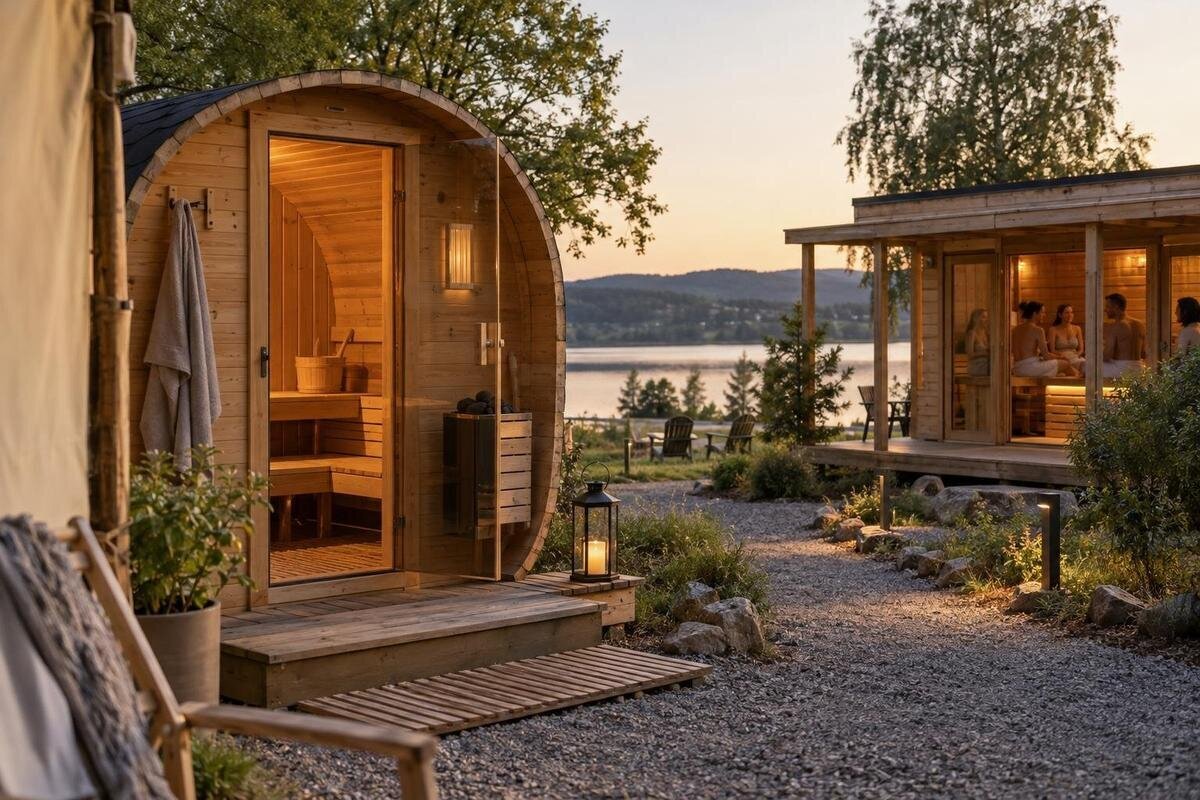
A private sauna is allocated to one accommodation unit and reserved for the party staying there, under the access terms you promise. Guests do not have to coordinate their session with people staying elsewhere, although the sauna may still be a separate walk from the unit. A shared sauna serves guests from more than one accommodation unit. It can offer exclusive sessions for each party without becoming a private, per-unit facility. The important distinction is who may use it and when, not whether it is a barrel sauna, cabin sauna or a particular shape. Decide whether your offer promises access throughout a stay, an exclusive bookable session or use alongside other guests during set hours; each creates a different expectation and workload.
Separate the choice of access arrangement from the choice of product. You can include the Sauna N-250 in an initial shortlist, but first write down what each proposed arrangement must provide: access for one unit throughout a stay, or a facility serving several units through managed bookings. Define that boundary on the site plan and in your booking terms: which party may enter, how they receive access, what happens if another guest arrives, and whom they contact if the agreed arrangement fails. Make the same promise on the accommodation listing, confirmation message and on-site instructions. In particular, do not describe an exclusive session in a shared facility as though guests have their own sauna for the whole stay.
Privacy depends on both access rules and siting
Privacy has two parts: the booking rule and the experience of reaching and using the facility. A sauna can be exclusive to one unit yet sit beside a shared path; a central shared facility may be screened but still involve a walk past other pitches. Look at entrances, sightlines, lighting after dark, noise and the route between accommodation and sauna. Consider how close the facility is to sleeping areas and whether guests may cross someone else’s outdoor space. A plan that looks private from above can feel exposed in use, so walk the proposed route at different times and from both ends before settling on its position.
Consider where guests will change, leave clothing and put personal belongings, rather than treating the sauna door as the whole privacy question. Establish whether those spaces are included in the proposed configuration, provided separately or available only back at the accommodation. When comparing the Sauna LC-260 listing with other options, request drawings and an inclusions list to understand the layout; do not infer changing facilities from the product photograph. For a shared facility, consider whether arriving guests would meet the previous party while collecting belongings or preparing to enter. Describe any separate changing provision, the walking route and the nature of exclusive access before guests book, so they can judge whether the arrangement meets their expectations.
02
Assess demand from overlapping bookings
Estimate demand from the booking pattern you actually expect, rather than multiplying the number of beds by a guessed take-up rate. Mark arrival and departure days, overlapping stays, weekends and seasonal peaks; note enquiries or preferences that mention sauna access, while recognising that interest is not a confirmed booking. A shared facility has to serve the moments when several parties want it, not just an average day. Private provision removes a queue between separate parties only if it is genuinely allocated to each unit; it does not prove that every unit will use it or that a particular number of saunas is warranted. Use your own calendar and records to test the pattern, then revisit the assumptions as operating data accumulates.
Keep physical size separate from guest capacity. The product listing for Sauna HCF-300 shows 6.89 m², but a listed area is not a stated user limit, approved throughput or measure of how many booking slots the site can offer. Ask the manufacturer for the permitted capacity and use conditions for the exact configuration, then compare that information with overlapping stays, staff coverage and the time required for any changeover. If the relevant information is not available, do not build a timetable or advertise a group size around an assumption. This matters particularly for a shared option, where a capacity error can affect more than one party.
Build booking rules around a shared facility
With a shared sauna, access rules need to be simple enough for a guest to follow and an operator to administer. Decide how a reservation is made, when the calendar opens, who can change a booking, and how late arrivals, cancellations or no-shows are handled. Avoid selling a slot that leaves no time for the operator’s required check or clean between parties. Set the interval using manufacturer guidance for the sauna’s use and your actual reset routine, rather than copying a timetable from another venue. Also decide whether a booking covers the whole party or whether separate guests can share a session; explain the arrangement before a guest commits to a stay.
Set out how guests reach the facility and gain entry, including what to do if a code, key or booking record does not work. A digital calendar can reduce staff handling, but only if someone is responsible for keeping it accurate and helping guests who cannot use it. If you are considering the Sauna HCF-225, request its operating documentation before deciding how staff will prepare it for a booked session and hand it over afterwards. Keep preparation, guest access and the subsequent staff check distinct in the schedule. Staff must be able to block the calendar during cleaning, servicing or an unexpected closure, without those periods appearing as available slots to guests.
03
Make cleaning part of each changeover
Cleaning is different under the two arrangements, but neither should leave responsibility vague. With a private sauna, decide whether staff inspect it after every departure, whether guests are asked to leave it tidy, and who checks it during a longer stay. With shared sessions, plan an inspection and reset between parties as well as the broader routine between operating days or bookings. The time required depends on the actual setup and the manufacturer’s care instructions, so observe the process rather than making a timetable based on a generic sauna. Include access to the facility, supplies and staff availability in the changeover plan; a clean sauna is not useful if the next party cannot reach it at the promised time.
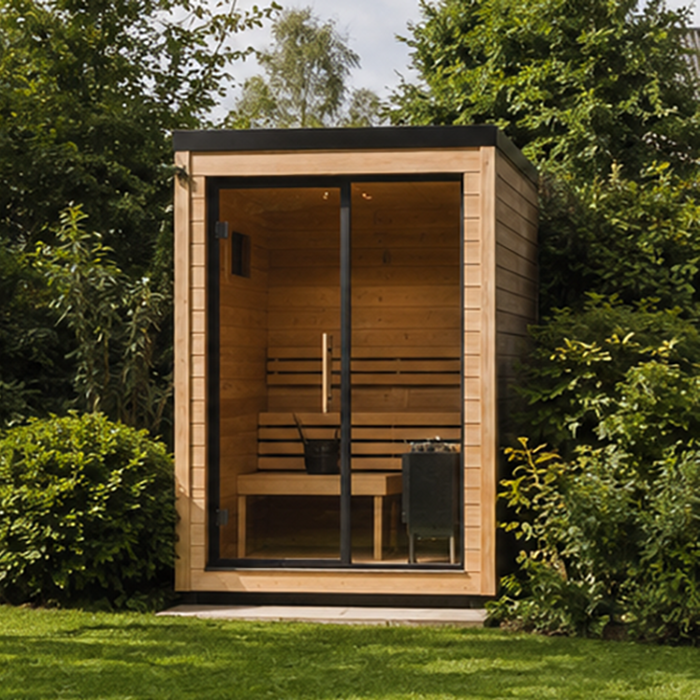
Write down which tasks are routine cleaning and which require maintenance or a qualified technician. Identify approved cleaning products and surfaces, and follow the instructions for the exact model and configuration instead of applying a generic checklist that might be unsuitable. When reviewing a product such as the Sauna S-140, obtain the relevant operating and care documentation and confirm who will carry out each task; the product name alone cannot tell staff how to clean it. Use a simple record to note inspections, reported problems and action taken, so repeated faults are not mistaken for ordinary cleaning. Do not make guest self-cleaning the only check on readiness.
Plan servicing for one location or several
Servicing is often easier to coordinate when equipment is in one known location, but that does not automatically make a shared facility simpler to run. A central sauna concentrates access for staff and visiting technicians, while a closure may affect every booking relying on it. Private units spread the work across the site: staff may need to reach several locations, manage separate access arrangements and keep track of different reports. A fault at one unit need not automatically close access to the others. Compare actual distances, access restrictions and the way bookings are linked to each facility, rather than assuming either layout is cheaper or more reliable.
Before committing to a model, ask who will provide service, what information they need before attending, how parts and technical support are obtained, and what access they require. For a shortlisted model such as the Sauna HC-150, request the support terms that would apply to your intended accommodation use and establish who handles queries about each supplied component. Keep model details, manuals and service records together for each location, especially if several saunas are installed at different times. Assign one person to coordinate routine inspections and reported faults, while giving booking staff a clear procedure for taking an affected sauna out of use. Pass technical issues to a qualified service professional; guests should not be expected to diagnose or repair faults.
04
Confirm commercial suitability for the exact model
Commercial suitability needs a direct answer for the exact product and planned configuration. Ask the manufacturer to confirm in writing whether it is intended for glamping or other paying guest use, and whether the expected frequency, turnover, user group and operating arrangements fall within the stated limits. Ask how the confirmation relates to the heater, controls and any included or separately chosen components; a change to the configuration may alter the answer. Obtain current drawings, operating and maintenance instructions, and warranty terms for the proposed use before comparing shortlisted models. If any answer is conditional, record the condition in the site plan and operating procedure rather than leaving it as an informal conversation.
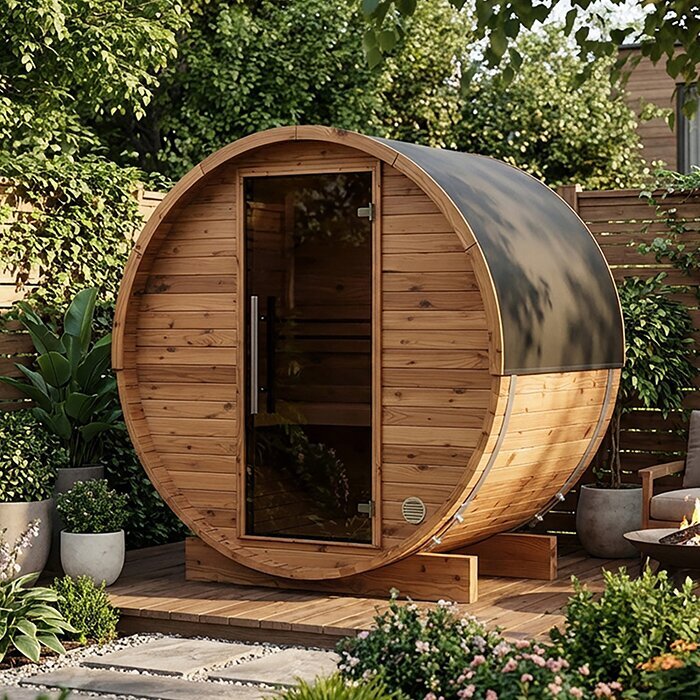
Do not infer approval from the fact that a sauna appears in a retail catalogue, from its construction style or from an area figure. The Sauna HC-225 product page identifies a Thermowood barrel sauna and shows 4.4 m²; those details do not establish a commercial duty cycle, approved user count, installation requirements or warranty cover for guest use. Ask a suitably qualified installer to review the intended location and connections, and check the planned activity with the relevant insurer or other professional where appropriate. This is a verification step for each specific product, not a judgement that all domestic or all outdoor saunas are alike.
Check site routes, space and service access
Site planning looks different when each accommodation unit has its own sauna. Allow for the actual footprint and required space around every installation, a route staff can use for cleaning and servicing, and enough separation that doors, guest paths and neighbouring outdoor areas do not conflict. Check whether supplies and equipment can be carried to each location without passing through occupied accommodation. A shared building may be easier to find and service from one location, but the route still needs to work in wet, dark or busy conditions. Consider gradients, surface condition, gates and any steps, and describe relevant access limitations accurately to guests. Assess the real plot rather than relying on a building symbol on a site plan.
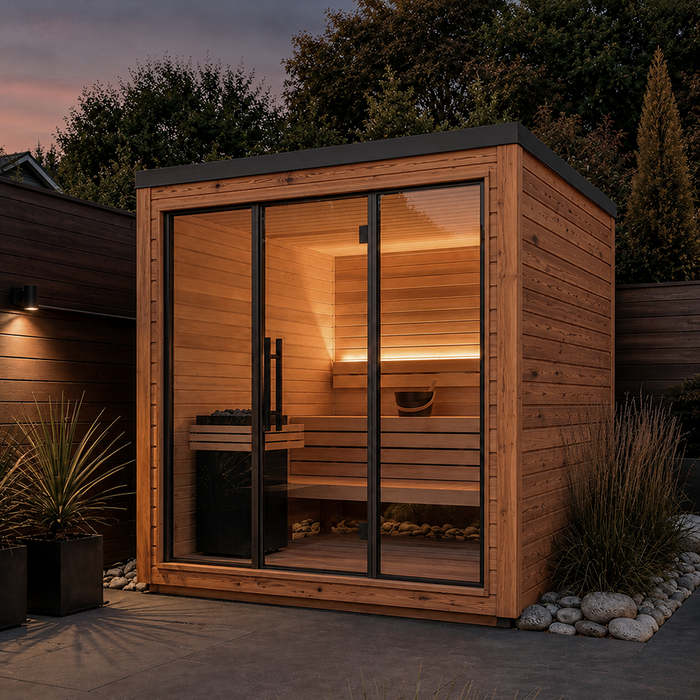
Use current manufacturer drawings and a site-specific review to check dimensions, clearances, delivery access, base or support requirements and utility routes; have relevant technical questions assessed by qualified professionals. One catalogue figure is not an overall siting envelope. For example, the Sauna N-210 listing shows 4.43 m², but that alone does not establish the required clearances or full space needed around the model. Check guest routes as carefully as the building position: wayfinding, lighting, privacy and staff access all affect how the arrangement works in practice. Keep the final position consistent with installation conditions confirmed for the exact product.
05
Compare full costs and plan for downtime
Compare whole-life cost categories rather than counting sauna units alone. For private provision, request an itemised price for each unit and its installation, site preparation, any required utility work and the staff time to reach and check separate locations. For shared provision, include the facility, booking administration, cleaning between parties, guest access arrangements and the staff time needed to manage a central amenity. Both arrangements also need a budget for energy based on actual use, routine maintenance, repairs and insurance terms. Use written quotes for the same scope and the supplier’s actual assumptions; do not treat an unverified consumption figure or a forecast of extra bookings as a saving.
Model what happens when a sauna is unavailable as well as when it is operating. A shared-facility outage may disrupt several parties who expected access; a private-unit fault is tied to the stay at that unit, unless your layout offers another confirmed option. Neither setup has an automatic backup. Decide who can suspend bookings, communicate the change, manage any remedy under your own guest terms and coordinate a repair. Include supplier support and realistic service access in that plan. Reliability is an operational question: how quickly can you identify, communicate and resolve a problem, not simply how many saunas appear on the site.
Test booking clashes, delays and closures
Use a short decision table with separate rows for privacy, timing, cleaning, servicing, site layout, commercial approval and cost. Rate each arrangement against the way your site will actually operate, and write the reason beside every rating. Private provision is more convincing where exclusive access is central to the guest offer and staff can reach each location without creating an unmanageable routine. Shared provision is more convincing where a central facility can be kept accessible, reservations can be administered reliably, and the timetable leaves room for cleaning and maintenance. These are conditions to test, not general claims that either model always saves money or attracts more guests.
Then walk through awkward cases with the people who will run the site: two parties request the same period, a guest arrives after a reserved time, cleaning overruns, a technician needs access, or the sauna is unexpectedly unavailable. For each case, record the guest message, who makes the decision, and whether the promised amenity remains available. If no one can answer without improvising, revise the booking or staffing plan before choosing the layout. A workable private-or-shared choice is the one whose access promise, care routine and commercial approval you can sustain through both normal stays and interruptions.
Frequently asked questions
Is a private sauna always better for a small glamping site?
No. Private access can make the offer more exclusive and avoid booking clashes, but each location adds to the work of cleaning, checking and servicing. A shared facility may suit the site better if access can be managed reliably and guests understand how to book. Compare both arrangements against your layout and actual operating capacity.
How many guests can use a shared sauna at once?
Do not estimate this from the floor area, a photograph or the number of beds on site. Ask the manufacturer to confirm the permitted capacity and operating conditions for the exact model and configuration. Use that information when setting bookings, and allow for any cleaning or checks needed between parties.
Can a domestic sauna be used for paying guests?
Do not assume that it can. Ask the manufacturer to confirm in writing that the exact model and configuration are suitable for your planned accommodation use, including the expected frequency and guest turnover. Check the relevant warranty and installation conditions as well; a retail listing alone does not establish commercial suitability.
Who should clean a shared sauna between bookings?
The operator should assign someone to inspect and prepare it between parties, following the manufacturer’s care instructions. Guests can be asked to leave the space tidy, but that should not replace a staff check. Build the work and the time it takes into the booking schedule.
Can guests from other units use a sauna described as private?
If guests from other units can book it, it is a shared facility, even when each session is exclusive to one party. A private, per-unit sauna is reserved for the guests staying in that unit. State which arrangement you offer, prevent conflicting bookings and ensure that the approved use, cleaning routine and servicing plan cover access by the intended guests.
Choose the arrangement that makes its promise easiest to keep: exclusive access and a reliable routine at each unit, or fair, transparent bookings and dependable changeovers at a shared facility. Site layout and guest expectations determine where the balance falls, but neither replaces model-specific confirmation of commercial use. Before committing, make sure the access rules, care plan, servicing arrangements and written product approval describe the same operation.
