
Ready-Made Sauna or Self-Build? A Practical Comparison
Sauna buying guide
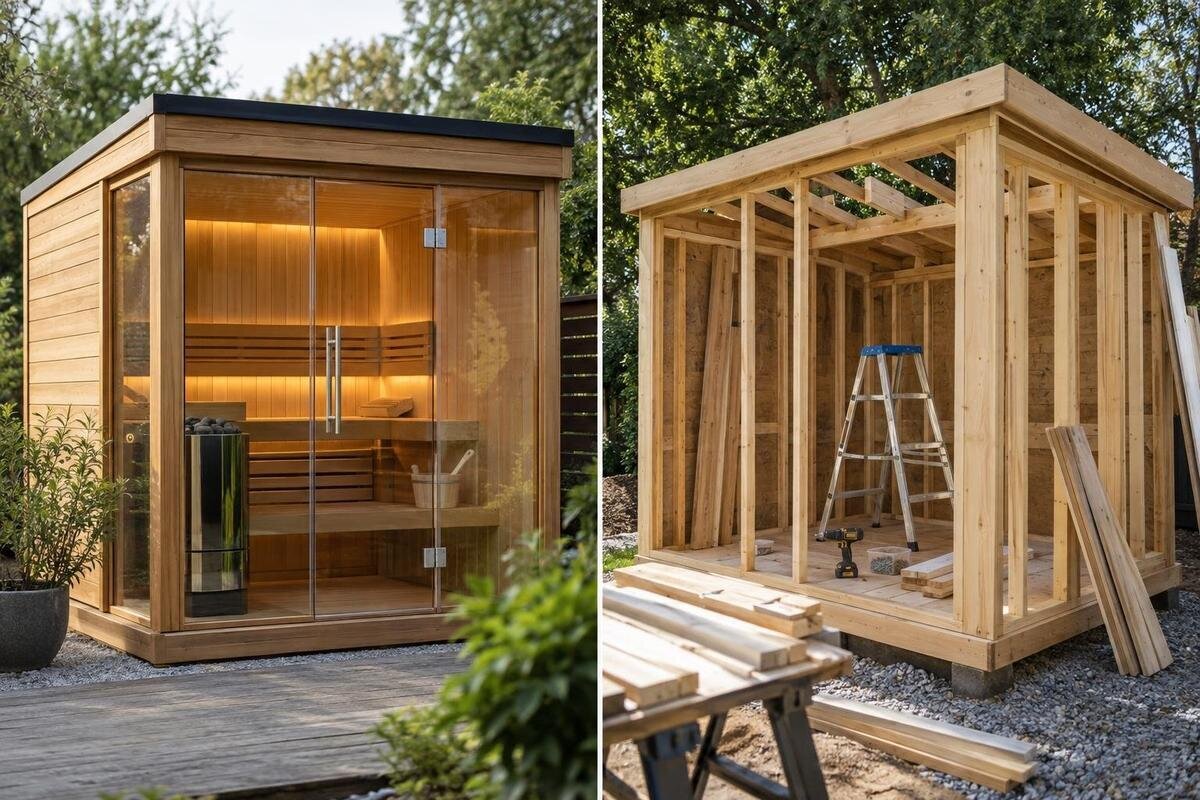
The choice between a ready-made sauna and a self-build is chiefly about who defines the design, sources compatible components and coordinates construction. A ready-made product gives you an established design to assess, but does not necessarily arrive assembled or include every item and service. Building from scratch offers more control while making you responsible for a wider set of decisions. A supplied kit is different: it may leave assembly to you while its design and package are already defined. Compare work and responsibility, not labels alone.
What ready-made, kit and self-build mean
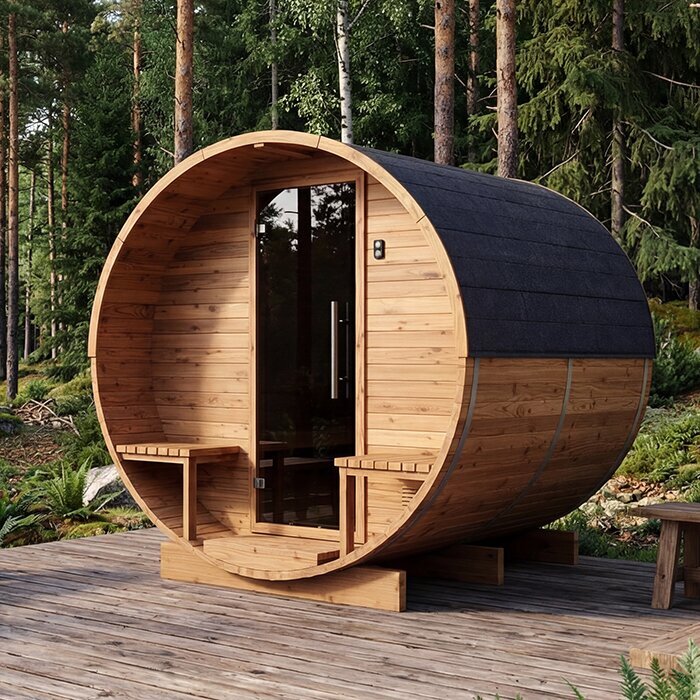
‘Ready-made’ describes a buying route, not a guaranteed delivery state. You select a sauna whose design has already been defined as a product; you still need to establish whether it arrives assembled, in sections or as a package, and what work remains on site. A self-build from scratch gives you responsibility for developing the design, identifying materials and components, and coordinating construction. You may appoint tradespeople, but that does not automatically transfer design or sourcing decisions: the agreement must say who provides drawings, chooses parts and manages their interfaces. Before comparing offers, note the exact model and configuration you are considering; a changed option can affect the drawings, inclusions and work required.
Assembling a supplied kit is different from building independently from scratch. Its design and some or all of its parts are defined in advance, while the buyer may still do the assembly; the scope varies by package. Kit work can be physically demanding without requiring you to design and source the whole sauna yourself. A kit can therefore be one delivery format for an established sauna product, rather than a completely separate design route. Treat design, contents, delivery format, assembly and installation as separate questions. Ask for the package list and a written division of work rather than relying on labels such as complete, kit or ready-made.
Design responsibility and room to customise
An established model starts with decisions made by its designer: proportions, internal layout, access, ventilation approach and the options available. That can reduce the number of choices you need to originate, but it also limits adaptation to the choices actually offered. Check documented external and internal dimensions and the layout against your site and intended use; the question is not just whether the outline seems to fit. A product drawing is a more reliable basis than a photograph. If a standard arrangement conflicts with access, privacy or another site constraint, do not assume a small alteration leaves the design unchanged.
For a self-build, write a brief before drawing: who will use the sauna, how many people at once, what space is available, where the entrance can face and what needs to remain accessible. Turn those answers into a dimensioned layout and have specialist aspects reviewed before ordering materials. This takes time but gives you more control over a particular footprint or arrangement. If you are considering the HCF-225 sauna, request the drawing for your chosen configuration and compare it with that same brief. Note which requirements the standard design meets and which would require an alteration; ask whether those alterations are offered before treating them as part of the purchase.
Sourcing materials and compatible components
Self-build sourcing means more than choosing timber by appearance. Create a schedule from the design, covering structural materials, interior finish, benches, door, ventilation components, fixings and the chosen heating system, as applicable. The exact list depends on the design, so a generic shopping list can omit interfaces or include parts that do not work together. Record product references, dimensions, quantities, sources and any substitutions. Use manufacturers’ technical information to check intended applications and compatibility, and get a competent designer or installer to review questions outside your experience. A component that looks similar is not automatically interchangeable.
Buying a defined sauna can narrow this research, but the word complete should never replace an inclusions list. Establish what is supplied, what is optional, what must be bought separately and what the site or installer must provide. When reviewing the S-140 product listing, use it to identify the option you want priced, then obtain an itemised quotation for that configuration. Check whether proposed equipment and components are specified to work together, rather than assuming separately purchased items will match. Keep the confirmed contents alongside quotations for anything supplied separately, including quantities and product references, so omissions become visible before you place orders.
Planning time, ordering and construction
Time on a self-build begins well before construction. You need to settle the brief, produce or commission a design, check compatibility, obtain quotations, coordinate suppliers and resolve questions raised by the drawings. An undecided dimension or component can hold up later choices, while a replacement product may mean reviewing the design. Make a task sequence that includes site preparation, any relevant approvals or professional reviews, ordering and work by each contractor. Ask suppliers for current lead times rather than assuming availability will remain unchanged. There is no dependable single build-time estimate for every independent project.
A ready-made product can avoid originating the whole design and sourcing every component, but that does not establish a short delivery date or quick installation. You still need to arrange access, prepare the location and allow for delivery, assembly and specialist work. If the HC-150 model is on your shortlist, ask the supplier which tasks must be completed before delivery and which documents your contractors need to plan their work. With any kit, estimate the assembly workload from its actual instructions and consider the people, tools and uninterrupted time available. Allow time to check delivered parts before arranging dependent work, and ask suppliers and contractors exactly which tasks their estimates cover.
Skills, contractors and specialist work
An independent build calls for practical experience in reading drawings, setting out accurately, following a sequence and spotting a mismatch before it becomes harder to address. You may also need tools, help handling materials and suitable storage space. Be realistic about what you can complete to a consistent standard and what needs a carpenter, designer or other competent tradesperson. If construction is new to you, arrange for someone knowledgeable to review the design before you commit to materials. Hiring a contractor does not remove the need to agree their scope: one may build to supplied drawings, while another may be expected to design, source and coordinate.
With a ready-made design, assembly can still involve substantial work, and site-specific installation remains to be planned. For a quotation covering the HC-225 sauna, ask whether assembly instructions are supplied, whether assembly is included, what preparation is excluded and who connects or commissions equipment. Give each contractor the same configuration details so their scopes do not overlap or leave gaps. Electrical supplies, heaters, flues and other specialist systems should be assessed and installed in line with manufacturer instructions and relevant local requirements by appropriately qualified professionals. Identify those specialists before setting a completion date: purchasing the structure does not establish that the remaining installation work has been assessed.
Site fit, delivery access and preparation
Both routes need a site check before you commit. Measure the proposed position and the route from the delivery point, including gates, turns, slopes, low branches or roof overhangs where relevant. Compare those measurements with a dimensioned drawing and the seller’s delivery information, not a photograph or nominal size. Allow room to use the entrance, maintain the sauna and move around it. Consider surface conditions, drainage and exposure to weather, but do not guess what base or support a design needs; ask the supplier or a suitably qualified professional to assess the site. Include space for temporary storage and handling if materials arrive before construction.
Self-building lets you respond to a difficult plot, but it does not make every adaptation straightforward. Changes to the base, wall positions, openings or equipment layout may affect other parts of the design, so have them reviewed by someone competent before construction. If you shortlist the N-210 sauna, obtain the exact drawing and delivery information before deciding how it will reach its position. Check both the permanent location and any space needed for unloading, storage or assembly. Ask who arranges handling equipment and what happens if the proposed access is unsuitable. These questions still apply when you intend to assemble the product yourself, rather than accept an assembled delivery.
Comparing the full project budget
Compare total project budgets, not a model’s headline price with the apparent cost of a pile of materials. A self-build estimate should include design and checking, every component, deliveries from multiple sources, waste, tools or hire, storage, paid labour and any corrective work that may be needed. Give your own hours a realistic value too: unpaid time still has an opportunity cost. Request quotations for specialist tasks using the same drawings and scope. Separate confirmed costs from allowances, and keep a contingency for unknowns without treating it as a substitute for missing information. Use current written figures rather than estimates from unrelated projects.
For a ready-made option, list every cost required to reach the same finished state: transport and unloading, site preparation, assembly, equipment, professional installation and separately supplied items. A quotation for the N-250 model can provide one side of the comparison, provided you record its configuration and exclusions. Confirm who pays if access or preparation differs from the assumptions used in the quote. A kit may reduce independent sourcing while leaving assembly and other project costs with you; it is not automatically the cheaper route. Compare the totals only after both estimates cover the same work, and flag provisional allowances separately from confirmed prices.
Who is responsible for the finished sauna?
Before purchase, ask what documentation supports the design and what remains your responsibility. For a ready-made model, seek the current technical drawing, assembly and maintenance instructions, list of included items, available configurations and terms covering support or guarantees; read the actual terms rather than assuming what they promise. Record any departure from the standard design and get it approved by the relevant supplier or designer. Keep document versions and contact details together, so you can refer to the right information if a component is missing or a contractor needs clarification. Ask who will inspect or sign off work where a professional service is part of the project.
In a self-build, responsibility is spread across design decisions, suppliers, trades and site work unless contracts make the boundaries clear. Keep one controlled set of drawings and record revisions, product references, invoices, installation records and professional advice. If a contractor has designed one part, do not assume their approval covers the whole sauna. Agree who investigates a problem involving several components and who authorises changes before work proceeds. When comparing this arrangement with purchasing the LC-260 sauna, ask how product queries, missing items and installation questions are handled, and obtain the relevant terms. A clear contact and scope for each task are more useful than a general promise of support.
Maintenance, repairs and later changes
Long-term maintenance depends on knowing the materials and components actually used, not simply whether the sauna was sold as a complete model. Before ordering, check what routine care the manufacturer specifies, which parts can be replaced and whether the instructions identify suitable replacements or finishes. Treat these as questions to ask, not assumed benefits of a branded product. A self-builder should retain the same information for every part, including its source and reference, and record approved changes. If a component later needs attention, a written record can help a professional identify what is present without guessing from appearance.
Think about future alterations as well as first use. Changing a bench, lining, opening, ventilation component or heater may affect other parts of the design, so seek the manufacturer’s or a suitably qualified professional’s advice before making a modification. An independent build can make later sourcing more difficult if parts are custom-made; preserve drawings, measurements, supplier details and installation notes. If you are considering the HCF-300 sauna, ask how to identify replacement components for the exact version ordered and what maintenance information is supplied. Keep that information with the order record, particularly if options or approved substitutions mean your sauna differs from the standard configuration.
Which route fits your priorities?
Choose the ready-made route when a documented design fits the site and your priorities, and you would rather select among defined options than originate every detail. It can reduce design and sourcing decisions, but it does not by itself promise assembly, a shorter schedule or fewer professional tasks. A self-build makes more sense when a particular layout or constraint justifies the extra control and you have the time and ability to coordinate design, procurement and construction. You can delegate parts of that work, but decide who remains responsible for keeping the components compatible and resolving disagreements.
Before committing, write down the finished scope you want, measure the site and delivery route, and compare a current supplier quotation with a self-build estimate covering the same items. For each route, list who designs, orders, prepares the site, assembles, handles specialist work and supplies documents; mark every unanswered point. Resolve uncertainties about critical components or installation before placing orders. A supplied kit may suit someone who wants a defined design but plans to assemble it; it should not be mistaken for a fully independent build. The useful comparison is the one that shows who does each job and what remains unknown.
Frequently asked questions
Does a ready-made sauna arrive assembled?
Not necessarily. Ready-made describes a product with an established design, not its delivery condition. Depending on the product and seller, it may arrive assembled, in sections or as a package. Confirm the delivery format, access requirements, assembly instructions and included work before ordering.
What does building a sauna from scratch involve?
It means defining or commissioning a design, sourcing materials and components, checking that they work together, and coordinating site preparation and construction. You can hire others to do some of this work, but agree whether they are responsible for construction alone or also for design, sourcing and coordination.
Is assembling a sauna kit the same as a self-build?
Not quite. A kit has a defined design and a package of parts, although its exact contents vary. You may do much of the physical work, but you are assembling a supplied solution rather than necessarily designing and sourcing the whole sauna independently.
Is a ready-made sauna always quicker to install?
No. A ready-made product can reduce design and sourcing work, but delivery, site preparation, assembly and specialist work still affect the schedule. Compare current lead times and task lists for the exact project instead of relying on a general estimate.
Can I design a sauna and hire someone else to build it?
Yes, provided the roles are clear. A contractor might build to drawings you provide, or take on design, sourcing and installation as well. Agree who checks component compatibility, coordinates specialist services and supplies the final documentation.
The strongest reason to choose a ready-made sauna is that an established design meets your needs without extensive alteration. The strongest reason to build from scratch is that a particular requirement justifies the extra design, sourcing and coordination work. Assembling a supplied kit can offer a defined design while leaving much of the physical work to you. Compare each option at the same finished stage, with site preparation and specialist work included. Your choice should leave you clear about both the sauna you will have and the work you are taking on.
