
Getting a Sauna into a Garden with Narrow Access
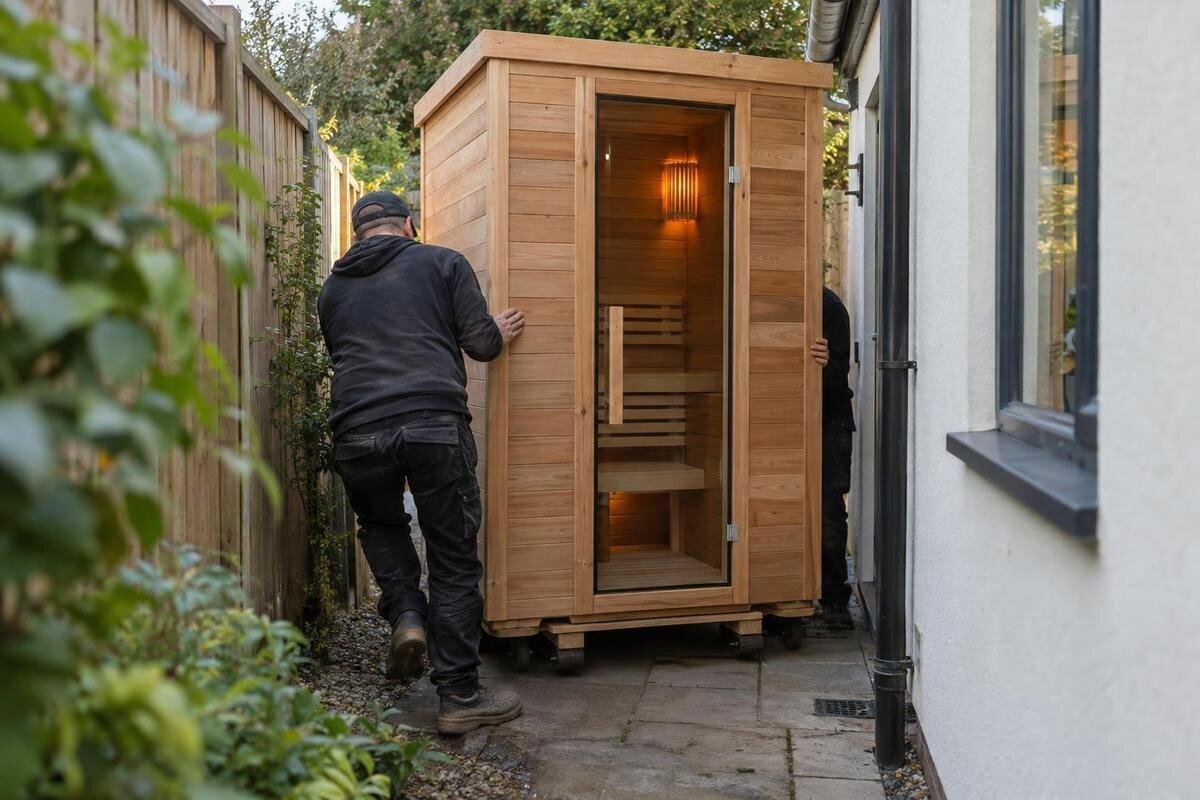
Garden sauna delivery
Getting a garden sauna through a narrow side passage depends on the delivery format and the whole route, not just the space available at the final site. The limiting measurement may belong to a crate, pallet or individual component rather than the assembled product. Before ordering, confirm the exact shipment dimensions and permitted handling orientation, then check each opening, turn, overhead obstruction and unloading point with the delivery provider.
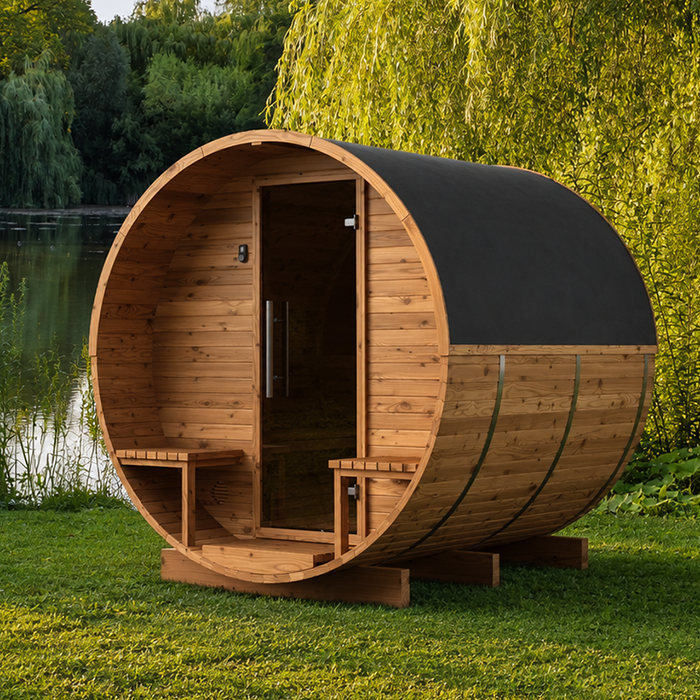
Delivery-route check 1
Find out how the sauna will arrive
Ask the seller or delivery coordinator how the exact sauna configuration will arrive: fully assembled, in large sections or as separate components. Do not infer this from a product photograph, a model name or an area figure. An assembled unit has one complete set of outer dimensions; a kit may involve several packages, with one long component or wide crate setting the limit. Request a packing list for every item, including its outside length, width and height and its packed weight. Ask whether items are palletised and whether measurements include the pallet, crate, wrapping and protective corners. The outer package, not the bare component, has to pass through the route.
Check which items arrive in the same consignment, whether parts are shipped separately and whether assembly will take place inside or outside the garden. If it is assembled on site, confirm the route for every delivered piece and the working space required at the assembly point under the manufacturer’s manual. If it arrives as a unit, request its complete dimensions in the orientation used during delivery. An assembled-product drawing and a packing schedule answer different questions, so obtain both where relevant and ask the seller to explain any mismatch. If consignments arrive separately, include each one in the access plan; passing the main unit is not enough.
Use shipment dimensions, not area figures
A listed area can help describe a product, but it cannot tell you the size of its delivery pieces. For example, the listing for Sauna N-250 records 5.27 m²; that figure does not give the outside width of a packed section, the length of a pallet or the height needed under an arch. Keep the listing and a delivery drawing together, but use shipment information for route decisions. Ask for documents tied to the exact model and configuration, not a measurement remembered from a similar-looking sauna or another version. Check that the drawing matches the option you are ordering.
Label the measurements for each handling unit separately rather than reducing the shipment to one ‘largest package’. The widest crate may govern the gate, while a longer, narrower item creates the difficulty at a corner. Keep package references alongside their dimensions and weights so the carrier can identify which item presents each constraint. Establish whether a pallet must travel intact or whether its packages can be moved separately after unloading; do not assume that unpacking is included or permitted at the roadside. Record any agreed separation of the shipment in the delivery plan, including where packaging will be removed and where the individual items will be set down.
Delivery-route check 2
Measure every clear opening
Measure every opening from the vehicle stopping point to the final position, not just the garden gate shown on a plan. At a gate, record the clear gap with the leaf in the position it will be during delivery, measuring between the actual obstructions rather than relying on the nominal frame size. Include hinges, latch, posts, walls, handles, meters, downpipes and anything else projecting into the opening. Check the width at different heights where posts, fencing or ground levels change; a gap can narrow near the ground or higher up. Measure long side passages at each pinch point, and note precisely where the narrowest usable width occurs.
Compare those measurements with the outside size of the package in its agreed orientation, then ask the delivery team what additional working clearance it needs. A load that nominally matches a gap may still be impossible to guide past a latch, wrapped corner or uneven approach. If Sauna LC-260 is the model you are considering, name that exact version when requesting its delivery dimensions; do not borrow a drawing for another LC model. Record whether gates or doors can open fully and whether a leaf blocks the next part of the route. Photographs with a tape measure visible are useful records, but they do not replace written measurements.
Check the space for each turn
An opening can be wide enough and still lead into a corner that is too tight. At each change of direction, note the widths of both passages, the distance from the opening to the opposite wall, the length of the approach and any space where a handler could pause. Long, rigid pieces need room to swing; comparing one side of a package with the gate width alone does not show whether it can be turned. Draw the approach as well as the corner, including gate swings, steps, retaining edges and an immediate turn into a side passage. Measure an offset entrance as a sequence of connected spaces, not as two unrelated openings.
Ask the supplier or carrier to assess whether the longest item can make each turn in the specified orientation and what manoeuvring space its handling method needs. Do not assume that a package may be stood on end, rolled onto an edge or rotated against a wall; packaging and manufacturer instructions determine permitted handling. For Sauna HCF-300, request the drawing and packing schedule for that exact model, then compare the relevant dimensions with each corner. A scaled sketch or lightweight floor template can reveal a possible clash, but it cannot confirm safe handling. Send measurements and photographs to the delivery provider for a feasibility check.
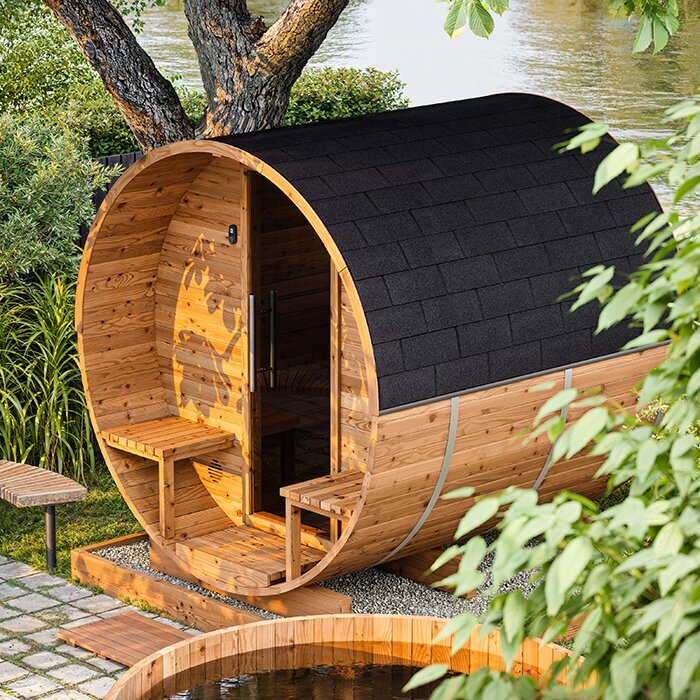
Delivery-route check 3
Include overhead clearance
Check clear height along the whole route, including arches, eaves, balconies, low branches, gutters, cables and crossbars. Record how far each restriction extends and whether the path slopes beneath it. Include the height of the package, pallet and agreed handling equipment in the approved travel orientation; the finished sauna’s height may not be the dimension that governs delivery. A slope, kerb or step can change the height at which an item passes an obstruction. Separate removable garden items from fixed structures in your survey, and do not assume a delivery team will trim branches or shift equipment without prior agreement.
Ask for the maximum packed height of each handling unit and whether an alternate orientation is permitted. The product name Sauna HCF-225 does not establish that measurement, so request documents for the exact version. Treat overhead services as a stop-and-check issue: do not touch, move or work near a line to make the route fit. If the route passes close to a service, seek advice from the relevant utility or a qualified professional before agreeing a method. For other fixed obstacles, get permission and arrange any removal or reinstatement well before delivery, then remeasure the opening.
Assess the ground along the route
Walk the route rather than judging it from a doorway. Record steps, thresholds, changes in paving, loose gravel, drains, slopes and places where the path becomes soft or uneven after rain. These features affect whether the agreed handling equipment can travel and turn, even when every opening measures large enough on paper. Note covers, edging and fragile surfaces that may need protection, and ask who supplies it. A route across a lawn or shared path should be assessed for the actual shipment and handling method: the fact that a person can walk there does not show that a loaded trolley or other equipment can use it.
Share details of the surface and levels with the delivery coordinator. Ask what conditions the company’s equipment can manage, where it can pause and who will assess an uncertain section; do not assume a small sauna can be moved with ordinary garden equipment. If Sauna S-140 is on your shortlist, include that exact model in the enquiry while still requesting shipment-specific dimensions and weight. Its name or listed area does not prove that it is easy to handle. Plan any alteration to paving, fencing or levels separately with appropriate advice, rather than making an improvised change for the delivery vehicle.
Delivery-route check 4
Plan the vehicle stop and unloading point
Start the route at the place where the delivery vehicle can actually stop, not at the plot boundary. Describe the approach, available parking or hardstanding, distance to the sauna site, and any gate, parked vehicle, shared access or boundary that reduces working space. Confirm how the vehicle is expected to approach and whether it can stop close enough for the agreed unloading method. Vehicle size and manoeuvring needs vary by carrier, so ask the company handling this shipment instead of assuming that a van, truck or lifting vehicle can reach the property. Include space to unload and stage packages without blocking the only entrance.
Get the delivery service in writing: does it unload at the vehicle, move packages to an agreed point or include separately arranged placement? Do not assume a kerbside delivery includes carrying the sauna into the garden, unpacking or assembly. Share the precise stop and set-down location with the seller and carrier; if Sauna HC-150 is being discussed, use its exact name to avoid confusion with similarly named versions. Agree who provides handling equipment, who protects surfaces and what happens if the vehicle cannot reach the planned position. For shared access, coordinate its use with everyone who needs to keep it clear.
Consider a different route or a lift
If the measured passage will not take the largest item, pause before ordering rather than planning to force it through. Ask whether the manufacturer and seller permit a different documented delivery format, separate handling of components, use of another entrance or a temporary opening. These are questions for the seller, carrier and installer; do not dismantle, unbolt or repack parts without confirmation. Identify who would do any agreed work and when it must happen. Survey an alternative entrance all the way to the sauna site too: it may involve a tighter turn, a longer carry or a less suitable unloading point. A smaller area figure does not necessarily mean a smaller delivery package.
A lift over a fence or building can appear to bypass a narrow path, but it raises separate questions about vehicle position, overhead clearance and a clear landing area. Feasibility needs to be assessed by a qualified lifting provider for the actual product and site; a product image or area figure cannot answer it. For Sauna HC-225, ask the seller about the confirmed delivery format and provide the shipment information to the contractor. Agree who will survey and coordinate the lift, and check any permissions or arrangements with relevant parties before treating it as a fallback. Do not assume a lift is available, included or possible simply because access on foot is tight.
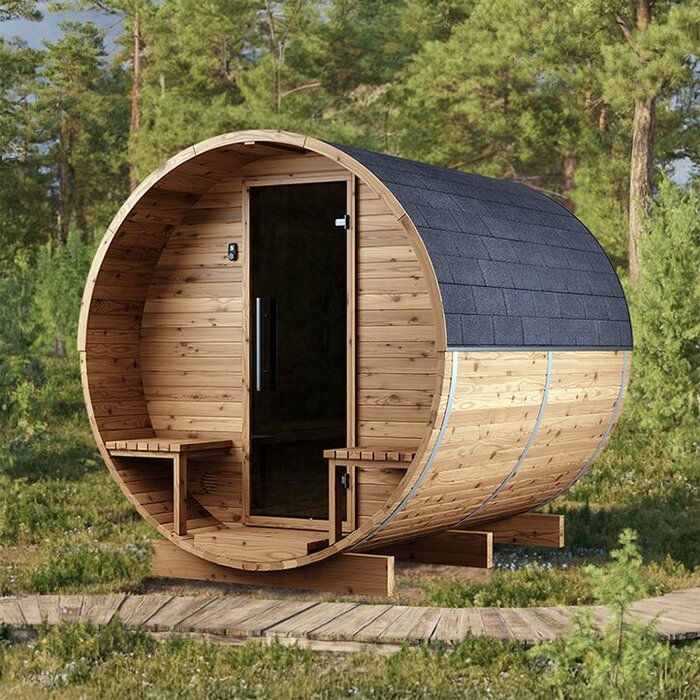
Delivery-route check 5
Record the route for the delivery team
Create a route record that someone who has not visited can follow. Sketch from the vehicle stopping point to the final position; mark every opening’s clear width and height, the length of each narrow stretch, the approach and turning space at each corner, the lowest overhead restriction, and steps or surface changes. Add gate swing, items that could be removed, areas needing protection, and the proposed unloading and staging locations. Label where each measurement was taken and when. Take photographs facing each opening and along the route, but include written dimensions too: perspective can make a narrow gap appear wider or deeper than it is.
Send the record with the exact model, configuration and requested delivery format, then ask the seller and provider to review the same route against the current manufacturer drawing and packing schedule. Identify Sauna N-210 by its full name rather than simply calling it a barrel sauna, and request documents for the version being ordered. Ask reviewers to point out any missing measurement or required clearance; a vague ‘it should fit’ does not settle a tight corner. Keep replies together and resolve conflicts between assembled dimensions, package sizes and carrier assumptions before booking. Repeat the review if the product, shipment, route or unloading point changes.
Confirm the plan before delivery day
Before confirming delivery, use a clear go-or-no-go test: every piece has a verified route, the handling orientation and method are accepted by the provider, and the stopping, unloading and set-down points are agreed. Arrange any temporary gate removal, surface protection or specialist survey in advance, with responsibility clear. If a package dimension, turn or handling requirement is still unknown, feasibility remains unconfirmed; do not rely on the delivery team to improvise. Ask what the provider will do if the route differs from the survey or a package cannot safely pass, and agree a contingency before delivery day.
Recheck the route shortly before arrival for parked vehicles, bins, overhanging growth, wet ground or building work that has reduced access. Make the agreed opening available and keep the path clear, but do not alter fixed services or structures as a last-minute fix. If conditions have changed, tell the provider before the vehicle is dispatched so it can assess the plan. Ensure the person meeting the driver has the route record and knows the agreed set-down point. Keep the carrier’s contact details available so any discrepancy can be referred to the coordinator before unloading begins, rather than resolved through improvised handling.
Frequently asked questions
Should I measure the assembled sauna or its packages?
Measure the complete unit if it will travel assembled, in the orientation agreed for delivery. If it arrives in parts, get the outside dimensions of every package, including any pallet, crate and protective wrapping, as well as each package’s weight. Confirm which configuration those measurements describe and account for every item in the consignment.
Is the width of my garden gate the deciding measurement?
No. Measure the clear opening as the gate will be positioned during delivery, then check every other pinch point, turn and overhead restriction along the route. A gate can be wide enough while the approach immediately beyond it is too tight. Ask the delivery provider what additional space its handling method requires.
Can a package be tilted or turned on its side to get through?
Only if the manufacturer and delivery provider confirm that the specific package can be handled that way. Packaging, components and instructions differ, so do not assume an item can safely be tilted, rotated or dismantled. Request the permitted travel orientations and use those measurements when assessing the route.
Would removing a gate or fence panel solve the problem?
It might create a wider opening, but it will not automatically resolve a tight turn, low obstruction or unsuitable approach. Check that you have permission to arrange removal and reinstatement, measure the opening that would actually result, and have the full alternative route reviewed by the delivery provider before relying on it.
Could a crane lift the sauna over a narrow passage?
A lift may be worth discussing, but it is not automatically available or feasible. A qualified lifting provider needs to assess the actual item, vehicle position, overhead clearance and landing area. Ask the seller and contractor to confirm the proposed delivery format, responsibilities and any arrangements needed with relevant parties before treating a lift as a solution.
Delivery feasibility depends on both the actual shipment and every part of its route. A current packing schedule, a full access survey and an agreed unloading point let you compare options on evidence rather than appearance or area figures. If those details cannot yet be matched, resolve the gap before booking: a sauna that fits its final site still has to reach it.
