
Choosing a Sauna for a Holiday Let: Guest Use, Cleaning and Costs
Holiday-let sauna guide
A sauna can add a distinctive amenity to a holiday let, but it also creates a facility that must be prepared, checked and supported between bookings. Choosing a model is only one part of the decision. You need written confirmation that the exact model and installation are accepted for the intended rental use, a guest process based on the manufacturer’s instructions, a changeover routine your team can complete and an energy estimate tied to real operating assumptions. Capacity, site preparation, insurance and service access should be resolved before you advertise it, rather than left as questions for the first guests.
Before you commit 1
Define the sauna offer in your holiday-let listing
Decide exactly what the listing promises before comparing cabins. Is access private to each booking, included in the stay or subject to a separate booking or charge? Will it be available throughout the year, or only when a host or manager can prepare it? State the location and access arrangement, along with any limits guests need to know before booking. Avoid promising that the sauna will be ready on arrival if a person must prepare it, or uninterrupted availability if you have no plan for checks, faults and repairs. If use is limited to certain times or needs a reservation, explain how guests request it. Keep the listing, pre-arrival message and on-site instructions consistent so guests know what the amenity includes.
Translate that promise into a realistic operating pattern: typical party sizes, stay length, the gap between bookings and who can attend if help is needed. Decide whether guests operate the sauna themselves or staff take a role; either arrangement must match the manufacturer’s approval and instructions. When considering the Sauna N-210 product page, describe this pattern in your enquiry rather than asking only whether the model suits a holiday let. Explain whether one booking has exclusive access and whether several members of the party may want separate turns. This helps the supplier assess the intended use and lets you plan staff availability without promising unrestricted access. If your bookings include guests with particular access needs, ask how these can be accommodated before making claims in the listing.
Get rental use and warranty acceptance in writing
Do not infer rental suitability from a product being sold as a sauna or from a warranty described as domestic. Before ordering, ask the manufacturer or authorised supplier in writing whether the exact model, heater, controls and installation package may be used by paying short-term guests, at your planned frequency and with your intended guest- or staff-operation arrangement. Ask them to identify any exclusion for commercial or rental use, which warranty applies, what servicing is required and whether guest operation affects cover. Request the current manual and warranty terms. If the supplier, installer and manufacturer have different roles, establish who is answering each question and who provides support; a verbal assurance or generic product description is not a record of the use you intend.
Make the enquiry property-specific: the Sauna N-250 catalogue entry identifies a model, but the name on a product page is not evidence that it is approved for holiday letting. Give the supplier your intended guest access, turnover pattern and installation proposal, and file the written answer against that unit. Separately ask your insurer or broker whether the proposed use fits the cover and what evidence or safeguards it expects. If the property is leased, managed or subject to site rules, identify any owner or operator consent you need. Check planning, building-control or other local questions with the relevant authority or a competent professional rather than assuming a garden installation is automatically acceptable. Treat unanswered conditions as open questions, not implied approval.
Before you commit 2
Set capacity from the documented layout
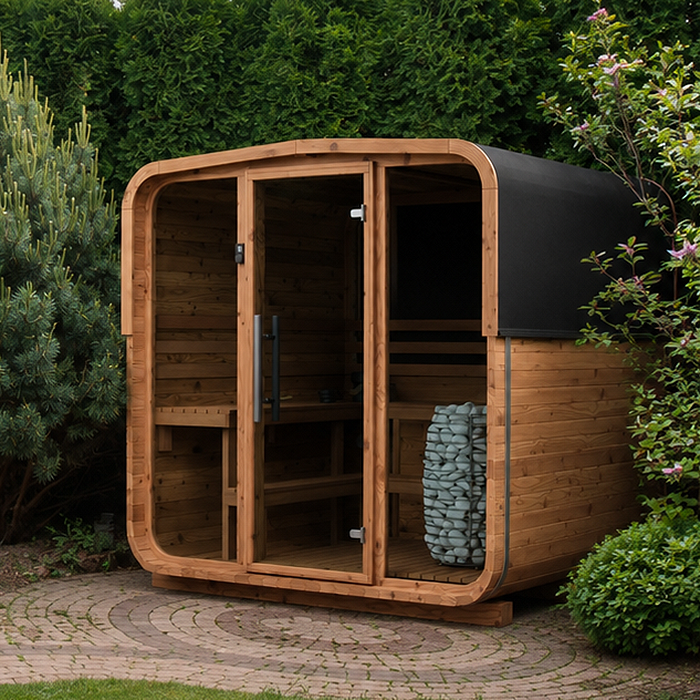
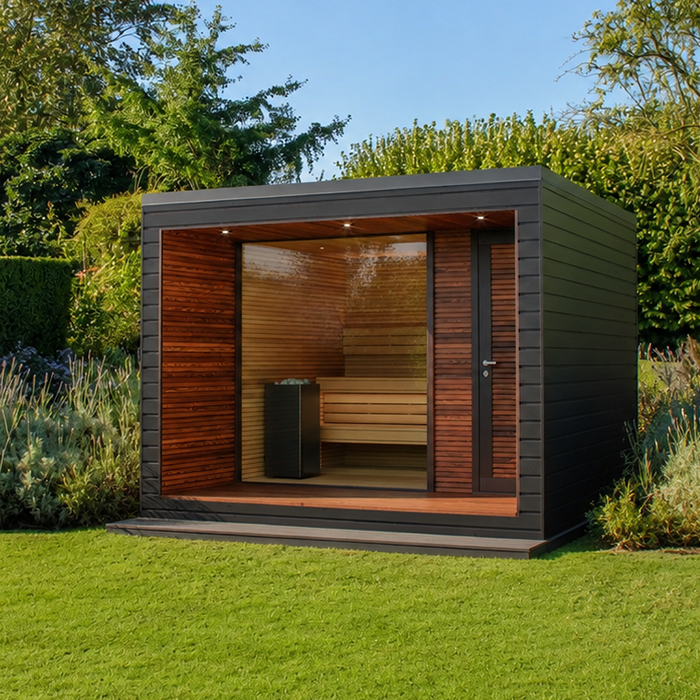
Set guest capacity from the manufacturer’s documented layout, not from the number of people who can sleep in the accommodation or a floor-area figure. Ask for a dimensioned drawing showing usable interior, benches, door position and any stated occupancy limits for the exact configuration. Compare this with your largest booking and how people will get in, leave belongings and move without blocking the entrance. A sales photograph cannot confirm those details, and similar-looking models may have different layouts. If guests need a particular access arrangement, confirm it against the drawing and a competent assessment before describing it in the listing.
For example, the Sauna LC-260 catalogue entry gives an area of 5.12 m²; that is not a capacity rating. Ask the supplier what the listed figure measures, then use the drawing to check internal and external dimensions separately. Include the door swing, approach space and route from the accommodation in your plan, rather than measuring only the cabin footprint. Avoid advertising a maximum number of sauna users or an accessibility feature unless the manufacturer’s information and completed installation support that specific claim. Sleeping capacity and useful sauna capacity are different planning questions, so check both against the experience you intend to offer.
Check the site, arrival route and service access
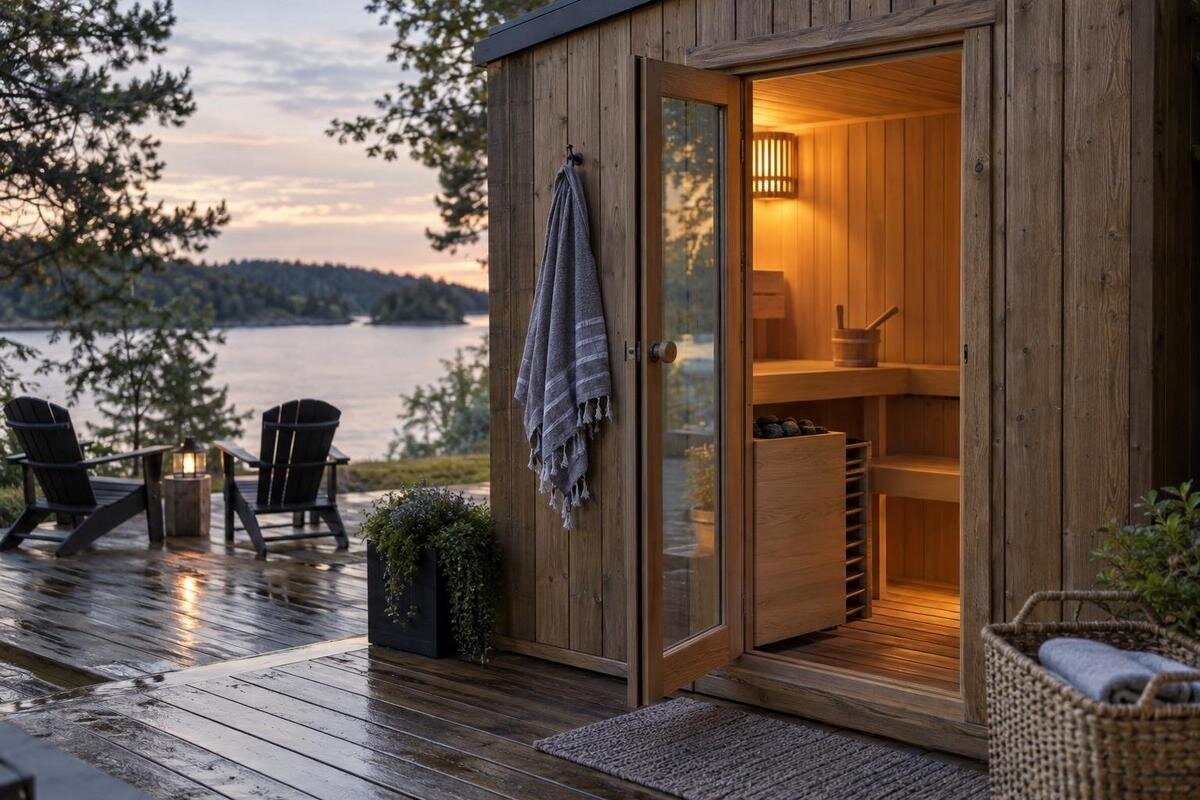
Walk the proposed site as both a guest and the person who will service it. Check the route from parking and accommodation, changes in level, lighting, privacy and whether a technician can reach the unit without entering a space reserved for guests. Consider sightlines from neighbouring homes or other holiday units, and whether the route remains clear when guests carry towels or belongings. Do not promise secluded use based only on a daytime photograph; consider the setting at likely times of use and discuss privacy concerns with the property manager. Check that the entrance is easy to find and that the sauna does not obstruct circulation or access to other parts of the property.
Ask the supplier and a qualified installer to confirm the required base, complete external footprint, clearances, assembly access and any preparation or connection work for the exact model. If you are considering the Sauna HCF-300 model page, request an installation drawing and delivery requirements for the configuration being quoted. Establish whether the delivery team needs vehicle access to the installation point or whether a separate handling arrangement is required, and who is responsible for it. Check the delivery route and supporting surface with the relevant professionals; do not assume an existing patio or deck is suitable. Resolve location, access and any consent questions before buying, so a delivery or site constraint does not force a last-minute change to the intended layout.
Before you commit 3
Make guest operation clear and manual-led
Write guest instructions around the manufacturer’s manual and the controls actually supplied. Keep the arrival guide brief: how access is arranged, who may use the sauna under your policy, what guests may operate, how to end use and leave the area, and whom to contact if a control behaves unexpectedly. Put the key points in the pre-arrival message as well as at the sauna, so guests do not need to guess after arriving. Use the operating sequence for the installed configuration, not a shortcut copied from another model. If staff must prepare or enable use, state that clearly and give guests a realistic way to request help.
Draw a clear line between guest actions and staff-only cleaning, inspection or servicing. Tell guests not to dismantle parts, alter controls beyond the permitted settings or attempt a repair. Include other restrictions only where they are supported by the manual, insurer or your operating policy; avoid inventing rules or making health promises. For a candidate such as the Sauna HCF-225 product page, obtain the matching user manual and base the quick guide on the delivered model and accessories, not a similar-looking cabin. Keep an accessible copy at the property and a current version for the manager; replace obsolete instructions whenever the configuration or supplier guidance changes.
Build cleaning into every changeover
Make the changeover routine explicit rather than relying on the next guest to leave the sauna ready. Assign who removes used towels and personal items, empties rubbish, checks the benches and floor, and wipes approved touch points such as the handle and controls. Follow the material-specific cleaning instructions; do not assume that household disinfectant, fragrance, oil or a wet-cleaning method is suitable for every surface or near the equipment. Keep a dedicated kit and clean cloths separate from guest supplies, and give the cleaner enough time to complete the sauna check as well as the rest of the accommodation reset.
Request written care guidance for the actual interior materials, benches, flooring and controls, including the difference between routine changeover work and any deeper cleaning the manufacturer specifies. When enquiring about the Sauna S-140 listing, ask which surfaces cleaners can reach and whether any cleaning tasks require trained service personnel. Use the answers to define the cleaner’s work and identify tasks that need a separate appointment. At departure, record whether the cabin is ready for the next booking and flag damage, persistent dirt or anything outside the routine process. Complete outstanding cleaning before reopening; where a fault or unexplained damage raises a safety concern, keep the sauna out of guest use pending advice from the appropriate professional.
Before you commit 4
Assign owner oversight and a fault response
Name an owner or manager who remains accountable after the cleaner has finished, when a guest cannot use a control or when an issue appears between stays. Their job is to recognise and record a concern, respond to guests and arrange the appropriate service—not to improvise technical work. Give guests and staff one clear contact route, including an out-of-hours contact if your advertised support arrangement requires it. Decide who can mark the amenity unavailable in the listing or booking system and how that person will tell arriving guests about a temporary closure. This prevents a fault report from being passed between people without anyone taking responsibility.
Keep a record for the exact unit: model and configuration, serial number where supplied, installation documents, the manufacturer’s rental-use response, dates of professional service and any fault reports or remedial work. If you shortlist the Sauna HC-150 product listing, use that model reference in your enquiries, then add the heater and control details from the final order. These details help the service provider identify the relevant equipment when a problem is reported. Train changeover staff to report damage, warnings or unexpected control behaviour rather than open panels or troubleshoot beyond their role. Make the current manual and service contact easy for the person on duty to find, particularly during a guest stay.
Estimate installation and running costs separately
Compare the full set-up cost, not just the sauna price. Request an itemised proposal for the selected model and heater or control configuration, including delivery and assembly scope, site preparation, professional connection and any work identified as necessary to make the location suitable. Ask which items are included, which are assumptions and which may need a separate quote after inspection; catalogue areas and photographs are not installation drawings. Add recurring costs you will actually carry, such as changeover labour, laundry, approved cleaning supplies, inspections and professional service. Separate one-off costs from recurring and usage-linked expenses so a single headline figure does not hide what the operation requires.
Estimate energy use from information for the exact heater and operating arrangement, then apply your own energy prices and expected booking pattern. When requesting a quotation through the Sauna HC-225 catalogue page, ask what heater is proposed and what use, warm-up and standby periods any running-cost estimate assumes. For an electric heater, rated input alone is not a bill forecast. If another fuel is proposed, obtain consumption and servicing information for that specific system. Where separate meter readings are available, compare representative guest bookings with your forecast; if electricity is metered for the whole property, avoid attributing the entire bill to the sauna. Allow for ordinary and busier booking periods, and keep energy, labour, laundry and maintenance as separate budget lines.

Before you commit 5
Keep the documents that govern day-to-day use
Keep one current operating file, digital or printed, available to the owner and the person handling changeovers. Include the applicable manual, cleaning guidance, warranty terms, written rental-use response, installation paperwork, service contact and any insurer, landlord or site permission relevant to the installation. Mark which documents apply to the configuration actually installed, and remove superseded copies from guest instructions. If written approval is conditional—for example, it depends on a specified installation or staff-operated use—put that condition in the manager’s checklist so it is not lost when personnel change. The file should answer practical questions quickly, not merely sit in an owner’s inbox.
Use a short handover log rather than an elaborate calendar: note that the agreed between-stay reset was completed, record any issue and who accepted it, and state whether the sauna was available for the next booking. Keep technical decisions with the named owner or professional rather than asking cleaners to judge equipment safety. Review the guest sheet when controls, installation or supplier guidance changes, and after an incident or repeated guest confusion. This record helps reveal recurring problems and shows whether the advertised service is deliverable without turning ordinary turnover into a maintenance programme.
Final checks before ordering
Before ordering, put every candidate through four separate checks: written permission for your rental arrangement, a workable site and installation proposal, a documented guest and cleaning process, and a budget based on realistic use. A gap in one area is not cured by attractive photographs or a larger catalogue area. Ask suppliers the same questions about intended rental use, included configuration, professional work, care guidance and service arrangements. That makes answers easier to compare and exposes missing information before you commit, rather than after the sauna has been delivered.
Shortlist only options whose permitted use and warranty position match how your holiday let will operate; then compare the actual drawings with your guest plan and property. If the manufacturer, insurer or installer cannot confirm a critical point, pause and resolve it with the relevant party instead of filling the gap with an assumption from a domestic product label. Check that someone can handle guest guidance, cleaning, fault response and bills during both busy and quiet periods. The right choice is not simply a model that fits the site; it is one your team can support in the way you have promised.
Frequently asked questions
Will a domestic sauna warranty automatically cover holiday-let guests?
Do not assume so. Ask the manufacturer or authorised supplier to confirm in writing that the exact model, heater, controls and proposed rental use are covered, and request the current warranty terms and exclusions. Check the arrangement separately with your insurer, and keep the replies with the documents for the installed unit.
Can I work out sauna capacity from the listed floor area?
No. Use the manufacturer’s capacity guidance and drawings for the exact configuration. A catalogue area or photograph does not establish the seating layout, usable interior, access or approved number of users. Match the documented arrangement to the occupancy you intend to advertise.
Can I switch the sauna on before guests arrive?
Only if the manufacturer’s instructions, approved installation, insurance position and your operating procedure support that arrangement. Do not assume remote or unattended pre-heating is permitted. If preparation needs a person on site, include that task in your guest-access plan and explain any limits before booking.
What should the changeover clean include?
Set out who removes towels and belongings, empties rubbish, checks the floor and seating, and cleans approved touch points using the correct care instructions. Follow the manufacturer’s guidance for surfaces and equipment. Record anything that is damaged, unusually dirty or outside the routine process, and arrange specialist help where needed.
How do I estimate the running cost?
Use information for the exact heater and operating arrangement, your energy prices and a realistic booking pattern. Ask what assumptions sit behind any supplier estimate. For an electric heater, rated input alone is not a bill forecast; for another fuel, request consumption information for the proposed system. Include changeover labour, laundry, cleaning supplies and servicing as separate costs.
The strongest choice is the one whose approved use, layout and instructions match the service you intend to offer. Resolve rental-use and warranty questions in writing, verify the drawings and installation with the relevant professionals, and build changeover work and energy assumptions into the budget. If any part depends on a guest improvising or on a warranty interpretation you have not confirmed, revise the plan before advertising the sauna as an amenity.
