
Sauna Showroom Checklist: What to Try, Measure and Ask
Sauna buying guide
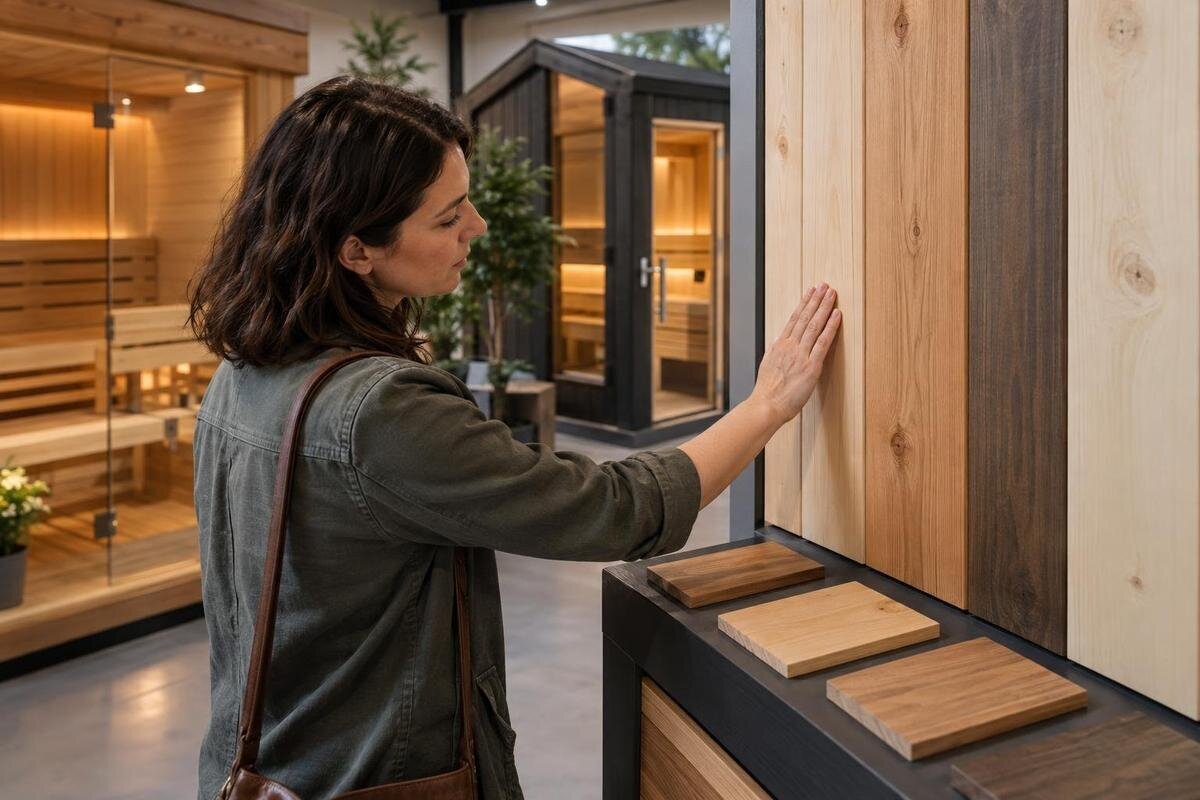
Photographs can show a sauna’s appearance, but they cannot tell you whether its entrance feels awkward, whether the benches suit the people who will use them or whether the proposed unit fits your access route. A display visit is most useful when you know exactly what is on view. Confirm the model and options, try the seating and entry where permitted, take relevant measurements, and request drawings and written product information. This checklist applies to any supplier’s display; confirm that a unit can actually be viewed before travelling.
01
Confirm what is actually on display
Before travelling, ask the supplier exactly which model and configuration is on display. Confirm the venue, opening arrangements and whether visitors can enter the cabin; some displays may be closed, unheated or available only by appointment. Ask whether the unit will be operating, but do not expect to control a heater unless staff explicitly allow it. If the seller can show only photographs, a brochure or a material sample, that can still help you ask questions, but it is not a hands-on assessment. Check availability of the display separately from availability of the product, and ask whether a member of staff can identify its options.
Take the product name or quotation with you and match it to a model label or the seller’s written description of the display. Note differences in door position, windows, benches, heater and controls: the display may not represent the package you are considering. For example, Sauna HCF-300 catalogue entry gives you a model name to ask about, but does not establish that a local unit is available to view or that its options match. Ask the supplier to confirm the exact configuration on display and the version in your quotation. If anything is covered or inaccessible, record it as unseen rather than treating the outside view as confirmation.
Measure your route and intended position
Before travelling, sketch the complete route from the likely unloading point to the sauna position. Include gates, side passages, corners, steps, slopes, low branches or eaves, and narrow doorways; note the narrowest clear width and lowest height rather than measuring only the entrance. Measure a gate with it open and allow for projecting handles or hinges that reduce the passage. At the site, mark the intended footprint and space needed to reach the door, assemble or maintain the unit. A display’s access route cannot establish whether your own site is workable.
Take a tape measure and a simple sketch, recording whether each figure is internal, external or a clear opening. Ask for the dimensions of the largest delivery components and how much working space assembly requires; do not assume the finished footprint describes either. Note where overhead clearance changes, and take photographs of tight points only with permission. If Sauna HCF-225’s listing is on your shortlist, use its exact name when requesting the correct drawing, then compare that document with your route and planned position instead of using a product photograph as a scale reference. Include any obstacle that might need to be moved or removed.
02
Try the seating in the positions you would use
Try each intended sitting position only if the display is open to visitors. Sit upright, then lean against the backrest if one is fitted; note the seat height, usable depth and length, legroom and how easily you can shift position. If more than one person will use the sauna, sit together in the arrangement you expect rather than judging capacity from one empty bench. Notice whether knees or shoulders meet a wall, whether feet have a comfortable place to rest, and whether one person must move to let another sit down. Your build and preferred posture matter more than a general sales description. If possible, involve the people who will use it most; differences in height can change how the seat and backrest feel.
Check the bench edge and support points, plus the distance between levels if the display has tiered benches; do not climb onto a feature that staff have not invited you to test. Ask which benches, backrests or footrests are included in the offered version, and request their usable measurements. When considering the Sauna S-140 product page, record the seating arrangement you want to compare with the display: how many people will sit together, their preferred positions and any need for a backrest. Note whether your assessment depends on an optional accessory. This gives you a practical seating comparison rather than a judgement based only on the cabin’s overall size or a stated capacity.
Check the entrance and door movement
Approach and use the door as you normally would: notice the threshold, the clear opening, the handle position, and the direction and space taken by the moving door. The outside measurement of the frame is not the same as the usable opening. If the display is open, make a careful entry and exit, turn around, and see whether the threshold or nearby equipment forces an awkward step. Consider everyone who will use it, including anyone who needs a walking aid or extra room, rather than judging access only by your own movement. Also check whether there is room to pause just inside without blocking the doorway.
Ask the supplier to show the clear opening width on a dimensioned drawing and identify the door arrangement on the model being quoted. Check the door at its full swing and whether it blocks your planned route or another working area. If the display has a latch or handle, try it only as staff permit and note whether it is easy for the intended users to reach and operate. A quick trial does not establish compliance with an accessibility standard. For Sauna HC-150, keep the entrance measurements alongside your site sketch so you can compare the doorway, approach and space needed for the door to open.
03
Compare usable space with the stated dimensions
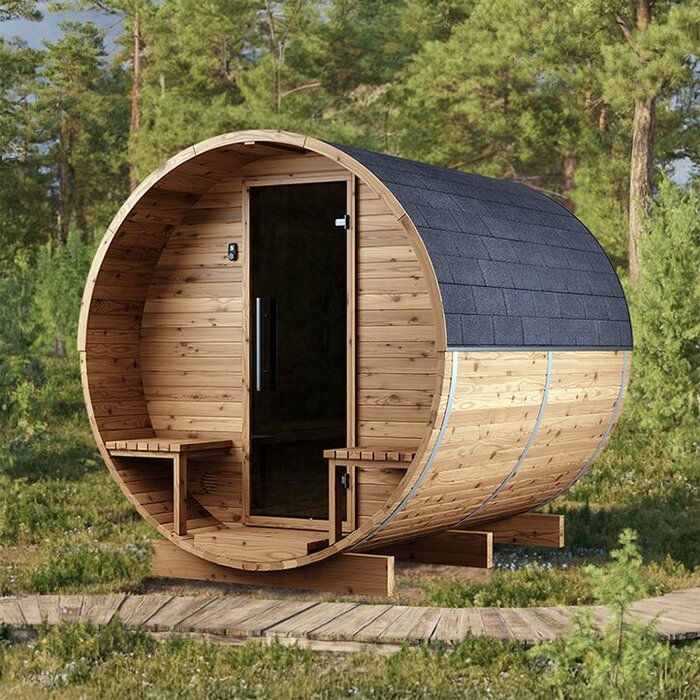
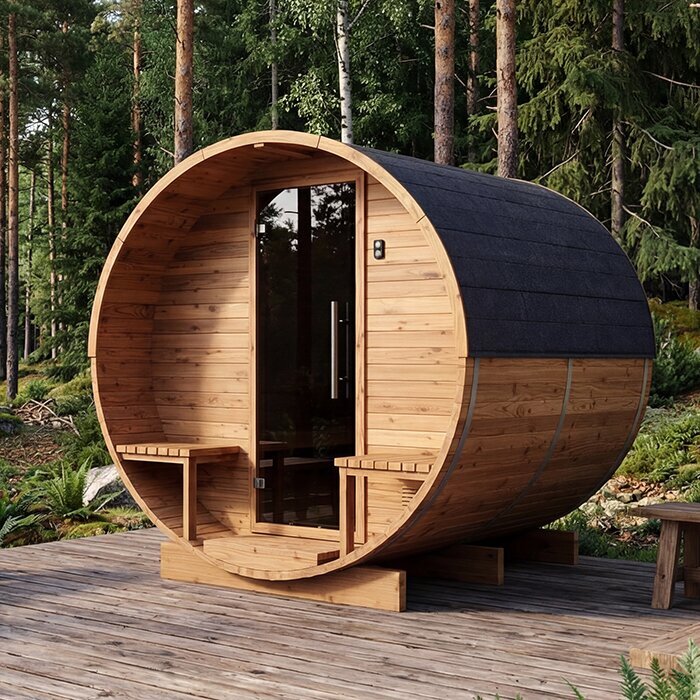
Ask what each published area or overall dimension actually measures. A stated footprint may describe the outside of the cabin, while seat depth, internal floor space and headroom answer different questions; do not treat one number as a measure of usable room. In the display, note where you can sit and stand without obstructing the door or heater, and whether the shape reduces room near the edges. If the interior has a curved or sloping roof, check headroom above the bench and at the sides rather than extrapolating from the centre. This makes the drawing easier to interpret.
If staff permit, measure internal length, width and height at clearly identified points, and mark those points on your sketch. Note projections such as benches, steps or the heater so that a measurement of the empty shell is not mistaken for unobstructed space. Ask what arrangement underlies any stated user capacity and compare it with the bench layout you tried. Use Sauna HC-225’s listing as a reference when recording the supplier’s figures, keeping external dimensions, internal dimensions and seating measurements in separate columns. Where a drawing and your measurement appear to differ, ask whether they use the same reference points before concluding that either figure is wrong.
Inspect the finish and moving parts
Look at the surfaces in ordinary light and at close range. Check the edges you are likely to touch, seat faces, door surround and visible joints for rough patches, splinters, loose trim, gaps, uneven finish or signs of display wear. Look across a surface as well as straight at it, then inspect corners and joints where parts meet. Test movable elements only as staff permit, including the door, handle and any window or bench element the supplier identifies as movable. An older or frequently used display may show wear that is not representative of a new unit, so ask what you are seeing.
Do not identify a wood species, treatment or coating by colour or feel alone. Ask for the written materials and finish description for the cabin, benches and other contact surfaces, and what care each requires. Ask whether the display has been cleaned, repaired or treated since assembly so you can distinguish routine wear from the intended finish. If Sauna N-210’s catalogue page is your reference, confirm that the documents apply to that exact model and finish. The display helps you judge appearance and feel; the specification clarifies what is offered.
04
Ask about the heater and controls
Record which heater, controls and visible accessories are actually fitted to the display, but do not assume any are part of the quoted package. Ask for the heater’s maker and model, where the controls are located, and whether lighting, guards or other visible items are included, optional or display-only. Check whether you can read or reach the controls from the position you expect to use them; ask staff to explain or demonstrate them rather than operating them yourself. Keep clear of the heater, and use controls only if staff explicitly invite you to do so. Note any difference between a demonstration and the written offer.
Request the heater specification, controls information, ventilation layout and installation requirements for the exact sauna configuration. Have a suitably qualified installer check the documented electrical and installation requirements against your planned site; a showroom display cannot confirm what your property can support. For a model such as Sauna N-250, ask whether the displayed heater package is the one included in the configuration being quoted, and get options or exclusions recorded in writing. Ask which components are intended to be used together rather than assuming a control or heater shown with one display belongs with every version.
Request drawings and product documents
Ask for dimensioned plans, elevations and, where needed, a section drawing for the exact model and options, not only a brochure image. Useful drawings identify external and internal dimensions, the door opening and orientation, bench layout, window positions, and heater and vent locations. Ask which figures describe the cabin itself, what base or support interface is assumed, and whether a variant changes the drawing. If a key dimension is absent, request it rather than estimating from a photograph or stated floor area. Keep the document title or revision so you can match it to the quotation and avoid mixing versions.
Also request the manufacturer’s assembly and installation instructions, operating and care information, a written list of included and excluded items, and the applicable warranty terms. Read the documents for the actual configuration and note any work that must be completed by an installer; ask the supplier who is responsible for it. If the Sauna LC-260 page is your starting reference, request matching technical paperwork rather than assuming the web listing contains every detail. Save answers with the drawing, especially where the supplier has explained a dimension or option not clear on the page.
05
Compare the quotation with what you saw
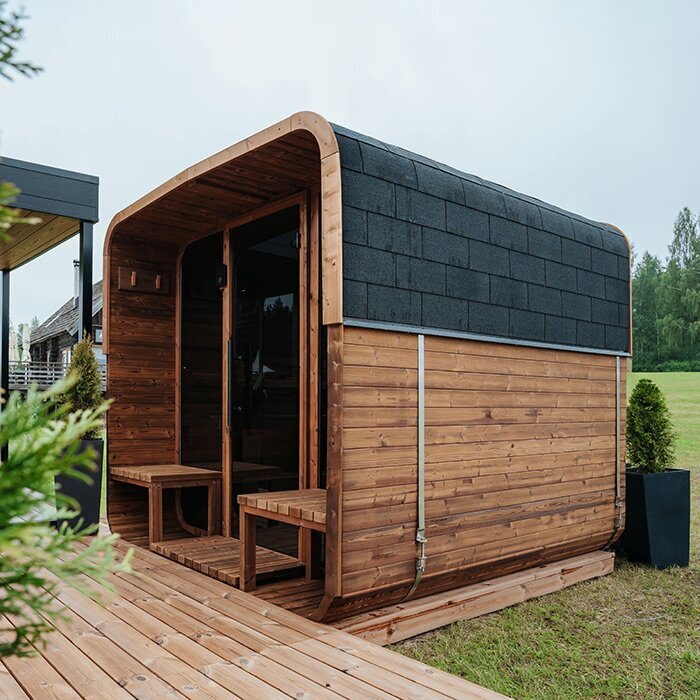
Compare the quotation with your display notes line by line. Match the model code and orientation, benches, door and windows, heater and controls, finish, and accessories; mark each as included, optional or excluded. Check whether the display showed a feature absent from the written offer, or whether the quotation uses a different configuration. An itemised description is more useful than a broad statement that the sauna is fully equipped, because it lets you compare like for like without guessing what that phrase covers. Record any agreed change in the written documents rather than relying on memory.
Ask what the quoted scope says about delivery access, unloading, assembly, base preparation and electrical connection or commissioning, and who arranges each part. These may be separate responsibilities, so record the answer instead of assuming the display visit covers them. Check that any site work or installation assumption is consistent with your plan and the manufacturer’s instructions. Ask what must be ready before delivery and who confirms it, without treating a display visit as a site assessment. If comparing offers, use the same list of features and responsibilities; the headline price alone cannot reveal differences in scope.
Record your findings and outstanding questions
Make a compact record while details are fresh: exact model and options, measurements with units, what you tried, what staff explained, and which answers appear in documents. Separate observations from confirmed specifications and keep unresolved questions in their own column. If you take photographs or measure the display, ask permission first and label each image with the model; a close-up of a handle or bench is easy to misidentify later. Collect the drawing or product sheet for the same version, and note the date or display identifier if the supplier provides one.
Before visiting, write down your priorities, such as easy entry, room for more than one person or a particular bench position. Afterwards, compare those priorities with your site measurements and the supplier’s drawings. Follow up on mismatches before deciding: a changed door position, unclear usable width or missing heater specification can affect more than appearance. If something still cannot be judged from the display, decide whether a different demonstration or written answer is needed; do not treat an unanswered point as confirmation. This keeps the visit useful without asking the display to prove things it cannot.
Frequently asked questions
How can I check whether the displayed sauna matches the one I am considering?
Ask the supplier to identify the displayed model and options in writing, then compare these with the quotation and drawing. Check details such as the door position, benches, windows, heater and controls rather than relying on the overall appearance. A display may have a different configuration or optional equipment, so confirm the version being offered.
What should I measure during the visit?
Measure your route from the likely unloading point to the intended position, including narrow gates, turns, headroom and thresholds. At the site, note the footprint and door swing. At the display, check the clear door opening, usable bench dimensions and internal measurements. Record whether each figure came from your own measurement or a supplier drawing.
Can I try the sauna while it is heated?
Follow the showroom staff’s instructions. Keep clear of the heater and operate controls only if staff expressly invite you to do so. You can assess seating and entry without a heated demonstration; for operating details, use the manufacturer’s instructions and ask staff to distinguish what a demonstration shows from the information supplied for the configuration you are considering.
Which documents should I ask the supplier for?
Request dimensioned drawings for the exact model and options, plus assembly and installation instructions, operating and care information, and a written list of inclusions and exclusions. Ask for the relevant warranty terms and any stated electrical or installation requirements. Match each document to the model being quoted, and get written answers to questions the documents leave open.
Does a showroom visit prove that a sauna will fit my garden?
No. A display lets you assess access, proportions and feel, but it cannot reproduce your route, boundaries, base or site conditions. Compare your own measurements with drawings for the exact configuration, and ask a suitably qualified professional to review technical installation requirements where needed. Confirm delivery and assembly assumptions separately.
Use the display to learn what a photograph cannot show: how the door works, how the seating feels and where dimensions matter in practice. Then check those impressions against the exact model documents, your measured access route and the written offer. A sound decision combines what you have tested with clear information about the configuration, fit and installation requirements.
