
Summer House Doors That Stick: Seasonal Movement and Adjustment
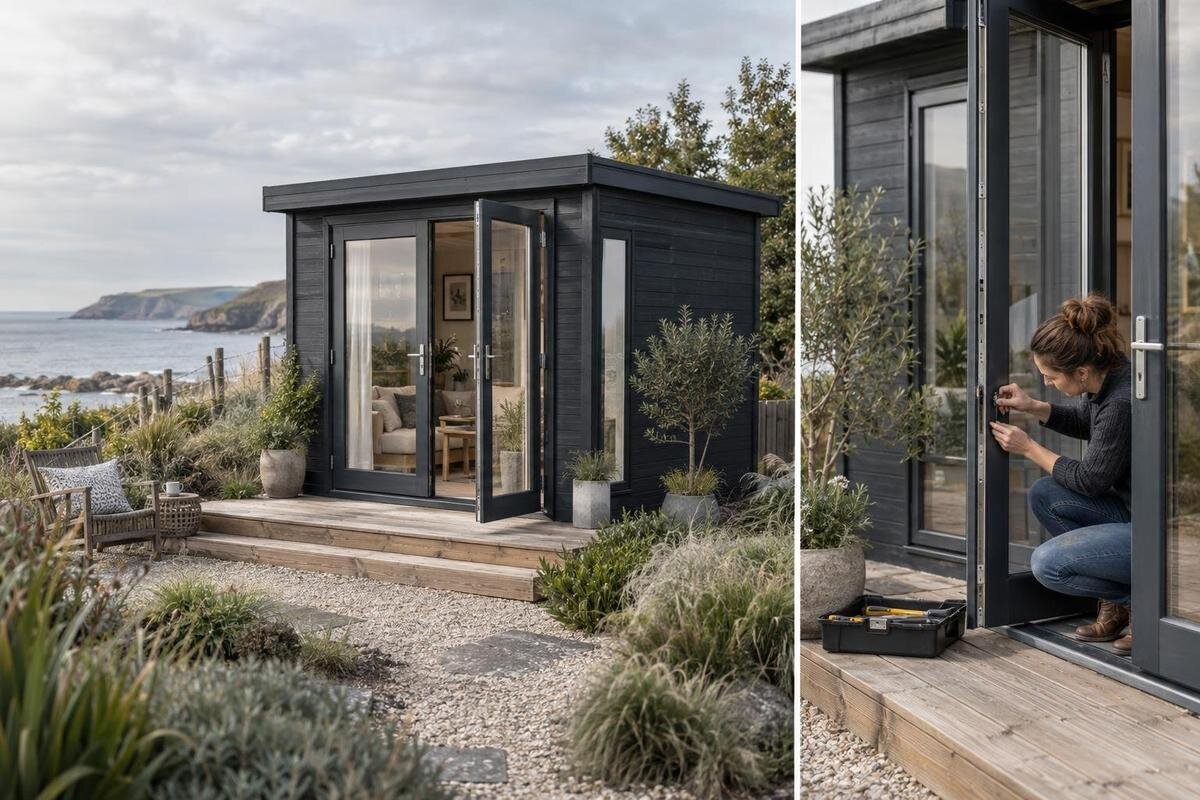
Summer house care
When a summer house door opens freely for part of the year but rubs or resists in another spell, seasonal movement may be involved. That pattern is useful evidence, not a diagnosis: timber can respond to changing moisture, while loose hinges, a shifted frame, debris or a misaligned latch can produce similar symptoms. Forcing the door or immediately removing wood can make a temporary problem worse. This guide explains how to locate the contact point, assess what may have changed and decide whether a small adjustment is appropriate. It also covers when to seek a carpenter and what to confirm when buying a replacement summer house.

Why a summer house door may stick at certain times of year
For a timber door and frame, seasonal sticking can reflect a change in moisture rather than the calendar itself. Timber takes up moisture from damp air or wet surfaces and releases it as conditions become drier; its dimensions can then change, with movement depending on the grain, construction and the way the pieces are joined. A small change may be enough for a door to rub where its clearance is narrow. It may feel freer after a dry spell and tighter after prolonged damp, but that is not a universal rule. Exposure, shade, ventilation and leaks can make one edge respond differently from another, and heat alone does not explain every change.
Note the dates, recent weather and exact point of resistance before adjusting anything. A door that catches in the same spot each day may have a hinge or frame fault, even if you first noticed it in winter. If it moves freely when open but binds only as it closes, the latch or its receiving plate may be involved. If it scrapes at the threshold, look for grit, an object or a change in floor clearance. Seasonal change is a clue, not proof that the door needs trimming; a pattern across several observations is more useful than one difficult opening. Also note whether the door has recently been repainted, rehung or adjusted.
Find the point where the door catches
Start by observing the door rather than pulling harder. Close it gently and look at the gap along the top, both sides and bottom; then open it slowly, noting when resistance starts. Fresh scuffing, a polished patch, compressed paint or a mark where the latch meets its plate can show the contact point. Compare the gaps instead of assuming they should be identical: construction and fittings determine the intended fit. Keep fingers clear of the closing edge, and do not wedge the door against the frame to inspect it. Check the hinge side as well as the latch side, and note whether resistance changes as the door swings.
Repeat the observation when the door is noticeably tighter and when it eases, if conditions change naturally. Dated photos of the gaps and contact marks can reveal whether the same corner shifts or the problem is spreading. Check the door both open and closed: if it swings freely but catches near the end of closing, assess the latch alignment; if it drags through the swing, hinges or the frame may be more relevant. Record any recent assembly, impact or repair. Do not sand or plane it based on one brief test; first rule out dirt or an obstruction at the threshold. Deliberately wetting or heating the door is not a useful test.
How moisture affects timber and door fit
Wood exchanges moisture with its surroundings, and this can alter its dimensions. The amount and direction of movement depend on how the timber is cut and assembled, the door and frame design, and differences between the two faces. It is too simple to say that every door swells in summer or shrinks in winter: a wet period, a warm dry spell or a change in ventilation may matter more than the month. Exposure can also be uneven, with one face getting wetter or an edge drying more slowly. A finish may slow moisture exchange, but it does not make timber immobile. A sticking door may still have nothing to do with timber movement.
Look for a nearby source of damp as well as a seasonal pattern: water running onto the door, repeated wetting at its lower edge or a leak above the frame deserves attention before an adjustment. Do not assume the surface finish has failed just because the fit changes; assess visible damage separately and follow the relevant care instructions. When comparing models, use the listing for the Verdana 1 garden house to identify the exact option, then check current product information and supplier documentation for stated materials, finish and door-care guidance. The name and photograph do not establish how its door is made or adjusted. If a building is newly assembled, ask the supplier about a fit issue before making an irreversible change.
Check the frame and the building, not just the door
A door can bind because the opening has changed shape, not because the leaf itself has grown. Compare the clearances around the frame, look for a visible shift at joints, and note whether the door appears to lean or sit differently from before. A change in the gaps at the top and bottom may be more revealing than the appearance of one edge alone. Check that the frame is secure and that nothing has been pressed against it. On a garden building, the support beneath it and the condition of the base can affect how the frame sits. Do not try to correct suspected movement by lifting a corner or altering supports yourself; if the frame has visibly moved, treat it as a building issue.
Look at the threshold and the ground immediately outside for signs that water collects against the entrance, and check the route by which rain reaches the door. Clear loose leaves or a small obstruction, but do not change drainage, foundations or structural supports as a door adjustment. When choosing a replacement, check the siting and base requirements for the exact model; treat the Verdana 2 garden house listing as a starting point for obtaining its assembly and base guidance, then confirm that the instructions suit the intended site. A different building or base arrangement may need different preparation. If water continues to reach the same part of the frame, address the source rather than repeatedly adjusting the door.

Inspect hinges, screws and the latch
With the door in its normal position, inspect the hinges for loose screws, movement between hinge and frame, bent parts or a pin that has worked out. Do not pull a heavy or glazed door off its hinges to test it. A sagging hinge can make the door scrape at the opposite corner and cause the latch tongue to miss its plate. If the door closes without rubbing but will not latch, check whether the tongue meets the centre of the receiving plate and whether the handle moves normally. A latch that feels stiff only when the door is shut may be reacting to misalignment rather than failing. If a fixing looks damaged, note it rather than trying to force it back into place.
Follow the assembly or maintenance instructions for the exact hardware. If they permit tightening an accessible hinge screw, use the correct driver and stop if the screw turns freely, the timber is damaged or the hinge shifts; overtightening can strip its fixing. Do not substitute longer screws or move the latch plate without suitable knowledge. For a prospective purchase, ask what door hardware and adjustment information accompany the Durano garden house listing, and whether the instructions apply to the precise version offered. Similar-looking doors can use different fittings, so do not assume that a method used on another model is appropriate.
Check the door’s movement and its exposure
A door needs enough clearance to move without binding, but clearance is part of the designed fit, not spare material to remove on sight. Check for an obstruction around the swing, such as stored items, a shifted threshold strip or debris in a channel. In a sliding system, inspect the visible track for loose dirt and damage; do not force rollers or dismantle hardware without the maker’s instructions. Hinged, sliding and multi-panel doors do not all adjust in the same way. Identify the type and point of resistance before choosing a remedy, and check that any seals or stops have not come loose. Do not remove a seal simply because it touches the door.
Weather exposure can make the door and frame react differently: one edge may get wet while another is sheltered, and water can collect at a poorly protected joint. Check that the outside is not repeatedly wet from a leak or splash, and seek the relevant care guidance rather than coating a moving edge at random. On a new-house shortlist, check the opening arrangement and clearance information provided for the Veltor 1 garden house. Confirm the space needed for the door and any specified care of exposed edges instead of judging from a photograph; a picture does not show how much room the opening needs.
Make only adjustments you can identify
If the only problem is a small, clearly identified obstruction, clear it and test the door again before changing hardware. If a hinge has a documented adjustment feature, use the maker’s sequence and make only a small change at a time, then close the door gently and check the full gap and latch. Keep a note or photo of the original position so you can reverse an unsuccessful change. Do not use force to bend a hinge or frame into line. If one adjustment makes the door bind elsewhere, stop rather than stacking further corrections; a change at one hinge can affect several points around the door. If you cannot identify how a fitting is meant to move, do not guess from its screws.
Adjustment instructions matter because moving one hinge can alter the gap at several points. Before ordering, ask for the guide that applies to the exact version and its supplied fittings; a generic video for a similar-looking door may show a different arrangement. For the Orello 1 garden house listing, verify which documents and aftercare details are available and whether they explain owner adjustments or work for a competent installer. The listing alone is not evidence that one method suits every door. If a newly assembled door is out of line, contact the supplier with a clear description before making a large adjustment.
When to stop and call a carpenter
Call a carpenter or competent installer if the frame is visibly twisted, hinges are pulling out, timber around a fixing is split, the door has dropped significantly, or the sticking is worsening rather than following a mild, repeatable seasonal pattern. A new crack across the frame, movement after an impact or a door that cannot be secured also warrants prompt assessment. Do not keep opening and closing a door that is jammed or feels unstable. An on-site inspection can distinguish a local hardware repair from a problem with the opening or its support. If the building is newly supplied, contact the seller before altering parts, and include photos of the door and the points where it catches.
Use extra caution with glazed panels, folding arrangements, tall or heavy doors and unfamiliar mechanisms. Their weight and fittings can make trial-and-error adjustment unsafe, and one altered component may affect the whole system. If considering the Modano 1 garden house, ask for its specific door-system documentation and where to get competent help before you commit; do not assume that its door can be adjusted by the same method as a simple hinged leaf. Do not attempt to lift a heavy door or disconnect panels unaided. If unsure, leave the hardware undisturbed until it has been assessed.

Decide whether repair or replacement is appropriate
A sticking door by itself is rarely enough to decide that an entire summer house needs replacing. If the frame is sound and the cause is a loose fixing, obstruction or documented hinge setting, a focused repair may be proportionate. If the door or frame is badly damaged, water continues to reach the same joint, or the opening is persistently out of alignment, ask a carpenter to identify the underlying problem first. Fitting a new door into a distorted frame can reproduce the fault, while removing too much material from an old leaf may leave an excessive gap when conditions change again. Consider whether the problem returns after a documented adjustment before deciding that the repair has failed.
If replacement is being considered, compare the documents for the chosen model against what your site and use require: dimensions, opening direction, threshold, access around the door, fitting details and adjustment guidance. The Veltor 2 garden house listing is a named option to assess, not evidence of any particular clearance or hardware. Confirm relevant facts in the current product information and ask questions before ordering; also establish whether a replacement door can be sourced separately before assuming that a complete building is necessary. A repair assessment can help distinguish damage to the door from a problem with the frame or its support.
Plan for door access and aftercare when ordering
At the planning stage, picture the door fully open, not just the closed front shown in a product image. Check the stated dimensions and opening direction, how much clear space the leaf or panels need, whether a threshold suits the path into the building, and whether stored furniture could block the route. Confirm the delivery route to the site and any assembly access requirements using the seller’s information rather than guessing from a photograph. For example, review the Veltor 3 garden house listing as a distinct model, then verify the measurements and door details that matter for your plot. Include the door’s full opening space in your layout, not only the building’s footprint.
Before placing an order, ask for instructions specific to the exact model and version, and find out which door parts are replaceable, how alignment is checked and what adjustments an owner may make. Clarify whether the information applies before or after assembly, because the door’s final fit depends on the completed structure; follow the maker’s or supplier’s sequence rather than altering the door to compensate for an unverified assembly issue. If product information leaves a key point unclear, obtain an answer before purchase. Keep the model details with the instructions you receive so that future checks refer to the correct fittings. This can make routine ownership easier without promising that a door will never move as conditions change.
Frequently asked questions
Why can a summer house door stick after wet weather?
Where the door and frame are timber, they can take up moisture and change dimension, reducing a narrow clearance. Wetting may also affect the frame or fittings. It is not the only explanation, so check where the door rubs, the gaps, hinges and latch before concluding that the wood has swollen.
Is a sticking door always caused by seasonal timber movement?
No. Loose hinges, a misaligned latch, debris at the threshold or a changed frame can produce similar symptoms. Seasonal timing is a useful clue, especially if the fit changes as conditions change, but it does not confirm the cause. Investigate persistent or worsening binding rather than assuming it will resolve.
Should I plane or sand a sticking summer house door?
Not as a first response. If the fit changes with moisture, removing timber when the door is tight may leave an excessive gap later; it can also damage the finish. Identify the contact point and check the frame first. Ask a carpenter to assess material removal if the cause remains unclear.
Can I adjust the hinges myself?
Only if the hinge is designed to be adjusted and the maker’s instructions explain how. Check for loose or damaged fixings, avoid forcing anything and stop if the door becomes less aligned. If the door is heavy, glazed or uses unfamiliar hardware, seek help from a competent carpenter or installer.
When should I call a carpenter?
Arrange an assessment if the frame has moved, timber or fixings are split, the door has dropped, or repeated adjustments have not helped. Get advice promptly if a door cannot be secured or feels unstable. Avoid forcing it, particularly if it has glazed panels or a complex mechanism.
A seasonal change in fit is a reason to observe the door, not to force it into shape. Find the contact point, compare the door and frame, and check for a moisture source, obstruction or loose hardware before considering an adjustment. Use the procedure for the exact fitting, and leave frame movement or an unstable door to a competent carpenter. When buying a replacement, consider the door’s opening space, fitting information and aftercare guidance; a model name or product photograph cannot predict how it will fit on your site.
