
Thermowood or Untreated Timber for an Outdoor Sauna?
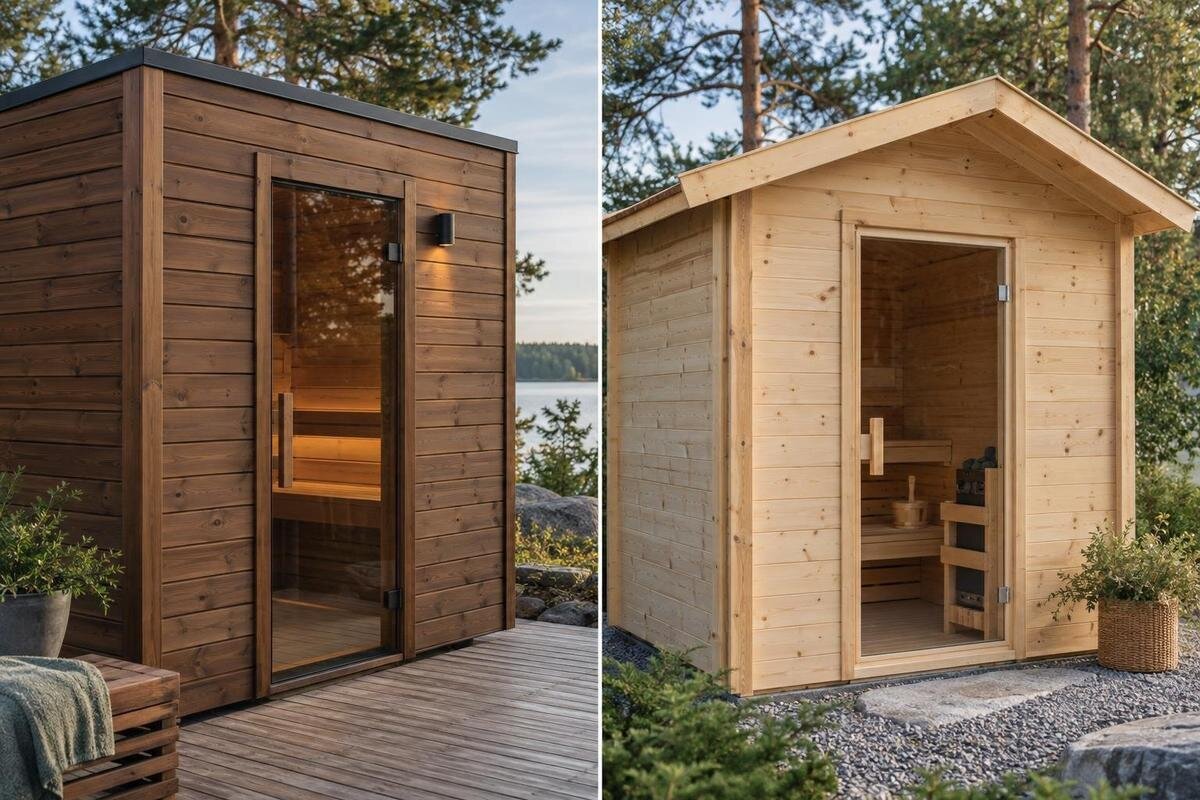
Outdoor sauna buying guide
An outdoor sauna’s timber has to cope with more than rain on a wall. Wind-driven showers, splashback, strong sun and slow drying in a sheltered corner create different conditions across one building. “Thermowood” and “untreated” are starting descriptions, not a complete forecast of appearance, durability or upkeep. To compare them fairly, identify which parts of the sauna use each timber, what treatments or coatings are present, how the maker expects it to be installed, and the written maintenance plan. That evidence matters more than treating either label as a promise of a maintenance-free exterior.
Buyer’s checklist 1
What “Thermowood” and “untreated” mean
Thermowood is commonly used for timber modified through a controlled heat process, but a word on a product page is not a complete specification. Ask which species is used, how the manufacturer defines the process, whether it applies to every exterior component or only selected parts, and what properties are documented for that timber. A process description is not a species name, a grade or a statement about the whole sauna. Do not infer a particular standard, performance figure, certification or chemical profile from the label. “Untreated” also needs a definition: it may describe the board before a finish is applied, or be used for wood without a specified preservative treatment. Ask the supplier to state exactly what is absent and what has been applied.
Keep the sauna’s material label separate from its product identity. The Sauna HC-150 is listed in the Thermowood Saunas range, with an area of 2.97 m²; those details identify a catalogue model, not the species, finish or treatment on every board. For any model, ask for a component-by-component timber specification and compare the named exterior cladding with the frame, roof trim and other exposed parts. A drawing with material call-outs is easier to interpret than a category name alone. If a product page gives only a model name and floor area, use those details to identify the exact version before asking for the build specification.
Check which parts of the sauna use each timber
A sauna can contain several timber zones, so “made from Thermowood” should not automatically be read as “every timber component is thermally modified”. External cladding, supporting frame, floor, roof edges and interior lining occupy different positions and may be specified separately. Benches and hot-room lining are a different question from weather-facing cladding; an interior material description does not establish what is used outside. Request a parts schedule, ideally marked on a drawing, that names the material, treatment and finish for each area. This shows whether the headline description covers the whole building or only selected pieces.
Use the parts schedule to work out exactly what you are comparing. For example, a description of thermally modified cladding does not answer a question about an exposed door surround made from another timber. Mark any unspecified pieces and ask the seller to complete those entries, rather than treating the headline material as a default for the whole structure. For the HC-225 product details, the supplied catalogue evidence identifies a Thermowood model with an area of 4.4 m²; the component schedule is still needed to establish the extent of that description. Keep separately specified pieces in your comparison, especially where they meet the main cladding. Otherwise, a choice based on the largest visible surface can overlook smaller exposed parts with different care requirements.
Buyer’s checklist 2
Assess rain, splashback and drying conditions
Rain exposure depends on the location as well as the material. Wind can carry rain onto faces that seem sheltered; water may run off a roof edge or splash back from paving and soil at the base. A wall close to a fence, planting or another structure may dry differently from an open face. Before choosing, note which sides are exposed, where runoff goes and whether the ground nearby is likely to stay damp. These observations do not replace the maker’s siting instructions. Check the exact model’s manual for requirements relating to spacing, the base, drainage and airflow rather than assuming general advice applies.
Prepare a short description of the proposed location, with photographs showing nearby boundaries, planting and ground surfaces. Record observations after rain where possible: a sheltered-looking corner may still receive runoff, and damp ground may not be obvious on a dry viewing day. This gives the supplier something concrete to assess against its siting guidance. If you are considering the N-210 outdoor sauna, ask whether the documented installation arrangement is compatible with that location. Do not treat heat modification as making wood waterproof or compensating for unsuitable drainage. Where the site needs work, separate that work from the material choice: buying a different timber does not establish that an unresolved water-management problem has been addressed.
How sun and rain change timber appearance
Both untreated and modified timber can change appearance outdoors. Sunlight and repeated wetting and drying may alter colour, while different exposure on each side can lead to uneven weathering. The finish supplied with the sauna also affects what you see. A small sample or a product image cannot promise how every elevation will look at your site. If a particular uncoated or weathered appearance matters to you, ask the maker what to expect from the exact timber, both with the supplied finish and without it. Check whether the answer describes normal variation or a specific outcome the manufacturer is willing to guarantee.
Decide whether you want to preserve the supplied colour or are happy for the exterior to weather, then compare the care implications of those two aims. Ask for photographs of the same timber and finish after outdoor exposure, with the age and conditions identified; an undated image cannot show how quickly a change occurred. For the N-250 model listing, use the product reference to request the relevant finish information rather than assuming the catalogue shade will remain unchanged. Also consider how visible differences between sunny and sheltered faces would look from your garden. Keep appearance separate from condition: a change in shade alone does not establish that a board is damaged or that a coating needs renewal.
Buyer’s checklist 3
Check the evidence behind durability claims
Treat broad phrases such as “more stable”, “water resistant”, “rot resistant” or “longer lasting” as claims to check, not as universal properties. They may refer to one species, process, grade, profile or surface treatment rather than every board in an outdoor sauna. Ask the manufacturer to identify the exact component and evidence behind each statement, including the conditions and comparison used. A result for one timber or test cannot automatically be transferred to a finished building exposed to rain, sun, ground splash and assembly joints. If comparable evidence is not supplied, treat a service-life prediction as unknown.
For a useful comparison, the evidence must address the same property under comparable conditions. A statement about reduced timber movement is not an answer to a question about decay, and neither establishes a coating-renewal interval. Untreated timber also needs to be identified by species and specification rather than treated as a single benchmark. When reviewing the LC-260 sauna details, separate any claim about its timber from a claim about the assembled sauna. Record the comparison material, the measured property and any stated limitations. If one seller provides a defined test result and another offers only a general description, that is a difference in the available evidence, not proof of a particular difference in outdoor lifespan.
Separate heat modification from coatings and preservatives
Thermal modification, a factory-applied surface coating and preservative treatment describe different things. A thermally modified board may also have a finish. Depending on what the supplier means by “untreated”, that description may refer to the timber rather than a separately stated surface finish. Only the specification can settle what is present. Do not infer “chemical-free”, a particular preservative or a certification from either label. Ask for the name and purpose of every treatment or coating, which surfaces receive it, whether it is applied at the factory, and what the manufacturer says about repairs or recoating. If a claim matters to your choice, request written evidence and check that it covers the component in question.
A coating record is useful later as well as at purchase. It should identify the product applied, the surfaces covered and the compatible approach to local repairs or renewal. Keep that information for the HCF-300 sauna model with its material specification so that a future owner or maintenance contractor does not have to guess what is already on the boards. Exterior and hot-room surfaces must remain separate in that record: a product intended for one is not automatically suitable for the other. If you want to add a finish to timber supplied uncoated, establish compatibility with the sauna manufacturer before buying the coating. A generic description such as oil or stain is not enough to identify an approved product.
Buyer’s checklist 4
Compare the actual maintenance schedules
Maintenance depends on the surface you receive, the location and the manufacturer’s instructions, not only on whether the wood is modified. One exterior may be intended to weather naturally; another may arrive with a finish that calls for particular cleaning or renewal. Untreated does not automatically mean no maintenance: the owner may still need to inspect or clean the timber as directed. Equally, do not call thermally modified timber maintenance-free unless the manufacturer says so for the exact product and explains the conditions. Ask for the care guide before purchase, including what the maker expects if you leave the exterior uncoated.
Turn each care guide into a practical list of tasks: cleaning, inspection, coating renewal where applicable, and attention to damaged areas or exposed ends. Note whether the maker specifies a fixed interval or signs that should trigger action, and whether the advice changes with exposure. For the HCF-225 product information, request the guide for the finish actually supplied, then consider how you would carry out those tasks at your site. Can you reach every exterior face, and would planting or a nearby boundary obstruct the work? Compare the effort involved, not just the number of scheduled visits. A brief inspection and a full coating renewal are different commitments, even when both appear under the heading of routine maintenance.
Inspect assembly details that affect water exposure
Construction details that hold water or restrict drying remain relevant whatever timber is specified. Check the assembly drawing for roof edges, joints, openings, board ends and the lower perimeter, then see whether the manual explains the intended base and clearance around the sauna. Fasteners, trim and replacement pieces may use different materials, so ask whether they need separate care. Do not alter a joint, cut a board or add a product based on generic online advice: a change may affect fit or conflict with the maker’s instructions. If a drawing leaves a practical question unanswered, ask for model-specific guidance or have a suitably qualified installer review it.
Maintenance access is worth checking on the drawing before the sauna is positioned. Identify any faces that would be difficult to inspect, roof-edge details that need attention, and components whose replacement would require other pieces to be removed. These are questions for the manufacturer or installer, not reasons to improvise changes to the design. Use the S-140 sauna listing to identify the model when requesting its current assembly documents; the supplied catalogue area of 1.93 m² does not describe the working space needed around it. Confirm which clearances the instructions require and whether your proposed location leaves access for the stated care tasks. A material choice is easier to maintain when the installation allows its care instructions to be followed.
Buyer’s checklist 5
Documents to compare before choosing
Make a simple record for each model. Note the species and grade of each exterior part, the type and extent of thermal modification if applicable, any factory-applied finish, and the maker’s stated exposure limits. Record the revision or date of the product specification so it can be matched to the configuration you would buy; a general brochure may cover several options. Where the seller uses terms such as “treated”, “untreated” or “Thermowood”, ask for a written definition. This is especially useful when an answer comes from a sales summary rather than a technical sheet, because it helps prevent two different components being compared under one label.
Add the installation and maintenance documents to those material notes. Look for conditions on location, cleaning, coating, exposed edges and replacement timber, and ask whether a recommendation applies to the whole exterior or just one finish. For performance or certification claims, request evidence that names the product or component and explains its scope; do not assume a test or certificate for raw timber covers the assembled sauna. If the documents are silent, ask a specific written question instead of filling the gap with a general rule. A precise answer is more useful than an unsupported statement about how long the product should last.
Choose by documented performance and upkeep
If you prefer a natural appearance and are comfortable with gradual colour change, ask whether the manufacturer supports an uncoated exterior and what inspection it needs. If reducing routine care is the priority, look for a documented schedule rather than assuming heat treatment removes all upkeep. For an exposed site, use the maker’s siting guidance and the specification for the weather-facing parts to judge suitability. Consider who will carry out the upkeep and whether those surfaces can be reached for inspection. These are personal priorities, not a universal ranking of timber types.
Where both options meet the documented requirements for your site, compare the ownership commitments alongside the purchase quotations. Include any finish you intend to use, the stated renewal tasks, access needed for maintenance and the arrangements for obtaining matching replacement timber. Use actual supplier information rather than assumed savings or lifespan figures. If one option has a higher initial price, ask what documented difference matters to you: the timber specification, the supplied finish or something else in the package. If the quotations contain different inclusions, separate those differences before attributing the price gap to thermal modification. This keeps the final choice focused on the exterior you will receive and the upkeep you are prepared to undertake.
Frequently asked questions
Does Thermowood mean an outdoor sauna needs no maintenance?
No. The label does not tell you whether the exterior has a finish, how the wood is meant to weather or what care the maker expects. Ask for maintenance instructions for the exact sauna and its supplied timber.
Is untreated timber automatically unsuitable for an outdoor sauna?
No, but the word alone cannot establish whether a particular sauna is suitable for your site. Check the timber specification, construction details, exposure guidance and maintenance plan for the exact model.
Does Thermowood prove that no chemicals were used?
No. The name does not describe every coating, preservative or other material in a sauna. Ask the supplier to identify any treatments and finishes, which parts they cover, and provide written evidence for any claim that matters to you.
Which option lasts longer outdoors?
You cannot reliably tell from “Thermowood” or “untreated” alone. Compare evidence for the exact exterior components, species, process, finish and exposure conditions. A broad label is not a service-life guarantee.
What documents should I ask the seller for?
Request a component-level timber specification, model-specific assembly instructions and a maintenance guide. Ask for details of any coating or treatment and evidence behind performance or certification claims. Check that each document applies to the configuration you are considering.
Neither material label settles the choice. What matters is what is used on the weather-facing parts, how the complete sauna is meant to be installed, and what care the manufacturer sets out for the supplied finish. Compare that evidence for the exact models and choose the maintenance commitment that fits your site and routine.
