
Wood-Fired Sauna Heaters: Internal or External Feed?
Sauna heating guide
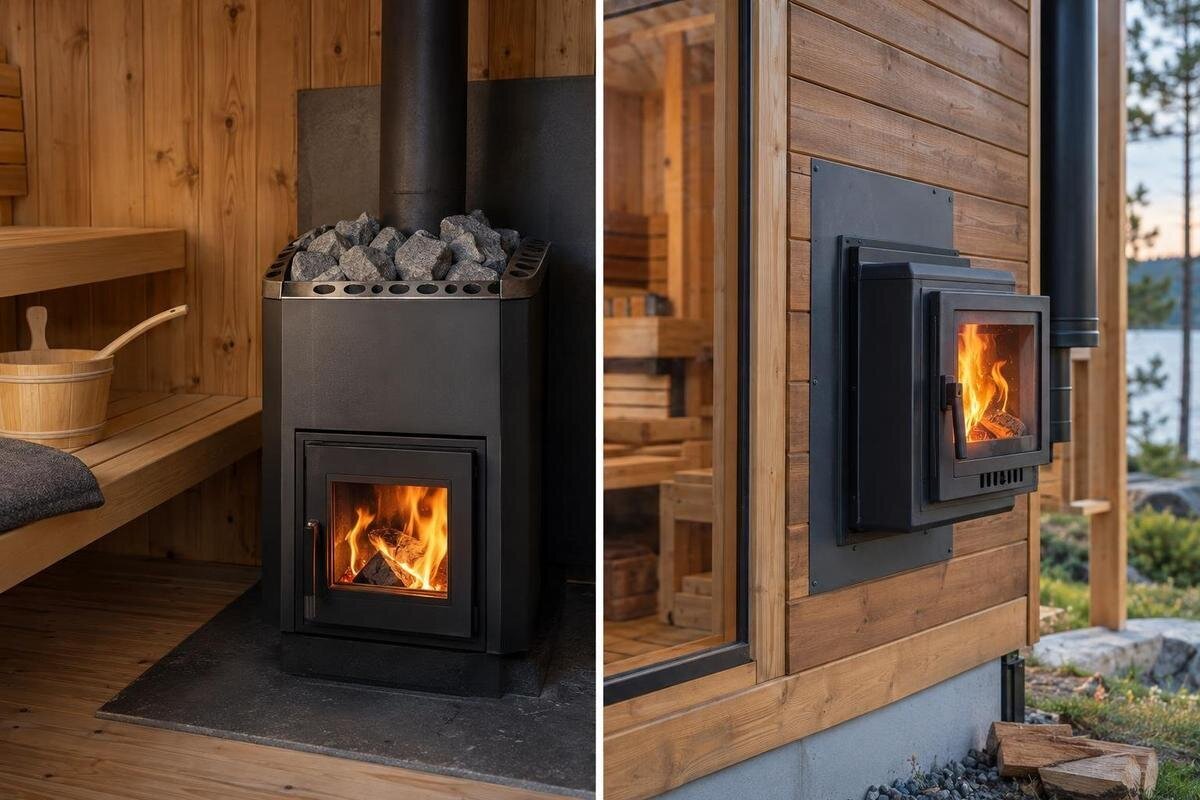
Choosing between an internal- and external-feed wood-fired sauna heater affects how you bring in fuel, move around the sauna and reach the heater for maintenance. Internal feed puts the loading door in the hot room; external feed puts it outside that room. Neither position is automatically better, safer or more powerful. The practical choice depends on the exact heater design, the cabin layout and where there is room to stand and tend the fire.
What internal and external feed mean
An internally fed wood-fired sauna heater has its loading door on the sauna-room side. The person tending it carries logs into the cabin and loads them there. An externally fed heater has its loading door outside the hot room, commonly on the other side of a wall or partition. This describes the access point, not a universal stove shape: the firebox, feed-through parts and flue arrangement vary by design. Check the manufacturer’s drawing for the exact version. A product photograph or short listing name may not show which side is intended for loading.
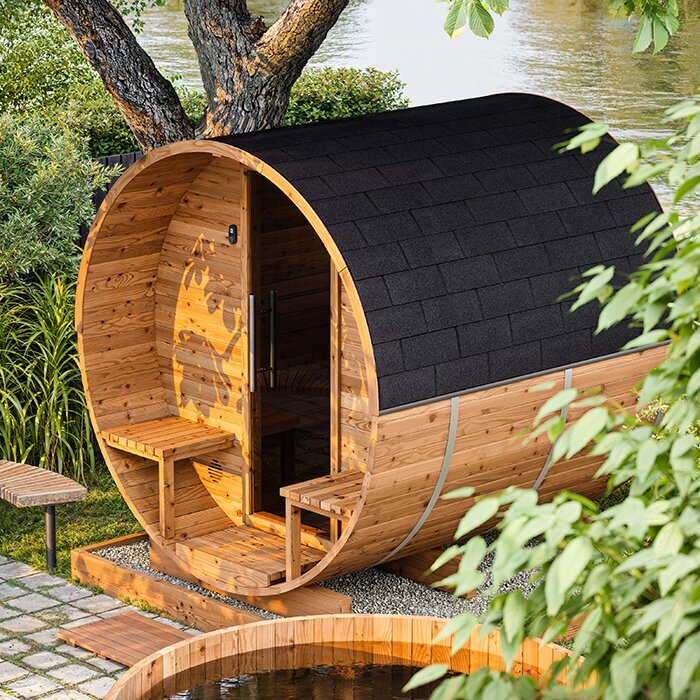
Feed location is not a performance label: it cannot by itself tell you the heater’s output, warm-up time or suitability for a particular cabin. Those depend on the model and its installation. Nor should you treat a standard heater as reconfigurable unless its maker specifies that option. When comparing descriptions, distinguish the sauna entrance from the heater’s loading door: an externally fed heater is loaded from outside the hot room, but that need not mean outdoors. It could face a separate adjoining space if the documented design permits it. For a cabin such as the Thermowood Barrel Sauna HCF 300, ask for a drawing identifying both doors and the proposed heater version. The supplied catalogue information identifies the cabin, not an approved heating arrangement. This distinction helps you compare like-for-like proposals rather than assuming that an illustration of one configuration represents every option.
How loading changes the route for firewood
Map the route from where firewood is kept to the loading door, rather than considering only the heater’s position. With internal feed, each load has to pass through the sauna entrance and across the room. Doorways, thresholds, steps and the distance from a wood store can all affect how convenient that feels. External feed moves the final loading point outside the hot room, but still requires a clear route to the other side of the cabin or partition. Think about where the person carrying the logs will walk and stand, not just where the heater will sit.
Tending a wood-fired heater involves more than the first load, so consider repeated trips as part of the routine. Internal feed avoids leaving the sauna to add wood, but fuel has to be brought in and handled in the room. External feed can keep more of that activity outside, while requiring access to the external door each time. Trace the complete journey in both directions, including the return trip when the person tending the fire rejoins the sauna. A shorter route is not necessarily easier if it includes an awkward doorway or passes through a busy seating area. If you are considering the Thermowood Barrel Sauna HCF-225, use its cabin plan alongside your site sketch to compare those journeys. Note where carrying logs would interrupt someone entering or leaving; that is a practical difference an overall floor-area figure cannot reveal.
Space around the heater door
The loading door needs an accessible approach as well as space for the heater itself. With internal feed, allow for a person to reach and operate the door without blocking the usual route to the entrance or benches. Its opening direction and the way fuel is handled matter; follow the clearances in the heater instructions rather than estimating them from a photograph. External feed removes the need to stand at the loading door inside the sauna, but it does not remove the heater from the room or cancel the clearances required around it.
A useful plan shows the entrance, benches, heater, loading-door position and the space needed to move around them. Distinguish the space occupied by the heater from the space used when its door is open and someone is tending it. These are different considerations, and neither replaces the manufacturer’s required clearances. Check whether a person approaching a bench would need to pass immediately behind whoever is loading the fire, or whether the open door would interrupt the route to the sauna entrance. The listing for Sauna S-140 states 1.93 m², but that overall figure cannot resolve these details. Request a dimensioned layout showing the proposed heater rather than comparing cabin areas alone. When reviewing seating, consider access with the sauna occupied, not just an empty floor plan. Do not trade required clearances for an extra seat.
The wall opening in an external-feed layout
External feeding brings the wall or partition into the heater choice. The heater must be designed for the specified external-loading arrangement; a door extension or feed-through cannot be assumed to fit a standard model. Wall thickness and construction, the position of the opening and the heater components that pass through it all need to match the manufacturer’s design. Do not plan an opening or modify the cabin around a generic diagram, and do not assume that two heaters with similar names use the same parts.
Have a qualified sauna-heater installer assess the exact cabin wall, heater and flue route against the manufacturer’s instructions, including the required clearances and suitable surfaces. Give them information about both sides of the proposed wall, not just a photograph of the sauna interior. An adjoining room, an outdoor loading point and a narrow passage present different access questions, even though each might be described as external feed. If the loading door would face an exposed or unheated area, ask the manufacturer whether that location suits the specified configuration. For the Sauna HC-150, request the relevant cabin construction details before discussing a wall opening. The supplied listing does not establish an external-feed option. Confirm who will provide the compatible design and assess it before making the opening part of your purchase plan.
When the loading door is inside the sauna
An internal loading door can suit a site where access to the outside face of the sauna is awkward, or where the person tending the fire would rather remain in the room. It avoids a separate trip outside when adding wood, but it does not remove the need to carry fuel into the cabin. Consider the route through the entrance and where a load can be handled without blocking the way. Follow the heater instructions for where fuel may be placed and keep the approach to the door unobstructed.
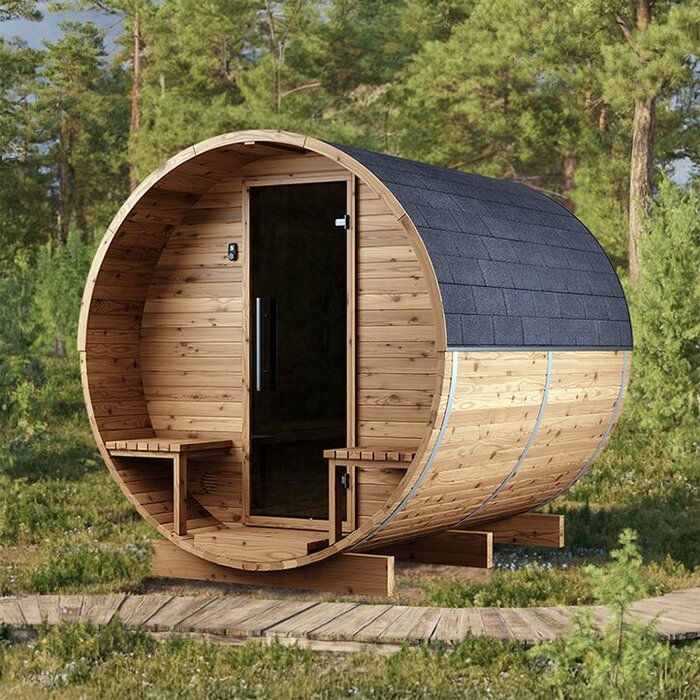
The loading routine also takes place in the sauna itself. Carrying logs inside can bring bark or small pieces of wood with them, and opening the loading door means working beside the heater in the room. Think about whether someone tending the fire would interrupt a conversation, need another person to move, or have to cross the usual path between the entrance and benches. These are questions about the layout, not reasons to assume internal feed is unsuitable. If everyone can remain comfortably clear of the loading activity, keeping it within the room may fit your routine well. When comparing the Thermowood Barrel Sauna HC-225, ask to see the proposed loading-door position relative to the seating. A photograph taken through the entrance may not show that relationship clearly, particularly when the heater door is closed and the cabin is empty.
When the firebox is loaded from outside
External feed can reduce the need to carry each log through the sauna and lets the loading point sit in an adjacent space or on the other side of the cabin. That may be appealing if you want to keep fuel handling separate from the room where people sit. It does not mean that every part of tending or cleaning happens outside, though; the heater manual determines which tasks are carried out from which side. Nor does an external door make a poor approach convenient simply because it is outside the hot room.
Check whether there is enough room to stand at the loading door and a clear route to reach it throughout the year. If the door opens outdoors, access and exposure to the weather are part of the routine; if it opens into another space, consider how that area is used. A loading point beside a frequently used doorway may still interrupt other people, even though it is outside the sauna. Also consider whether the person tending the fire can leave and return without making an awkward detour around the building. For the Sauna N-210, mark the proposed external loading point on your site sketch and include nearby doors, boundaries and stored items. This helps distinguish genuinely separate fuel handling from simply moving the same obstruction elsewhere. Keep the required access available in ordinary use, rather than relying on moving furniture every time.
Combustion air, draught and smoke are separate questions
Where wood is loaded does not, on its own, determine how the heater receives combustion air or how the sauna is ventilated. An external loading door does not automatically mean the heater draws air from outside, and an internal door does not describe the full ventilation arrangement. The heater, cabin and flue need to be considered as one installation, following the manufacturer’s instructions. Do not infer an air route from the position of a feed-through or from a product photograph.
The feed position also cannot guarantee that smoke will never enter the sauna. The firebox, loading door, flue and way the heater is operated all matter, so ask a qualified installer about the complete proposed arrangement rather than treating external loading as a smoke-control feature. Keep the questions separate: where will wood be loaded, how will combustion air be supplied, and how will the sauna be ventilated? Clear answers to one do not establish the others. If you are discussing the Sauna N-250 with a supplier, request the proposed heater and ventilation information together, so the installer can assess the same configuration you intend to buy. Avoid comparing air supply or draught from cabin photographs. Those images may help you understand the appearance, but they cannot show whether the complete installation has been properly specified.
Service access is not the same as loading access
A loading door tells you where to put the wood; it does not tell you where inspection, cleaning or repair can be carried out. A heater may require access to parts or maintenance points from a side other than the loading door, and that can be true of either feed layout. Check the heater manual for the tasks it describes and the access each one needs. Keep that space in mind when planning the cabin, so routine use or stored items do not obstruct it.
Ask the supplier or a qualified service professional which sides need to stay reachable after the sauna is assembled, and whether access is needed around the flue or other connected components. Discuss ash removal separately from adding logs: do not assume that both tasks use the same opening or require the same working space. The manual should establish the maintenance arrangements for the exact heater. When reviewing a proposal for the Sauna LC-260, have the necessary service access identified on the layout alongside the loading position. Consider whether a technician could reach those points without first dismantling unrelated fittings or moving permanently installed furniture. This is particularly useful when one side of the cabin is close to a boundary or another structure. A plan that works for daily loading should also allow the maintenance specified by the manufacturer.
Check the whole cabin-and-heater plan
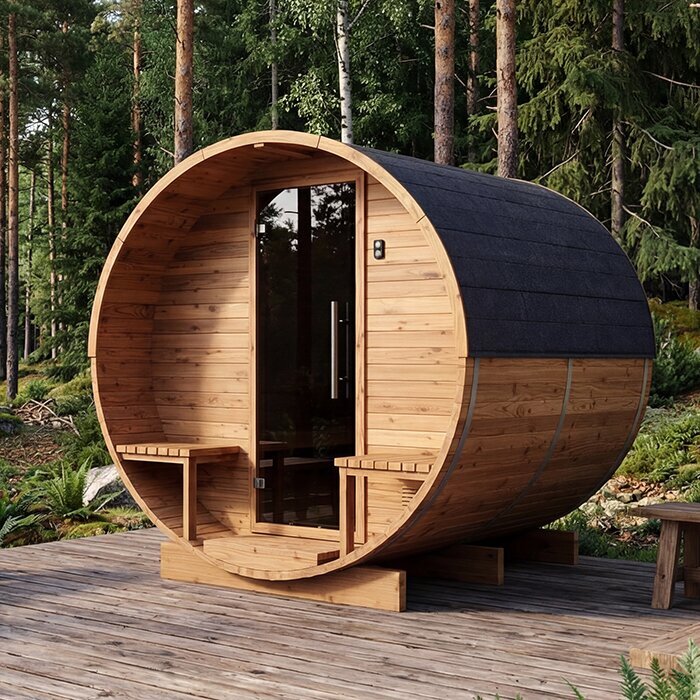
Compare the exact cabin and heater models, not just the words “internal feed” or “external feed”. Put the two proposed arrangements on equivalent plans, using the same bench layout and entrance position wherever possible. Otherwise, a change in seating or cabin size can look like a benefit of feed location when it is really a different design. For each option, identify the heater version, loading-door side, fuel route and service access. Keep manufacturer-required clearances distinct from the additional space you would prefer for convenient movement. Record any unanswered questions rather than filling gaps with assumptions from a similar model. This gives the supplier and installer a clear basis for explaining which combinations are supported and which layout differences genuinely result from the loading arrangement.
The sauna catalogue listings linked in this guide identify cabin models and provide an area figure, but they do not establish compatibility with a wood-fired heater or either loading layout. Ask the supplier or manufacturer to confirm the exact combination if the documentation is unclear. Keep that confirmation with the drawings and heater instructions, and make sure they refer to the same version. If a proposed model or component changes during ordering, ask whether the earlier layout assessment still applies. Give the final cabin details and heater configuration to a qualified installer for assessment. A comparison is only useful when both options are sufficiently defined; an attractive external-feed sketch without a supported heater arrangement is not yet an alternative to a documented internal-feed proposal.
Which feed layout suits your routine?
Give most weight to the route you and the fuel will actually take. Internal feed may be more convenient if you want to tend the heater from the sauna side and can bring wood through the entrance without obstructing the room. External feed may suit you if you prefer to handle logs outside the hot room and can reach the external loading door easily. Consider who will tend the fire and whether that person normally stays in the sauna or spends time in an adjoining space. Also think about how the arrangement works when several people use the cabin, rather than judging it only for a single user. Decide which inconvenience matters more to you: carrying fuel through the sauna or making a separate trip to load it. That preference can help choose between two otherwise suitable, documented options.
Treat a verified fit as the first requirement, then use everyday convenience to choose between compatible options. External loading can lose its advantage if the outside approach is awkward; internal loading can be inconvenient if carrying and handling wood in the cabin does not suit the layout. If neither arrangement gives the access and circulation you need, reconsider the heater or cabin rather than adapting an unverified design. There is no universal winner: the better layout is the one that works with the documented installation and the way the sauna will be used.
Frequently asked questions
Does an externally fed heater heat a sauna better?
Not simply because it is loaded from outside. Feed location alone does not establish heat output, warm-up time or how a particular heater suits a cabin. Compare the exact heater’s specifications and installation instructions with the cabin, and have the proposed configuration confirmed.
Can a standard internal-feed heater be converted to external feed?
Do not assume so. An external loading arrangement must be specified for that heater, including any required feed-through components. Extending a firebox or cutting a wall to suit an unverified design is not a substitute for a manufacturer-supported configuration and professional assessment.
Will external feeding keep wood dust and smoke out of the sauna?
It can reduce the need to carry each log through the hot room, but it cannot guarantee a dust-free or smoke-free sauna. Ash handling, the heater door, flue design and operation still matter. Check the manual for the particular heater.
Which feed layout is safer?
Neither is automatically safer. The exact heater must be installed in the configuration specified by its manufacturer, with the required clearances and suitable access. A qualified sauna-heater installer should assess the cabin, wall and flue arrangement.
Is an externally fed heater harder to service?
The loading-door position does not answer that. Service access depends on the heater design and the maintenance tasks set out in its manual. Ask which side needs to remain accessible for inspection, cleaning and any work on the heater or flue.
Internal feed keeps the loading point in the sauna, while external feed moves it beyond the hot room and adds an access route and wall arrangement to plan. The right choice depends on how fuel and people will move around the actual cabin, as well as the heater’s documented configuration and service access. Treat feed direction as one part of the complete layout, not as a shortcut for judging heater performance or compatibility.
