
Removing Algae from Pergola Posts and Surrounding Paving
Pergola care guide
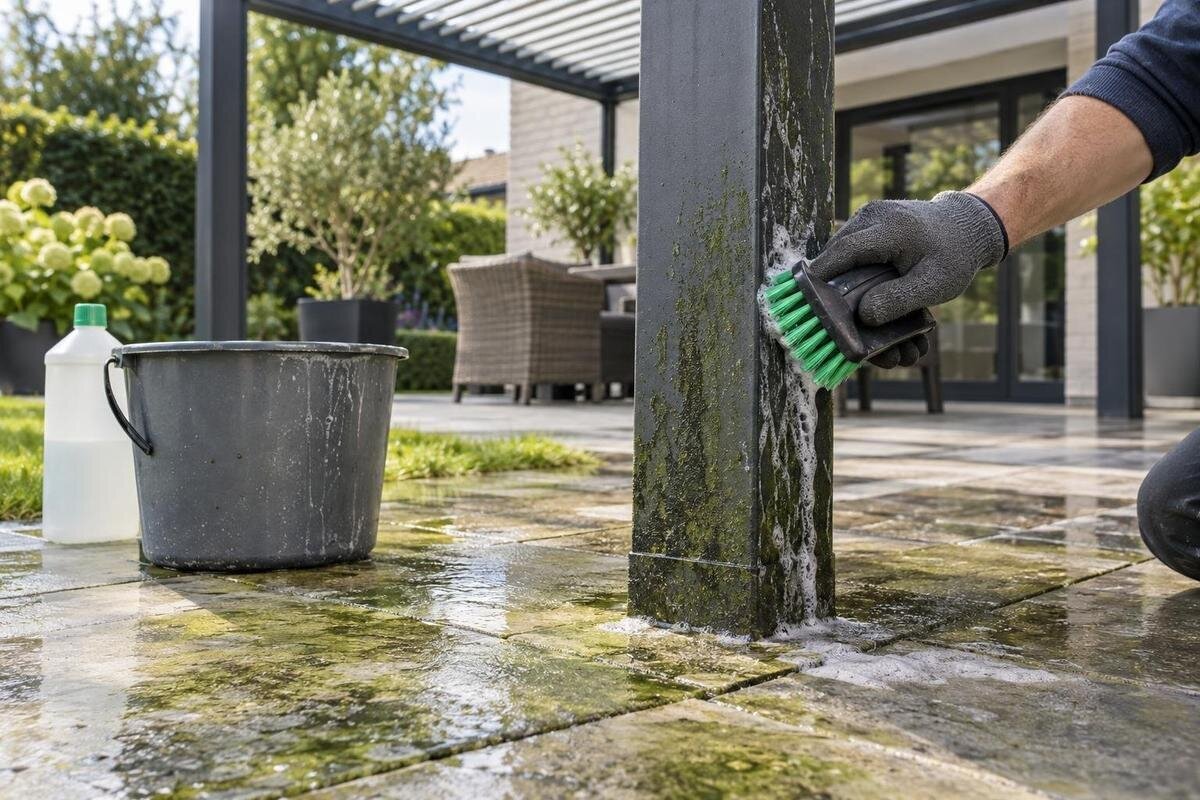
Green growth on a pergola post and nearby paving may look like one cleaning job, but the two surfaces can need different methods. A treatment intended for paving can mark coated aluminium if it splashes onto the frame, while runoff can carry cleaner back to the posts. First identify the finish and paving material. Clean the frame only with methods allowed by its care instructions, then choose a paving method labelled for the actual surface. Start gently, work in a controlled way and watch where rinse water goes. If a mark persists or the finish changes, stop rather than reaching for a stronger chemical.

Cleaning checklist 1
Identify the mark and both surfaces
Algae often grows where a surface stays damp, but a green or dark mark does not confirm what it is. Dust, leaf stains, mineral deposits, pollen, mould-like growth and changes in a coating can look similar. See whether a light wipe with clean water removes a surface film; do not scrape, sand or use a wire brush to find out. If the mark persists, or the post feels powdery, rough, blistered or raised, stop before using a stronger cleaner. Note where the mark appears and how the finish looks in good light.
Identify the pergola finish and the paving separately. Check the care manual, order documents or product identification before choosing a cleaner; appearance alone may not tell you whether a post is coated aluminium or what kind of coating it has. If you need a model name, the Bloomcabin Wall-Mounted Pergola listing can help you refer to a product, but its title does not establish the finish on your installed unit or approve a cleaning method. Note which details are confirmed and which are still unknown, rather than treating a visual match as identification. For the paving, look for information about the surface material, sealer and joints as separate items. If the paperwork is missing, ask the supplier for guidance using a clear photo of the actual post. Explain whether the mark is on the upright face, around the base or on both surfaces, so the query is specific.
Keep frame and paving cleaners separate
The frame finish and the paving may react differently to the same cleaning product. A treatment intended for paving is not automatically suitable for coated aluminium, and spray or runoff can carry it onto the posts. Likewise, a method gentle enough for the frame may not remove growth from textured or porous paving. The Bloomcabin Pergola listing can serve as a model reference when gathering care advice; keep the paving details separate so instructions for one surface are not mistaken for instructions for the other. Before opening a cleaner, decide exactly where it will be used and which nearby surfaces must be kept clear of it. Pay particular attention to the boundary around each post base, where the two cleaning tasks meet. Treating this narrow area carefully is more useful than choosing one strong product for the whole patio.
Treat each surface as a separate task. Use a dedicated soft cloth or sponge for the frame and a separate brush for the paving, so grit or paving cleaner is not transferred between them. Keep used tools apart from clean ones, and do not put a cloth used for paving treatment back into the frame-cleaning water. If you clean the posts first, use a controlled rinse; then protect the frame while treating the paving. Follow the product label and care manual for rinsing rather than assuming that extra water will make an unsuitable product safe. Finish and put away the materials for one task before preparing the next.
Cleaning checklist 2
Use a gentle method on coated aluminium posts
Follow the care instructions for the installed finish before using detergent or an algae treatment. For light surface growth, start with clean water and a soft, non-abrasive cloth or sponge. Use a mild detergent only if the frame’s instructions allow it, and follow its label. Even a product described as gentle or neutral is not automatically compatible with every coating. Avoid abrasive powders, scourers and strong household or paving cleaners unless the finish manufacturer specifically approves them.
Remove loose grit before wiping, so particles are not dragged across the coating. Work on a small area with light pressure, then rinse any permitted cleaner as directed and check the result once dry. Keep the first cleaned area small enough to compare with the surrounding finish. Look at whether the surface film has lifted without a change in colour or texture, rather than judging success while everything is wet. Do not try to polish away a mark or force water into joints and fittings. If you need to request an approved method, identify your model using a reference such as the Bloomcabin Bioclimatic Pergola page and include a photo of the actual finish. Describe the gentle method already tried, including whether it removed any loose material. This gives the supplier a clearer question than simply asking for a stronger algae remover.
Choose a treatment for the paving material
Paving can be concrete, clay pavers, natural stone, porcelain or another material, and it may also have a sealer or treated joints. Those details affect which cleaners and tools are suitable. Some natural stones and cement-based joints, for example, can be affected by acidic products. Check the paving maker’s advice and the cleaner’s label for the exact surface, including any coating or jointing material, rather than choosing a product just because it is sold as an algae remover.
Begin with water and a brush appropriate to the surface; a firm non-metal brush may suit robust paving if its care instructions allow it. Work on a discreet patch and check the surface after it dries before continuing. Choose a patch that includes the material you intend to clean, rather than testing only an adjacent surface with a different finish. If growth remains, use only a treatment labelled for that paving and follow its directions. For a patio with a regular Bloomcabin pergola, record the paving material and any sealer separately from the pergola details. If the patio contains more than one paving material, do not extend a successful test to all of them automatically. Keep the treatment within the area it is intended for, and assess the surface and joints before working across the rest of the patio.

Cleaning checklist 3
Control splash and cleaning runoff
Before applying a paving treatment, sweep away loose leaves and move furniture or other items that could collect spray. Apply the product in a controlled way rather than spraying widely towards the posts. A temporary splash shield can help, but do not stick tape to the coating or leave a cover in place longer than needed. Where a wall-mounted pergola adjoins the cleaning area, include the wall edge in your assessment of where splashes and rinse water could go. Check the actual layout rather than assuming that water will travel away from the frame. Plan where you will stand and where you will rinse each section, especially beside post bases. The shield should be an additional precaution, not a reason to spray freely. Check behind and around it as you work so that collected liquid does not remain unnoticed against the finish.
Read the product label for dilution, contact time, rinsing and disposal. Do not use a stronger mixture, let a product dry on the frame or combine different cleaners. Before starting, check where water will drain and prevent concentrated cleaner from collecting around post bases, entering joints or running onto planting or water features. Keep the rinse controlled and follow the label’s directions for cleaning up any leftover product.
Suitable brushes and pressure-washing precautions
Keep tools appropriate to each surface. A soft cloth is a safer starting point for coated posts; avoid steel wool, wire brushes, abrasive pads and hard scraping tools that can scratch or wear the finish. Use a separate brush on paving, and rinse grit from it before use. Choose the tool for the surface being cleaned, not simply for how quickly it removes the green layer. If a brush needs heavy pressure to shift a mark, pause rather than changing to a more abrasive tool. For a model such as the bioclimatic pergola, ask specifically which tools and washing methods its care instructions permit. A product listing alone does not answer that question. Pressure washing should not be treated as the automatic next step when wiping has not worked.
Pressure can also disturb some paving surfaces or joints, depending on their material and condition. Try a controlled rinse and suitable manual brushing before considering a pressure washer, and follow the paving manufacturer’s instructions if you do use one. Do not direct jets at seals, openings, fittings or electrical components. Check whether you can keep the spray within the intended paving area throughout the task, including when changing position. If you cannot avoid the frame or nearby fittings, use a different permitted method rather than trying to complete that edge with a jet.
Cleaning checklist 4
When a mark remains after cleaning
If gentle cleaning has not removed the growth, do not immediately reach for bleach, acid, alkali, solvent or a concentrated algae treatment on the frame. Use a product there only when the finish manufacturer explicitly permits it. A label that names paving does not mean the product is safe for coated aluminium; words such as natural or biodegradable do not establish compatibility either. Never mix cleaners, and follow the product label for handling and rinsing.
Allow the surface to dry before deciding whether a mark remains. It may be a stain, residue or a change in the finish rather than algae that needs a stronger treatment. Compare the cleaned patch with the untouched area and note what changed: whether the loose film came away, whether a discolouration remains, and whether the surface still feels the same. These observations help describe the problem without assuming its cause. Keep the notes with your model reference, such as the Bloomcabin Pergola page, and record the cleaner and method already used. If you ask for advice, explain the result of that first attempt rather than repeating the cleaning with several different products. Leave the remaining mark alone while seeking guidance; repeated treatments make it harder to distinguish the original problem from a reaction to cleaning.
Make the cleaning area safe
Wet algae and cleaning solution can make paving slippery. Keep children and pets away from the work area until it has been rinsed and dried, and avoid walking across wet sections. Wear footwear with a secure grip and use gloves or eye protection if the product label calls for them. Plan to reach posts from stable ground; do not climb on the pergola or stand on an unstable surface to reach higher areas.
Set out clean water, separate tools and the product label before you begin, so you are not carrying a chemical-soaked cloth across the patio. Work in manageable sections and keep containers closed when not in use. If wind carries spray towards the frame, people or nearby plants, pause and change the method. Stop if the surface reacts unexpectedly, rather than finishing the area with a product that may be incompatible.

Cleaning checklist 5
Reduce dampness and debris that encourage regrowth
Algae is more likely to return where moisture lingers and debris collects. Once the area is clean and dry, look for leaves, soil or other material gathered around the post bases and on the paving. Sweep these away regularly. Notice whether nearby irrigation repeatedly wets the same spot or whether a drip keeps one part of the surface damp. Compare that location with nearby areas that dry more readily, and note whether growth returns in the same place after cleaning. This is more informative than treating the entire patio more often without looking at the pattern. Where practical, address simple sources of overspray or debris without altering the pergola or making changes to its structure. Keep this routine maintenance separate from any repair needed to resolve persistent water problems.
There is no single cleaning interval that suits every site: shade, exposure, rain and nearby plants all affect how quickly growth returns. Inspect the area from time to time and clean light buildup using the method allowed for each surface. If water repeatedly pools or paving joints look loose or damaged, more chemical is unlikely to resolve the underlying issue. Get advice on the paving or drainage problem instead of increasing the strength or frequency of treatment.
Stop if the finish or structure looks damaged
Stop cleaning if the coating blisters, flakes, changes colour or texture, or if you see corrosion or pitting beneath it. Repeated scrubbing or another chemical can make the damage harder to assess. A loose post, visible movement or a cracked component is not an algae-cleaning problem; do not use cleaning as a way to test or correct it. Keep clear of the affected area and ask an appropriate professional to assess damage or repairs.
For a cleaning or support query, record the pergola model, the finish if known, the paving material, the cleaner and how you applied it. Take a wider photo showing the location and a close-up of the mark, ideally before further cleaning. Make clear which surface each photo shows, especially if the paving and post have different symptoms. The Wall-Mounted Pergola product page can provide a model reference, but include your order details to identify the installed unit more precisely. Describe any visible damage separately from the green growth, and explain whether it was present before cleaning or became noticeable afterwards. If you do not know, say so rather than guessing. Ask for the relevant care instructions or repair guidance before trying a stronger treatment; a cleaning enquiry should not assume that a damaged finish or component needs only another wash.
Frequently asked questions
Can I use the same algae remover on the pergola posts and the paving?
Only if the product is labelled for the exact paving material and the pergola’s care instructions explicitly allow it on the frame finish. Otherwise, treat them separately: use an approved gentle method on the posts and a paving-appropriate method nearby. Keep the paving treatment and its runoff off the coated aluminium.
Is bleach safe for algae on coated aluminium?
Do not assume it is. A product that is suitable for one type of paving may mark or damage a coated finish. Use bleach on the frame only if the finish manufacturer explicitly permits it and the product label covers that use. Never mix bleach with other cleaners.
Can I pressure-wash the paving around a pergola?
That depends on the paving, its joints and the manufacturer’s instructions. High-pressure water can damage some surfaces or disturb jointing, and spray can reach the frame. Try a controlled rinse and suitable brush first. Use a pressure washer only when guidance for both the paving and the pergola allows it.
Why does algae come back after cleaning?
Growth can return where surfaces stay damp, shaded or covered with debris. Look for leaves collecting at post bases, sprinkler spray or water that remains on the paving. Removing debris and addressing a manageable source of moisture may help, but persistent pooling or failing joints need attention beyond another round of cleaner.
What should I do if the green mark will not come off?
Let the area dry, then check whether the mark remains in the surface or the finish has changed. Do not respond by scrubbing harder or using a stronger chemical. Photograph the area and note the pergola model, surface materials and any cleaner already used; ask for guidance before trying another treatment.
A careful clean starts with identifying the surfaces, not choosing the strongest algae remover. Use only approved care methods on coated pergola posts, select a separate treatment for the paving material and keep splashes and runoff under control. If the mark resists gentle cleaning or the finish changes, pause and get guidance before proceeding. That way, removing growth does not create a new problem for the frame or paving.
