
Dismantling and Reinstalling an Aluminium Pergola
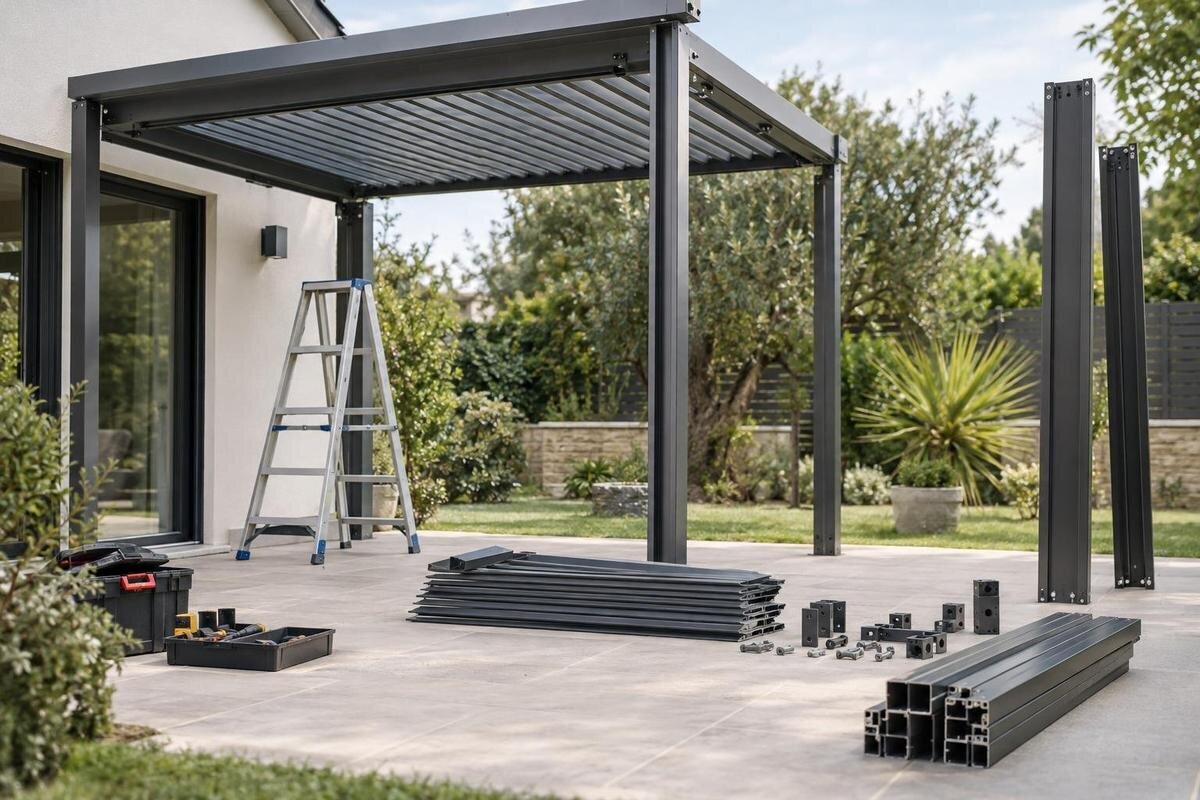
Pergola relocation guide
Moving house or redesigning a patio? An aluminium pergola may sometimes be dismantled and put up elsewhere, but being made of aluminium does not make it automatically reusable. The answer depends on the exact design, the condition of each part, the original fixings and whether the new site can support the same arrangement. Treat it as a fresh installation assessment, not a simple lift-and-shift. Gather the available records and ask a pergola installer or supplier to assess the structure and destination before booking the move.

01
Can an aluminium pergola be moved?
It can be possible, but the material alone tells you very little about whether a pergola can be relocated. Some systems are assembled from separate posts, beams and roof pieces; moving them may still disturb joints, seals, alignment or finishes. Age, corrosion, impact marks, previous repairs and the original installation all matter. A structure that looks straight from below may have damage at a connection, while a visible scratch alone does not prove that it is unsafe. The question is not simply whether the frame can be taken apart, but whether the whole system can be dismantled, transported and reassembled in an approved configuration.
A move also changes the supporting conditions. The old patio, paving, wall or footing may not match the new surface, and a frame that fitted one layout may not fit another. Treat the project as a new installation using a reused component set, rather than as a simple lift-and-shift. Ask the original supplier or a pergola installer familiar with the make to confirm whether the exact model is intended to be dismantled and whether its main parts can be reused. If that cannot be established, do not rely on appearance or a general guide; arrange an assessment before booking transport.
Identify the exact pergola and find its documents
Before discussing dates, gather the invoice or order confirmation, model or serial label if available, purchase date, original assembly manual, technical drawings and any service notes. Record the installed arrangement as far as you know: its layout, whether it is free-standing or attached to a building, and which roof, screen, lighting or control options are present. Take clear photos of all sides, visible connections, post bases, wall brackets, labels and any damage. Photograph accessible parts from a safe position; do not open electrical housings or remove covers to find a label. Dated pictures and a parts list help an installer ask precise questions and reduce the risk of ordering a similar-looking but incompatible part.
A catalogue name is not enough to identify the unit. The Bloomcabin Pergola product listing gives one product name, but a pergola bought earlier or supplied in another configuration may not match every catalogue detail. Check the original paperwork or ask the supplier to confirm the exact model; do not infer it from colour or a photograph. Request model-specific installation instructions and technical drawings, along with guidance on whether the unit may be dismantled and reinstalled. If records are missing, provide label photographs, order details and close-ups of connections. Instructions for a visually similar structure are not evidence that its parts or fixings are interchangeable.
02
Check which components can be reused
Assess the parts by function, not just appearance. A professional should examine posts and beams, brackets, connector faces, roof sections, gutters, seals and any accessories that will be moved. Record bent sections, dents, crushed edges, cracks, loose joints, damaged threads, enlarged holes, coating loss and corrosion, particularly around connections and post bases. These are observations to report, not a home diagnosis: a mark may be cosmetic, while damage at a joint may need closer assessment. Ask the installer to separate parts that can be reused from those needing a specified replacement or further inspection. If the frame has been repaired before, share when and how if you know.
A clean-looking component is not automatically serviceable. Dismantling may reveal damage hidden by a cover or bracket, so agree how unexpected findings will be handled and whether work pauses for your approval. Do not straighten a bent profile, enlarge a hole, substitute a convenient bolt or rely on sealant to make a poor joint fit. Ask the manufacturer or supplier to identify replacement parts for the exact model and configuration before mixing components. If you are comparing replacement parts with a complete new pergola, keep these as separate enquiries: the Bloomcabin Bioclimatic Pergola listing describes a product, not a source of confirmed compatible spares for your existing structure. Seals and small fittings also need individual assessment; their size or cost does not establish that old ones remain suitable.
Assess the old anchors and fixings separately
Fixings are a separate question from the aluminium frame. Before dismantling, record the position of visible base plates, anchors, bolts and wall brackets. The installer should identify what each one is fixed into, such as a concrete base, masonry or another support. Removal can damage a fastener or the material around it, and hardware that survives may still have been selected for the original surface. A bolt that fits a hole is not necessarily suitable for a different base or wall. Do not plan on reusing every anchor because it looks intact. Ask the installer to state which fasteners, if any, can be reused and which must be replaced with components confirmed for the new site.
The supports at both sites need attention. At the original site, agree how exposed holes and any damage from removing anchors will be dealt with. At the destination, existing footings or a slab may not match the pergola's support positions or suit the proposed arrangement. Have a qualified installer or structural professional assess the support and identify any new work. If you are considering a wall-mounted replacement, use the Bloomcabin Wall-Mounted Pergola page to identify the product in your enquiry, then ask which fixings and brackets the proposed wall requires. Provide available pictures and information about that wall for a site-specific review. Do not drill new holes or modify brackets on the assumption that the new positions will line up.

03
Assess the new site from scratch
Measure the destination independently. Check the space the pergola will occupy, the position of posts or wall connections, nearby doors and windows, paths, drains, gutters, fences, trees and overhead obstructions. Note the surface type, any slope or uneven areas, water run-off and where rainwater from the structure could go. Allow for usable access around the pergola rather than measuring only the rectangle of the old footprint. Moving from paving to a deck, lawn or different patio is not an equivalent installation just because the area looks large enough. The installer must confirm the clearances and suitable supports for the exact model and arrangement.
Take site photos from several directions and mark the intended outline on a sketch, including boundaries and nearby fixed objects. Share these with the installer alongside any drawings or information you have about the surface; do not guess what lies below paving. The professional should also consider exposure to wind, drainage and access for installation. If a replacement is more practical, the Bloomcabin Pergola is listed in configurations from 9 to 24 m². Use that range for an initial comparison, then request the exact dimensions and support requirements for the configuration you are considering. Compare those details with your site sketch: the listed area alone does not establish whether the post positions, access or overall layout will work.
Check a new wall before reusing a wall-mounted pergola
If the existing pergola is fixed to a building, assess the attachment separately from the frame. The new wall may be made from a different material or have different fixing positions, concealed services, cladding or weatherproofing details. A finish such as plaster or cladding is not by itself proof of a suitable structural attachment. The installer should identify the supporting substrate and review the proposed position, support points, clearances and water-management details. Existing brackets may suit one specific arrangement; they are not automatically suitable for another wall or for converting the pergola to a free-standing configuration.
Ask who will check the wall and whether that assessment is included in the relocation quote. Photos of the proposed attachment area are useful, but may not reveal the construction behind a finish. If the new building is still being designed, include the pergola attachment in the discussion before the wall is finished. When comparing a new unit with relocating the existing one, refer to the wall-mounted pergola product page and ask for the attachment requirements of the proposed configuration. This gives the wall assessment a specific design to consider. Any change from the original mounting arrangement needs manufacturer or professional approval; do not assume that old brackets can be adapted or that an alternative attachment can be improvised.
04
Treat moving parts and electrical components as a separate job
List any parts that move or connect to services separately. Depending on the model, a pergola may have adjustable roof sections, screens, lighting, sensors or powered controls; these are possibilities, not features to assume. Record visible product labels and take photos of accessible components, wiring routes and control units without opening enclosures or disconnecting anything. Ask the supplier which items belong to the pergola and which are separate accessories, and whether each is approved for removal and refitting. A reusable frame does not prove that a motor, sensor, screen or roof mechanism can be transferred to a different configuration.
If electrical or motorised equipment is present, have disconnection, inspection and reconnection assessed by a suitably qualified service professional. Keep the exact wiring and control information with the job file; do not ask a general building team to guess how a cable or control should be reconnected. Roof panels, slats, seals, tracks and moving parts also need to be checked as a compatible system, not forced into place because the frame looks similar. If you are considering the Bloomcabin Bioclimatic Pergola as a replacement, ask the supplier to specify the controls and accessories included in the chosen configuration. Keep that specification separate from the inventory of equipment you already own, and have any proposed transfer of accessories checked for compatibility.
Plan dismantling, transport and storage with the installer
A relocation quote should cover more than taking the pergola down. Ask who will inspect it first, dismantle it, identify and label components, protect finished surfaces, load and transport the parts, offload them, and handle old anchors or site repairs. Confirm whether the same team is responsible for support work and reinstallation, or where responsibility passes between trades. If the move involves long sections, heavy parts or limited access, the contractor should plan suitable handling and lifting arrangements. Do not remove structural connections or attempt to lift an assembled pergola using a generic online sequence; the appropriate method depends on the exact construction and site.
Agree how reusable items will be labelled and inventoried, and how loose fasteners and small accessories will stay with the correct section. Ask how parts will be protected from scratches, knocks, moisture and loss during the move, and where they will be stored if the destination is not ready. Keep a photo record before loading and after delivery so missing or damaged parts can be identified before reassembly begins. The quote should state whether transport, temporary storage, replacement fixings, disposal, electrical work, adjustment and final function checks are included or excluded. Compare quotes with the same scope, not just their headline totals.

05
Compare relocation with a replacement
Compare the full relocation cost with a new installation quote, not only with the purchase price of a replacement frame. Moving can involve inspection, dismantling, labour, transport, storage, new anchors, support work, approved replacement parts and service for powered components. The new-site layout may also require changes that add work or rule out reuse. Ask for itemised quotations, the assumptions behind each one and a note of uncertain findings that could change the scope after dismantling. There is no general percentage that predicts whether a move will be cheaper: the answer depends on the condition of the parts, distance, access and work needed at both addresses.
Relocation is more promising when the exact model is identified, the manufacturer or installer accepts the proposed dismantling method, the key parts are serviceable and the destination can support the same approved configuration. Replacement deserves serious consideration if important parts are damaged or unavailable, the old model cannot be identified, the new layout needs major changes or the move costs approach those of a new project. You can include the Bloomcabin Bioclimatic Pergola listing in a replacement enquiry once you have established the required footprint and layout. Ask for a quote for the complete proposed installation so that you can compare it with the relocation quote on the same basis, including site work and the accessories you need.
Agree the work and keep a record
Put the agreed scope in writing before work starts. It should identify the pergola as accurately as possible, list the parts expected to be reused or replaced, name who is responsible for each stage and say what happens if hidden damage appears. Specify whether support or wall checks, transport, storage, qualified electrical services, reassembly, adjustments and functional checks are included. Ask for specified replacement parts where needed and confirm that any departure from the original layout has been reviewed. Clarify how additional work will be priced and approved before it is done; this helps avoid a disagreement after the structure is dismantled.
At handover, keep the final parts list, photographs, manuals, updated drawings if supplied, replacement-part details and records of any service or function checks. Ask the original supplier how moving the pergola affects warranty and future support; do not assume that either automatically continues or ends. If the assessment leads to a new installation instead, use the Bloomcabin Pergola catalogue entry to identify the product in your enquiry and request a written specification for the chosen configuration. Keep that specification and its instructions with the installation records. A clear record of what was fitted, where it was installed and which parts changed will help with future servicing and any later move.
Frequently asked questions
Can every aluminium pergola be dismantled and reinstalled?
No. It depends on the design, condition, original assembly and manufacturer guidance. Ask for an assessment of the exact model and destination; an aluminium frame alone is not proof that the structure can be reused.
Can I reuse the old anchors and bolts?
Do not assume so. Removal can damage fasteners or the surrounding support, and hardware selected for one site may not suit another. Ask the installer to identify any fixings that can be reused and specify replacements for the new site.
Does the new site need to be checked if it is the same size?
Yes. Check the actual footprint, supports, wall or base conditions, clearances, drainage and installation access. A pergola that worked at its original site is not automatically suited to a different surface or layout.
Could moving the pergola affect its warranty?
It could. Terms depend on the product and supplier, so ask the original retailer or manufacturer in writing before dismantling. Keep the response with the manuals and moving records; do not assume the warranty transfers or ends automatically.
Can I dismantle the pergola myself?
Use an installer familiar with the product, and have any electrical work assessed by a suitably qualified service professional. Fixings, component condition and site-specific supports all need consideration; generic online instructions cannot replace that assessment.
A successful move does not depend on keeping every old part. It depends on reusing only the components that a professional confirms are suitable for the new installation. If the frame, fixings or layout no longer suit the destination, a planned replacement may be the more practical outcome. The important decision is to assess the structure and site before dismantling begins, while the condition and responsibilities are still clear.
