
Buying a Motorised Pergola: Controls, Wiring and Maintenance
Pergola buying guide
Buying a motorised pergola involves more than choosing a remote or an app. The motor, controls, power supply, site wiring, installer responsibilities and future servicing need to work as one system. Before placing an order, establish exactly which part moves, which controls or sensors are included, what electrical work is required, who is doing it and how the system will be handed over. This guide focuses on those buying questions, so you can compare written offers without assuming that a pergola listing includes a particular motor, control package or installation service.

Confirm what the motor operates
The label “motorised pergola” can refer to different moving parts: a roof mechanism, a retractable cover, a side screen or another accessory. These are not interchangeable, and a motor for one part does not mean other parts move. Ask the seller to name each motorised component, explain what it does and identify anything that remains manual. If you want more than one moving feature, check whether each is controlled separately or whether the system can coordinate them. Confirm whether the user can pause movement at an intermediate position or only use set positions, if that matters to you. Do not infer the mechanism, movement limits or included options from a photograph, category title or the word “bioclimatic” alone.
Treat the product page and the written offer as different sources of information. The general pergola listing helps identify the page you are comparing; it does not, by itself, establish that a motor, remote, sensor, wiring or installation is included. Request a configuration sheet or detailed quotation naming the pergola, motorised element, controls and selected options. Check the stated dimensions and mounting arrangement against your intended layout, then have the installer confirm that the proposed configuration suits the site. If a revised quotation changes what moves or how it is controlled, get the updated details in writing before accepting so the order and installation plan refer to the same version.
Compare motorised pergola controls
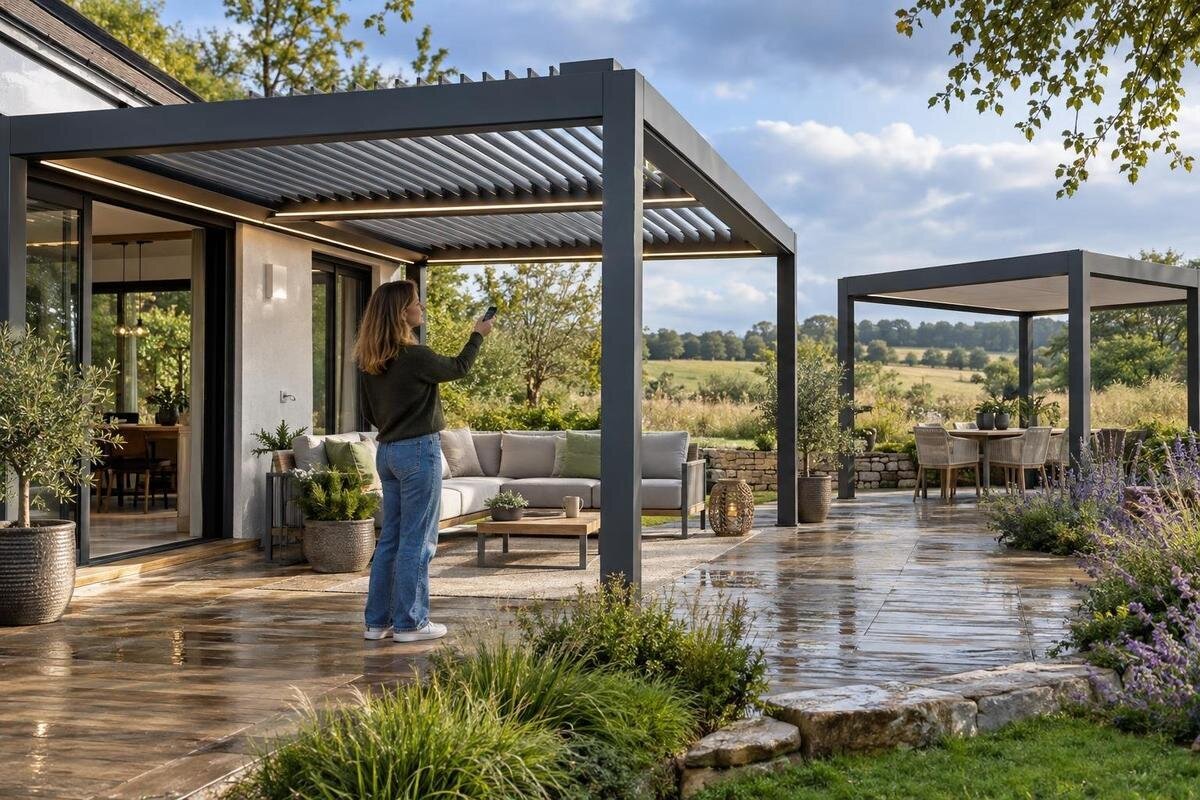
Choose a control around the way people will actually use the pergola. A wall control may suit a fixed operating point; a handheld remote can be convenient across a seating area; an app may appeal if you prefer to use a phone. These are options to compare, not features to assume. Confirm which method is supplied, which are optional, whether a control uses a wired connection or wireless link, and whether an app needs a nearby network or account. Consider who will use it, where a control can be kept and whether visitors can understand it without a long explanation. The easiest setup is the one that suits your routine, not necessarily the one with the longest list of functions.
Check how many functions the control handles and how clearly it distinguishes them. If the system has several motorised parts, find out whether one command operates all of them or whether each can be controlled independently. Confirm whether more than one user can have access, how an extra remote or phone is added, and what happens if a remote is lost or an account changes. If a remote uses replaceable batteries, ask how to identify a compatible replacement. The bioclimatic pergola page identifies a product category; confirm the control package for the exact configuration separately. If household members prefer different controls, check that those methods can work together rather than assuming one replaces the other.
Check app, automation and manual operation
Ask what the system can do automatically, if anything. Sensors or schedules may be offered as options, but they may not be included or suitable for every site and intended use. Find out which condition each sensor responds to, what action it triggers, whether you can override that action and who sets it up. Ask how a fault or loss of sensor communication is indicated. An automatic response is not a substitute for checking conditions around the structure. If the controls depend on an app, confirm supported devices, network requirements, account access and what functions remain available without an internet connection. These details affect everyday reliability more than a general promise of “smart” control.
Compare the manual alternative as well. Find out whether a separate hand control or switch can operate the pergola if the app is unavailable, whether there is a manufacturer-approved way to move it during a power failure, and whether a technician must carry out that procedure. Never assume a powered mechanism can be pushed or turned by hand. The wall-mounted pergola listing identifies a product type, not an automation package, so request the controls and compatible accessories for the selected configuration. If straightforward hands-on operation matters to your household, test the interface or request a demonstration rather than relying on a brochure image. Ask the seller to include any limits on manual operation and the correct instructions in the handover pack.
Get the wiring requirements before ordering
Motorised pergola wiring requirements depend on the system being quoted. A powered mechanism needs a suitable electrical supply, but you should not infer the details from another model or a general online description. Before ordering, request the manufacturer’s written requirements for the selected motor and controls, including the supply, connections, control wiring and whether any accessories need separate provision. Give that information to a qualified electrician so they can assess the existing supply and the work at your property. Do not choose a cable, protection device or connection method yourself. If the documentation is not available, arrange the electrical assessment before finalising the installation plan instead of guessing and correcting the work later.
Clarify who is responsible for each part of the electrical scope. The pergola supplier, structure installer, electrician and automation specialist may have different roles; the quotation should identify who supplies the motor and controls, who makes the electrical connection, who routes and protects the wiring, and who tests the completed system. Ask whether the quotation includes the electrician’s visit and any work needed to reach a suitable supply, or whether those items are excluded. The pergola product page can identify a listing, but cannot replace the electrical specification for a chosen motor. Keep the written requirements available to the electrician and have the supplier approve proposed changes before installation. Confirm who will provide the relevant handover documents.

Coordinate the site layout and cable route
Walk the proposed cable route with the installer and electrician before paving, decking, planting or other finishing work is fixed. Consider whether a visible route would be acceptable, where a control will be convenient, and whether the cable path could interfere with doors, paths, outdoor furniture or later maintenance access. These are planning questions, not a do-it-yourself wiring plan: have the electrical professional determine the appropriate route and method. If you want a tidy finish, ask what can be concealed, what access will remain for servicing and which trade is responsible for making good any affected finishes. Agree whether the final route will be confirmed after a site visit; it is easier to resolve it before landscaping than afterwards.
Mounting and movement also need to be coordinated. Ask the pergola installer to confirm the proposed fixing arrangement, clearances for moving sections and access needed to inspect the motor or controls; have a suitable professional assess the supporting surface or wall where required. Do not assume the same layout works for every site, or that wall-mounted and freestanding designs have identical needs. Agree who measures, checks the site, identifies obstacles and approves the final position. Include enough working room for installation and later servicing, not just the finished outline. Plan the route to the motor and controls so they are not boxed in behind a finish or placed where routine access is awkward.
Agree on commissioning and power-failure procedures
Commissioning is the point when the completed system is checked and its controls are explained. Confirm who performs it and whether the installer will demonstrate each motorised component, starting and stopping, any limits or settings, and every supplied control. If automation is included, ask for a demonstration of what happens when a sensor or schedule sends a command and how to override it. Find out how you can tell that a command has been received and what to do if movement is hesitant, noisy or different from the demonstration. Keep the handover instructions and contact details together, and make sure every regular user knows where to find them. Do not adjust internal settings or open electrical covers to investigate a fault; use the service route specified by the supplier or installer.
Discuss loss of power before purchase, not during the first outage. The correct response depends on the design: a mechanism may stop where it is, have an approved manual procedure or need technical assistance. Ask which applies, whether the instructions are supplied and whether using a manual release affects any terms of cover. If the system includes automation, establish whether it resumes, waits for a new command or needs attention after power returns. The bioclimatic pergola listing names a product category only; request these answers for the exact motor and control package. A clear handover should leave every regular user knowing the approved operating procedure.
Compare the full installation scope
Compare quotations line by line rather than weighing one headline total against another. Each written offer should identify the structure and configuration, motorised parts, controls, any sensors or automation, installation, electrical work and commissioning, with inclusions and exclusions clearly stated. Ask how site measurement, mounting checks, cable routing and extra work will be handled if conditions differ from the initial assessment. A low initial figure can leave important items outside the scope; a longer list is not automatically better if it includes controls you will not use. Request a revised, itemised quote when the configuration changes so you can compare like with like and know who is responsible for each part.
Make product identity explicit on the paperwork. The wall-mounted pergola page can help you find a category, but it should not be read as confirmation of the motor, finish, dimensions or electrical work in a quote. Have the seller record the selected configuration and options using clear names, then check that the installer has the same version. Agree the sequence for site assessment, structure installation, electrical connection, control setup and final handover; one party should coordinate questions between trades. Confirm how changes, call-outs and remedial work will be authorised and priced before work starts. Clarify any exclusions for site preparation or making good finishes rather than relying on an informal assumption.
Understand motorised pergola maintenance
Ask for a maintenance plan specific to the pergola’s moving parts, motor and controls. Follow the manufacturer’s instructions for cleaning and inspection, including limits on products or methods; do not assume a household lubricant, pressure washer or chemical cleaner is suitable. Keep leaves, dust or other debris away from areas the manual identifies as needing to stay clear, and look for visible damage or looseness without dismantling covers or adjusting the mechanism. The pergola product listing identifies the item under discussion, but its title is not a service schedule. Get the recommended checks, intervals and permitted user tasks in writing at handover.
Maintenance needs can vary with exposure and use, so ask what changes in a dusty, leafy or coastal setting and whether professional servicing is recommended. Do not assume a universal interval: use the guidance for the exact model and keep a record of checks, cleaning and repair visits. A log makes it easier to describe a new symptom and track work carried out; keep invoices and service documents together so you can find the right contact later. If movement changes, the motor stops responding or a control behaves unexpectedly, do not keep repeating commands or force the mechanism. Follow the stated fault procedure and call a technician if the instructions require one.

Check support, parts and warranty terms
Support arrangements matter because a motorised system combines mechanical and electrical parts. Before committing, find out who handles a motor fault, who deals with a controller or app issue, and whether the installer or seller coordinates the response. Request written warranty terms for the structure, motor, controls and installation, since cover may differ by component; do not assume one term applies to the entire package. Check what maintenance is required, what records to keep, how to report a problem and whether a repair needs approval before it begins. The page for the bioclimatic pergola is a catalogue reference, not evidence of support or cover for a motorised configuration.
Ask about replacement parts and compatibility while choosing the system. If a remote is lost or a control needs replacing, find out how the correct part is identified and whether pairing can be done by the user or only by an installer. For app-based systems, ask who maintains the software, how long support is expected and what happens if the app or service changes; do not treat a present-day compatibility statement as a promise of future updates. Request the servicing contact and fault-reporting route, plus any documents provided at handover. Clear answers let you compare the support behind two packages, not just their feature lists.
Use a written comparison before you order
Bring the decision back to a short written comparison. For each option, note the moving component, control type, power requirements, who assesses and installs the wiring, any automatic features, the power-failure procedure, commissioning, maintenance and the support contact. Then weigh those details against how the pergola will be used: a household wanting straightforward operation may value a clear fixed control, while someone who prefers phone access can investigate an app option, if one is offered. Neither is automatically better; usability, compatibility and site work need to fit together. Record which features are essential and which are optional so the comparison does not get lost in a long list of extras.
Before accepting, read the quotation and product documentation as one package. Check that the model or category, selected motor and controls, site assumptions, excluded electrical work, commissioning, maintenance instructions and warranty terms are consistent, and ask for unresolved points in writing. Have the relevant installer and a qualified electrician review the details within their work; do not treat a product image or sales shorthand as an installation specification. If a required control, connection or service route is not confirmed, pause the order until it is. Keep the final version with the handover documents so everyone involved refers to the same configuration.
Frequently asked questions
What happens if the power goes out?
It depends on the motor and controls. Ask whether the mechanism stops where it is, has a manufacturer-approved manual procedure or needs a technician, and get the instructions in writing. Do not force a powered mechanism.
Does a motorised pergola include electrical installation?
Not necessarily. A product page or headline quotation may exclude the electrical supply, wiring, connection or commissioning. Ask for an itemised scope and have a qualified electrician review the written requirements.
Should I choose a remote or an app?
Choose according to where and how you will operate the pergola. Compare the controls actually offered, any network or account requirements, access for other users and what remains available without a phone or connection.
How often does a motorised pergola need maintenance?
Follow the guidance for the exact system; there is no universal interval. Ask which checks and cleaning tasks you can do yourself, which require a service technician and what records to keep.
Can I add sensors later?
Only if the sensor is compatible with the selected motor and controller and supported by the supplier. Confirm availability, electrical requirements, installation and control options before ordering rather than assuming an add-on will work.
Motorisation is a good fit only when the controls and electrical plan suit the site as well as the way you will use the pergola. Compare the exact moving components, installation scope and service arrangements, not just the advertised control feature. With a written specification, input from a qualified electrician and a clear handover, you can order with realistic expectations about operating and maintaining the system.
