
Can a Ceiling Fan Be Fitted Under a Pergola?
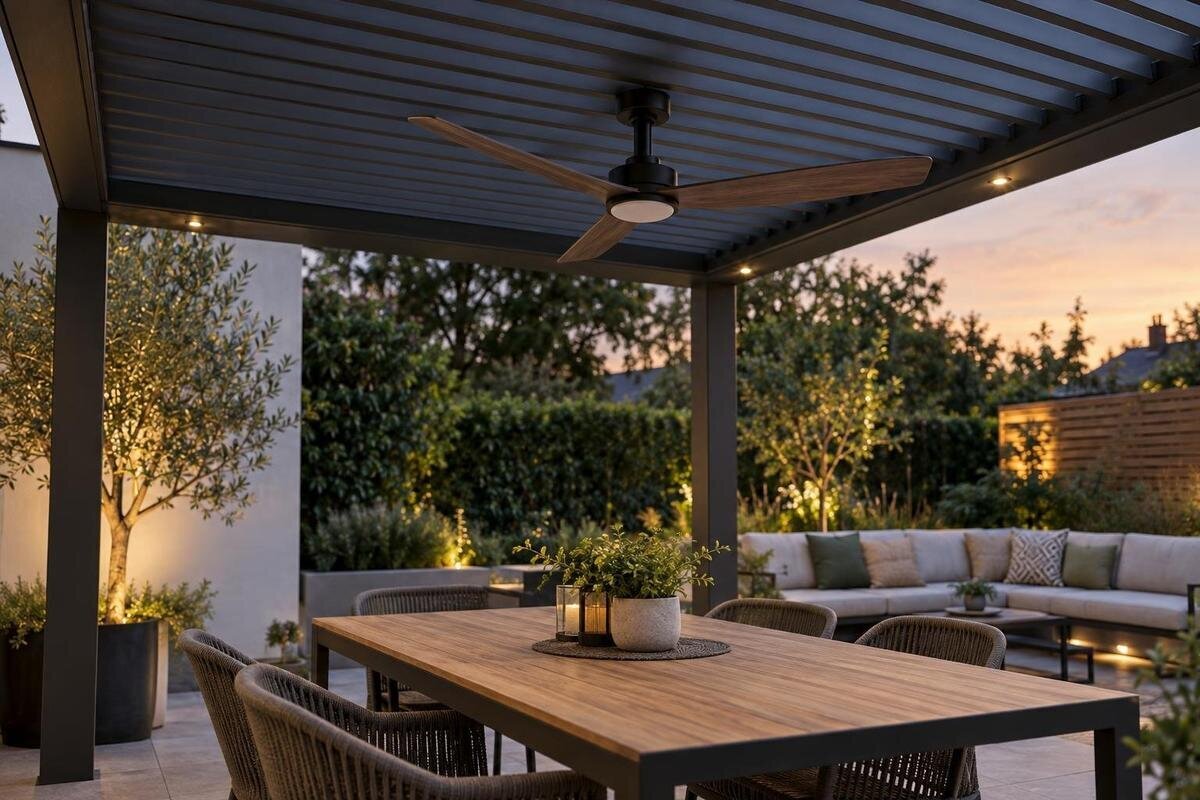
Pergola planning
A pergola can provide overhead shelter without being designed to carry a rotating ceiling fan. Compatibility depends on the exact support point and approved operating loads, the fan’s complete blade clearance, outdoor rating and electrical plan. Treat these as separate checks: a roof or beam that looks sturdy does not settle them.

01
A pergola is not automatically a fan support
Yes, a ceiling fan can be fitted beneath some pergolas, but an overhead frame is not automatically a fan support. A pergola may have beams or a canopy, yet those parts may not have been designed to carry a suspended, rotating fixture. The fan contributes its own weight and, while running, introduces movement and vibration. Its mounting detail therefore needs approval for the operating loads, not merely a visual judgement that a beam looks substantial or can support the roof components it was designed for. A general yes or no based on the word pergola is not technically meaningful.
That distinction applies to a free-standing structure and one attached to a building: apparent solidity does not show how a particular fixing point transfers load. Use the Bloomcabin Pergola listing to identify the model you are considering, then establish which configuration will be assessed. A model name, photograph or overall floor area cannot prove fan compatibility. The assessment must cover the actual pergola and complete fan assembly, including its bracket and any other mounting parts. Keep the structural question separate from whether there is enough room for the blades: a fan may fit beneath the roof without having a suitable support. A separately designed support is a different installation, not approval to attach the fan to the pergola frame.
What structural approval must cover
Request confirmation for the intended fixing point, not just a general maximum load for the structure. A capacity statement is meaningful only within the use and conditions it covers; it may not address a suspended fixture that turns and vibrates. Give the pergola supplier the fan’s exact make and model, its complete assembled mass and the manufacturer’s mounting details. Ask whether the approval covers operation as well as static weight, and whether it includes the selected bracket, any light kit and the proposed location. A figure without a defined application cannot answer those questions.
Do not transfer an approval from a different span, configuration or accessory unless the manufacturer says it applies to your selected build. For the Bloomcabin Bioclimatic Pergola, ask whether the exact configuration and intended fixing point are approved for that dynamic load. If the supplier cannot provide a suitable mounting detail, a qualified structural professional needs the relevant drawings and fan information to assess the complete arrangement. Avoid altering the frame or commissioning an improvised mount before that review. Keep a record of which fan and location were assessed, who provided the approval and any conditions or exclusions. Make the location unambiguous on the layout rather than recording only that the fan will be under the pergola. If the fan, bracket or position changes during ordering or installation, confirm whether the approval still applies before accepting the substitution.
02
Measure the full blade and body clearance
Clearance is about the complete fan envelope, not just whether the motor housing fits between two beams. The blade tips sweep a circle, so check the whole area against beams, roof panels, lights, screens, walls and other nearby obstructions. Vertically, use the fan manufacturer’s instructions for the space above the blades and the required distance from the floor or occupied area. These limits vary by fan and mounting arrangement, so generic rules of thumb are not reliable. Include the canopy, bracket and any downrod in the vertical plan, not just the blade plane.
Draw the proposed position in plan and side elevation using the selected fan’s actual dimensions. Mark its blade sweep and the paths of doors, curtains, roof parts and people moving through the space. For the Bloomcabin Wall-Mounted Pergola, use dimensions for the exact configuration rather than estimating distances from a product photograph. The plan view should show nearby walls and beams; the side view should show the complete suspended assembly and the relevant heights. Include any light kit when recording the fan’s lowest point. Check the layout with furniture in its usual position and when chairs are pulled out or tables are moved. Record the clearances required by the manual alongside the proposed measurements so the two can be compared directly. If the fan model has not been chosen, label the layout as provisional and repeat the check when its dimensions and instructions are available. If the required space is not available, change the position or reconsider the fan.
Check the fan’s outdoor rating against the site
A pergola roof does not turn the space beneath it into an indoor location. Open sides can allow wind-driven rain, humidity, dust and sunlight to reach a fan; in some settings, salt in the air may also matter. The degree of exposure depends on the actual site and roof. A covered position may be sheltered from direct rain yet still fall outside a fan’s permitted use. Check the manufacturer’s manual and product markings for the conditions allowed at the intended location instead of relying on words such as outdoor or weather-resistant in a short listing.
Confirm that the instructions apply to the complete installation, including the motor, blades, canopy, mount and controls, as well as any supplied receiver or light kit. Accessories may have separate conditions. For a proposed installation beneath the Bloomcabin Pergola model you are considering, describe the exposure at the intended fan position rather than describing the whole patio simply as covered. Note whether rain reaches that spot and how much direct sun, dust or moisture it receives. Include any difference between the roof settings you intend to use, without assuming that one sheltered position represents all of them. Record the exact fan and accessory combination, and ask the fan supplier for clarification if the instructions do not cover those conditions. Keep that answer with the chosen product details so a later change of receiver or light kit does not go unnoticed. Follow any stated cleaning or inspection requirements for outdoor use.

03
Account for moving roof components
Where any part of the overhead assembly moves, plan around its full travel rather than one static view. Louvres, retractable panels, blinds or screens may occupy space above or beside a fan at different settings. A panel that clears the blades when open may not clear them when closed. Check the mechanism’s path, stop positions and service access against the instructions for the exact pergola. Also establish whether the fan must be off during roof movement; do not assume simultaneous operation is allowed just because the parts do not touch in one position.
Ask the supplier to confirm the combined arrangement for every intended roof position and operating mode. When considering the bioclimatic pergola listing, request the movement details for the selected configuration. On the layout, distinguish the space occupied by stationary beams from the space needed by moving components. Include normal use, opening and closing, and any access needed for servicing; a view of the roof fully open is not enough to describe all three. Make sure the proposed fan position will not obstruct a roof component or rely on an unapproved attachment to it. A fixed roof still needs beam and blade clearance; a moving roof adds another area that must remain clear. Do not assume that a fan can stay in place as panels close, or that a control system prevents a collision, unless the manufacturers document that combination.
Plan the electrical supply with a qualified electrician
Structural approval and electrical suitability are separate. A qualified electrician should review the fan’s installation instructions, the available supply, circuit protection, isolation and control arrangements, and the route for outdoor wiring and connections. That route needs to suit the actual pergola layout without interfering with moving roof parts or exposing electrical components beyond their specified conditions. This is not a do-it-yourself wiring exercise: ask the electrician to define what can be supplied and controlled, and to carry out any electrical work.
Discuss the fan’s wall switch, remote receiver or other controls alongside any planned lights or motorised pergola functions; do not assume that a nearby power point or existing lighting circuit is suitable. Share the exact fan manual and proposed position with the electrician before finalising the layout. If you are considering the wall-mounted pergola model, have the supplier and electrician review the selected build and proposed cable route together. Explain where you would like to operate the fan and which functions need separate controls, without specifying the wiring solution yourself. Ask how access for maintenance will be retained and how the electrical plan will accommodate the mounting restrictions. Record who will coordinate any change in fan position with the structural assessment. This gives the electrician a clear brief while leaving the electrical design and installation to the qualified professional.
04
Match airflow to the way the space is used
A fan can be structurally compatible and still be a poor fit for how the pergola is used. Define the task first: moving air over a particular seating area is different from expecting a fan to condition the whole open space. A ceiling fan circulates air; it does not enclose the area or guarantee an indoor-like cooling effect. In an open setting, natural breezes and surrounding obstructions can change how airflow feels. Set expectations using the fan maker’s guidance for the intended location, rather than a room-area rule alone.
Mark where people sit, dine or stand for longer periods, along with walkways and tall furniture, then compare that plan with the fan’s airflow information and clearance envelope. Tie the proposed position to an occupied area rather than centring it automatically on the pergola. If the Bloomcabin Pergola configuration is on your shortlist, put the planned furniture on the layout for that specific build; floor area by itself does not settle fan size or location. Include any screens or side panels in the plan, as they change the final arrangement. Explain which seating positions matter most and whether the furniture will usually stay in one layout. Where the preferred airflow position conflicts with an approved support point, show both positions to the suppliers rather than quietly moving the fan on the drawing. They can then discuss the trade-off using the same layout, without confusing a preferred location with one already assessed as suitable.
Coordinate the installation team
Before ordering, establish who will coordinate the pergola supplier, fan supplier, structural professional and electrician. Their responsibilities are related but not interchangeable: an electrician’s acceptance of the supply does not approve the frame, and structural approval does not establish outdoor suitability. Give everyone the same layout and product information, and identify which questions each person is answering. Ask them to flag any dependency on another part of the design, such as a mounting location that has not yet been confirmed. The aim is to avoid separate conversations producing answers for different versions of the installation, even though each answer may sound satisfactory on its own.
For the listed bioclimatic model, prepare a shared project record identifying the selected configuration, fan model, mounting parts, proposed position, roof movement and site exposure. Keep the latest layout with that record, and clearly mark an earlier version as superseded if the design changes. Establish who supplies the fan and mount, who assesses the support and who handles electrical work. Also clarify who will pass an agreed change to the other parties before work continues. At handover, retain the instructions and confirmations for the equipment actually fitted, rather than only the products originally considered. Check that any substitutions are reflected in the record. This is a coordination task, not another compatibility test: it makes the separate assessments usable together and gives you a clear reference if you later replace a component or alter the layout.

05
What to do if the mounting point is not approved
If the pergola supplier cannot approve the mount and no qualified professional can confirm it, treat the installation as not approved. Do not drill, clamp, hang or adapt a roof member on the basis that it seems strong, or rely on someone else’s installation as proof. A different bracket is not automatically a structural solution; any independent support still needs assessment for its own loads, attachment and clearances. In that situation, it is better to stop the ceiling-fan plan before buying equipment than to leave the main support question unresolved.
Consider a different approach if the support cannot be confirmed: revise the layout, leave the pergola without a suspended fan, or assess a fan intended for another placement and for the site’s outdoor conditions. A freestanding model, for example, still needs to be used as its manufacturer directs and positioned without creating an electrical or clearance issue. Compare the alternative with the same seating plan used for the ceiling fan, including the floor space it would occupy and its position relative to walkways. Ask the relevant professional to assess that arrangement separately where needed. You can also reconsider whether the open space meets your needs without a fan rather than forcing a fixture into an unverified position.
When to proceed with a ceiling fan
Distinguish an unanswered question from a confirmed incompatibility. If the supplier has not yet assessed the mounting point, the proposal is unconfirmed; it is not a reason to guess either that the fan will work or that no fan could ever be fitted. If the selected arrangement cannot meet a stated support, clearance or exposure requirement, that arrangement needs to change. Keep the unresolved point specific so the next discussion addresses the actual obstacle rather than reopening every part of the plan.
Proceed with the selected arrangement only when the separate assessments agree and any conditions can be met. Before placing the order, compare the final product selections with the assessed layout, including the bracket, accessories and mounting position. If an item is unavailable or a different position is proposed, resolve that change before installation rather than treating it as a minor substitution. Where the combination is unsuitable, retain the useful parts of the planning work—the seating layout, exposure notes and dimensions—to assess an alternative without starting again.
Frequently asked questions
Can I attach a ceiling fan to any pergola beam?
No. The particular beam and fixing point need approval for the fan’s operating loads, not just its weight. Ask the pergola supplier or a qualified structural professional to confirm that the exact fan and mounting arrangement are suitable.
Does a pergola with a moving roof rule out a ceiling fan?
Not automatically, but moving roof parts add another clearance and operating check. Confirm that the fan stays clear throughout the roof’s full travel and whether it may run during roof movement and in each roof position. Do not infer this from the pergola’s category name.
How much clearance do the blades need?
There is no single distance that applies to every fan. Follow the exact fan manual for clearances from the roof, nearby obstructions and the floor, then map the full blade sweep against beams, walls, lights, furniture and moving roof parts.
Is an indoor fan suitable if the pergola has a roof?
Not necessarily. A roof may provide some shelter, but an open-sided space can expose a fan to rain, moisture, sun, dust or other conditions outside its permitted use. Check that the fan’s instructions cover the actual location and its accessories.
Who needs to approve a ceiling fan under a pergola?
The pergola supplier should confirm the approved support point, the fan manufacturer should provide mounting and exposure requirements, and a qualified electrician should assess the power and controls. If there is no approved mounting detail, a qualified structural professional should assess the proposed support.
Treat the fan, pergola and site as one coordinated installation. A documented support, clear blade envelope, equipment suited to the outdoor conditions and an electrician’s plan are what turn a possible idea into a suitable option. If a key detail is uncertain, resolve it before fitting the fan or choose a different arrangement.
